

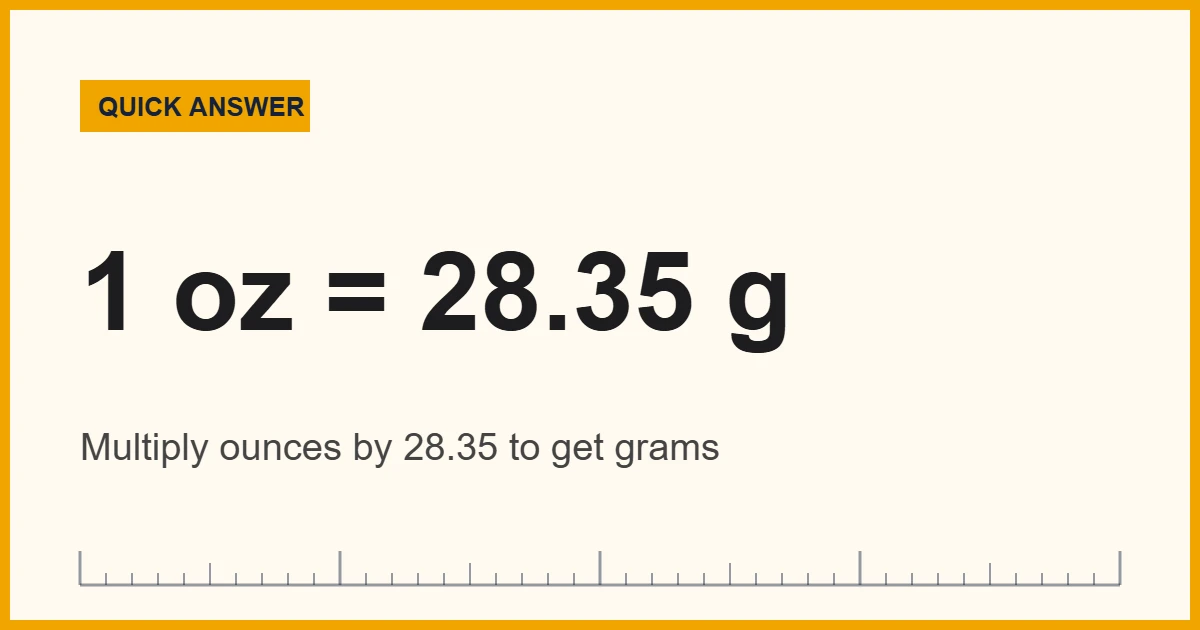
To convert ounces to grams, multiply the number of ounces by 28.35. One avoirdupois ounce (oz) is exactly 28.349523125 grams (g) by US and international definition, so 4 oz is about 113 g and 8 oz is about 227 g. For most home cooking, 28 g per ounce is close enough.
Convert Ounces to Grams for Any Amount
First, enter the weight from your recipe and pick the unit. The converter then uses the exact definition of the ounce and also shows pounds, kilograms and milligrams.
To begin with, American recipes usually list weights in ounces and pounds. Most of the world, however, cooks in grams. So if you have a British cookbook, a European chocolate bar, or a digital scale set to metric, you will need to switch between the two systems sooner or later.
Fortunately, the math never changes. Since 1959, the international avoirdupois pound has been defined as exactly 453.59237 g, and an ounce is one sixteenth of that pound. The US National Institute of Standards and Technology (NIST) gives the rounded factor of 28.35 on its metric conversion table. In other words, the ounce has a fixed metric value.
Still, the tricky part is not the arithmetic. Instead, it is knowing which ounce a recipe means, and how much rounding your dish can take. Therefore, this guide covers both, with a full chart and practical scale tips.
Ounces to Grams Chart for Cooking
This chart covers 1 to 16 ounces, which is one full pound. First, the exact column uses 28.349523125 g per ounce, rounded to two decimals. Meanwhile, the kitchen column rounds to the nearest gram, which is what most digital scales display anyway.
| Ounces (oz) | Grams (exact, rounded) | Kitchen grams |
|---|---|---|
| 1/4 oz | 7.09 g | 7 g |
| 1/2 oz | 14.17 g | 14 g |
| 1 oz | 28.35 g | 28 g |
| 2 oz | 56.70 g | 57 g |
| 3 oz | 85.05 g | 85 g |
| 4 oz (1/4 lb) | 113.40 g | 113 g |
| 5 oz | 141.75 g | 142 g |
| 6 oz | 170.10 g | 170 g |
| 7 oz | 198.45 g | 198 g |
| 8 oz (1/2 lb) | 226.80 g | 227 g |
| 9 oz | 255.15 g | 255 g |
| 10 oz | 283.50 g | 283 g |
| 11 oz | 311.84 g | 312 g |
| 12 oz (3/4 lb) | 340.19 g | 340 g |
| 13 oz | 368.54 g | 369 g |
| 14 oz | 396.89 g | 397 g |
| 15 oz | 425.24 g | 425 g |
| 16 oz (1 lb) | 453.59 g | 454 g |
Also, to keep a printable copy, print this page or take a screenshot of the chart and tape it inside a cabinet door. For a closer look at the 4-ounce mark, see our guide to a quarter pound in ounces.
The Ounces to Grams Formula, Step by Step
The formula is short: grams = ounces x 28.349523125. For cooking, you can simply use 28.35. Going the other way, ounces = grams / 28.35, or grams x 0.03527.
Next, here is how it works on real recipe amounts:
- 2 oz of butter: 2 x 28.35 = 56.7 g, so weigh out 57 g.
- 5 oz of sugar: 5 x 28.35 = 141.75 g, or about 142 g.
- 0.5 oz of yeast: 0.5 x 28.35 = 14.17 g, or about 14 g.
- A 250 g block of butter: 250 / 28.35 = 8.82 oz, which is slightly more than 8 oz.
Also, remember that a recipe written in pounds needs one extra step. First multiply the pounds by 16 to get ounces, and then convert. For example, 1.5 lb is 24 oz, which comes to about 680 g.
Fluid Ounces vs Weight Ounces: The Big Trap
Above all, the most common mistake has nothing to do with math. Rather, it comes from two different units sharing one name. First, a weight ounce (oz) measures mass. A fluid ounce (fl oz), by contrast, measures volume. As a result, you cannot convert fluid ounces to grams without knowing what the ingredient is.
| Unit | What it measures | Metric value | Measured with |
|---|---|---|---|
| Ounce (oz, avoirdupois) | Weight (mass) | 28.35 g | Kitchen scale |
| US fluid ounce (fl oz) | Volume | 29.57 mL | Liquid measuring cup |
| UK fluid ounce | Volume | 28.41 mL | Imperial measuring jug |
| Troy ounce (oz t) | Weight of precious metals | 31.10 g | Jeweler’s scale (not for cooking) |
For water and thin liquids such as milk or broth, one US fluid ounce weighs close to 29.6 g, so the two units nearly match. For thicker ingredients, though, they drift apart. Honey, for example, weighs about 42 g per fluid ounce. Similarly, a cup of all-purpose flour holds 8 fl oz but weighs only about 4.25 to 4.5 oz (120 to 125 g), depending on how you fill the cup.
Ounces to Grams Rounding: 28 g or 30 g?
Of course, different sources round the ounce in different ways. Because of that, the same recipe can look inconsistent from one book to the next.
- Exact: 28.35 g. Because it is exact, use this for baking, bread, curing and candy.
- US nutrition labels: 28 g. The FDA rule says that, for labeling, 1 ounce means 28 g and 1 fluid ounce means 30 mL.
- Quick mental math: 30 g. Many cooks and some cookbooks use 30 g per ounce because it is easy to multiply.
So how much does the choice matter? Rounding to 28 g makes every amount about 1.2% light, while 30 g makes it about 5.8% heavy. At 16 oz, for instance, 28 g per ounce gives 448 g and 30 g gives 480 g, against a true 453.59 g. Thus, in a stew, that difference disappears. In a bread dough, on the other hand, an extra 26 g of flour can noticeably stiffen the dough.
Recommended Kitchen Scales for Ounces to Grams
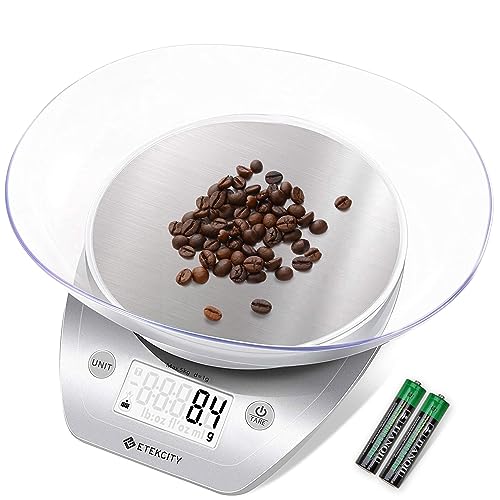
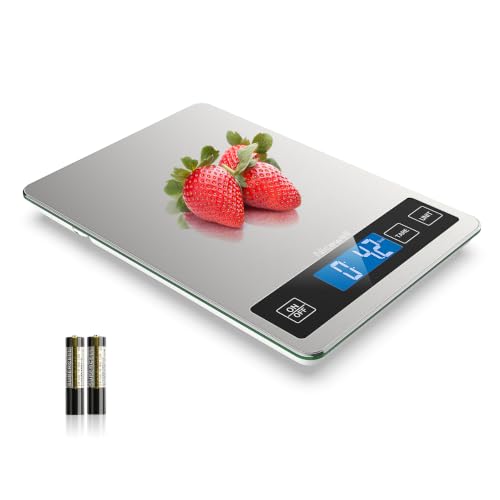
A digital kitchen scale removes the guesswork completely, because most models switch between ounces and grams with one button. Therefore, when you shop, look for 1 g resolution (or 0.1 g for spices and yeast), a tare button, and a capacity of at least 11 lb. In addition, a small angled measuring cup helps you keep fluid ounces separate from weight ounces.



As an Amazon Associate, Measuring Expert earns from qualifying purchases.
How to Weigh Ingredients in Grams
- Set the scale on a flat, hard surface. A towel or uneven counter can also throw off the reading.
- Switch the display to grams. Press the unit button until you see “g” on the screen.
- Place your bowl and press tare. The scale resets to zero, so only the ingredient is weighed.
- Add the ingredient slowly. Pour or spoon it in until you reach the converted gram value.
- Tare again before the next ingredient. As a result, you can weigh everything into one bowl.
- Check the battery now and then. Weak batteries, for example, often cause drifting or jumpy readings.
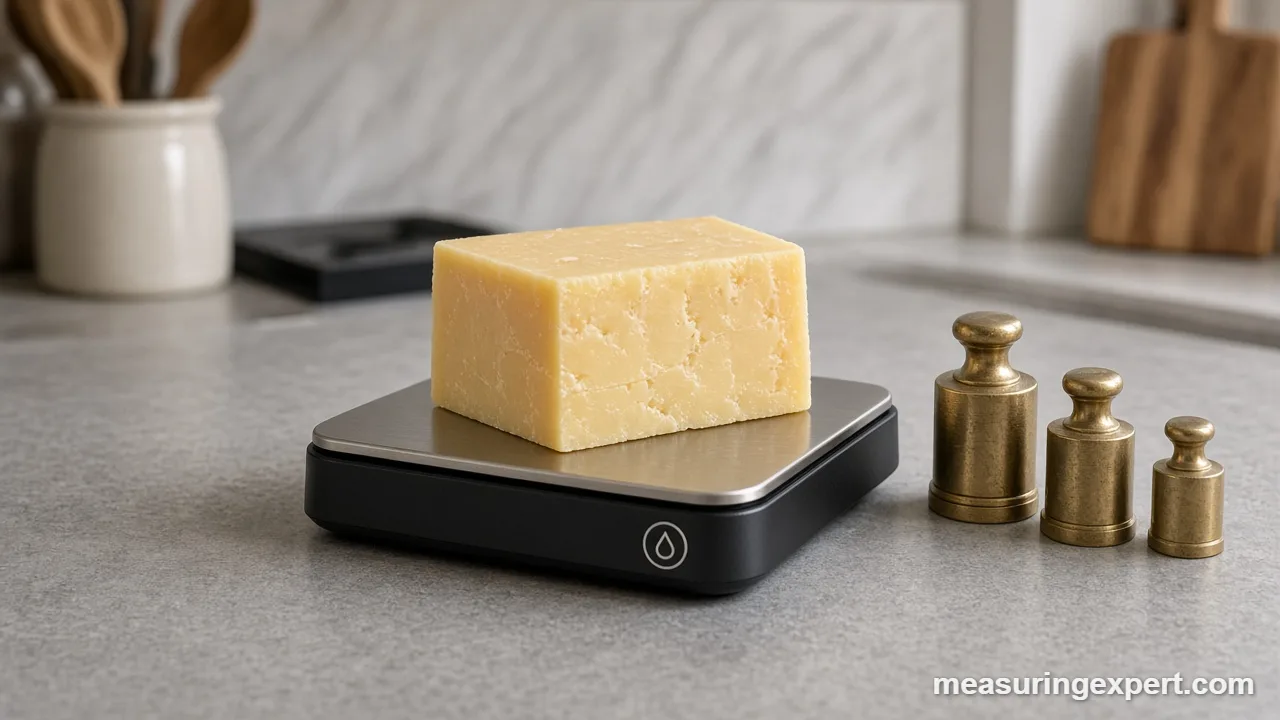
Finally, if you want to check your scale, a US nickel is a handy test weight. In fact, the US Mint lists it at 5.000 g, so the display should read 5 g.
Do and Don’t When You Convert Ounces to Grams
Do
- Use 28.35 g per ounce for baking.
- Confirm whether “oz” means weight or volume.
- Tare the scale with the bowl on it.
- Keep one rounding factor for the whole recipe.
- Weigh sticky ingredients like honey instead of measuring by volume.
Don’t
- Treat fluid ounces of flour as weight ounces.
- Mix 28 g and 30 g factors in one recipe.
- Use troy ounces for food.
- Weigh on a soft or tilted surface.
- Forget to multiply pounds by 16 first.
Honest Limits of Ounces to Grams Conversions
The conversion itself is exact, but your kitchen is not. For one thing, many basic scales read in 1 g steps and may be off by a gram or two, so tiny amounts such as 1/8 oz (3.54 g) are hard to weigh accurately. Moreover, converting volume to weight always depends on the ingredient and how tightly it is packed. For this reason, this page only converts weight to weight. Finally, older British recipes sometimes rounded an ounce to 25 g, which makes scaled-up batches noticeably smaller. In short, trust the exact factor and watch your rounding when precision matters.
For a wider look at the unit itself, including troy and fluid ounces, read how much is an ounce.
Ounces to Grams FAQs
How many grams are in an ounce?
One ounce equals exactly 28.349523125 grams. For cooking, round it to 28.35 g, or 28 g for everyday recipes.
What is the formula to convert ounces to grams?
Multiply the ounces by 28.35. For example, 6 oz x 28.35 = 170.1 g.
Is 4 oz the same as 100 g?
No. Four ounces is about 113.4 g, so 100 g is only about 3.5 oz.
Is 250 grams equal to 8 oz?
Not quite. In fact, 250 g is about 8.82 oz, while 8 oz is about 226.8 g.
Why do some recipes use 30 g for ounces to grams?
It is a rounding shortcut that makes the math easy. However, it makes each ounce about 5.8% heavier than the real 28.35 g.
Can I convert fluid ounces to grams?
Only if you know the ingredient. For water, 1 US fluid ounce weighs about 29.6 g, but honey and flour weigh very different amounts.
How many grams are in a pound?
A pound is exactly 453.59237 g, or about 454 g. That equals 16 ounces.
How do I convert grams back to ounces?
Divide the grams by 28.35, or multiply by 0.03527. So 100 g works out to about 3.53 oz.
Is a troy ounce the same for ounces to grams?
No. A troy ounce is about 31.10 g and is only used for precious metals, never for food.
What scale setting should I use for recipes in grams?
Set the scale to g and use the tare button. Ideally, pick a scale that reads in 1 g steps, or 0.1 g for yeast and spices.
The Bottom Line on Ounces to Grams
To sum up, one ounce is 28.35 g, so multiply ounces by 28.35 and round to the nearest gram for cooking. However, make sure the recipe means weight ounces, not fluid ounces, before you start.
Next time, you can skip the arithmetic altogether. Instead, use the converter at the top of this page, or switch your kitchen scale to grams and weigh directly.
2 thoughts on “How to Convert Ounces to Grams for Cooking (Chart and Tips)”