

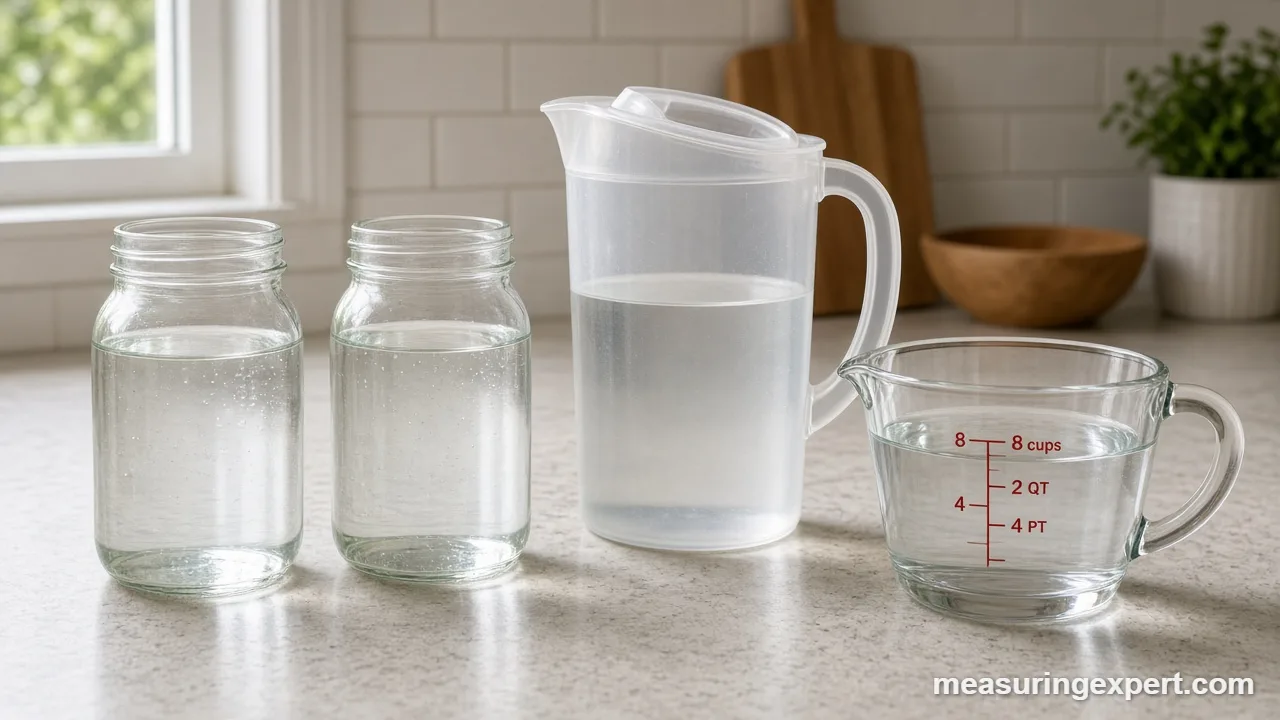
2 quarts is half a US gallon. In US liquid measure, that equals 8 cups, 4 pints, 64 fluid ounces or 128 tablespoons, which is about 1.89 liters (1,892.7 mL). The figure comes from the definition of the gallon: 231 cubic inches, or exactly 3.785411784 liters, split into 4 quarts.
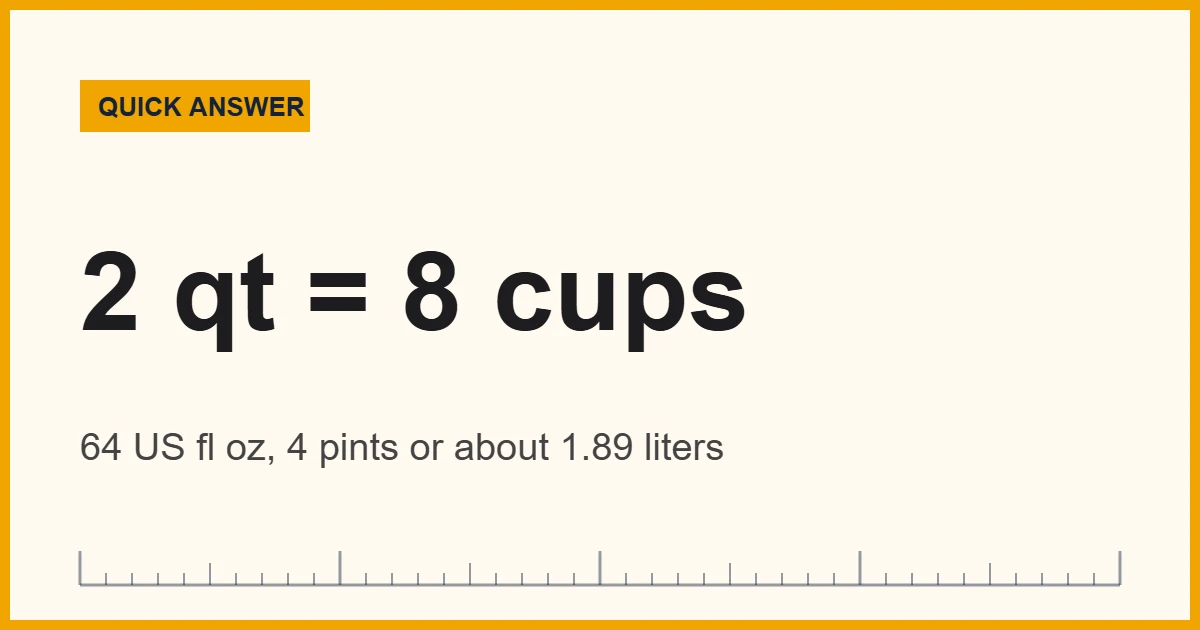
Convert 2 Quarts to Cups, Ounces and Liters
The converter starts at 2 quarts. Then change the number or the unit, and it instantly shows cups, fluid ounces, pints, gallons, tablespoons and metric values, using the exact US definitions.
To begin with, the quart gets its name from the Latin word for a fourth, and that is still the easiest way to remember it: one quart is a quarter of a gallon. Therefore, two of them make half a gallon. Also, you meet this amount all the time, even if the label does not say so. For example, a half-gallon carton of milk, a 2-quart saucepan, and the big 8-cup measuring pitcher many cooks keep for stock all hold about the same volume.
In addition, every number on this page comes from fixed definitions rather than estimates. The National Institute of Standards and Technology (NIST) defines the US liquid quart as exactly 57.75 cubic inches, about 0.946 liter, in its Handbook 44 tables of units. Therefore, 2 quarts is exactly 115.5 cubic inches. For everyday cooking, the NIST kitchen equivalents table rounds a quart to 950 mL.
Below, you will first find a quick chart. Next, you will see what the volume looks like, how dry and British quarts differ, how much it weighs, and finally how to measure it with ordinary kitchen tools.
2 Quarts Conversion Chart
First, this chart lists the conversions people search for most. In addition, the metric values use the exact gallon definition and are rounded to two decimals.
| Unit | 2 US liquid quarts equals |
|---|---|
| Gallons | 1/2 gal (0.5) |
| Pints | 4 pt |
| Cups | 8 cups |
| Fluid ounces | 64 fl oz |
| Tablespoons | 128 tbsp |
| Teaspoons | 384 tsp |
| Liters | 1.89 L |
| Milliliters | 1,892.71 mL |
| Cubic inches | 115.5 cu in |
Need a different amount? Instead, the table below scales the same math up and down. Also, it makes a handy printable reference for the inside of a cupboard door.
| Quarts | Cups | Fluid ounces | Pints | Liters |
|---|---|---|---|---|
| 1/2 qt | 2 | 16 | 1 | 0.47 L |
| 1 qt | 4 | 32 | 2 | 0.95 L |
| 1 1/2 qt | 6 | 48 | 3 | 1.42 L |
| 2 qt | 8 | 64 | 4 | 1.89 L |
| 2 1/2 qt | 10 | 80 | 5 | 2.37 L |
| 3 qt | 12 | 96 | 6 | 2.84 L |
| 4 qt | 16 | 128 | 8 | 3.79 L |
| 6 qt | 24 | 192 | 12 | 5.68 L |
| 8 qt | 32 | 256 | 16 | 7.57 L |
For the full gallon breakdown, including UK and dry gallons, see how many quarts are in a gallon. Similarly, if your recipe lists ounces instead, our guide to how much 64 oz is covers the same half gallon from the ounce side.
Recommended Tools for Measuring 2 Quarts
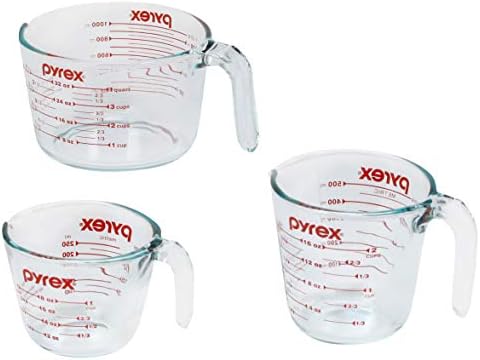
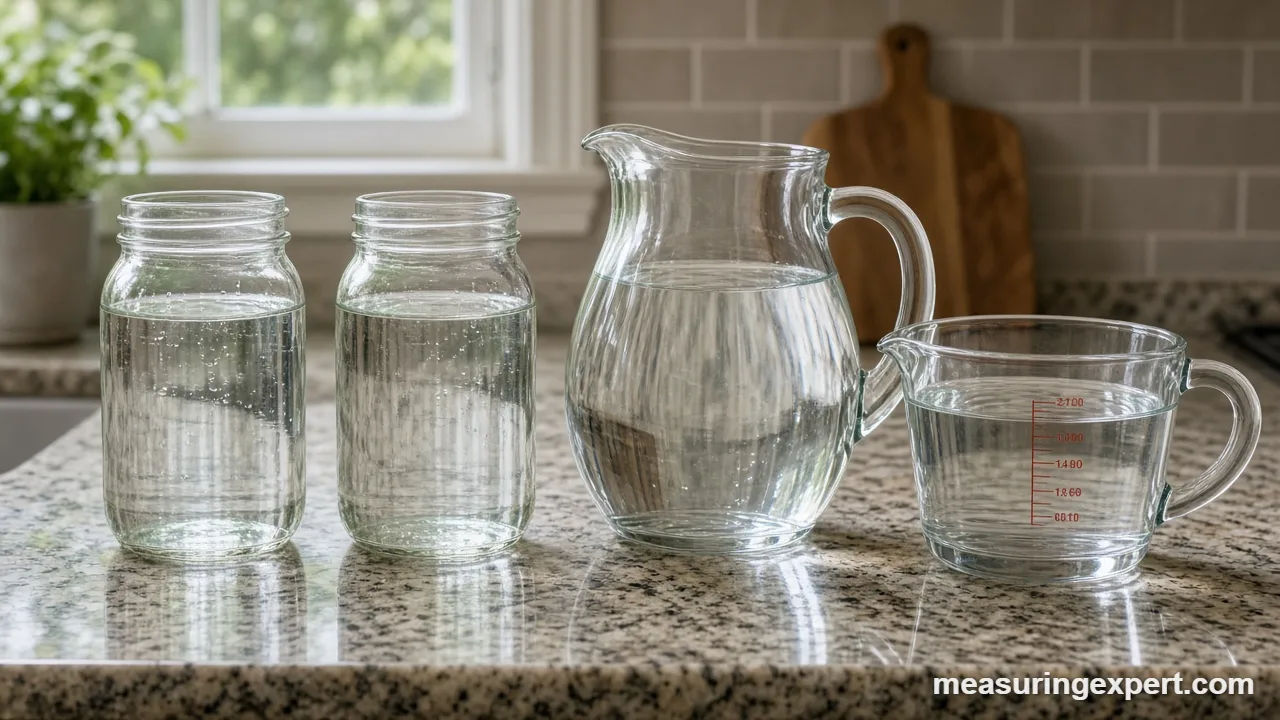
You do not need special gear. However, the right container saves a lot of refilling. First, an 8-cup or 2-quart pitcher measures the whole amount in one pour. Next, a set of smaller glass cups handles the in-between amounts. Finally, a mixing bowl with printed markings lets you measure and mix in the same vessel.


As an Amazon Associate, Measuring Expert earns from qualifying purchases.
What Half a Gallon Looks Like in Real Life
In general, numbers are easier to picture when you can link them to something in the fridge. So here are some common containers that hold the same volume, or close to it:
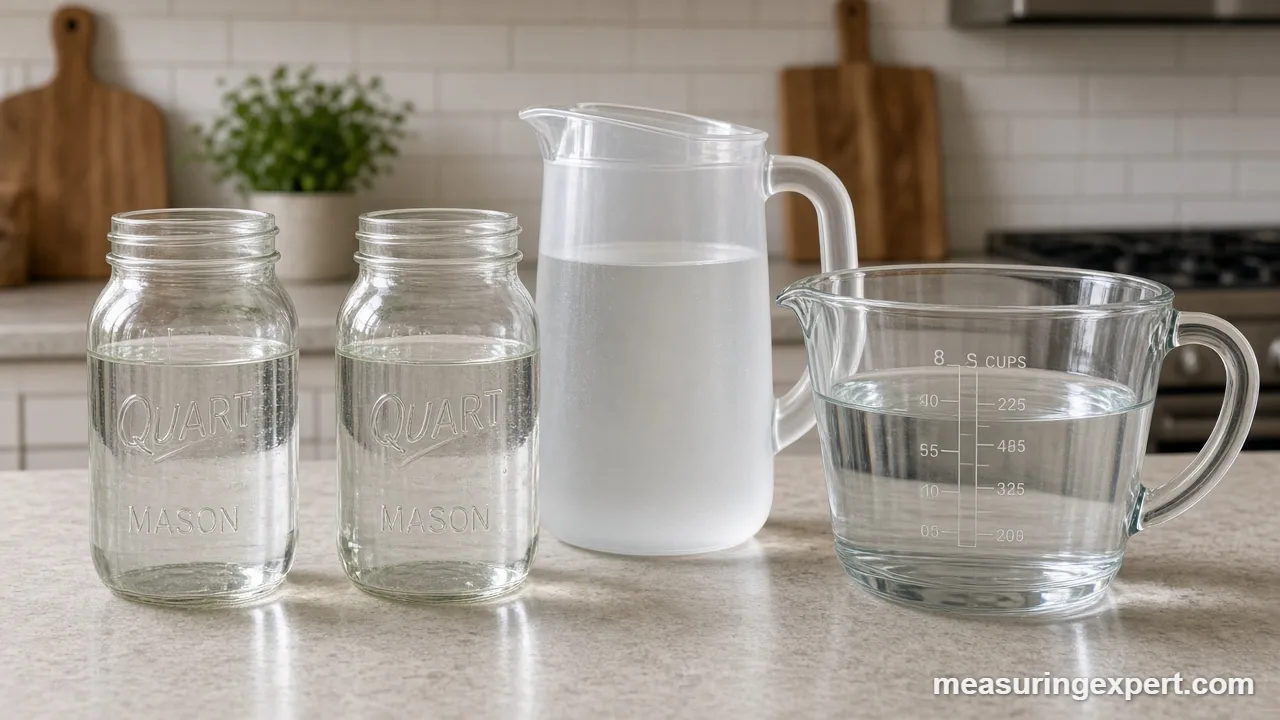
- A half-gallon carton of milk or juice. As a result, this is the closest everyday match, at exactly 64 fl oz.
- A 2-quart saucepan. Because pans are sized by their brim capacity, in practice you fill them a little less.
- A 2-liter soda bottle. On the other hand, it holds slightly more, about 2.11 quarts, or roughly 3.6 extra fluid ounces.
- Eight standard measuring cups. In fact, this is the most practical way to build the amount if you have no large pitcher.
- Four 16-ounce drink bottles. Similarly, each one is a pint, and four pints make the full half gallon.
Is 2 Quarts the Same Everywhere?
Not quite. For example, in the US, the quart you meet in recipes and on drink labels is the liquid quart. However, a separate dry quart exists for things like berries, and older British recipes use the larger imperial quart. Because these three are easy to mix up, here they are side by side.
| Type of quart | One quart | Two quarts | Where you see it |
|---|---|---|---|
| US liquid quart | 0.946 L (57.75 cu in) | 1.893 L | Recipes, milk, oil, paint |
| US dry quart | 1.101 L (about 67.2 cu in) | 2.202 L | Berries, produce at farm stands |
| Imperial (UK) quart | 1.137 L (about 69.35 cu in) | 2.273 L | Older British and Canadian recipes |
Clearly, the difference is not trivial. For instance, 2 imperial quarts hold about 76.9 US fluid ounces, almost 13 more than the US version. In the same way, a fluid ounce is not a weight ounce: one measures space, while the other measures mass. For more on how British and American kitchen units differ, read our explainer on US vs UK cooking measurements.
How to Measure 2 Quarts Without a Quart Measure
- Choose your measuring cup. For instance, a standard 1-cup liquid measure works; a 2-cup or 4-cup glass measure is faster.
- Set the cup on a flat counter. Otherwise, measuring in your hand tilts the cup and skews the reading.
- Fill to the line at eye level. Next, bend down so your eyes line up with the marking, then read the bottom of the curved surface.
- Pour into the final container and count. In total, you need 8 one-cup pours, 4 two-cup pours or 2 four-cup pours.
- Mark the level once. Finally, after the last pour, mark the waterline on the pot or pitcher with tape, so next time you can fill straight to it.
Alternatively, use a kitchen scale for water. First, set a bowl on the scale, zero it, and pour until it reads about 1,893 g. Because one milliliter of water weighs close to one gram, this method is often more accurate than counting cups.
How Much Do 2 Quarts Weigh?
Quarts measure volume. Therefore, the weight depends on what you pour in. Water is the simple case: 2 quarts of water weighs about 1.89 kg, or roughly 4.2 pounds. Meanwhile, milk is a little denser, so 2 quarts of milk comes to about 4.3 pounds. Cooking oil, on the other hand, is lighter than water and weighs less for the same volume.
Dry foods, however, vary even more. For example, 8 cups of flour can weigh anywhere from about 2 to 2.6 pounds depending on how it is scooped, while 8 cups of sugar weighs far more. Consequently, recipes that matter for texture, like bread, often give weights instead of quarts.
Do and Don’t When Measuring Large Volumes
Do
- Above all, use a clear liquid measure with printed lines.
- Read the marking at eye level on a flat surface.
- Check whether a recipe is US, British or metric.
- Weigh water on a scale whenever precision helps.
- Leave headroom in pans for boiling and stirring.
Don’t
- Assume a pan holds its full labeled size in practice.
- Mix up fluid ounces and weight ounces, since they differ.
- Count heaping cups of flour as level cups, because they hold more.
- Swap a dry quart of berries for a liquid quart.
- Trust worn or faded markings on old jugs, either.
Honest Limits of These Numbers
On paper, the conversions above are exact by definition. Even so, real containers are not. For one thing, measuring cups have small manufacturing tolerances, and the way you read a meniscus can add a few milliliters per pour. As a result, over eight pours, these small errors can add up to a tablespoon or two. Similarly, cookware capacity is a rough label, not a calibrated value. In addition, liquids also expand slightly when hot, so 2 quarts of boiling stock takes up a little more room than the same stock straight from the fridge. In short, for soups and drinks none of this matters, but it explains why two cooks can get slightly different results.
When Accuracy Really Matters
Most of the time, close is good enough, of course. Still, a few jobs deserve careful measuring:
- Brines and pickling. Typically, salt ratios are set per quart of water, so a short pour makes the brine too salty.
- Home canning. Likewise, tested canning recipes depend on the right volume of liquid and acid; follow them exactly.
- Garden and pool chemicals. Also, mixing rates are given per quart or gallon, and errors can harm plants or skin.
- Infant formula. In this case, always follow the label and use the scoop and bottle markings it specifies.
2 Quarts: Frequently Asked Questions
How many cups are in 2 quarts?
There are 8 US cups in 2 quarts, because each quart holds 4 cups.
Is half a gallon the same as two quarts?
Yes. Since a US gallon has 4 quarts, 2 quarts is exactly half a gallon, or 64 fluid ounces.
How many ounces are in 2 quarts?
There are 64 US fluid ounces in 2 quarts. However, if you use British imperial quarts, the total is 80 imperial fluid ounces.
How many liters is 2 quarts?
In short, two US liquid quarts equal about 1.89 liters, or 1,892.7 milliliters.
Is a 2-liter bottle bigger than half a gallon?
Yes, slightly. A 2-liter bottle holds about 2.11 quarts, which is roughly 3.6 fluid ounces more.
How many pints make half a gallon?
There are 4 pints in half a gallon. After all, each quart holds 2 pints, and each pint holds 2 cups.
How many tablespoons are in 2 quarts?
There are 128 tablespoons in that amount, since a cup holds 16 tablespoons and you need 8 cups.
How much does 2 quarts of water weigh?
It weighs about 4.2 pounds, or 1.89 kilograms, so plan accordingly when lifting it.
Can a 2-quart pan hold that much soup?
Only just. Because pan sizes describe the volume to the brim, a 2-quart pan leaves no room for stirring or boiling. Instead, a 3-quart pan is safer.
What is the difference between dry and liquid quarts?
Two US dry quarts hold about 2.20 liters, while two liquid quarts hold about 1.89 liters. Still, recipes use liquid quarts unless they say otherwise.
The Bottom Line
To sum up, 2 quarts equals half a US gallon: 8 cups, 4 pints, 64 fluid ounces or about 1.89 liters. However, dry and British quarts are larger, so check where a recipe comes from before you pour.
Finally, if you need any other amount, the converter at the top of the page does the math for you. In short, measure at eye level, count your pours, and you will hit the mark every time.
1 thought on “How Much Is 2 Quarts? Cups, Ounces, Liters and Gallons”