

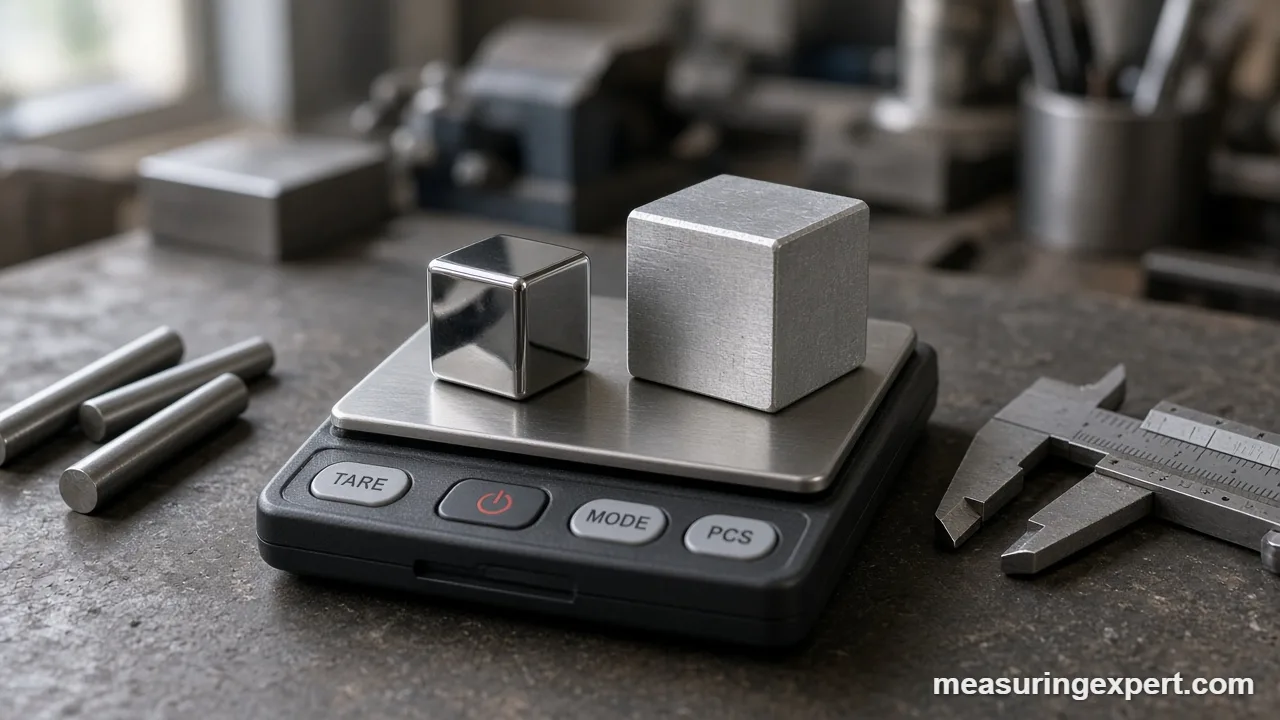
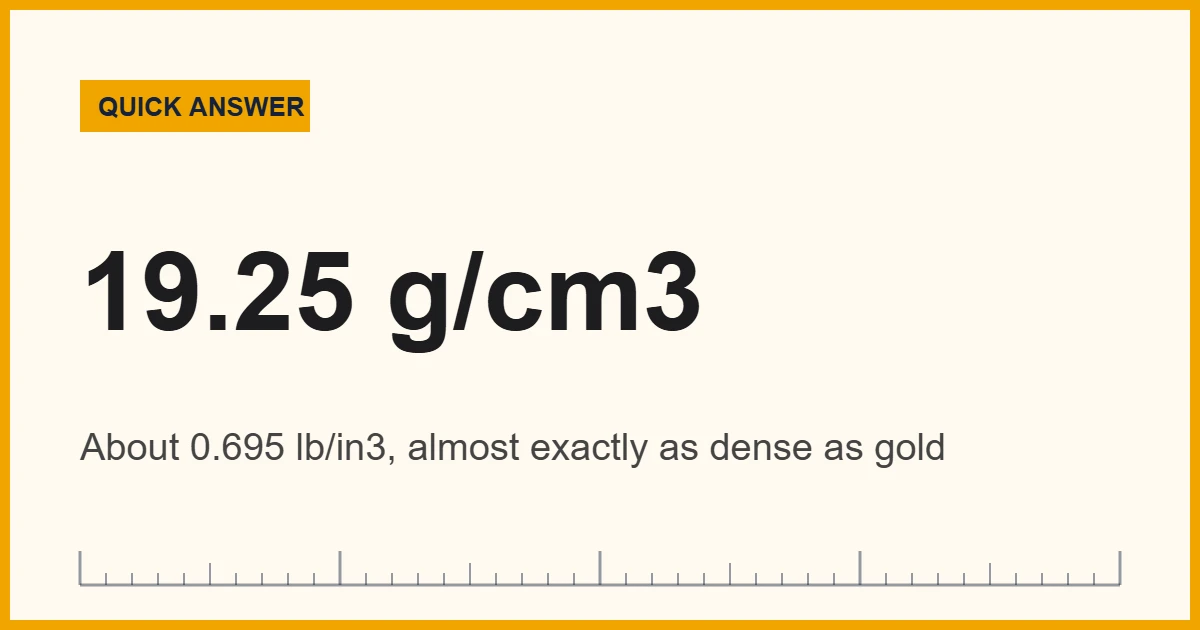
How dense is tungsten? Pure tungsten has a density of about 19.25 g/cm3 (19,250 kg/m3), which most tables round to 19.3. In US units, that is about 0.695 pounds per cubic inch or 1,202 lb/ft3. As a result, tungsten is roughly 19 times as dense as water and almost exactly as dense as gold.
How Dense Is Tungsten in Your Units? Convert It Here
For instance, machinists think in pounds per cubic inch, while lab reports use g/cm3 and engineers use kg/m3. So type a value below, for example 19.25 for pure tungsten or 18 for a typical heavy alloy, and the converter shows it in every common unit.
Tungsten, also called wolfram (hence the symbol W), is element 74. In addition, it is a gray-white metal with the highest melting point of any metal, roughly 3,400 degrees C (over 6,100 degrees F). Also, its name comes from the Swedish words “tung sten”, meaning heavy stone, and the name fits.
The Royal Society of Chemistry lists the density of tungsten as 19.3 g/cm3 in its tungsten element page. However, more precise handbooks give 19.25 g/cm3 at room temperature. In fact, you can check that figure yourself from the crystal: tungsten atoms sit in a body-centered cubic lattice about 0.3165 nm on a side, with two atoms per cell, and that geometry works out to 19.25 g/cm3.
Because the number is so high, a small piece of tungsten feels shockingly heavy. For example, a 1-inch cube weighs about 315 g, or 11.1 ounces. In contrast, the same cube in steel weighs only about 4.5 ounces.
How Dense Is Tungsten Compared With Gold, Lead and Other Metals?
Overall, tungsten sits near the very top of the density chart. However, it is not the densest metal. Osmium, iridium and platinum all beat it, and gold edges it out by a tiny margin. For comparison, the table below uses common handbook values at room temperature.
| Material | Density (g/cm3) | lb/ft3 | lb/in3 | Compared with tungsten |
|---|---|---|---|---|
| Osmium | 22.59 | 1,410 | 0.816 | 17% denser |
| Iridium | 22.56 | 1,408 | 0.815 | 17% denser |
| Platinum | 21.45 | 1,339 | 0.775 | 11% denser |
| Gold | 19.32 | 1,206 | 0.698 | 0.4% denser |
| Tungsten | 19.25 | 1,202 | 0.695 | – |
| Uranium | 19.05 | 1,189 | 0.688 | 1% lighter |
| Mercury (liquid) | 13.53 | 845 | 0.489 | 30% lighter |
| Lead | 11.34 | 708 | 0.410 | 41% lighter |
| Silver | 10.49 | 655 | 0.379 | 46% lighter |
| Copper | 8.96 | 559 | 0.324 | 53% lighter |
| Carbon steel | about 7.85 | about 490 | about 0.284 | 59% lighter |
| Aluminum | 2.70 | 169 | 0.098 | 86% lighter |
In particular, two rows deserve a closer look. First, gold and tungsten differ by less than half a percent. As a result, that near match is why counterfeiters sometimes hide tungsten inside fake gold bars, and our guide to how dense gold is explains why a density test alone cannot catch them. Second, tungsten is about 1.7 times as dense as lead. So for the same weight, a tungsten part takes up about 41 percent less space; see how dense lead is for the full lead numbers. The record holder, meanwhile, is covered in our article on osmium density.
Tungsten Weight Chart for Common Sizes
Of course, density becomes useful once you turn it into weight. Therefore, this chart uses 19.25 g/cm3 and exact NIST conversion factors (1 inch = 2.54 cm, 1 pound = 453.59237 g). However, real parts made from heavy alloy will weigh about 4 to 12 percent less.
| Size of pure tungsten | Volume | Weight (metric) | Weight (US) |
|---|---|---|---|
| 1 cm cube | 1 cm3 | 19.25 g | 0.68 oz |
| 1-inch cube | 16.39 cm3 | 315.5 g | 11.13 oz |
| 2-inch cube | 131.1 cm3 | 2.52 kg | 5.56 lb |
| 3-inch cube | 442.5 cm3 | 8.52 kg | 18.78 lb |
| 4-inch cube | 1,048.8 cm3 | 20.19 kg | 44.51 lb |
| 10 cm cube (1 liter) | 1,000 cm3 | 19.25 kg | 42.44 lb |
| 1 US gallon | 3,785 cm3 | 72.87 kg | 160.6 lb |
| 1 cubic foot | 28,317 cm3 | 545.1 kg | 1,201.7 lb |
| 1 kilogram of tungsten | 51.95 cm3 (3.17 in3) | 1 kg | 2.20 lb |
| 1 pound of tungsten | 23.56 cm3 (1.44 in3) | 453.6 g | 1 lb |
Printable: save or print this chart and keep it next to your scale or in your shop binder.
Put another way, a kilogram of tungsten fits in a cube only about 3.7 cm (1.5 inches) on a side. By comparison, a kilogram of water needs a 10 cm cube.
Why Is Tungsten So Dense?
In short, density comes down to two things: how heavy each atom is and how tightly the atoms pack. Tungsten, therefore, scores high on both.
To begin with, each tungsten atom is heavy. Its atomic weight is 183.84, so one atom carries more than three times the mass of an iron atom. Next, those atoms are small for their mass. This is because, in heavy elements, the inner electrons pull in close to the large nuclear charge, so the atom does not grow in proportion to its weight. Finally, the atoms bond very strongly in a compact body-centered cubic crystal. Similarly, that same strong bonding explains the record melting point and the great hardness.
So why is gold slightly denser? First, gold atoms are about 7 percent heavier (196.97 versus 183.84). Gold also packs them in a face-centered cubic crystal that fills about 74 percent of space, while tungsten’s body-centered cubic crystal fills about 68 percent. However, gold atoms are a bit larger, so the effects nearly cancel, and gold wins by a hair.
Pure Tungsten vs Tungsten Carbide vs Heavy Alloy
However, many products are sold as “tungsten” even when they are not the pure metal. In fact, this mix-up is the most common reason a measured density does not match 19.25.
| Material | What it is | Typical density | Where you see it |
|---|---|---|---|
| Pure tungsten | Element 74, usually made from pressed and sintered powder | About 19.25 g/cm3 when fully dense | Lamp filaments, welding electrodes, furnace parts |
| Tungsten heavy alloy | Mostly tungsten bonded with nickel plus iron or copper | About 17 to 18.5 g/cm3 | Balance weights, radiation shielding, fishing and dart weights |
| Tungsten carbide (WC) | A compound of tungsten and carbon | About 15.6 g/cm3; cemented grades with cobalt run lower | Drill bits, cutting tools, jewelry rings |
| Tungsten-filled polymer | Plastic loaded with tungsten powder | Varies widely; often 10 g/cm3 or less | Lead-free weights and shielding |
Above all, tungsten carbide matters most in industry. According to the US Geological Survey’s Mineral Commodity Summaries 2025, about 60 percent of US tungsten use goes into cemented carbide parts for cutting and wear resistance. In addition, the USGS notes that depleted uranium or lead can replace tungsten where high density is the goal.
Recommended Tools for Checking Tungsten Density
Fortunately, you only need three tools to check a sample. First, a 0.01 g pocket scale weighs small parts precisely. Second, a glass graduated cylinder measures the water a part displaces. In addition, a digital caliper measures regular shapes such as cubes and rods, so you can work out volume without water at all.


As an Amazon Associate, Measuring Expert earns from qualifying purchases.
How Dense Is Tungsten in Your Sample? Measure It at Home
First of all, the water displacement method works for any shape. In other words, it follows Archimedes’ principle: an object pushes aside its own volume of water. Here is how to do it:
- Clean and dry the part. First, remember that oil, dirt or trapped water throws off both the weight and the volume.
- Weigh it on a precise scale. Then record the mass in grams, for example 50.00 g.
- Half-fill a graduated cylinder with water. Then read the level at eye level, at the bottom of the curved surface.
- Lower the part in gently. Also, tilt the cylinder or use a thread so the part does not crack the glass, and tap away any air bubbles.
- Read the new level. Next, subtract the first reading from the second to get the volume in mL, which equals cm3.
- Divide mass by volume. For instance, 50.00 g in 2.6 mL gives about 19.2 g/cm3. Finally, enter that result in the converter above.
For small parts, a better method is to weigh the part in air and then hanging in water from a thread. Then the weight loss in grams equals its volume in cm3. As a result, you avoid reading tiny volume changes on the cylinder.
Do and Don’t When You Measure Tungsten
Do
- Use 19.25 g/cm3 for pure, fully dense tungsten.
- Expect 17 to 18.5 g/cm3 for heavy alloy parts.
- Weigh in grams to two decimal places for small parts.
- Remove air bubbles before you read the water level.
- Repeat the test two or three times and average.
Don’t
- Assume every “tungsten” product is the pure metal.
- Rely on density alone to prove gold is real.
- Read the cylinder from above or below the line.
- Test tiny parts in a large cylinder with coarse marks.
- Drop heavy parts into glassware.
Honest Limits of These Numbers
To begin with, the 19.25 g/cm3 figure describes ideal, fully dense, pure tungsten at room temperature. In reality, parts rarely match it exactly. Most tungsten is made by pressing and sintering powder, so a part that is not fully worked can hold tiny pores and come in slightly lower. Also, alloys and carbides have their own ranges, as the table above shows. Temperature has only a small effect: tungsten expands very little when heated, so its density drops by well under 1 percent even at several hundred degrees. On top of that, home measurement adds its own error. For instance, misreading a 10 mL cylinder by 0.1 mL on a 2.6 mL reading changes the result by about 4 percent. In short, treat a home result within a few percent of 19.25 as a match.
When Accuracy Really Matters
Of course, a rough answer is fine for curiosity. Still, some jobs need real numbers:
- Balancing and weights. Aircraft, race cars and golf clubs use tungsten weights, so designers work from the supplier’s certified density, not a textbook value.
- Radiation shielding. Because shielding depends on density and thickness, engineers use the measured density of the actual alloy.
- Precious metal testing. Since tungsten nearly matches gold, buyers add ultrasonic or X-ray checks rather than trust density alone.
- Machining and shipping. Tungsten bar stock weighs about 2.5 times as much as steel of the same size, which affects fixtures, cutting loads and freight costs.
Frequently Asked Questions
How dense is tungsten in g/cm3?
Pure tungsten is about 19.25 g/cm3 at room temperature, so it is very heavy. However, many periodic tables round this to 19.3 g/cm3.
How dense is tungsten in pounds per cubic inch?
Pure tungsten is about 0.695 pounds per cubic inch, so it equals about 1,202 pounds per cubic foot.
Is tungsten denser than gold?
No. In fact, gold is about 19.32 g/cm3 and tungsten is about 19.25 g/cm3, so gold is denser by less than half a percent.
How dense is tungsten compared with lead?
Tungsten is about 1.7 times as dense as lead. For example, lead is 11.34 g/cm3, while tungsten is about 19.25 g/cm3.
Is tungsten the densest metal?
No. Instead, osmium is the densest at about 22.59 g/cm3, followed closely by iridium. In addition, platinum and gold are slightly denser than tungsten.
How dense is tungsten carbide?
Tungsten carbide is about 15.6 g/cm3. However, cemented carbide grades that contain cobalt are usually a little lighter, so many carbide rings and tools measure around 14 to 15.5 g/cm3.
How much does a 1-inch cube of tungsten weigh?
For example, a 1-inch cube of pure tungsten weighs about 315.5 grams, or 11.13 ounces.
Why is tungsten so heavy for its size?
First, each tungsten atom is heavy, with an atomic weight of 183.84. Second, the atoms pack tightly in a compact crystal. Together, that gives tungsten about 19 times the density of water.
How dense is tungsten heavy alloy?
Because of their binder metals, tungsten heavy alloys typically run from about 17 to 18.5 g/cm3, depending on how much nickel, iron or copper they contain.
How dense is tungsten compared with water?
Tungsten is about 19.3 times as dense as water at room temperature, so a liter of tungsten would weigh about 19.25 kg.
How Dense Is Tungsten? The Bottom Line
To sum up, pure tungsten has a density of about 19.25 g/cm3, often rounded to 19.3, which equals about 0.695 lb/in3. As a result, it is about 1.7 times as dense as lead and almost exactly as dense as gold, although gold is very slightly heavier.
For real parts, however, check what you actually have. For example, heavy alloys run about 17 to 18.5 g/cm3, and tungsten carbide is about 15.6. So weigh your sample, measure its volume, and then plug the result into the converter at the top of the page.
1 thought on “How Dense Is Tungsten? Density in g/cm3, lb/in3 and vs Gold and Lead”