

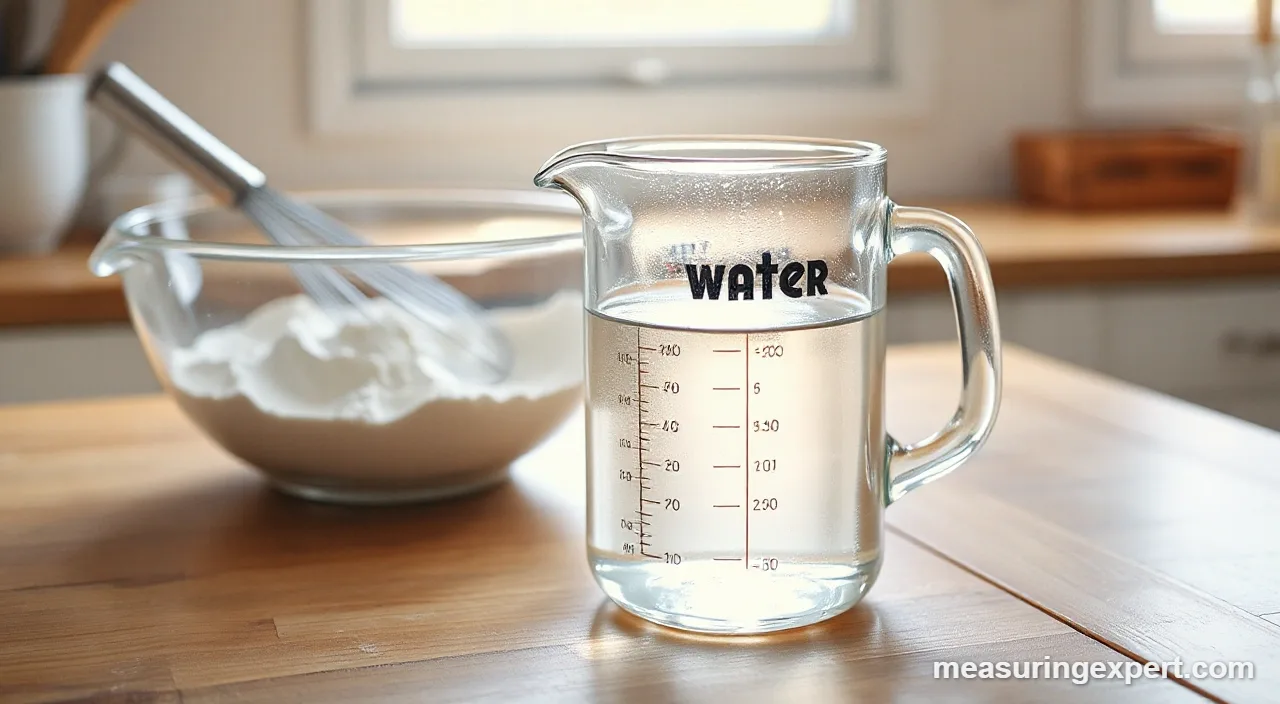
You are halfway through a custard when the recipe asks for exactly 600 mL of milk. Your jug says 2 cups and a bit, the lines are faded, and you are guessing. A good measuring jug removes that guess. It shows the level clearly, pours without dripping and keeps its markings for years.
The best measuring jug for most kitchens is a glass one with a spout, a handle and clear graduations, such as the Pyrex glass measuring jug at the top of our list. Glass stays clear, does not hold odors and works for hot and cold liquids. If you read jugs from above, an angled plastic cup saves bending, and if you cook in batches, a 1-quart or 2-liter pitcher is easier to stir and pour.
In short: pick glass for everyday work, angled plastic for fast reading, a pitcher for big batches, and an adjustable cup only for sticky liquids like honey.
Official weights and measures guidance is written for commercial devices. The National Institute of Standards and Technology publishes Handbook 44, which covers liquid measures and graduates sold for trade. Household jugs are not held to those tolerances, so it pays to check yours once, as shown in the how-to section below.
Below you will find 10 jugs, a comparison table, a converter and a plain-language guide to materials, markings and checking accuracy. If you also need conversions, our pages on how many mL are in a quart and 4 cups in ounces cover the numbers.
As an Amazon Associate we earn from qualifying purchases. Picks are based on manufacturer specs and buyer reports, not on lab testing, and we never type prices because they change.
On this page
Heat-safe glass with a spout and handleBest Angled MarkingsOXO Good Grips 4-Cup Angled Measuring Cup
Angled inner ledge you read from aboveBest SetPyrex Essentials 3-Pack Glass Measuring Cups (1, 2 and 4 Cup)
Three nested sizes for small and large pours
Key Takeaways
- Best overall: the Pyrex glass measuring jug (glass, spout, handle).
- Best angled reader: the OXO Good Grips 4-cup angled cup.
- Best set: the Pyrex 3-pack with 1, 2 and 4 cup sizes.
- Match jug size to the job: small volumes read more accurately in small jugs.
- Read at eye level on a flat surface, or use an angled cup and look down.
- Check any new jug once against a kitchen scale; water is about 1 g per mL.
- Everything here is chosen from specs and buyer feedback, not lab tests.
How We Chose These Picks
We shortlisted jugs and measuring pitchers from listings with strong ratings from many shoppers, then compared what each maker states about capacity, material, markings and handles. Thin listings with few reviews or unclear sizes were left out. This is research-based work, not lab testing, and we did not run our own accuracy tests on these products.
We limited each brand to two picks, skipped near-duplicates such as the same cup in another color, and kept accessories out. The ranking weighs reading clarity first, then durability, then pour control, then how well the size fits common recipes.
The 10 Best Measuring Jugs Right Now
The table gives the quick view. The cards below carry details, pros and cons for each pick. We do not list prices because they change; follow the product cards for current prices.
| # | Pick | Best for | Standout |
|---|---|---|---|
| 1 | Pyrex Glass Measuring Jug | everyday cooking, baking and hot liquids | Heat-safe glass with a spout and handle |
| 2 | OXO Good Grips 4-Cup Angled Measuring Cup | people who hate bending down to read a jug | Angled inner ledge you read from above |
| 3 | Pyrex Essentials 3-Pack Glass Measuring Cups (1, 2 and 4 Cup) | kitchens that want three sizes ready at once | Three nested sizes for small and large pours |
| 4 | Anchor Hocking Glass Measuring Cups, 3 Piece Set | people who want a second glass set option | Thick glass in three sizes |
| 5 | Farberware Pro 4-Cup Angled Measuring Cup | a second angled option in a 4-cup size | Angled reading surface with a 4-cup capacity |
| 6 | OXO Good Grips Adjustable Liquid Measuring Cup, 2 Cup | honey, syrup, molasses and oil | Plunger-style base that pushes sticky liquid out |
| 7 | ACCUPOUR 32 oz Measuring Pitcher | mixing and pouring larger batches | One-quart capacity with a wide mixing body |
| 8 | EISCO 2000 mL Plastic Pitcher | metric work and larger volumes | 2-liter capacity with metric markings |
| 9 | Cambro 4 Qt Liquid Measuring Cup (Camwear) | large batches and food service | Four quarts with a commercial-grade build |
| 10 | Newness 2 Cup Stainless Steel Measuring Cup | people who want a non-breakable metal cup | Stainless steel body that will not shatter |
Buying from this list? Get it fast, and catch Black Friday deals, with Prime
#1Best Overall
Pyrex Glass Measuring Jug

Best for: everyday cooking, baking and hot liquids
Glass is the default choice for a reason. This Pyrex jug is see-through, so you can check the level from the side, and it does not pick up stains or odors from stock, tomato sauce or oil. The printed graduations sit close to the glass wall, which keeps the reading honest when you look straight across.
Because it is glass, it can go from a warm counter to the microwave for melting butter or warming milk, and it cleans up in a dishwasher. The trade-off is weight and fragility: drop it on tile and it is done. For most kitchens that is a fair price for a jug that stays clear for years.
- Material: glass with printed graduations, per the listing
- Pour spout and a fixed handle for one-handed pouring
- Markings in cups, ounces and milliliters on the standard Pyrex line
- Fits microwave use; check the listing for temperature notes
- Clear side view of the liquid level
- Does not stain or hold odors
- Works for hot and cold liquids
- Heavier than plastic and breaks if dropped
- Printed markings can fade after years of hard dishwasher cycles
Skip it if you cook with kids, on a boat or in a busy commercial kitchen where glass is a risk.
#2Best Angled Markings
OXO Good Grips 4-Cup Angled Measuring Cup

Best for: people who hate bending down to read a jug
The angled design is the whole point. Instead of crouching to bring your eye level with a straight wall, you look down into the cup and read markings on a sloped inner surface. For anyone who measures a lot of stock, milk or water, that saves your back and cuts reading mistakes.
It is a 4-cup size, which covers most recipes, and the plastic body is light and shatter-resistant. The soft handle is comfortable with a full jug. As with any angled cup, the reading is only as good as your pour: add the liquid slowly and let it settle before you check.
- Capacity: 4 cups, per the title
- Angled inner markings readable from above
- Plastic body that does not shatter like glass
- Handle with a grippy feel for wet hands
- Easy reading without bending down
- Light and unbreakable in normal use
- Large size covers most recipes
- Plastic can scratch and may stain with tomato or turmeric
- Not the choice for scalding liquids over long contact
Skip it if you want a see-through glass wall or plan to heat liquids in it often.
#3Best Set
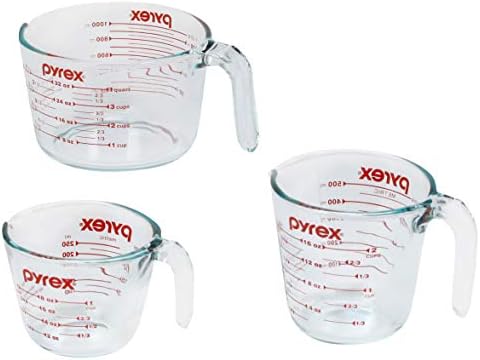
Pyrex Essentials 3-Pack Glass Measuring Cups (1, 2 and 4 Cup)
Best for: kitchens that want three sizes ready at once
Measuring a quarter cup of cream and a quart of stock in the same jug is a recipe for sloppy results. A set of 1, 2 and 4 cup glass jugs lets you match the size to the pour, and small volumes read far more accurately in a small container.
The sizes also let you prep several liquids for a recipe without washing between steps. Each is the same tempered-glass build as the single jug, so the same advice applies: wait for the level to settle, read at eye level and keep them away from sudden temperature shocks.
- Sizes: 1, 2 and 4 cup, per the title
- Glass construction with graduated markings
- Spouts and handles on each size
- Sold as a three-piece set
- Right-size jug for every pour
- Glass that does not stain
- Easy to buy once and be done
- Takes more cabinet room than one jug
- Same fragility as any glass
Skip it if you only ever measure one liquid at a time and have little storage.
#4Best Heavy-Duty Glass
Anchor Hocking Glass Measuring Cups, 3 Piece Set

Best for: people who want a second glass set option
Anchor Hocking has made kitchen glass for generations, and this three-piece set follows the same plan as the Pyrex set: small, medium and large jugs with markings you can read from the side. The sizes shown in the listing run from 1 cup up to 4 cups.
If you already own a Pyrex jug, this is a way to build a matched set from another maker. Use the same habits: read at eye level on a flat surface, and check the markings against a scale once to see how true they are.
- Three glass cups, 1 cup to 4 cups per the listing
- Handles and pour lips on each piece
- Graduations printed on the glass
- Dishwasher use is covered in the manufacturer care notes
- Glass clarity and stain resistance
- Three useful sizes
- Familiar, easy-to-read markings
- Glass can chip at the rim over time
- Fewer unit markings than some angled cups
Skip it if you prefer a single large jug and have no need for small sizes.
#5Best Angled Alternative
Farberware Pro 4-Cup Angled Measuring Cup

Best for: a second angled option in a 4-cup size
If the OXO angled cup is not available or you simply want another brand, the Farberware Pro takes the same idea: markings on a sloped inner wall that you read from above. It is a 4-cup size that handles most liquid jobs.
Angled cups reward careful pouring because you can see the level rise as you add liquid. Keep it on the counter while you pour instead of holding it in the air, and your readings will be steadier.
- Capacity: 4 cups, per the title
- Angled markings meant to be read from above
- Lightweight plastic body
- Handle designed for wet hands
- Reading without crouching
- Light and drop-tolerant
- Good size for batters and stocks
- Plastic can stain and scratch
- Markings wear with long use
Skip it if you want glass or you need a tiny-volume jug for spices and extracts.
#6Best for Sticky Liquids
OXO Good Grips Adjustable Liquid Measuring Cup, 2 Cup

Best for: honey, syrup, molasses and oil
Sticky liquids are the hardest to measure with a normal jug because half of the honey stays behind on the wall. An adjustable cup lets you set the amount and then push the contents out, so what you measured is what lands in the bowl.
It is a 2-cup capacity, so it suits recipes rather than bulk work. Treat it as a specialist next to a main jug, not a replacement. Wash it soon after use, since dried syrup on the moving parts is hard to clean.
- Capacity: 2 cups, per the title
- Adjustable design to set the volume
- Made for liquids that cling to measuring cups
- Hand-wash care is the safest approach
- Cleaner transfer of sticky liquids
- Compact size
- Reduces waste of honey and syrup
- More parts to clean and keep dry
- Not a big-batch jug
Skip it if you rarely measure anything thicker than water or milk.
#7Best 1-Quart Pitcher
ACCUPOUR 32 oz Measuring Pitcher

Best for: mixing and pouring larger batches
A pitcher shape trades the compact look of a jug for room to stir. At 32 ounces, which is one US quart or about 946 mL, it is handy for pancake batter, vinaigrette bases, cold brew and water for bread dough.
Larger pitchers are more forgiving to pour but less precise at the bottom of the scale, so do not use it for a tablespoon of anything. Think of it as the mixing vessel with a built-in measuring line.
- Capacity: 32 oz (1 quart), per the title
- Plastic multipurpose build
- Graduated for volume checks
- Wide opening for whisking
- Roomy for mixing
- Light to hold when full
- Good for batters and drinks
- Not accurate for small volumes
- Plastic can retain smells from strong foods
Skip it if most of your measuring is under a half cup.
#8Best Metric Lab-Style
EISCO 2000 mL Plastic Pitcher

Best for: metric work and larger volumes
This pitcher comes from a science supplier and is built around metric volume. At 2000 mL it holds about 8.45 US cups, so it is useful for brining, fermentation water, garden mixes and classroom demonstrations.
Because it is a lab-style plastic jug, expect markings in milliliters rather than cups. That is a plus if you follow metric recipes, and a small inconvenience if you work in cups. Use our converter above to move between the two.
- Capacity: 2000 mL (2 L), per the title
- Short-form design with a pouring lip
- Plastic body suited to water-based work
- Metric graduations typical of lab supplies
- Large capacity with metric marks
- Light and easy to clean
- Good for science and craft use
- Cups are not the main scale
- Not meant for hot cooking liquids
Skip it if you only follow US cup recipes and want cup markings.
#9Best Commercial Size
Cambro 4 Qt Liquid Measuring Cup (Camwear)

Best for: large batches and food service
Cambro supplies restaurants, and this Camwear measure shows it: a big 4-quart body with a sturdy handle that tolerates daily service. For home canners, brewers and big-batch cooks, it replaces three trips with a smaller jug.
Four US quarts is 3.785 L, which is one US gallon. That is far too big for small recipes, but ideal for stock, brine, sanitizer solutions and batch mixers. Pour carefully when it is full, because the weight adds up.
- Capacity: 4 quarts (1 US gallon), per the title
- Commercial polycarbonate-style construction, per the Camwear line
- Handle built for repeated use
- Sized for food service tasks
- Huge capacity for batch work
- Built for heavy use
- Easy to read from the side
- Too big for small kitchens
- Weighs a lot when full
Skip it if you cook for two and rarely need more than a quart.
#10Best Stainless Option
Newness 2 Cup Stainless Steel Measuring Cup

Best for: people who want a non-breakable metal cup
Stainless steel is the long-lived option. It will not break, does not stain, and handles hot liquids without worry. The title lists a 2-cup size, which is a handy mid-range jug for sauces and milk.
The catch with any opaque metal cup is that you cannot see the level from the side, so you read the markings from above or by the inside lines. If the markings are engraved or etched instead of printed, they will last longer. Check the listing photos before you decide.
- Capacity: 2 cups, per the title
- Stainless steel construction
- Handle for pouring
- Suited to hot and cold liquids
- Does not break or stain
- Handles hot liquids
- Compact 2-cup size
- Cannot see the level through the wall
- Reading from above takes practice
Skip it if you like to watch the liquid level through the side of the jug.
Glass, Plastic or Stainless: Which Jug Material Wins
Material decides how long a jug stays readable and what you can safely put in it. Glass is stable, clear and neutral. Plastic is light and tough. Stainless steel is nearly indestructible but opaque.
| Material | Best at | Weak at |
|---|---|---|
| Glass | Clarity, stain resistance, hot liquids | Weight and breakage |
| Plastic (polypropylene or similar) | Light weight and drop tolerance | Staining, scratching, heat limits |
| Stainless steel | Durability and hot liquids | No side view of the level |
If you only buy one, buy glass. If you bake with children or work near hard floors, buy plastic and accept the slight staining.
How to Read the Markings: Cups, Ounces and Milliliters
Most US jugs carry three scales: cups, fluid ounces and milliliters. One US cup is 236.5882365 mL, or exactly 8 US fluid ounces. A US quart is 946.35 mL and a liter is about 33.8 US fluid ounces. Metric cups used in Australia and elsewhere are 250 mL, and the US legal cup used on nutrition labels is 240 mL, so recipes from other countries can differ by a few percent.
| Unit | Milliliters | US fluid ounces |
|---|---|---|
| 1 US cup | 236.6 mL | 8 fl oz |
| 1 US pint | 473.2 mL | 16 fl oz |
| 1 US quart | 946.4 mL | 32 fl oz |
| 1 metric cup (AU) | 250 mL | 8.45 fl oz |
| 1 UK pint | 568.3 mL | 19.2 US fl oz (20 UK fl oz) |
Do not mix a jug’s US fluid ounces with weight ounces. A fluid ounce measures volume; an ounce on a scale measures mass. Our guide to dry volume, liquid volume and weight explains when each applies.
Picking the Right Size: 1 Cup, 4 Cups or 2 Liters
Accuracy suffers when the amount you want is a small slice of the jug. A 4-cup jug has lines every quarter cup or so; asking it for 2 tablespoons is asking for trouble. A practical rule is to keep the amount you measure above about one quarter of the jug’s capacity.
- Up to 1 cup: a 1-cup jug or a small angled cup.
- 1 to 3 cups: a 2-cup jug, or a 4-cup if you only own one.
- Quart and larger: a 32-ounce pitcher or a 2-liter jug.
- Gallon jobs: a 4-quart commercial measure.
How to Check Your Jug With a Kitchen Scale
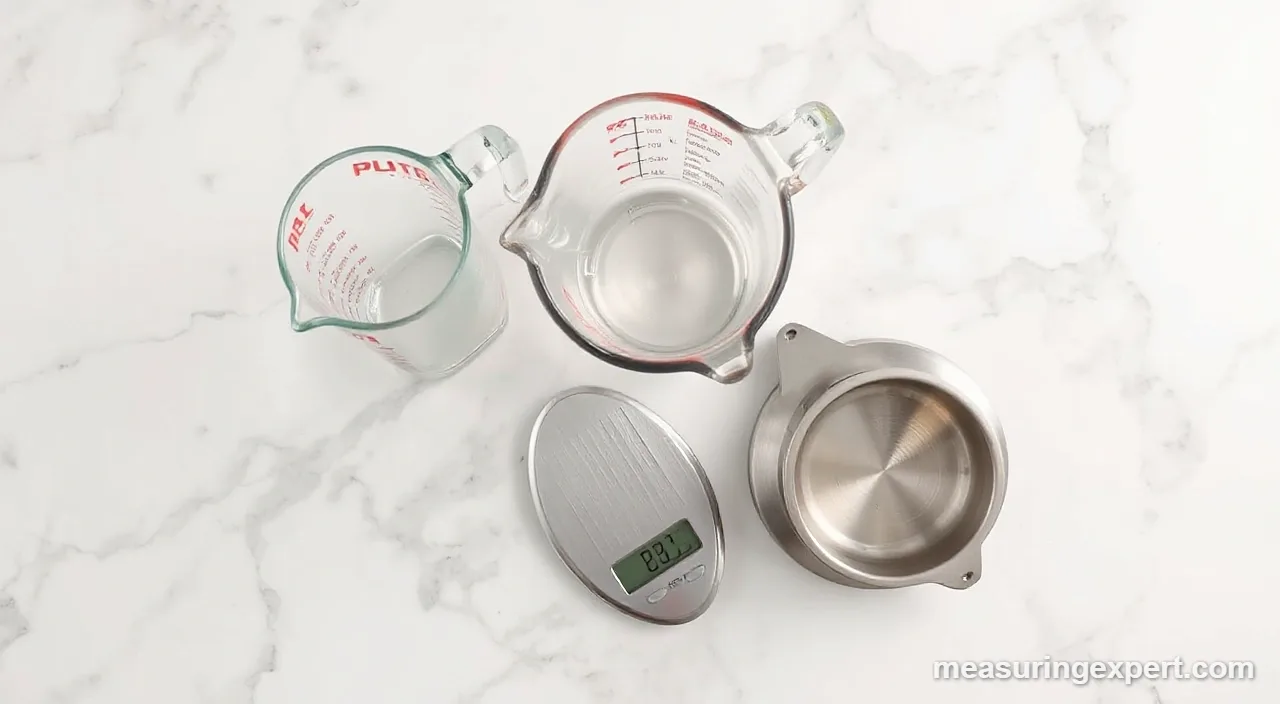
Household jugs are not certified, and their printed markings can be off by a few percent. Water makes a simple check because one milliliter weighs about one gram at room temperature. A true 1-cup mark should hold about 236 g of water.
- Set the jug on a flat counter and place a kitchen scale beside it.
- Put an empty bowl on the scale and press tare to zero it.
- Pour water into the jug up to the 1-cup line, reading at eye level or from above if it is angled.
- Pour that water into the bowl and note the weight in grams.
- Compare with about 236 g. A result between roughly 230 g and 242 g is typical for household ware.
- Repeat at the 2-cup line, aiming for about 473 g.
If a jug is far off, retire it or use it only for rough work like soup water.
- Place the jug on a flat surface before you read it.
- Read at eye level, or from above on an angled cup.
- Read the bottom of the curved liquid surface.
- Pre-wet the jug with water for sticky liquids.
- Wash markings gently so they last.
- Hold the jug in the air while you pour and read.
- Use a liquid jug for packed flour or sugar.
- Put cold glass straight into a hot oven or onto a hot burner.
- Trust faded lines for exact work.
- Use kitchen jugs for dosing medicine.
Honest Limits of Any Measuring Jug
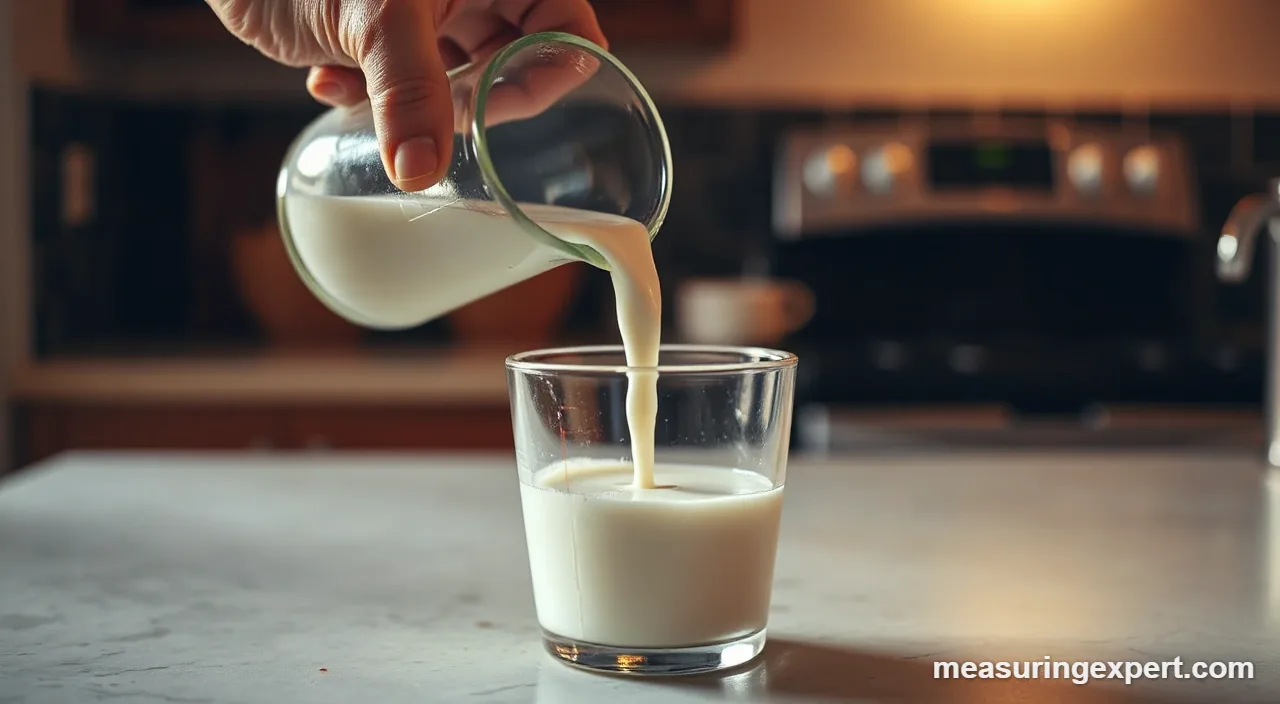
A jug is a convenience, not an instrument. Markings are printed or molded to household tolerances, the meniscus (curved surface) of the liquid adds reading error, and pour speed matters. Most home recipes tolerate a few percent either way. Bread hydration, brines and canning solutions do better when you weigh the liquid on a scale.
For science experiments needing real accuracy, use graduated cylinders or volumetric glassware rather than a kitchen jug. For medicine, never measure with a kitchen jug. Use the dosing device that came with the product and ask a pharmacist or doctor if you are unsure.
When to Weigh Instead of Measure
Weighing liquid is often better for precision. Water, milk and most thin stocks are close to 1 g per mL, so 500 g of water is about 500 mL. Oil is lighter, near 0.92 g per mL, and honey is much heavier, around 1.4 g per mL. If a recipe gives grams, use a scale and skip the jug entirely.
| Liquid | Approx. density | 500 mL weighs about |
|---|---|---|
| Water | 1.00 g/mL | 500 g |
| Whole milk | 1.03 g/mL | 515 g |
| Vegetable oil | 0.92 g/mL | 460 g |
| Honey | 1.4 g/mL | 700 g |
These densities are typical values; check the label or a reference for the exact product.
Questions People Ask About Measuring Jugs
What is the best material for a measuring jug?
Glass is the best all-round material because it stays clear, resists stains and handles hot and cold liquids. Plastic is better if weight or breakage is a concern, and stainless steel is the toughest but hides the liquid level.
What size measuring jug should I buy first?
A 2-cup or 4-cup jug covers most recipes. If you can own two, add a 1-cup jug for small amounts, because small volumes read more precisely in a small container.
Are angled measuring cups more accurate?
They are easier to read, not necessarily more accurate. You look down into the cup instead of crouching, which cuts reading mistakes, but the printed markings still have normal household tolerances.
How many mL are in a US cup?
One US cup is 236.5882365 mL. Many recipes round it to 240 mL or 237 mL. The US legal cup used on nutrition labels is exactly 240 mL.
Can I microwave a glass measuring jug?
Many glass jugs are made for microwave use, but check the maker care notes for your exact product. Avoid sudden temperature changes such as pouring cold water into a hot jug.
Why do my measurements look different from the recipe?
Common causes are reading the level from an angle, mixing US and metric cups, measuring dry goods in a liquid jug, or faded markings. Weighing the liquid on a scale removes most of these errors.
Can I use a measuring jug for dry ingredients?
It is not ideal. Liquid jugs have headroom above the top line and dry goods are hard to level, so a nested dry measuring cup or a scale gives better results.
How do I measure honey or syrup cleanly?
Lightly oil or wet the jug first, or use an adjustable cup that pushes the contents out. Weighing sticky liquids on a scale is even cleaner.
How often should I replace a measuring jug?
Replace it when markings are faded, the plastic is cloudy or cracked, or a scale check shows a large error. Glass jugs can last decades if they are not chipped.
Is a liter the same as a quart?
No. A US quart is 946.35 mL, slightly less than one liter, which is about 1.057 US quarts. Mixing them up causes errors of nearly 6 percent.
Bottom Line
A measuring jug is one of the cheapest ways to make your cooking more consistent. Start with a glass jug you can read from the side, add an angled cup if you are tired of crouching, and keep a pitcher for large batches. Check any new jug once against a scale and you will know how far to trust the lines.
Use the converter above when a recipe switches between cups and milliliters, and weigh liquids whenever a recipe gives grams. Our other guides on liquid conversions are linked in the text above if you need more numbers.
The short version: buy the Pyrex glass measuring jug for everyday use, the OXO angled cup for easy reading, and the Pyrex 3-pack if you want three sizes. Add a quart pitcher only if you cook in batches.
Listen to a free audiobook while you cook, work or wait
1 thought on “10 Best Measuring Jugs (2026): Glass, Angled and Large Pitchers”