

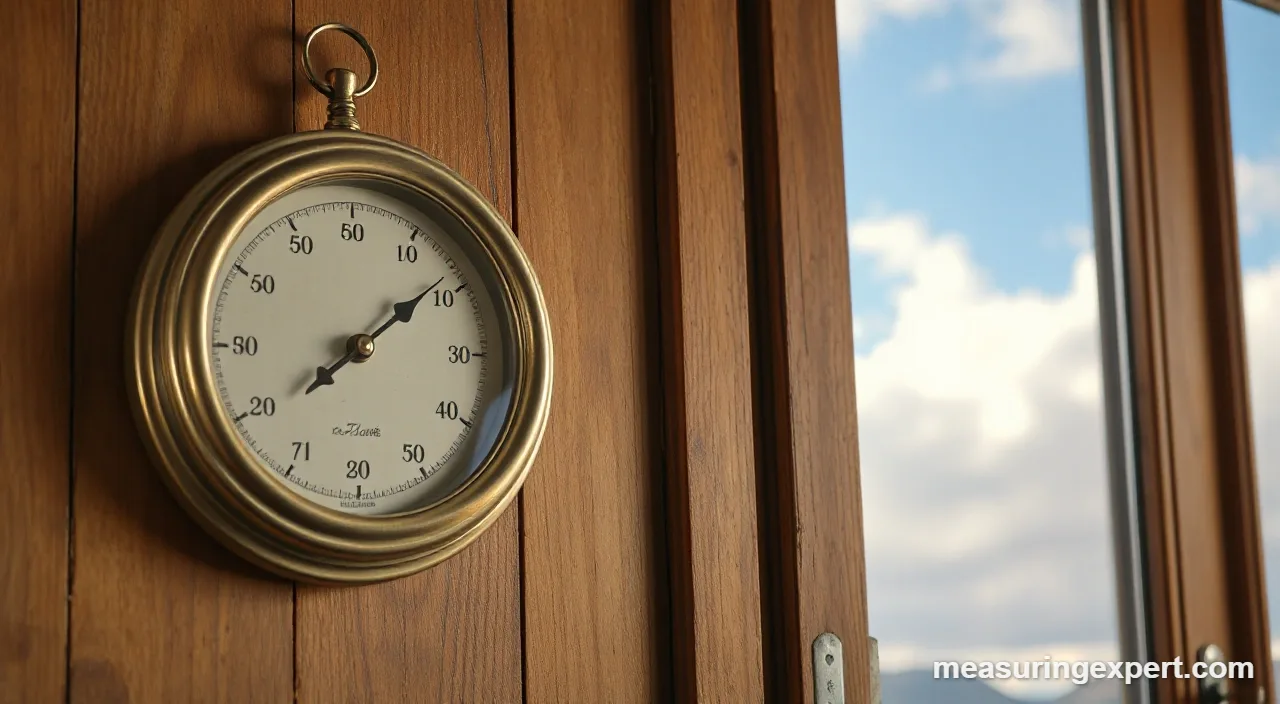
A barometer measures air pressure, and at home the best choice depends on what you want to see. For a pure, calibrated pressure reading, the Traceable digital barometer is the most direct tool. For pressure plus temperature, humidity and forecasts in one place, a home weather station with a built-in barometer such as the AcuRite Notos, La Crosse 308-1414MB or Davis Vantage Pro2 is more useful. Standard sea-level pressure is 29.92 inches of mercury (1013.25 hPa), and your forecast cue is the trend, not the number. We found only one dedicated barometer among matching products, so six of the seven picks are weather stations that include one.
Tap a classic wall barometer, watch the needle move and you are using a tool that is centuries old. Modern home barometers are quieter: a digital readout, a trend arrow and sometimes an app. What they all measure is the same thing, the weight of the air above you.
In short: a barometer tells you pressure, and falling pressure often accompanies unsettled weather, while rising pressure often follows clearing skies. What matters is how fast and how far the number moves, and whether your barometer is set for your elevation.
NOAA explains the basics: standard air pressure at sea level is 29.92 inches of mercury, or 1013.25 millibars (hectopascals), and pressure falls with elevation. It also notes that old sayings tying a falling barometer to weather do not apply everywhere (NOAA JetStream on air pressure).
Our catalog search found one dedicated digital barometer and six home weather stations that include a barometer, so this page is a buying guide of seven picks rather than a top-10 list, and we say plainly which are which. Classic aneroid wall barometers did not meet our listing criteria. For background see how air pressure and weather are related.
Below you will find a pressure unit calculator, the seven recommended devices, how to set and read a barometer, and an honest look at what pressure can and cannot tell you.
As an Amazon Associate we earn from qualifying purchases. Picks are based on manufacturer specs, listing details and buyer reports, not lab testing. We found one dedicated barometer and six weather stations with built-in barometers, so this is a buying guide rather than a top-10 list.
Key takeaways
- Best pure barometer: the Traceable calibrated digital barometer is a dedicated pressure instrument.
- Best all-round home station: the AcuRite Notos pairs pressure with temperature, humidity and a clear display.
- Best enthusiast pick: the Davis Vantage Pro2 is a long-running wireless station for serious weather hobbyists.
- Standard sea-level pressure is 29.92 inHg or 1013.25 hPa.
- Watch the trend over three to six hours. A falling trend often points to unsettled weather.
- Set your elevation or pressure offset or the reading will not match local reports.
- A barometer is a weather clue, not a forecast on its own.
- How we shortlisted the seven
- Recommended barometers and weather stations for home use
- Barometer or weather station: what you actually need
- Pressure units explained
- How to set and read a barometer
- What pressure trends can tell you
- How to check your barometer
- Honest limits of home barometers
- When to rely on official forecasts
- Frequently asked questions
- The bottom line
How we shortlisted the seven
We looked for barometers and weather stations whose listings show strong ratings from many shoppers and mention barometric pressure readings. We then compared each page with the maker’s description for display, sensor type and setup.
We did not pad the list. We found only one dedicated digital barometer, so six of the seven picks are weather stations with built-in barometers. We kept to two per brand and describe each by who it suits. This is a research-based guide from manufacturer specs and buyer reports, not lab testing, and we have not used these devices ourselves.
Recommended barometers and weather stations for home use
Pick 1 is a dedicated barometer. Picks 2 to 7 are weather stations with a barometer included. Confirm the pressure display and units on the current listing.
| # | Product | Type | Best use |
|---|---|---|---|
| 1 | Traceable digital barometer | Dedicated barometer | Accurate pressure readings |
| 2 | AcuRite Notos | Weather station | Pressure plus temperature and humidity |
| 3 | Davis Vantage Pro2 | Weather station | Enthusiast, long-term logging |
| 4 | La Crosse 308-1414MB | Weather station | Color display, forecasts |
| 5 | Ambient BA212 | Weather station | Wall display |
| 6 | AcuRite 00249 | Weather station | Outdoor sports forecasts |
| 7 | Sainlogic 12-in-1 | Weather station | Many readings, wireless |
Buying from this list? Get it fast, and catch Black Friday deals, with Prime
Traceable calibrated digital barometer: a dedicated pressure instrument

Best for: anyone who wants a dedicated, calibrated pressure reading.
The Traceable calibrated digital barometer is a dedicated pressure instrument. Its listing gives a range of 7.25 to 14.94 psi, which is about 14.8 to 30.4 inHg, with a resolution of 0.1 of a unit as stated.
It does one thing and does it directly, which makes it a natural fit for labs, schools, hobbyists and anyone who wants to cross-check a weather station. Check the listing for units and certificate details.
- Digital barometer
- 7.25 to 14.94 psi range per the title
- Calibrated, per the listing name
- Check the listing for displayed units and certificate
- Dedicated pressure instrument
- Calibrated per the listing
- Good as a reference
- Does not show temperature or humidity
- Less friendly than a full weather station
Skip it if you want temperature, humidity and forecast icons.
AcuRite Notos 01604A2 pro weather station with color digital display
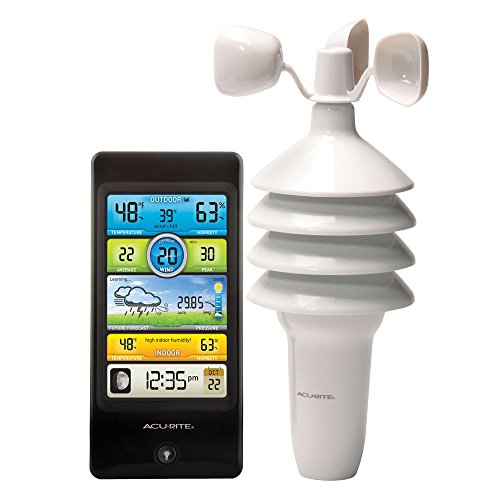
Best for: families who want a readable display and clear trends.
AcuRite’s Notos is a pro weather station with a color digital display, according to the listing. Weather stations of this kind show barometric pressure alongside temperature and humidity, with trend indicators.
It is a good fit for households who want one place to glance at conditions. Confirm the barometer feature and sensor setup on the current listing.
- Weather station with color display
- Includes barometric pressure on this class of device
- Made by AcuRite
- Check the listing for sensors and pressure trend display
- Readable display
- Clear trends
- Established consumer brand
- More than you need if you only want pressure
- Needs outdoor sensor placement
Skip it if you want only a pressure reading.
Davis Instruments Vantage Pro2 wireless weather station: a hobbyist favorite

Best for: serious weather hobbyists who want a well-regarded station.
Davis Instruments’ Vantage Pro2 is a wireless weather station widely used by hobbyists. The console includes a barometer and shows pressure trend.
It is a larger, more serious setup than consumer stations, and it rewards patience with installation and careful siting. Check the listing for what is included.
- Wireless weather station
- Barometer in the console per the maker’s design
- Made by Davis Instruments
- Check the listing for console and sensor contents
- Enthusiast-grade
- Long product history
- Strong community support
- Takes more setup
- More than casual users need
Skip it if you just want a simple indoor display.
La Crosse Technology 308-1414MB-INT wireless color weather station

Best for: people who like a color display with forecast icons.
La Crosse’s 308-1414MB-INT is a wireless color weather station, per the listing. Stations in this family show temperature, humidity and barometric pressure with forecast icons.
It is a sensible choice for a kitchen shelf or office desk, where you want a glanceable display. Check the listing for the exact sensor set.
- Wireless color weather station
- Barometric pressure display on this type of station
- Made by La Crosse Technology
- Check the listing for pressure units
- Easy to read
- Wireless outdoor sensor
- Forecast icons
- Forecast icons are generic
- Limited expandability
Skip it if you want a research-grade instrument.
Ambient Weather BA212 wall-mounted weather station: a classic wall look
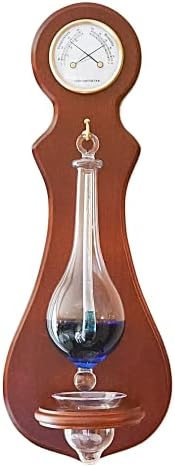
Best for: those who like a wall-mounted instrument display.
The Ambient Weather BA212 is sold as a wall-mounted weather station. Wall-mounted units suit a hallway or den, and they fit with the barometer tradition of a display on the wall.
Confirm on the listing which readings it shows, including pressure, and whether it needs batteries or a plug.
- Wall-mounted weather station
- Made by Ambient Weather
- Includes pressure display per the listing
- Check the listing for sensors and power
- Wall-mounted look
- Recognized weather brand
- Compact
- Limited details on the listing title
- Fewer features than larger stations
Skip it if you want smartphone connectivity.
AcuRite 00249 Sportsman’s weather station with hunting and fishing features

Best for: anglers and hunters who watch pressure for outdoor planning.
AcuRite’s Sportsman’s station is marketed with hunting and fishing features, according to the listing. Pressure trends are a favorite of anglers and hunters, who watch for changes before heading out.
It is a consumer weather station with a barometer. Treat the sport-specific indicators as rough guides, not promises.
- Weather station with outdoor activity features
- Barometric pressure display
- Made by AcuRite
- Check the listing for details on the forecast
- Pressure trends for outdoor planning
- Familiar brand
- Easy to read
- Sport indicators are rough
- Not a lab-grade instrument
Skip it if you want a plain pressure instrument.
Sainlogic 12-in-1 weather station with outdoor sensor and wireless display
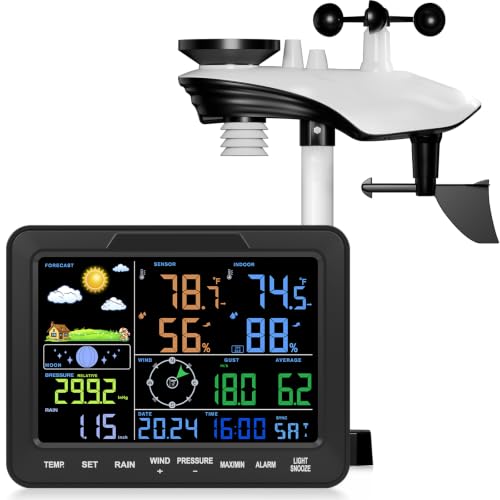
Best for: buyers who want many measurements from one outdoor sensor array.
Sainlogic’s 12-in-1 weather station pairs an outdoor sensor with a wireless indoor display and reports a wide set of readings. Stations like this include barometric pressure along with wind, rain and temperature.
It is the feature-rich option here, so budget time for placing the outdoor sensor properly. Check the listing for what the 12 readings are.
- 12-in-1 weather station
- Outdoor sensor and wireless display
- Includes barometric pressure on this class of device
- Check the listing for the full list of readings
- Many readings
- Wireless display
- Good value of features
- More to set up
- Less brand history
Skip it if you want a single instrument.
Barometer or weather station: what you actually need
A barometer measures air pressure only. A weather station is a package of instruments, with a barometer inside.
| Option | What you get | Good for | Limit |
|---|---|---|---|
| Dedicated digital barometer | Pressure only | Reference, labs, accuracy checks | No other readings |
| Home weather station | Pressure, temperature, humidity, sometimes wind and rain | Everyday home use | Setup and sensor placement |
| Classic aneroid wall barometer | Dial with a needle | Decor and a simple trend | Needs manual setting |
See our broader weather station roundup if you want to compare stations by sensors rather than pressure.
Pressure units explained
Pressure is reported in several units. US forecasts often use inches of mercury (inHg), while many other sources use hectopascals (hPa) or millibars, which are equal.
| Unit | Standard sea-level value |
|---|---|
| Inches of mercury (inHg) | 29.92 |
| Hectopascals or millibars | 1013.25 |
| Millimeters of mercury (mmHg) | 760 |
| Pounds per square inch (psi) | 14.696 |
The conversion factors are 1 inHg = 33.86389 hPa and 1 inHg = 25.4 mmHg. The calculator above does the rest.
How to set and read a barometer
A barometer reads station pressure, which falls as you gain elevation. Forecasters compare readings at sea level, so you need to adjust for your height.
- Place the device indoors away from vents, windows and direct sun.
- Look up the current sea-level pressure from a nearby official weather station or the National Weather Service.
- Set your elevation or enter a pressure offset so the display matches the official number.
- Note the reading and the trend arrow once or twice a day.
- Watch changes over three to six hours rather than a single number.
What pressure trends can tell you
NOAA explains that old rules of thumb linking a falling barometer to storms do not apply everywhere, and that day-to-day pressure changes in the tropics are very small. In many mid-latitude places, a steady fall often goes with clouds and wind, and a rise with clearing.
| Trend | Often means | Caveat |
|---|---|---|
| Falling steadily | Unsettled weather approaching | Not a guarantee |
| Rising steadily | Clearing, drier air | Local effects matter |
| Steady | Little change | Weather can still shift |
Use the trend alongside forecasts and radar. Our guide to weather forecast numbers shows how pressure fits with dew point and wind.
How to check your barometer
Compare your barometer with a nearby official reading, such as an airport report, on a calm day. If the numbers differ by a consistent amount, apply an offset if the device allows it.
- Compare with an official source
- Set your elevation
- Keep it indoors away from drafts
- Log readings for a week
- Hang it near a heater
- Trust one reading
- Ignore the offset setting
- Place it in a drafty window
Honest limits of home barometers
Consumer barometers are accurate enough for trends but may not match official numbers without calibration. Sensors drift slowly, and indoor drafts or air conditioning can add small errors.
Pressure alone cannot forecast weather. It needs context from temperature, humidity, wind and the regional pattern.
When to rely on official forecasts
For severe weather, boating, flying or anything safety-critical, use official National Weather Service forecasts and warnings, not a home barometer.
Frequently asked questions
What is the best barometer for home use?
For a dedicated pressure instrument, the Traceable calibrated digital barometer. For a full home setup, a weather station with a barometer such as the AcuRite Notos is more practical.
What is a normal barometric pressure?
Standard sea-level pressure is 29.92 inHg, or 1013.25 hPa. Real readings vary above and below this with weather.
Does falling pressure mean a storm is coming?
Often it points to unsettled weather, but not always. Watch the speed of the fall and check the forecast.
How do I set my barometer?
Compare it with a nearby official sea-level pressure reading and set your elevation or offset so the numbers match.
Why does pressure drop at higher elevation?
There is less air above you, so the weight of the air column is smaller. Near sea level it falls about 1 inHg per 1,000 ft.
How do I convert inHg to hPa?
Multiply inches of mercury by 33.86389. For example, 29.92 inHg is 1013.2 hPa. The calculator above does it.
Are digital barometers more accurate than analog?
Digital ones often read more precisely and can be calibrated, but analog ones are fine for trends. Accuracy depends on the individual device.
Can I use a weather station as a barometer?
Yes. Most home stations include one, and the pressure trend is useful. Check that it shows the pressure units you prefer.
Where should I put a barometer?
Indoors, away from vents, windows and direct sun, at a stable temperature.
How often should I check it?
Once or twice a day is plenty. The trend over several hours tells you more than a single reading.
The bottom line
If pressure is your only interest, the Traceable calibrated barometer is the direct, instrument-grade choice. If you want the bigger picture, a home weather station such as the AcuRite Notos, La Crosse 308-1414MB or Davis Vantage Pro2 puts pressure in context with temperature and humidity.
Whichever you choose, set it for your elevation and watch the trend. A barometer is most useful as a quiet clue that the weather is changing before the sky shows it.
Listen to a free audiobook while you cook, work or wait