

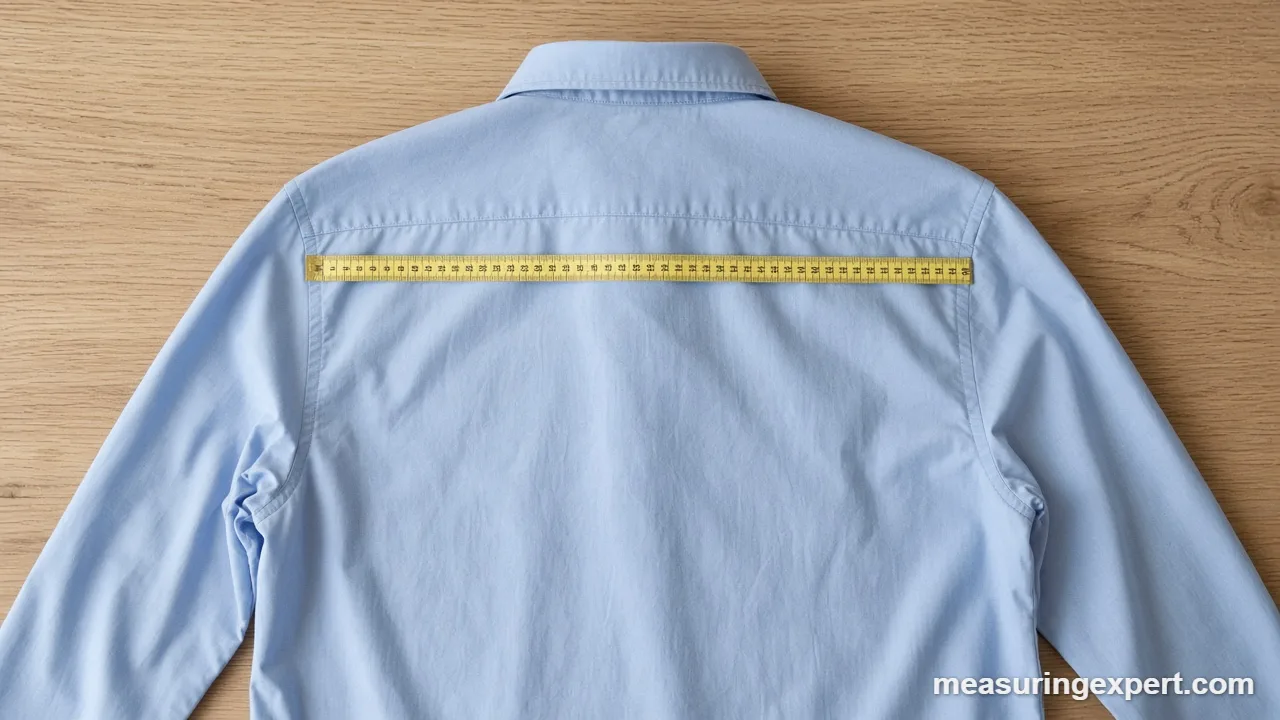
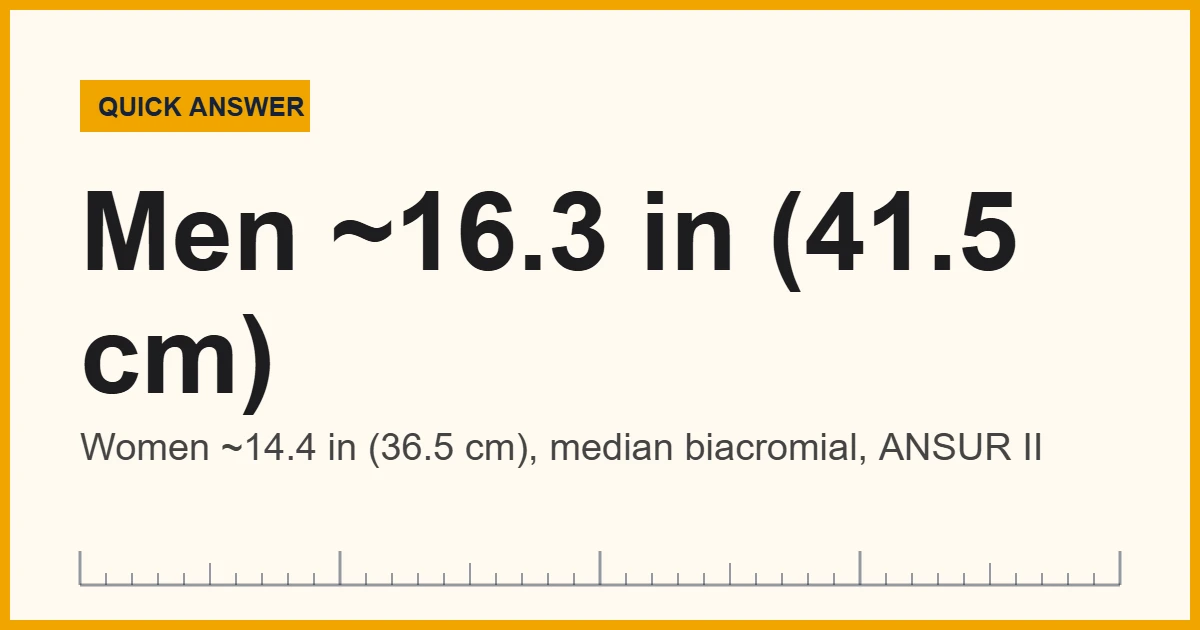
To measure shoulder width, run a soft tape across the back from the bony tip of one shoulder to the other. On a shirt, lay it flat and measure straight from one shoulder seam to the other. Men’s skeletal shoulder width averages about 16.3 inches (41.5 cm), and women’s about 14.4 inches (36.5 cm).



As an Amazon Associate, Measuring Expert earns from qualifying purchases.
Shoulder width decides how a shirt, jacket or coat hangs. If the seam sits too far in, the sleeve pulls across your upper arm. If it sits too far out, the fabric droops and the whole garment looks a size too big. So it pays to know your number before you order clothes online or visit a tailor.
However, “shoulder width” means three different things depending on who asks. A tailor wants the distance across your back between the shoulder points. A clothing seller lists the seam-to-seam width of a shirt laid flat. Meanwhile, a scientist measures biacromial breadth, a straight caliper reading between the two shoulder bones. The numbers differ, and mixing them up is the most common reason a “correct” size still fits badly.
In short: measure your body across the back for tailoring, measure a shirt that fits you well for online shopping, and use biacromial breadth only to compare yourself with research averages.
For averages, the best public data comes from body-size surveys. The US Army’s 2012 anthropometric survey (ANSUR II) measured thousands of soldiers, and North Carolina State University’s ergonomics center reproduces its summary in its anthropometric summary tables. The CDC’s National Health and Nutrition Examination Survey also trained its staff to take biacromial breadth, as its NHANES III anthropometry videos show.
Below, you will find a converter, a step-by-step method, the flat-shirt method, average ranges, and what each number means for fit.
Convert a Shoulder Width Measurement to Centimeters
Size charts from different countries mix inches and centimeters. Type your reading below and pick its unit. The converter uses the exact definition of 1 inch = 2.54 cm and also shows the nearest 1/16-inch mark.
Recommended Tools for Measuring Shoulders
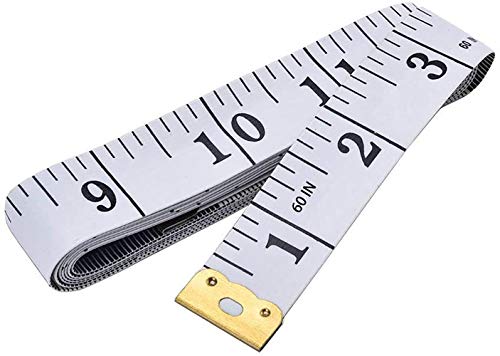
A flexible tape does almost all of this job. First, choose a fiberglass or vinyl sewing tape, because it bends over the back without stretching. Next, look for both inch and centimeter scales so you can match any size chart. Also, a retractable body tape with a lock helps if you measure alone. Finally, an anthropometry kit with a bone caliper suits students and trainers who want research-style breadth readings.
- Body shoulder width runs across the back between the two bony shoulder tips (acromions).
- A shirt is measured flat, straight across from one shoulder seam to the other.
- Biacromial breadth is a straight caliper reading, so it comes out shorter than a tape over the back.
- ANSUR II medians: about 16.3 in (41.5 cm) for men and 14.4 in (36.5 cm) for women.
- Bideltoid breadth, the widest point across the muscles, runs about 3 to 4 inches wider.
- Take three readings and average them, because posture shifts the number.
- Compare a well-fitting shirt with brand size charts rather than trusting body numbers alone.
Shoulder Width, Biacromial Breadth and Bideltoid Breadth
Before you grab a tape, decide which measurement you need. Each one starts and stops at different points, so each gives a different result for the same person.
| Measurement | Start and end points | Tool | Main use |
|---|---|---|---|
| Body shoulder width (tailor) | Tip of one shoulder to the other, over the curve of the upper back | Soft tape | Shirts, jackets, sewing patterns |
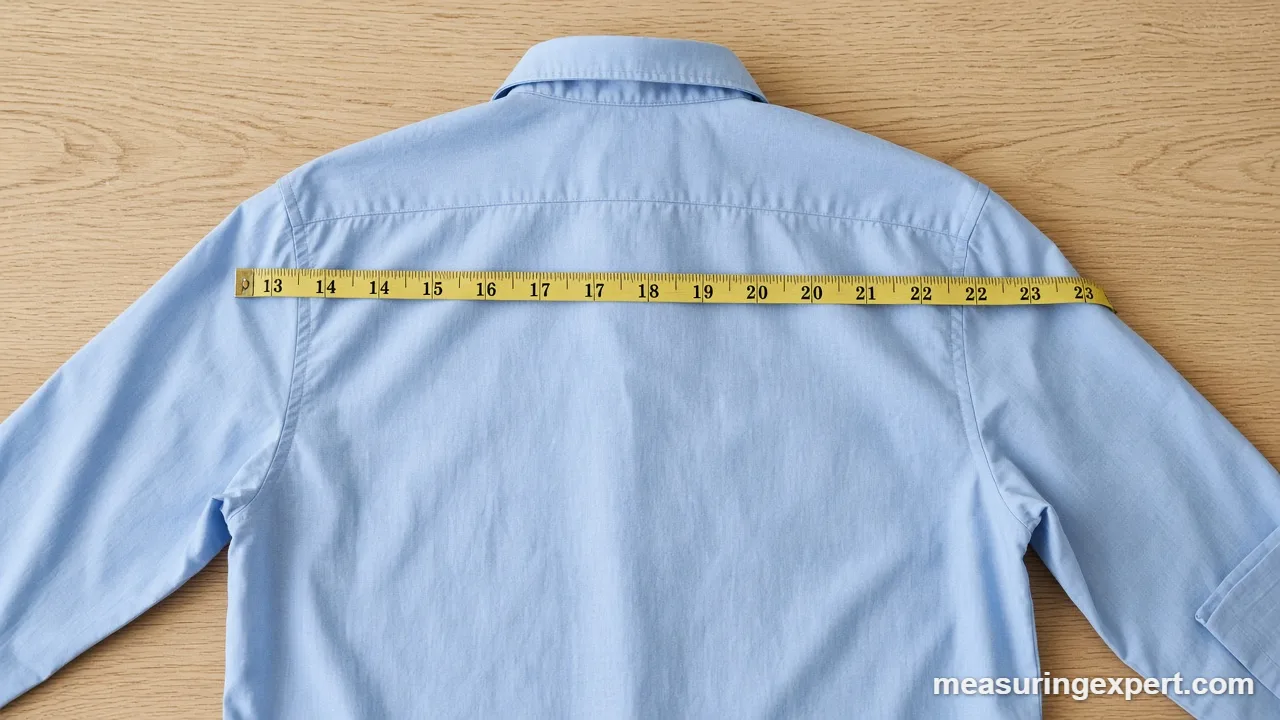
| Garment shoulder width | Shoulder seam to shoulder seam, garment laid flat | Soft or rigid tape | Online size charts |
| Biacromial breadth | Straight line between the two acromions, measured from behind | Anthropometer or large sliding caliper | Research, ergonomics, frame size |
| Bideltoid breadth | Widest point across the deltoid muscles of the upper arms | Anthropometer or caliper | Seat and doorway design, “broad shoulders” |
For example, a caliper cuts straight through the air between the bones, while a tape rides over the rounded upper back. As a result, the tailor’s figure is usually somewhat longer than biacromial breadth for the same person. Bideltoid breadth, on the other hand, includes the muscle that bulges past the bone, so it is the widest of all.
How to Measure Shoulder Width on Your Body
A helper makes this far easier, because you cannot see your own back. Still, the method below also works alone with a mirror and two stickers.
- Wear a thin, fitted top. Start in a T-shirt or a thin fitted shirt, because a thick sweater adds width and hides the shoulder bones.
- Stand relaxed. Next, stand tall with your arms hanging loosely at your sides and look straight ahead. Do not pull your shoulders back or shrug.
- Find both shoulder points. Then feel along the top of each shoulder toward the arm until you reach the bony tip, the acromion. Mark each point with a small sticker or washable pencil.
- Run the tape across the back. Have a helper hold the zero end on one shoulder point and lay the tape across your upper back, following its natural curve, to the other point.
- Read and write it down. After that, read the tape at the second point to the nearest 1/4 inch or 0.5 cm and note the unit next to the number.
- Repeat and average. Finally, take the reading two more times and use the average. If one reading is more than 1/2 inch off, measure again.
Then convert the result if a chart uses the other unit. For instance, a reading of 18 inches equals 45.72 cm.
Measuring Alone Against a Wall
No helper? Stand with your back flat against a wall and place a sticky note at the outer edge of each shoulder bone. Then step away and measure the straight gap between the notes. Keep in mind that this gives a straight-line figure, closer to biacromial breadth, so it will read a little shorter than a tape laid over your back.
How to Measure the Shoulder Width of a Shirt Laid Flat
This is the number most online stores list, and it is the easiest one to get right. So pick a shirt that already fits your shoulders well and use it as your reference.
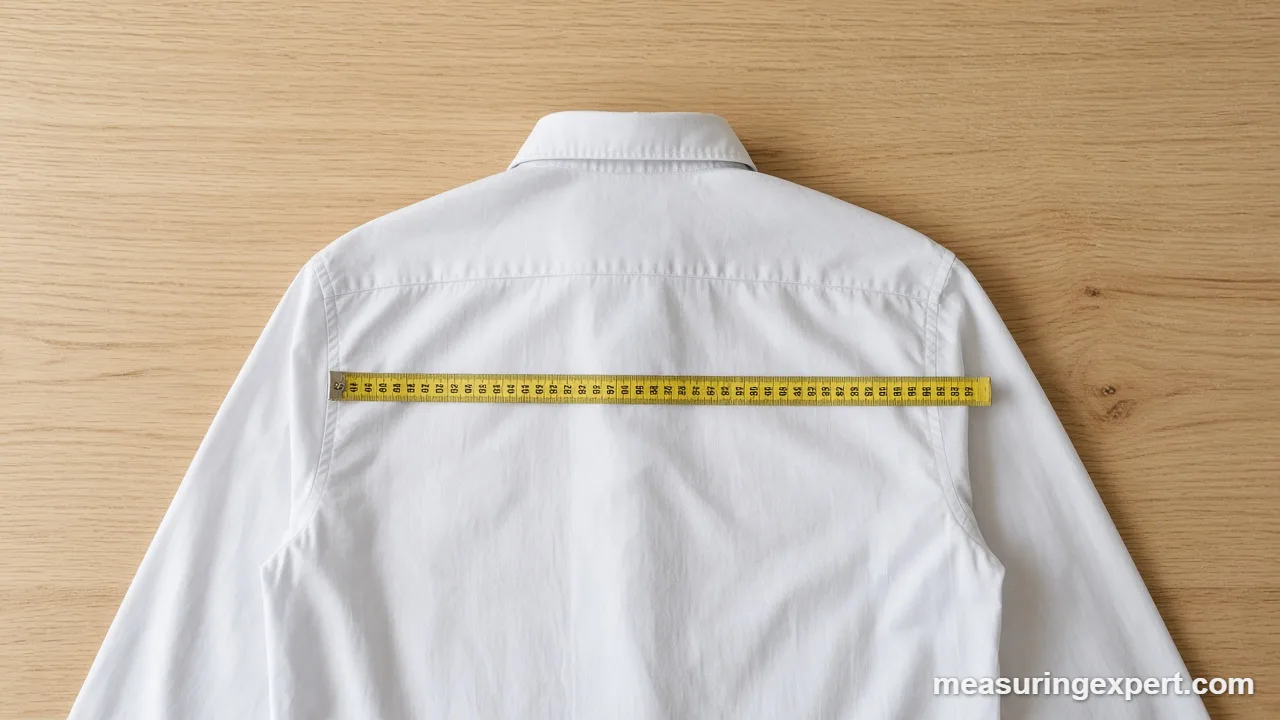
- Button the shirt and lay it face down on a table, back panel up.
- Smooth out wrinkles with your hands without stretching the fabric.
- Find the shoulder points, where each sleeve seam meets the shoulder seam.
- Lay the tape straight across the back yoke from one point to the other.
- Read the tape to the nearest 1/4 inch or 0.5 cm.
Now compare that figure with the shoulder value in a brand’s size chart. If your favorite shirt measures 18 inches and the chart lists 17.5 for a medium and 18.5 for a large, you know which way to lean. Similarly, our guide to pit to pit measurement covers the chest width, the other number that decides fit.
Average Shoulder Width for Men and Women
The most detailed public figures come from ANSUR II, the 2012 US Army survey. The table below shows the 5th, 50th (median) and 95th percentiles, so 90% of the people measured fall between the first and last columns.
| Measurement (ANSUR II) | 5th percentile | Median | 95th percentile |
|---|---|---|---|
| Biacromial breadth, men | 15.12 in (38.4 cm) | 16.34 in (41.5 cm) | 17.60 in (44.7 cm) |
| Biacromial breadth, women | 13.19 in (33.5 cm) | 14.37 in (36.5 cm) | 15.59 in (39.6 cm) |
| Bideltoid breadth, men | 18.07 in (45.9 cm) | 20.04 in (50.9 cm) | 22.32 in (56.7 cm) |
| Bideltoid breadth, women | 15.98 in (40.6 cm) | 17.72 in (45.0 cm) | 19.65 in (49.9 cm) |
Notice the gap between the two rows for each sex. The muscle measurement runs about 3.7 inches wider for men and 3.4 inches wider for women at the median. That gap explains why someone with average bones can still look broad-shouldered.
Are 18-Inch Shoulders Broad?
It depends on which measurement the 18 inches comes from. As a biacromial (bone to bone) figure, 18 inches would sit above the 95th percentile for men in ANSUR II, so it is genuinely broad. As a bideltoid figure across the muscles, however, 18 inches is close to the 5th percentile for men and near the median for women. Similarly, 21 inches across the deltoids is above the male median but still well inside the normal range.
You may also see a rule that shoulders are one eighth of your height. That rule does not hold up. For example, one eighth of 5 feet 9 inches is under 9 inches, about half of a typical adult reading.
Keep in mind, though, that soldiers are not the general public. They skew younger and fitter, so treat these figures as a reasonable guide rather than a national average.
Using Shoulder Width for a Better Fit
Shoulders are the one area a tailor struggles to change, so they matter most when you buy. In other words, buy for your shoulders first and let the tailor take in the waist.
| What you see | Likely cause | What to try |
|---|---|---|
| Seam sits on top of the shoulder, sleeve pulls | Garment shoulder too narrow | Next size up or a brand with a wider cut |
| Seam hangs off the shoulder bone | Garment shoulder too wide | Next size down or a slim fit |
| Fabric dimples just past the seam | Shoulder slightly narrow for your deltoids | Compare bideltoid width, try an athletic fit |
| Back feels tight when you reach forward | Back too narrow overall | Check back length and across-back width |
For jackets, also check length. Our guide on how to measure back length explains the nape-to-waist measurement that pairs with your shoulder figure.
Do and Don’t When Measuring Shoulders
Do
- Find the bony shoulder tip by touch before you measure.
- Stand relaxed with arms at your sides.
- Keep the tape snug against the body without pressing in.
- Average three readings.
- Write the unit next to every number.
Don’t
- Measure over a thick sweater or jacket.
- Pull your shoulders back or puff out your chest.
- Compare a body figure directly with a flat-shirt figure.
- Use a cloth tape that has stretched with age.
- Round to whole inches before converting.
Honest Limits of a Shoulder Width Reading
Even a careful reading carries some error. For one thing, the acromion is a small bony ridge, and two people may place the tape a few millimeters apart. Posture also matters: rounded shoulders shorten a straight reading and lengthen one taken over the back.
Brand charts add another layer. One company measures seam to seam at the top of the yoke, while another measures slightly lower. Therefore, a difference of 1/2 inch between two brands with the same size label is normal. A measurement from a shirt you already like remains the most reliable guide.
When to See a Tailor or Clinician
A tailor is worth the visit for a suit, a wedding outfit or anything made to measure. Tailors know where the shoulder seam should sit for your posture, and they take several back measurements that a single tape reading misses.
Meanwhile, see a doctor or physical therapist if one shoulder sits clearly higher than the other, or if pain limits how you stand. Uneven shoulders can have many causes, and a tape measure cannot tell them apart.
Shoulder Width FAQs
How do you measure shoulder width by yourself?
Stand with your back to a wall, mark the outer tip of each shoulder on a sticky note, step away and measure between the marks. It gives a straight-line reading, so for a tailor-style measurement across the back a helper works better.
Where are the shoulder points?
They are the acromions, the bony tips at the outer end of each shoulder blade. You can feel each one at the top of the shoulder just before it curves down into the arm.
What is the average shoulder width for a man?
In the 2012 US Army anthropometric survey (ANSUR II), the median biacromial breadth for men was 16.34 inches (41.5 cm), and most men fell between about 15.1 and 17.6 inches (38.4 to 44.7 cm).
What is the average shoulder width for a woman?
In the same ANSUR II data, the median biacromial breadth for women was 14.37 inches (36.5 cm), with most women between about 13.2 and 15.6 inches (33.5 to 39.6 cm).
Is shoulder width the same as biacromial breadth?
Not quite. Biacromial breadth is a straight caliper reading between the two shoulder bones, while a tailor’s shoulder measurement follows the curve of the back, so it usually comes out somewhat longer.
How do you measure the shoulders of a shirt?
Button the shirt, lay it flat on a table and smooth it out. Then measure straight across from the point where one sleeve seam meets the shoulder seam to the same point on the other side.
Should a shirt shoulder seam sit on the shoulder bone?
For a classic fitted shirt, yes. The seam should land at or just past the bony tip of the shoulder. Drop-shoulder and oversized styles place it lower on the arm on purpose.
Is shoulder width the same as chest width?
No. Shoulder width runs between the shoulder points across the upper back, while pit to pit runs straight across the chest just below the armholes. A good fit needs both.
How accurate does a shoulder measurement need to be?
For buying clothes, the nearest 1/4 inch (about 0.5 cm) is plenty. For tailoring, take three readings and use the average, because posture alone can shift the number.
How do I convert shoulder width from inches to cm?
Multiply inches by 2.54, because one inch is exactly 2.54 cm. For example, 18 inches is 45.72 cm. The converter on this page does the math for any value.
The Bottom Line
Shoulder width is simple once you know which version you need. For clothes, measure a shirt that fits well, flat and seam to seam. For tailoring, measure your body across the back between the bony shoulder tips.
Then compare like with like. Research averages use straight caliper readings, so they run shorter than a tape over the back. In short, use the converter above for unit changes, average three readings, and trust your best-fitting shirt over any chart.
Black Friday is coming: shop the deals with Prime