

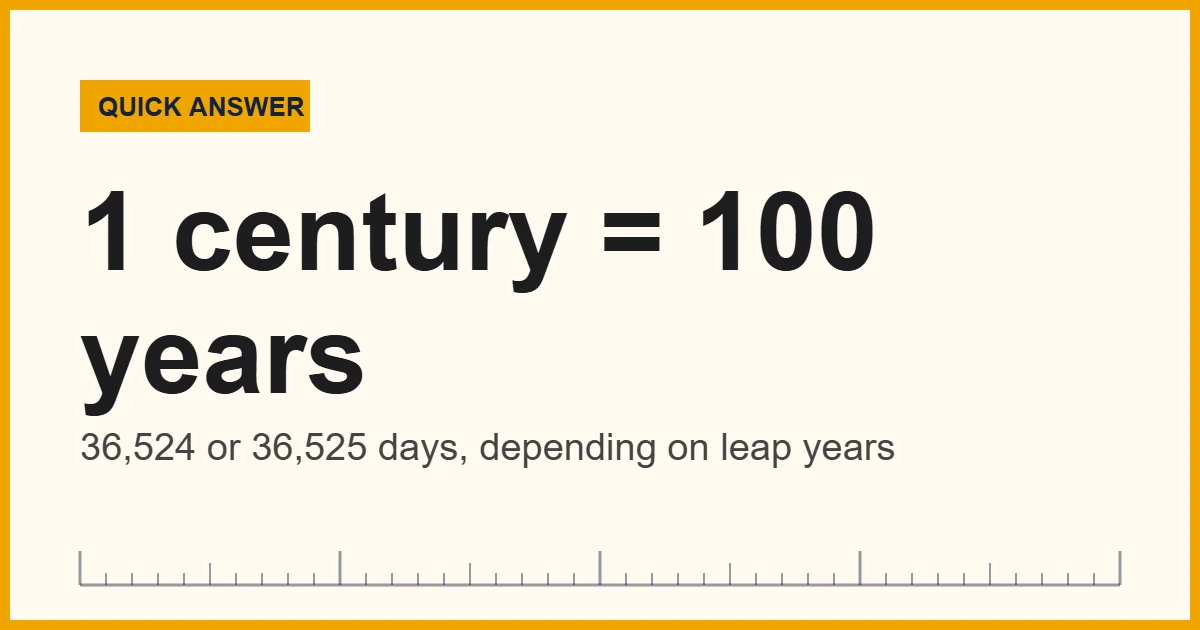
A century is exactly 100 years, or 10 decades and 1,200 months. In days, it is 36,524 or 36,525, depending on how many leap years fall inside it. For example, the years 1901 to 2000 had 25 leap years (36,525 days), while 2001 to 2100 will have only 24 (36,524 days).
Convert a Century to Years, Days and Hours
Enter any number of centuries below. The tool then shows the same span in years, decades, months, weeks, days and hours. It uses the average Gregorian year of 365.2425 days, so one unit comes out as 36,524.25 days. Real calendar spans, however, always contain a whole number of days, as the next sections explain.
| Centuries | Years | Months | Days (average) |
|---|---|---|---|
| 1 | 100 | 1,200 | 36,524.25 |
| 2 | 200 | 2,400 | 73,048.5 |
| 5 | 500 | 6,000 | 182,621.25 |
| 10 | 1,000 | 12,000 | 365,242.5 |
The word comes from the Latin “centum”, meaning one hundred. So the unit is simply a group of 100 years, the same way a cent is one hundredth of a dollar. Today, you meet the unit in history books (“the 19th century”), in birthdays (a person who turns 100 is a centenarian), and in astronomy, where scientists use a fixed span of 36,525 days for calculations.
The number of years never changes. However, the number of days depends on the calendar. Because most of the world uses the Gregorian calendar, the leap year rule decides whether a given 100-year span has 36,524 or 36,525 days. In addition, the counting has a quirk: there was no year zero, so the new period began on January 1, 2001, not in 2000. The US Naval Observatory explains this in its guide to when the 21st century began.
Century Conversion Chart
Here are 100 years in the units people search for most. The first column uses whole calendar centuries, while the second uses the Gregorian average that the converter above relies on.
| Unit | Calendar span (36,524 days) | Average (365.2425-day years) |
|---|---|---|
| Years | 100 | 100 |
| Decades | 10 | 10 |
| Months | 1,200 | 1,200 |
| Weeks | about 5,217.71 | 5,217.75 |
| Days | 36,524 (or 36,525) | 36,524.25 |
| Hours | 876,576 (or 876,600) | 876,582 |
| Minutes | 52,594,560 (or 52,596,000) | 52,594,920 |
| Seconds | 3,155,673,600 (or 3,155,760,000) | 3,155,695,200 |
Note that the second figures assume 86,400 seconds per day and ignore leap seconds. To check the daily figure itself, see how many seconds are in a day. In addition, this chart prints well on one page if you need it for class.
Why a Century Has 36,524 or 36,525 Days
To begin with, a normal year has 365 days, and a leap year has 366. Under the old Julian calendar, every fourth year was a leap year, so every 100-year block held 25 leap years and 36,525 days. That, however, made the average year slightly too long, and the calendar drifted against the seasons.

Later, the Gregorian reform of 1582 fixed this with one extra rule. According to the US Naval Observatory’s calendar FAQ, a year divisible by 4 is a leap year, except for years divisible by 100; those are leap years only if they also divide by 400. As a result, 1900 was not a leap year, but 2000 was.
| Years | Century year inside it | Leap years | Total days |
|---|---|---|---|
| 1701-1800 | 1800 (not leap) | 24 | 36,524 |
| 1801-1900 | 1900 (not leap) | 24 | 36,524 |
| 1901-2000 | 2000 (leap) | 25 | 36,525 |
| 2001-2100 | 2100 (not leap) | 24 | 36,524 |
In short, three out of every four Gregorian 100-year blocks have 36,524 days, and one in four has 36,525. Over 400 years, that averages out to 36,524.25 days per block, which matches the 365.2425-day average year.
When Does a Century Start? The Missing Year Zero
The calendar jumps straight from 1 BC to AD 1. In other words, there is no year 0. Therefore, the first one ran from AD 1 through AD 100, and the second began in AD 101. Following that pattern, each one starts in a year ending in 01 and ends in a year ending in 00.

| Century | First year | Last year |
|---|---|---|
| 1st century | AD 1 | AD 100 |
| 18th century | 1701 | 1800 |
| 19th century | 1801 | 1900 |
| 20th century | 1901 | 2000 |
| 21st century | 2001 | 2100 |
So the current hundred-year period, and the third millennium, officially began on January 1, 2001. Nevertheless, most people celebrated on January 1, 2000, because the “1900s” turning into the “2000s” felt like the change. Both views make sense, because they count different things. Even so, the 1900s (1900-1999) and the 20th century (1901-2000) are slightly different spans.
Century vs Decade, Millennium and Other Spans
Several words for long time spans sound alike, so they are easy to mix up. For that reason, this table separates them.
| Term | Length | What people confuse it with |
|---|---|---|
| Decade | 10 years | Often counted from years ending in 0 (the 1990s) |
| Century | 100 years | The “1900s” (1900-1999) vs the 20th century (1901-2000) |
| Millennium | 1,000 years (10 centuries) | The third millennium began in 2001, not 2000 |
| Centennial / centenary | A 100th anniversary | An event, not a span of time |
| Julian century | Exactly 36,525 days | Used in astronomy; not tied to calendar dates |
| Century in cricket | 100 runs by one batter | A score, not time |
For the shorter end of the scale, our guides to how long a decade is and how long a moment is use the same converter.
How to Work Out Which Century a Year Belongs To
- Take the year number. Use the AD (CE) year, for example 1969.
- Subtract 1. In this case, 1969 minus 1 gives 1968.
- Divide by 100 and drop the remainder. 1968 divided by 100 is 19 with a remainder, so keep 19.
- Add 1. Then 19 plus 1 gives 20, so 1969 falls in the 20th century.
- Check a boundary year. For 2000, the steps give (1999 / 100 = 19) + 1 = 20, which confirms 2000 is the last year of the 20th.
- Convert the span if needed. Finally, enter the number of centuries in the converter above to see years, days or hours.
Do and Don’t When Counting Centuries
Do
- Say “100 years” when only the length matters.
- Count leap years when you need exact days.
- Remember that 2000 was a leap year but 1900 was not.
- Start formal centuries in a year ending in 01.
- Name the calendar when dates are historical.
Don’t
- Assume every 100-year span has 36,525 days.
- Treat the “1900s” and the 20th century as identical.
- Forget there is no year zero between BC and AD.
- Mix the Julian century from astronomy with calendar dates.
- Expect 52 weeks to fill each year exactly.
Honest Limits of These Figures
The year count is fixed by definition, but the smaller units are not. First, the day total depends on the calendar and on the years you pick. Second, months vary from 28 to 31 days, so “1,200 months” is exact while any conversion of months to days is an average. Next, the seconds figures ignore leap seconds, which timekeepers added to clocks on 27 occasions between 1972 and 2016. Finally, dates before 1582 (and before later dates in some countries) used the Julian calendar, so very old spans can contain different leap years. For everyday answers, though, 100 years and about 36,524 days is all you need.
Similarly, weekday counts shift from year to year. For example, a year can have 52 or 53 Sundays, as our guide to how many Sundays are in a year shows.
When the Exact Count Really Matters
For school questions and general reading, “100 years” is the whole answer. Still, a few jobs need the exact number:
- Astronomy. Astronomers use a Julian span of exactly 36,525 days so that formulas stay simple, regardless of the calendar.
- Software and date math. For example, programs that treat 1900 or 2100 as leap years will be off by one day. Therefore, use a tested date library instead of hand-written rules.
- History and genealogy. First, check whether a record used the Julian or Gregorian calendar before you count days between old dates.
- Long-term contracts and finance. Day-count rules for interest differ, so rely on the contract’s own definition.
Frequently Asked Questions
How long is a century in years?
A century is exactly 100 years. That equals 10 decades or one tenth of a millennium.
How many days are in a century?
A Gregorian century has 36,524 or 36,525 days. Three out of four have 36,524; the one that includes a year divisible by 400, such as 2000, has 36,525.
How many months are in a century?
There are 1,200 months in a century, because each of the 100 years has 12 months.
How many weeks are in a century?
A century has about 5,217.7 weeks. With 36,524 days it is 5,217 weeks and 5 days.
How many hours are in a century?
A 36,524-day span has 876,576 hours. A 36,525-day span has 876,600 hours.
When did the 21st century begin?
The 21st century began on January 1, 2001, and it ends on December 31, 2100. This is because there was no year zero.
Was the year 2000 in the 20th or 21st century?
The year 2000 was the last year of the 20th century. It was also a leap year under the Gregorian rule.
How many leap years are in a century?
Usually 24. A span that includes a year divisible by 400, such as 2000, has 25 leap years.
What is the difference between a century and a millennium?
A century is 100 years and a millennium is 1,000 years. So one millennium contains 10 centuries.
Which century are we in now?
We are in the 21st century, which covers the years 2001 through 2100.
A Century in Short: The Bottom Line
To sum up, the unit is always 100 years, 10 decades and 1,200 months. Its day count is 36,524 in most cases and 36,525 when the span includes a year divisible by 400, such as 2000.
Also remember the counting quirk: with no year zero, centuries run from a year ending in 01 to a year ending in 00, so the current one began on January 1, 2001. For any other span, use the converter at the top of this page.
2 thoughts on “How Long Is a Century? 100 Years, 36,524 or 36,525 Days and Why 2001 Started the 21st”