

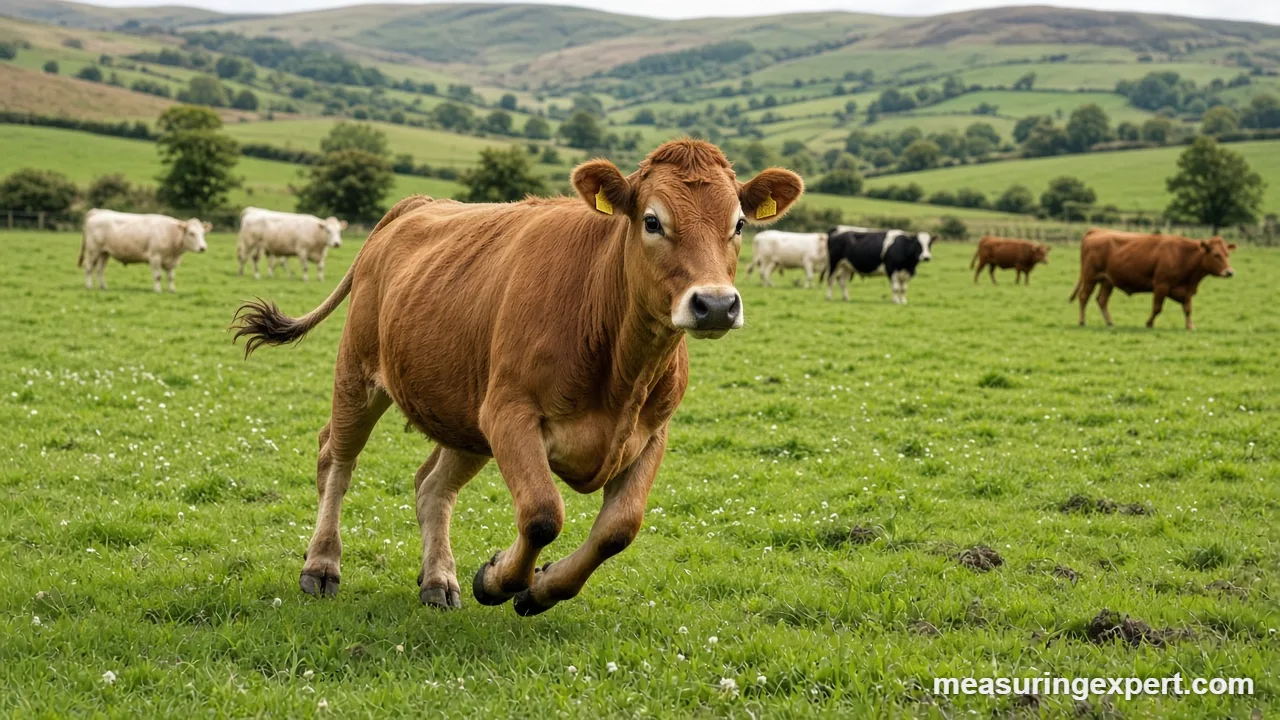
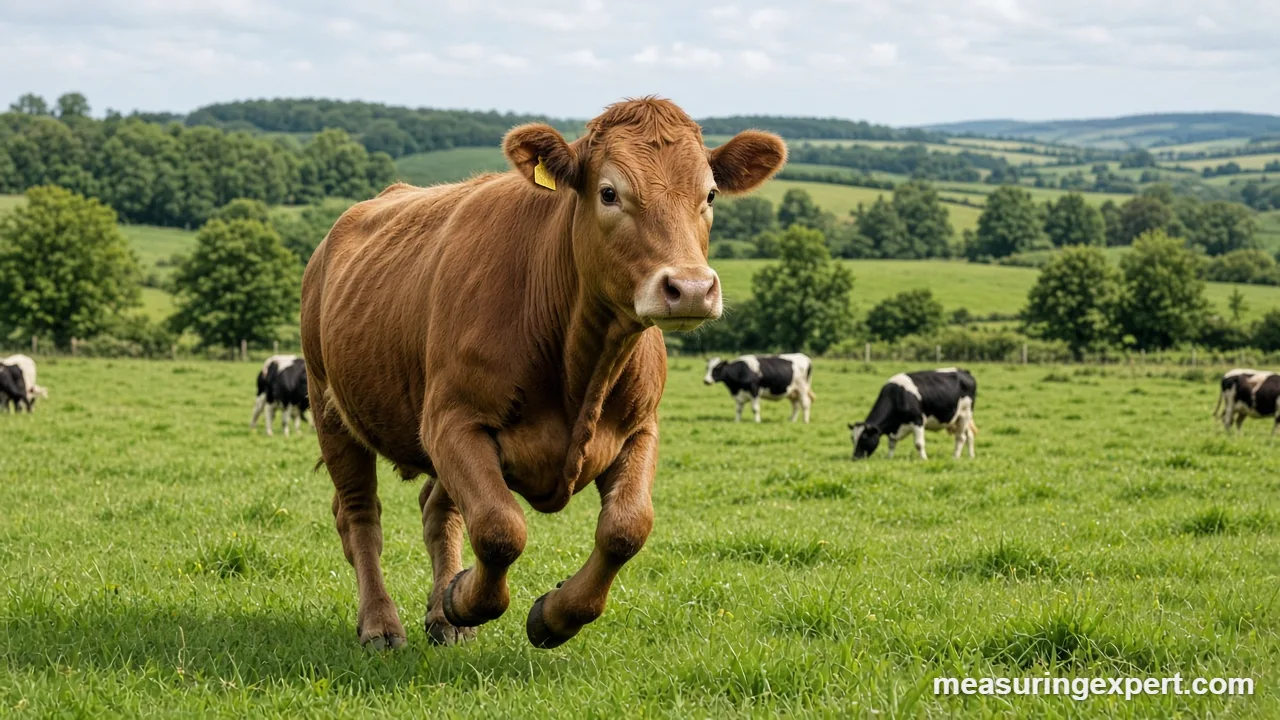
How fast can a cow run? A cow run usually settles at about 17 mph (27 km/h), and a frightened or excited cow can reach a top speed of about 25 mph (40 km/h) over a short distance. That is roughly 37 feet per second, so even a fit person cannot outrun cattle on open ground.
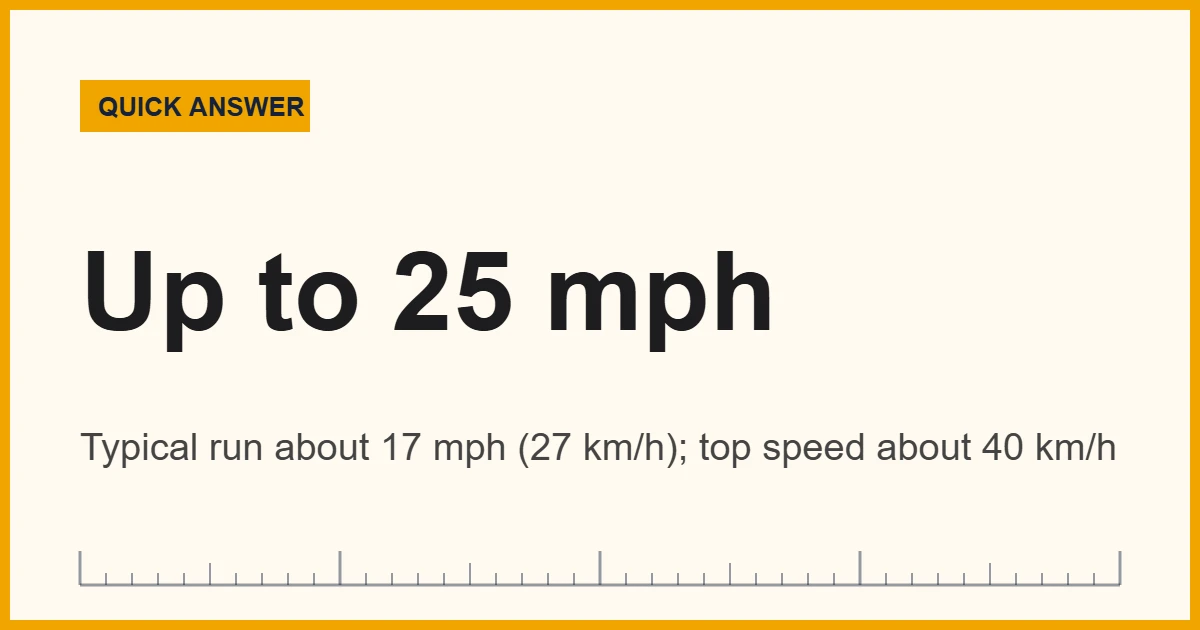
Convert a Cow Run Speed to km/h, m/s and Knots
First, the converter starts at 25 mph, the usual top-speed figure. Then change the number or the unit to see the same speed in kilometers per hour, meters per second, feet per second and knots. For example, type 17 to check the typical running pace instead.
At first glance, cows look calm and heavy, and most of the time they move at a slow walk while they graze. Even so, cattle can break into a gallop surprisingly quickly when something startles them, when they are let into fresh pasture, or when a cow thinks her calf is in danger.
BBC Countryfile’s explainer on how fast a cow runs gives the two figures most people need: cows usually run at about 17 mph, with a top speed of about 25 mph. It also explains why they are slower than deer or horses: breeding for milk or beef has made most cattle bulky.
So this page turns those numbers into units you can picture. First, you get a speed chart. Next, you will see how far a running cow travels in a few seconds, how cattle compare with people, bison and horses, and how to time an animal yourself. Finally, there is practical safety advice for walking through fields of cattle.
Cow Run Speed Chart in mph, km/h and m/s
To start, the first two rows are the speeds reported for cattle. After that, the chart is a plain unit conversion, so you can also use it for any speed between a jog and a gallop. Also, every value uses the exact definition 1 mile = 1.609344 km, and 1 knot = 1.852 km/h.
| Speed | mph | km/h | m/s | ft/s | Knots |
|---|---|---|---|---|---|
| Cow top speed | 25 | 40.23 | 11.18 | 36.7 | 21.72 |
| Cow typical run | 17 | 27.36 | 7.60 | 24.9 | 14.77 |
| – | 5 | 8.05 | 2.24 | 7.3 | 4.34 |
| – | 10 | 16.09 | 4.47 | 14.7 | 8.69 |
| – | 15 | 24.14 | 6.71 | 22.0 | 13.03 |
| – | 20 | 32.19 | 8.94 | 29.3 | 17.38 |
| – | 30 | 48.28 | 13.41 | 44.0 | 26.07 |
| – | 35 | 56.33 | 15.65 | 51.3 | 30.41 |
Printable tip: because this chart fits on one page, you can print it from your browser for a classroom worksheet or a farm notebook.
How Far a Cow Run Covers in a Few Seconds
Of course, miles per hour is hard to feel. It helps, then, to break the number down. At 25 mph, a cow covers about 37 feet (11.2 m) every second. In other words, it would cross a 100-yard football field in roughly 8.2 seconds.
Even at the more typical 17 mph, a cow still covers about 25 feet (7.6 m) per second. As a result, a herd 50 yards away can reach you in well under 10 seconds if it decides to come over.
| Time | Distance at 25 mph (top speed) | Distance at 17 mph (typical) |
|---|---|---|
| 1 second | 37 ft (11.2 m) | 25 ft (7.6 m) |
| 3 seconds | 110 ft (33.5 m) | 75 ft (22.8 m) |
| 5 seconds | 183 ft (55.9 m) | 125 ft (38.0 m) |
| 10 seconds | 367 ft (111.8 m) | 249 ft (76.0 m) |
However, these are straight-line figures on good footing. In addition, cattle hold a full gallop only briefly, so the 10-second row is a ceiling rather than a typical run.
Cow Run Speed Compared With People and Other Animals
To be clear, cattle are not the fastest animals on a farm, but they easily beat people. For instance, Usain Bolt averaged about 23.4 mph (10.4 m/s) over his 9.58-second 100-meter world record and peaked at about 27.8 mph. Most adults, by contrast, sprint far slower. Also, you can read more in our guide to how fast a human can run.
| Runner | Speed (mph) | Speed (km/h) | Source or note |
|---|---|---|---|
| Racehorse | about 40-44 | about 64-71 | Countryfile |
| American bison | up to 35 | up to 56 | National Park Service |
| Deer or riding horse | about 30 | about 48 | Countryfile |
| Usain Bolt (peak) | about 27.8 | about 44.7 | World-class sprinter |
| Cow (top speed) | about 25 | about 40 | Short bursts only |
| Cow (typical run) | about 17 | about 27 | Countryfile |
Their wild relatives, however, are faster. The National Park Service’s Yellowstone bison page says bison can run 35 mph, even though bulls weigh up to 2,000 pounds. Similarly, horses were bred for speed, which is why our page on how fast a horse can run shows numbers well above any cow.
Cow Run Claims to Treat With Care
For example, many pages online repeat neat-looking tables that rank cattle breeds by speed, such as one breed at 25 mph and another at 15 mph. In reality, we could not find measured data behind those breed rankings, so this page does not repeat them. Instead, the table below separates what is reasonably well supported from what is guesswork.
| Claim | What we can say |
|---|---|
| Cows run at about 17 mph and top out near 25 mph | Widely reported, including by Countryfile; a fair working range |
| Bison run up to 35 mph | Stated by the National Park Service |
| Beef breeds are always faster than dairy breeds | No measured comparison found, so treat it as unproven |
| A cow can outrun a horse | Not as a rule, because horses are much faster |
| Cows cannot run at all | False; cattle trot and gallop when startled or excited |
What Sets a Cow’s Running Speed?
First, body weight matters most. For one thing, modern dairy and beef cattle often weigh well over 1,000 pounds, and much of that mass is in a deep, heavy body rather than in long legs. Because of that, they accelerate quickly over a few strides but cannot hold a gallop for long.
Next, age and condition play a part. For instance, young, healthy animals move more freely, while lame, heavily pregnant or older cows run less and tire sooner. Likewise, ground conditions change everything: mud, slopes and slippery concrete slow cattle down and raise the risk of falls.
Finally, motivation sets the pace. For example, a cow that is merely curious walks or trots toward you. On the other hand, a cow protecting a calf, or a herd spooked by a dog, can reach a full gallop within seconds.
How to Time a Running Animal Yourself
Luckily, you do not need a radar gun to estimate speed. Instead, you need a known distance and a timer. Then watch from outside the field, or use a video clip, and then follow these steps.
- Pick two fixed markers. Choose two objects the animal passes, such as two fence posts.
- Measure the distance between them. Use a laser rangefinder, a tape measure after the animals have moved on, or a map tool.
- Time the run. Start a stopwatch as the animal passes the first marker and stop it at the second, or count video frames.
- Divide distance by time. For example, 100 feet in 4 seconds is 25 feet per second.
- Convert the result. Enter the speed in the converter above; 25 ft/s is about 17 mph.
- Repeat and average. Several timed runs give a fairer estimate than a single one.
Tools for Measuring a Cow Run From a Distance
So if you want real numbers for a school project or a farm video, three simple tools help. First, a pocket radar reads speed directly, although it is designed for balls and works best on a target moving toward or away from you. Meanwhile, a laser rangefinder measures the distance between markers without walking into the field. In addition, a large-display stopwatch makes timing runs easy.


As an Amazon Associate, Measuring Expert earns from qualifying purchases.
Cow Run Safety: Walking Through Fields of Cattle
Because cattle are faster than people, the safest plan is not to need to run. The UK government’s Countryside Code advises giving livestock plenty of space, since their behavior can be unpredictable, especially with young. It also says to keep a dog on a lead around livestock.
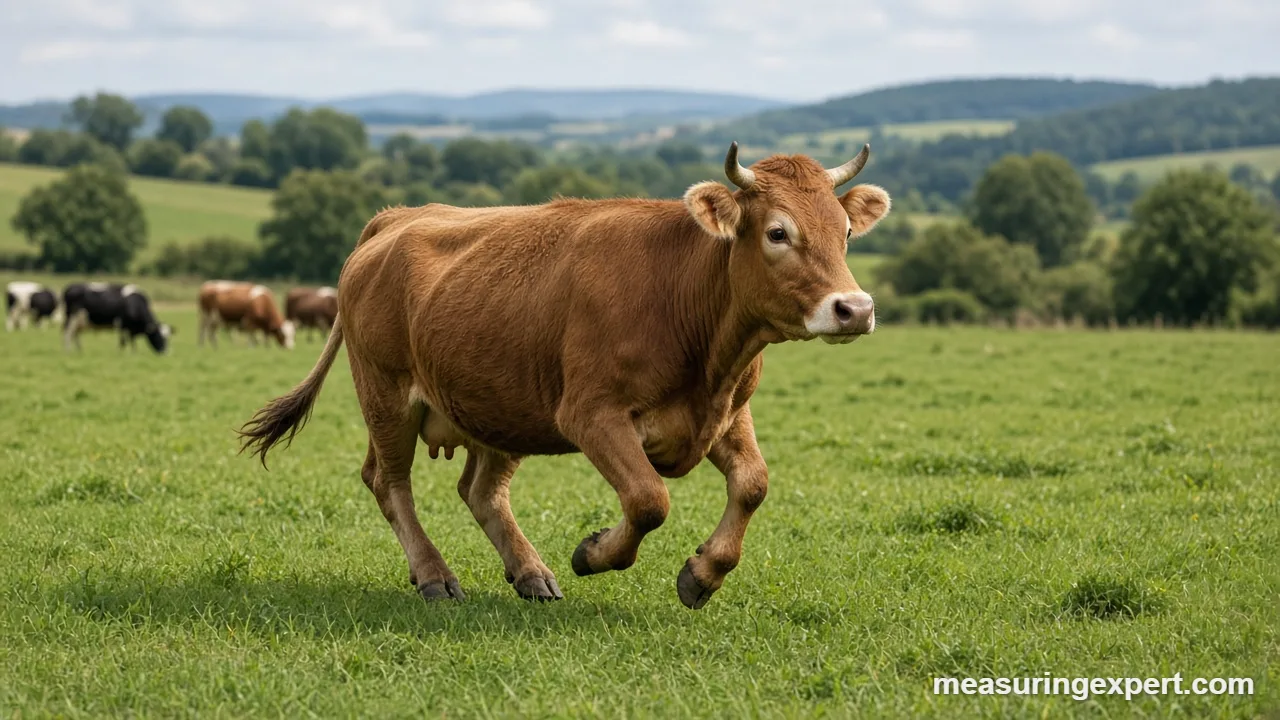
Most importantly, the same code says to let your dog off the lead if you feel threatened by livestock. That is because cattle often focus on the dog, and the dog can usually outrun them, whereas you cannot.
Do
- Walk calmly around the edge of the herd.
- Keep dogs on a short lead near livestock.
- Release the dog if cattle start to chase you.
- Look for another route when calves are present.
- Also, close gates behind you.
Don’t
- Walk between a cow and her calf.
- Shout, wave or run unless you must.
- Assume you can outrun cattle in the open.
- Approach cattle just for a closer photo; instead, use a zoom lens.
- Let a dog chase or bark at the herd.
Honest Limits of These Numbers
To begin with, cattle speeds are estimates, not lab measurements. After all, nobody puts a cow on a treadmill at full gallop. Therefore, treat 25 mph as a reasonable maximum for a healthy animal on good ground, not a fixed figure. Similarly, individual animals vary with weight, age, health and footing, too. Of course, the unit conversions on this page are exact. The input speeds, however, carry that natural uncertainty. In short, use the numbers to understand scale, and never to judge whether you can get away from a herd.
When Accuracy Really Matters
For trivia or a school report, “about 17 to 25 mph” is plenty. Still, two situations call for more care. First, farm workers moving cattle should plan escape routes and gates based on how quickly cattle close a gap, not on how calm they look. Second, walkers should treat a herd that is moving toward them as fast-moving, even if it starts at a walk.
Cow Run FAQs
How fast can a cow run?
A cow usually runs at about 17 mph (27 km/h) and can reach about 25 mph (40 km/h) over a short distance.
Can a cow outrun a human?
Yes, in most cases. A cow can reach about 25 mph, while most people sprint far slower. Even Usain Bolt averaged about 23.4 mph over 100 meters.
How long can a cow run at top speed?
Only briefly. Cattle are heavy, so they gallop in short bursts and then slow to a trot or walk.
What is 25 mph in km/h?
25 mph is about 40.23 km/h, or about 11.18 meters per second and 36.7 feet per second.
Is a bull faster than a cow?
There is no reliable measured comparison. Both are fast over short distances, and bulls deserve extra caution because of their size and temperament.
Are bison faster than cows?
Yes. The National Park Service says bison can run 35 mph, about 10 mph faster than the usual top-speed figure for cattle.
Can a cow outrun a horse?
No, not as a rule. Riding horses run about 30 mph and racehorses about 40 to 44 mph, well above a cow.
Why do cows suddenly run?
Cows run when they are startled, when a dog worries them, when they protect a calf, or when they are excited about fresh grass or feed.
What should I do if cows chase me and my dog?
Let the dog off the lead, as the Countryside Code advises, and keep moving calmly toward the nearest exit. The dog can usually get away on its own.
How far does a cow travel in one second at full speed?
At 25 mph, a cow covers about 37 feet (11.2 m) every second.
Bottom Line on Cow Speed
To sum up, a cow usually runs at about 17 mph (27 km/h) and can hit about 25 mph (40 km/h) in a short burst. In other words, that is slower than a horse or a bison, yet still faster than almost any person.
So give cattle room, especially cows with calves, and let a dog go if a herd starts to chase. For other speeds, the converter at the top of this page turns any mph figure into km/h, meters per second, feet per second or knots.