

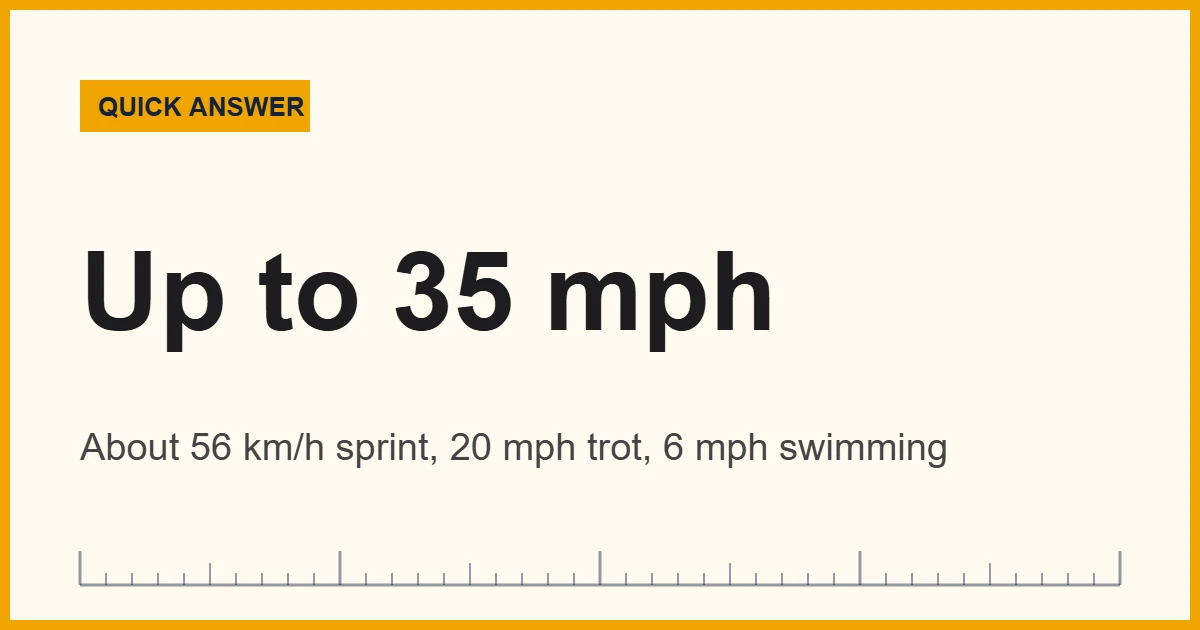
How fast can a moose run? A moose can run up to 35 mph (about 56 km/h) over short distances, and it can trot steadily at about 20 mph (32 km/h). In water, a moose swims at up to about 6 mph (9.7 km/h). So, even on open ground, no person can outrun a charging moose.
Convert a Moose Run Speed to km/h, m/s and Knots
The converter starts at 35 mph, the top sprint speed. Change the number or the unit to see the same speed in kilometers per hour, meters per second, feet per second and knots. For example, type 20 to check the steady trot, or 6 to see the swimming speed.
At first glance, a moose looks slow. After all, it is the largest member of the deer family, and the Alaska Department of Fish and Game puts adults at roughly 800 pounds for a small cow up to 1,600 pounds for a large bull, standing up to almost 6 feet tall at the shoulder. Even so, that bulk hides a lot of speed.
National Geographic’s moose fact sheet gives the two numbers most people need: a sprint of up to 35 miles per hour over short distances, and a steady trot of about 20 miles per hour. In addition, moose are strong swimmers. As a result, they can cross lakes and rivers that would stop many other large animals.
Therefore, this page turns those figures into units you can picture. First, you get a speed chart in mph, km/h, meters per second and feet per second. Next, you will see how a moose run compares with people and other animals, how to estimate an animal’s speed yourself, and finally what wildlife agencies say to do if a moose comes your way.
Moose Run Speed Chart in mph and km/h
First, the top three rows are the speeds reported by wildlife sources. Then the rest of the chart is a plain unit conversion, so you can also use it for any speed between a slow jog and a full moose sprint. Also, every value uses the exact definition 1 mile = 1.609344 km.
| Speed | mph | km/h | m/s | ft/s | Knots |
|---|---|---|---|---|---|
| Moose top sprint | 35 | 56.33 | 15.65 | 51.3 | 30.41 |
| Moose steady trot | 20 | 32.19 | 8.94 | 29.3 | 17.38 |
| Moose swimming (up to) | 6 | 9.66 | 2.68 | 8.8 | 5.21 |
| – | 5 | 8.05 | 2.24 | 7.3 | 4.34 |
| – | 10 | 16.09 | 4.47 | 14.7 | 8.69 |
| – | 15 | 24.14 | 6.71 | 22.0 | 13.03 |
| – | 25 | 40.23 | 11.18 | 36.7 | 21.72 |
| – | 30 | 48.28 | 13.41 | 44.0 | 26.07 |
Printable tip: because this chart prints cleanly from your browser on one page, you can easily keep it with a field notebook or a classroom worksheet.
How Far a Moose Run Covers in a Few Seconds
Miles per hour is hard to feel. So it helps to break the number down. At 35 mph, a moose covers about 51 feet (15.6 m) every second. In other words, it would cross a 100-yard football field in roughly 5.8 seconds.
That matters for safety, too. For example, if a moose starts a charge 50 feet away, it can close the gap in about one second at full speed. By contrast, at its steady 20 mph trot it covers about 29 feet (8.9 m) per second, which is still faster than most people can sprint.
| Time | Distance at 35 mph sprint | Distance at 20 mph trot |
|---|---|---|
| 1 second | 51 ft (15.6 m) | 29 ft (8.9 m) |
| 3 seconds | 154 ft (46.9 m) | 88 ft (26.8 m) |
| 5 seconds | 257 ft (78.2 m) | 147 ft (44.7 m) |
| 10 seconds | 513 ft (156.5 m) | 293 ft (89.4 m) |
However, these are straight-line figures on good footing. A moose holds its top speed only briefly, so the 10-second row is a ceiling, not a typical chase.
How Fast Can a Moose Run Compared With People?
In fact, moose are faster than any human runner. For instance, Usain Bolt’s peak speed in his 9.58-second 100-meter world record was about 27.8 mph, and his average over the whole race was about 23.4 mph (10.4 m/s). Similarly, you can read more in our guide to how fast a human can run.
| Runner | Speed (mph) | Speed (km/h) | Notes |
|---|---|---|---|
| Jaguar (top speed) | about 50 | about 80 | Very short ambush charge |
| Moose (top sprint) | 35 | 56.33 | Short distances |
| Usain Bolt (peak, 2009) | about 27.8 | about 44.7 | World-class sprinter |
| Usain Bolt (100 m average) | about 23.4 | about 37.6 | 9.58 s over 100 m |
| Moose (steady trot) | 20 | 32.19 | Can hold it much longer |
Big cats, however, are another story. Our page on how fast a jaguar is explains why a jaguar’s 50 mph or more lasts only a few dozen feet. Meanwhile, wolves, a major predator of moose, rely on stamina and teamwork more than raw speed; see how fast a wolf is for their numbers.
Sprint, Trot or Swim: Which Moose Speed Is Which?
Most “how fast” figures online, though, mix three different things. As a result, one page says 35 mph while another says 20 mph, and both can be right. So this table separates them.
| Figure | What it really means | Typical value |
|---|---|---|
| Top speed (sprint) | The fastest a moose runs, held only over a short distance | Up to 35 mph (56 km/h) |
| Steady trot | A pace a moose can keep up for longer stretches | About 20 mph (32 km/h) |
| Swimming speed | Speed through water, which is much slower than on land | Up to about 6 mph (9.7 km/h) |
| mph vs km/h vs knots | The same speed in different units; 35 mph = 56.33 km/h = 30.41 knots | Use the converter above |
How Fast Can a Moose Run Through Water and Swim?
Moose also spend a lot of time in ponds and marshes, feeding on water plants. According to the Wyoming Game and Fish Department’s moose profile, they are excellent swimmers that can reach about 6 mph. In addition, the same profile notes they can dive about 20 feet deep.
National Geographic adds that moose have been seen paddling several miles at a time, and that they can stay fully underwater for 30 seconds or more. Therefore, a moose in a lake is not stuck there. In fact, it can easily outswim a person and keep pace with a slow canoe.
Why a Moose Run Is So Fast for Its Size
First of all, long legs are the main reason. National Geographic lists a shoulder height of about 5 to 6.5 feet, and much of that is leg. Because each stride is long, a moose covers ground quickly even at a trot.
Those legs also help in the places moose live. For example, they let a moose step over fallen logs and wade through deep snow or soft bog where shorter animals flounder. Similarly, the trot is an efficient gait, which is why a moose can keep it going much longer than a full sprint.
Speed still has limits, though, because terrain matters. Dense forest, deep snow and steep slopes all slow a moose down. Meanwhile, young calves cannot keep up with an adult at full speed, which is one reason cows defend them so fiercely instead of fleeing.
How to Measure an Animal’s Speed Yourself
Fortunately, you do not need a radar gun to estimate speed. Instead, you need a known distance and a timer. Watch from a safe distance or use a video clip, then follow these steps.
- Pick two fixed markers. Choose two objects the animal passes, such as a tree and a fence post.
- Measure the distance between them. Use a rangefinder, a tape measure after the animal has gone, or a map tool.
- Time the run. Start a stopwatch when the animal passes the first marker and stop it at the second, or count video frames.
- Divide distance by time. For example, 100 feet in 2 seconds is 50 feet per second.
- Convert the result. Enter the speed in the converter above; 50 ft/s is about 34 mph.
- Repeat and average. Several timed runs give a fairer estimate than a single one.
Moose Run Safety: What to Do If One Charges
Surprisingly, moose injure more people in Alaska each year than bears do, according to the Alaska Department of Fish and Game. Its guide to aggressive moose lists clear warning signs: the long hairs on the hump stand up, the ears lie back, and the moose may lick its lips or walk slowly toward you.
Unlike the advice for some animals, running is the right move if a moose charges. ADF&G says to run and get behind something solid, such as a tree, or into a building or car. In most cases, charges are bluffs, and a moose usually will not chase you far. Finally, if it does knock you down, curl into a ball, protect your head with your hands, and hold still until it moves away.
Do
- Watch moose from well away, ideally with binoculars.
- Look for raised hump hair and laid-back ears.
- Run behind a tree, car or building if a moose charges.
- Keep dogs leashed and close.
- Back off when you see a calf nearby.
Don’t
- Feed a moose; in Alaska it is illegal.
- Walk between a cow and her calf.
- Assume you can outrun one in the open.
- Approach for a closer photo.
- Let a dog chase or bark at a moose.
Binoculars for Watching a Moose From a Safe Distance
In general, the best way to enjoy a moose is from far away. For this reason, a good pair of binoculars lets you see the animal clearly without crowding it. For wildlife, an 8×42 or 10×42 model is a common choice, because it balances magnification with a bright image at dawn and dusk, when moose are often active. Also, look for waterproof, fog-proof housings if you watch near lakes and marshes.


As an Amazon Associate, Measuring Expert earns from qualifying purchases.
Honest Limits of Moose Run Numbers
To begin with, wild animal speeds are estimates, not lab measurements. After all, nobody puts a moose on a treadmill. Instead, figures like 35 mph come from field observations, so treat them as a reasonable maximum for a healthy adult on good ground. In addition, individual moose vary with age, health, snow depth and terrain. Likewise, the 20 mph trot is a typical pace, not a fixed rule. Of course, the unit conversions on this page are exact, but the input speeds carry that natural uncertainty. In short, use the numbers to understand scale, and never to judge whether you can get away from a moose.
When Accuracy Really Matters
For trivia or a school project, for example, “about 35 mph” is plenty. However, two situations call for more care. First, drivers in moose country should slow down at dawn, dusk and night, because a moose can step onto the road quickly and is tall enough to be hard to see in headlights. Second, hikers and photographers should judge distance by how fast a moose closes it, not by how calm it looks.
Moose Run FAQs
How fast can a moose run?
A moose can run up to 35 mph (about 56 km/h) over short distances. It can trot steadily at about 20 mph (32 km/h).
Can a moose run faster than a human?
Yes. Even Usain Bolt peaked at about 27.8 mph, while a moose can sprint at up to 35 mph. Most people run far slower than either.
How long can a moose run at top speed?
Only for a short distance. After that, for longer stretches, a moose drops to a steady trot of about 20 mph.
How fast can a moose swim?
A moose can swim at up to about 6 mph (9.7 km/h), and it has been seen paddling several miles at a time.
What is 35 mph in km/h?
35 mph is about 56.33 km/h, or about 15.65 meters per second and 51.3 feet per second.
Should you run from a moose?
Yes, if it charges. The Alaska Department of Fish and Game says to run and get behind something solid, like a tree or a car. Most charges are bluffs.
Can a moose run in deep snow?
Yes. Because of their long legs, moose can wade through deep snow better than many animals, although snow and rough terrain still slow them down.
Can a moose run as fast as a bear?
Not by much either way. In short, moose and bears are both fast over short distances, so neither animal is one a person can outrun.
How far does a moose travel in one second at full speed?
At 35 mph, a moose covers about 51 feet (15.6 m) every second.
Can a moose dive underwater?
Yes. In fact, moose can submerge completely for 30 seconds or more, and wildlife officials report dives of about 20 feet.
Bottom Line on Moose Speed
To sum up, a moose can sprint at up to 35 mph (56 km/h) over short distances, trot at about 20 mph for longer, and swim at up to about 6 mph. As a result, it is far faster than any person, despite weighing up to about 1,600 pounds.
So enjoy moose from a distance, watch for the warning signs, and if one charges, get behind something solid. For other speeds, the converter at the top of this page turns any mph figure into km/h, meters per second, feet per second or knots.
1 thought on “How Fast Can a Moose Run? Sprint, Trot and Swimming Speeds”