

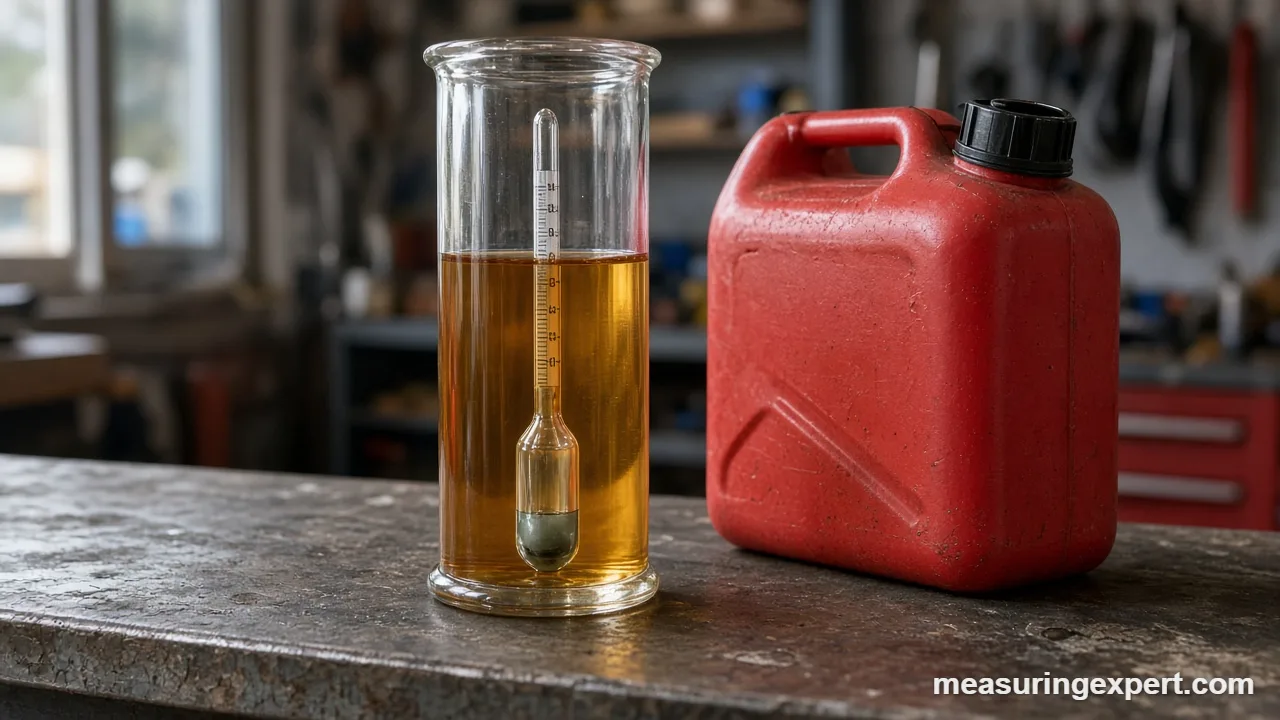
How dense is gasoline? Typical US gasoline has a density of about 0.74 g/mL (740 kg/m3) at 60 degrees F (15.6 degrees C), which works out to roughly 6.2 pounds per US gallon. Real fuel ranges from about 0.72 to 0.77 g/mL, depending on the blend and temperature, so it is about 26 percent lighter than water.
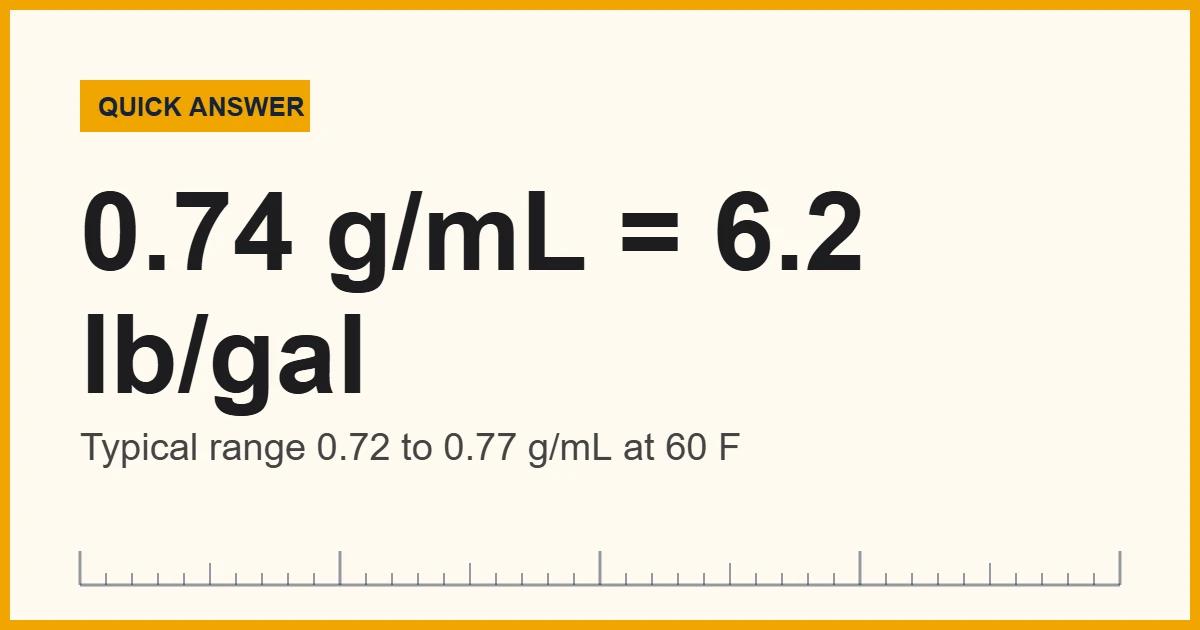
Convert Gasoline Density to lb/gal, kg/m3 and More
Fuel data sheets list density in many different units. So type any value below, for example 0.74 g/mL, and the converter shows the same density in kg/m3, kg/L, pounds per gallon and pounds per cubic foot. It also shows the formula it used.
Density is simply mass divided by volume. In other words, it tells you how much a given amount of fuel weighs. For gasoline, that number matters more than most drivers realize. For example, pipelines, tank trucks and refineries buy and sell fuel by volume, but they correct every reading to a standard temperature because the mass inside a gallon changes as the fuel warms or cools.
Gasoline is not one chemical, however. Instead, it is a blend of hundreds of hydrocarbons, plus ethanol in most US pump fuel. As a result, there is no single exact density, only a typical value and a range. The CDC’s NIOSH Pocket Guide entry for gasoline gives a specific gravity of 0.72 to 0.76 at 60 degrees F. Similarly, the European fuel standard EN 228 allows 720 to 775 kg/m3 at 15 degrees C.
So when someone asks how dense is gasoline, 0.74 g/mL is a fair, middle-of-the-range answer. Below, you will find a quick chart, a comparison with other liquids, the effect of heat and ethanol, and a simple way to measure a sample yourself.
How Dense Is Gasoline in lb/gal, kg/m3 and g/mL?
First, the chart below uses the typical value and both ends of the normal range. Next, find the density you need in the left column. Then read across for the other units. Also, you can print it and keep it with your fuel cans or shop notes.
| Grade or case | g/mL (g/cm3) | kg/m3 | lb per US gallon | lb/ft3 |
|---|---|---|---|---|
| Light summer blend | 0.72 | 720 | 6.01 | 44.95 |
| Typical pump gasoline | 0.74 | 740 | 6.18 | 46.20 |
| Heavier blend | 0.76 | 760 | 6.34 | 47.45 |
| EN 228 upper limit | 0.775 | 775 | 6.47 | 48.38 |
In addition, the pound figures use exact definitions: 1 US gallon is 3.785411784 liters and 1 pound is 0.45359237 kilograms. For instance, 0.74 kg/L times 3.7854 L, divided by 0.45359, gives 6.18 pounds per gallon.
| Amount of gasoline | Weight at 0.74 g/mL |
|---|---|
| 1 US gallon | 6.2 lb (2.8 kg) |
| 5 gallons (one jerry can) | 30.9 lb (14.0 kg) |
| 12 gallons (small car tank) | 74.1 lb (33.6 kg) |
| 15 gallons | 92.6 lb (42.0 kg) |
| 20 gallons (truck or SUV tank) | 123.5 lb (56.0 kg) |
Recommended Tools for Measuring Fuel Density
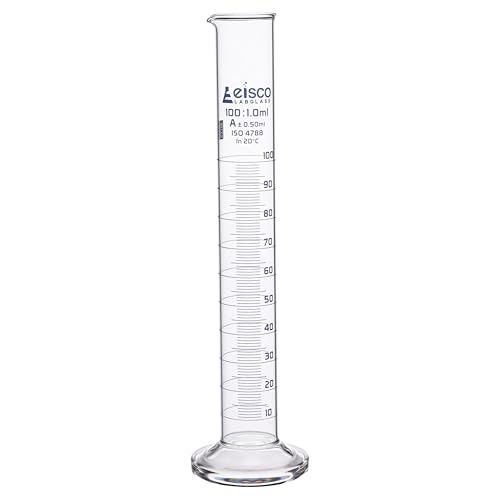
You only need a few simple tools to check a fuel sample. First, a petroleum hydrometer reads density or specific gravity directly. Next, a clear graduated cylinder holds the sample. Finally, a digital scale lets you weigh a known volume as a cross-check.



As an Amazon Associate, Measuring Expert earns from qualifying purchases.
How Dense Is Gasoline Next to Water, Diesel and Oil?
In general, gasoline sits near the light end of common liquids. That is why spilled gas floats on a puddle and spreads into a rainbow film. Also, it explains why a gallon of diesel feels heavier when you lift the can.
| Liquid | Typical density | lb per US gallon | Floats on water? |
|---|---|---|---|
| Gasoline | 0.72 to 0.77 g/mL | 6.0 to 6.5 | Yes |
| Ethanol (pure) | 0.789 g/mL at 20 °C | 6.6 | No, it mixes |
| Kerosene and jet fuel | 0.775 to 0.84 g/mL | 6.5 to 7.0 | Yes |
| Diesel | 0.82 to 0.845 g/mL | 6.9 to 7.1 | Yes |
| Motor oil | about 0.85 to 0.89 g/mL | 7.1 to 7.4 | Yes |
| Water | 0.999 g/mL at 15 °C | 8.34 | – |
For more detail on the other liquids, see our guides to the density of water, how heavy different oils are, and the density of alcohol, which covers ethanol in depth.
How Dense Is Gasoline at Different Temperatures?
Like most liquids, gasoline expands when it warms up. Specifically, its volume grows by roughly 0.1 percent for every degree Celsius, or about 0.05 percent per degree Fahrenheit. Because the mass stays the same, the density drops as the temperature rises.
| Fuel temperature | Approximate density | lb per US gallon |
|---|---|---|
| 14 °F (-10 °C) | 0.758 g/mL | 6.33 |
| 32 °F (0 °C) | 0.751 g/mL | 6.27 |
| 59 °F (15 °C) | 0.740 g/mL | 6.18 |
| 86 °F (30 °C) | 0.730 g/mL | 6.09 |
| 104 °F (40 °C) | 0.723 g/mL | 6.03 |
These values assume a fuel that is 0.740 g/mL at 15 degrees C. In practice, the change is small for a single fill-up. Even so, it adds up for a fuel terminal moving millions of gallons. For that reason, wholesale sales are usually corrected to 60 degrees F, while retail pumps in most US states measure plain volume.
Ethanol Blends and What Gasoline Contains
Most US gasoline is E10, which means it contains up to 10 percent ethanol. However, the earlier version of this page said ethanol blends are lighter than straight gasoline. In fact, the opposite is true. Ethanol is about 0.789 g/mL, so adding 10 percent nudges a 0.740 base fuel up to roughly 0.745 g/mL. Likewise, E85 flex fuel is denser still, at around 0.78 g/mL.
The hydrocarbon mix also matters. Gasoline is mostly alkanes, branched alkanes (isoparaffins), cycloalkanes and aromatics. Aromatics such as toluene and xylene are the heaviest of these, so fuels rich in them sit near the top of the range. On the other hand, winter blends contain more light butane, which pulls the density down a little.
The old page also claimed that gasoline is about 25 percent benzene. That figure was wrong. Instead, federal rules limit benzene in US gasoline to an annual average of 0.62 percent by volume, because benzene is a known carcinogen.
How to Measure Gasoline Density With a Hydrometer
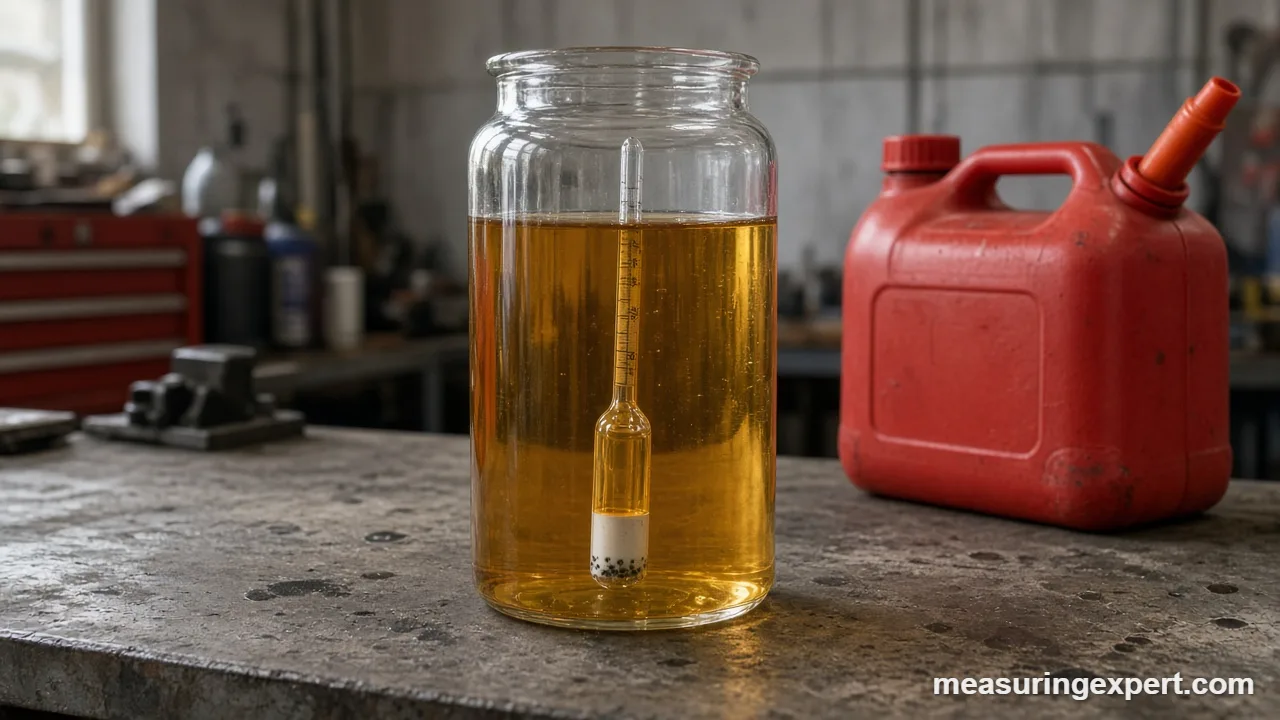
A hydrometer is a weighted glass float with a scale in the stem. It sinks deeper in lighter liquids, so the reading at the surface gives the density or specific gravity directly.
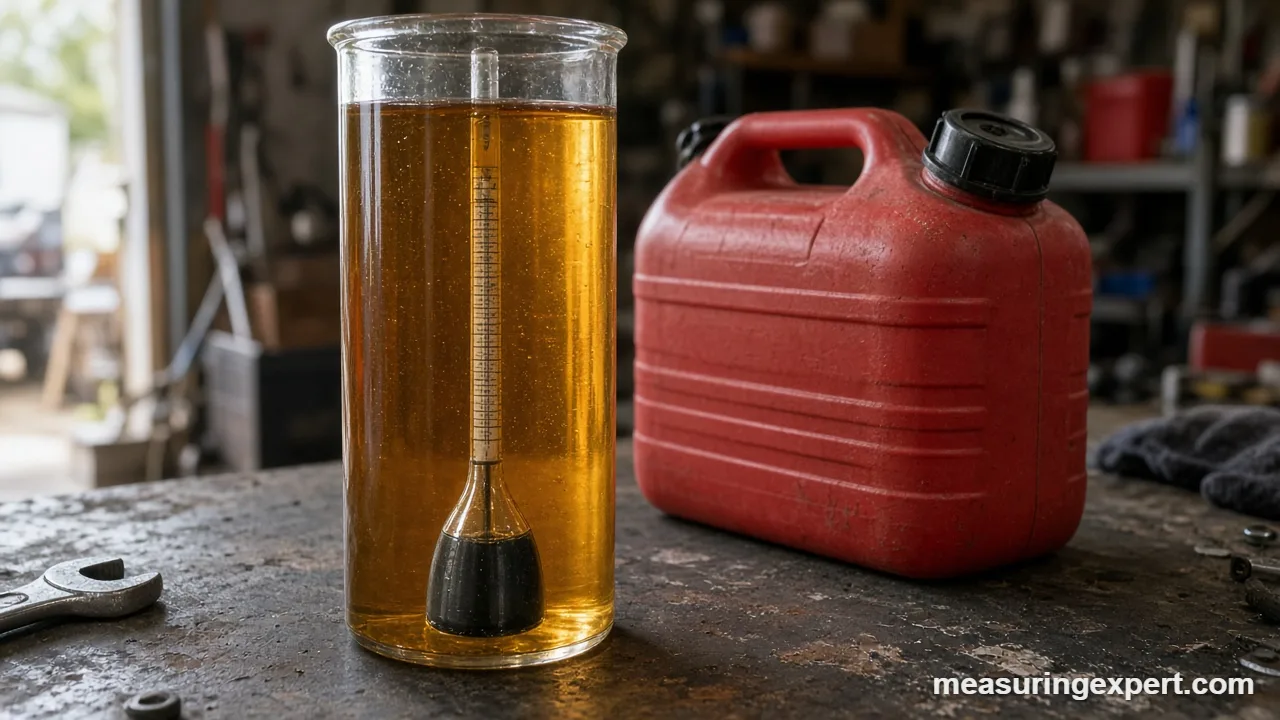
- Work outdoors and cool the sample. Choose a ventilated spot away from sparks and flames, and let the gasoline sit until it reaches a known temperature.
- Pour into a clear cylinder. Fill a glass hydrometer jar or graduated cylinder deep enough that the hydrometer can float freely.
- Lower the hydrometer gently. Release it near the expected reading so it does not bob deeply and wet the stem above the surface.
- Read at eye level. Read the scale where the flat liquid surface crosses the stem, and also note the temperature.
- Correct to 60 degrees F. Use the hydrometer’s correction table or the expansion rule in the temperature section, and then enter the result in the converter above.
As a cross-check, you can also weigh a sample. For example, tare a graduated cylinder on a scale, add exactly 100 mL of fuel, and read the mass. If it shows 74.0 g, the density is 0.740 g/mL.
Do and Don’t When Checking Fuel Density
Do
- Record the sample temperature every time.
- Use a hydrometer made for petroleum products.
- Clean and dry the cylinder before each test.
- Wear nitrile gloves and safety glasses.
Don’t
- Compare a hot reading with a cold data sheet value.
- Read the hydrometer from above or below eye level.
- Pour fuel back into the tank after testing.
- Store samples in food or drink containers.
Honest Limits of These Numbers
Overall, every figure on this page is typical, not exact. First, refiners change blends by season and region, so two fill-ups can differ by a few percent. Second, the expansion rate itself varies slightly with composition. Third, specific gravity and density are not quite the same number: specific gravity compares fuel with water at 60 degrees F, which is 0.999 g/mL rather than exactly 1. Finally, rounding to 6.2 pounds per gallon hides a spread of about 6.0 to 6.5. In short, use 0.74 g/mL for estimates and a measured value for anything that matters.
When Accuracy Really Matters
For a weight estimate before a road trip or a boat launch, the typical value is fine. However, aviation weight and balance, fuel tax audits, and lab work all need measured density at a stated temperature. In those cases, use calibrated equipment and the method your industry standard requires, such as ASTM D1298 for hydrometers or ASTM D4052 for digital density meters.
Frequently Asked Questions
How dense is gasoline in pounds per gallon?
At a typical 0.74 g/mL, one US gallon of gasoline weighs about 6.2 pounds. The usual range is roughly 6.0 to 6.5 pounds per gallon.
How dense is gasoline in g/mL?
Most pump gasoline falls between about 0.72 and 0.77 g/mL. A good everyday figure is 0.74 g/mL at 60 degrees F (15.6 degrees C).
How dense is gasoline compared with water?
In short, gasoline is about 26 percent lighter than water. Water is close to 1.00 g/mL, so gasoline floats on top and the two do not mix.
How dense is gasoline with 10 percent ethanol (E10)?
E10 comes out slightly heavier than ethanol-free gasoline, at about 0.745 g/mL for a 0.74 base fuel, because ethanol itself is about 0.789 g/mL.
Is diesel heavier than gasoline?
Yes. In fact, diesel is about 0.82 to 0.845 g/mL, so a gallon weighs roughly 6.9 to 7.1 pounds, compared with about 6.2 pounds for gasoline.
Does hot weather change how much gas I get?
A little. Warm fuel expands, so a gallon pumped at 90 degrees F holds slightly less mass than a gallon at 60 degrees F, roughly 1 to 2 percent less.
What is the specific gravity of gasoline?
The CDC’s NIOSH Pocket Guide lists a specific gravity of 0.72 to 0.76 at 60 degrees F. In other words, specific gravity is density divided by the density of water.
How much does a full tank of gas weigh?
For example, a 15-gallon tank holds about 93 pounds (42 kg) of gasoline at 0.74 g/mL. A 20-gallon tank holds about 124 pounds (56 kg).
What is the API gravity of gasoline?
API gravity equals 141.5 divided by specific gravity, minus 131.5. So for a specific gravity of 0.74, that gives about 59.7 degrees API.
Why is premium gasoline sometimes heavier?
Premium often contains more aromatic and branched hydrocarbons, which can be slightly denser. Even so, the difference between grades is usually small.
How Dense Is Gasoline: The Bottom Line
To sum up, gasoline weighs about 0.74 g/mL, or 6.2 pounds per US gallon, with a normal range of roughly 0.72 to 0.77 g/mL. That makes it lighter than water, ethanol and diesel. Moreover, its density falls as it warms, and ethanol blends come out slightly heavier, not lighter.
Finally, use the converter at the top of this page whenever a data sheet gives density in units you do not use. Also, if you measure a sample yourself, note the temperature and work outdoors.
1 thought on “How Dense Is Gasoline? Density in g/mL, kg/m3 and lb/gal”