

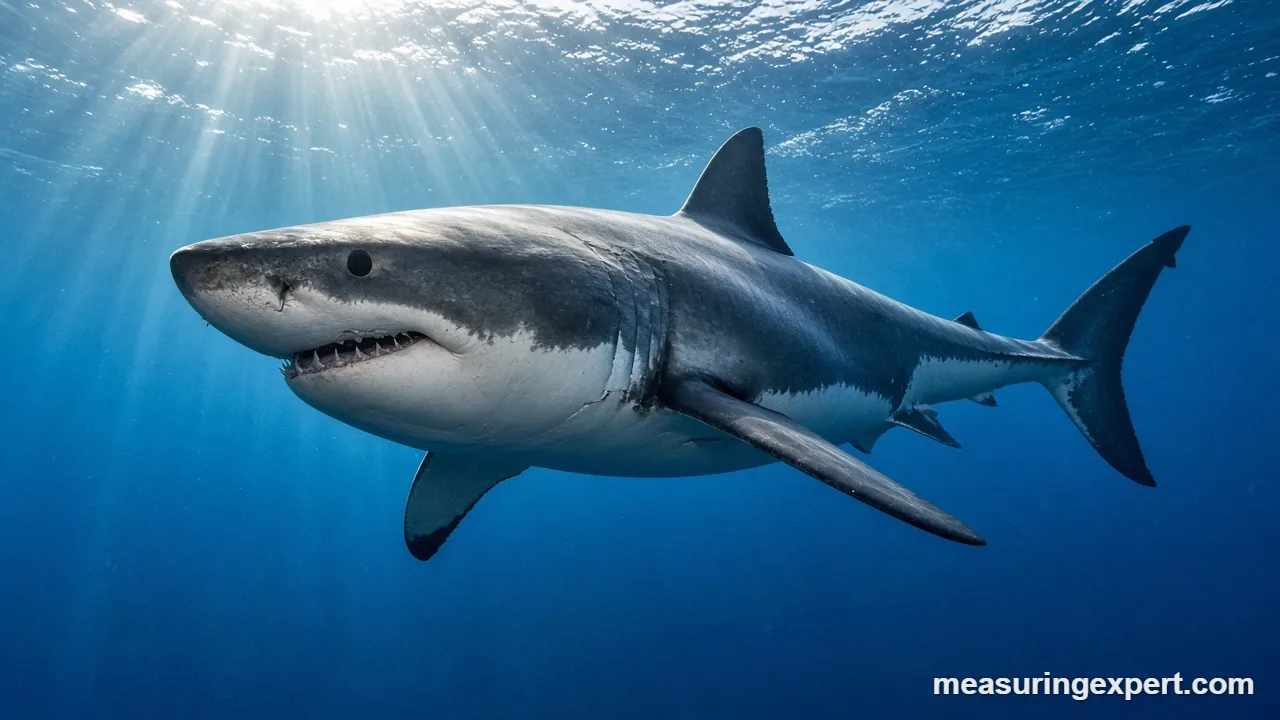
Great white shark speed tops out at about 25 mph (40 km/h) in short bursts, and some researchers think it can reach 35 mph (56 km/h). Most of the time, however, a great white cruises at only about 2 to 3 mph (3 to 5 km/h), roughly a brisk walking pace.
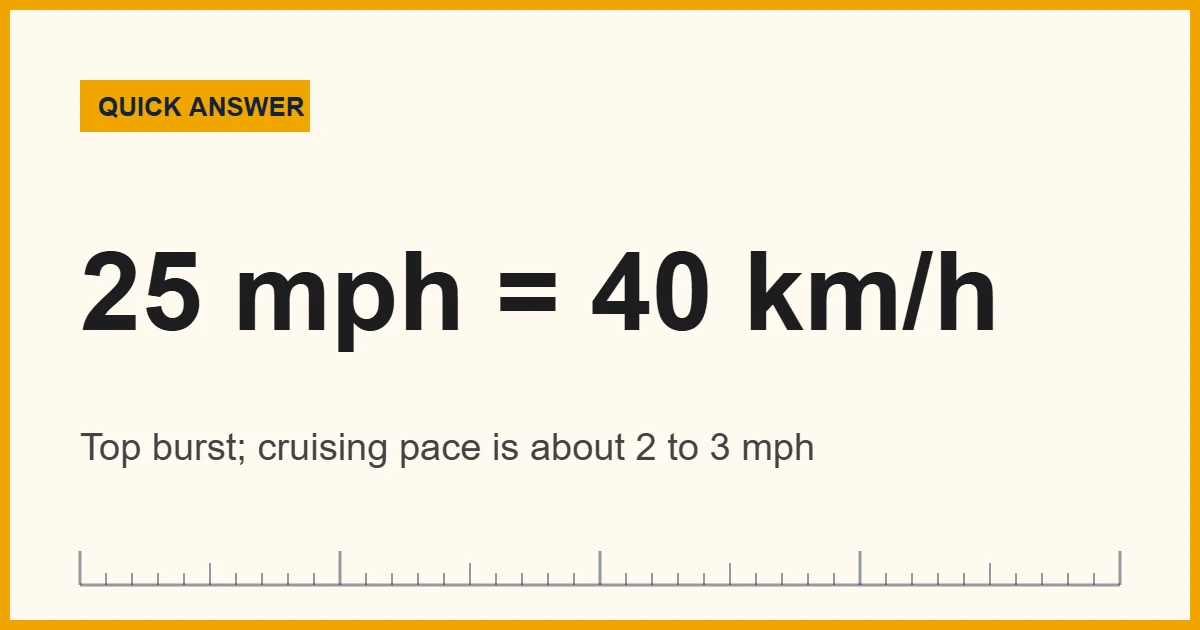
Convert Great White Shark Speed to km/h, m/s and Knots
The converter starts at 25 mph, the burst figure quoted most often. Next, type any speed from this page and pick its unit. The tool then shows the same speed in kilometers per hour, meters per second, knots and feet per second, so you can compare it with a boat, a swimmer or a research paper.
A great white shark can grow to about 20 feet long, yet it moves through the water with very little effort. For that reason, the question of its speed has two answers. First, there is the slow, steady pace it holds for hours while it patrols or migrates. Second, there is the explosive sprint it uses to ambush a seal from below.
Shark researchers stress the second number is hard to pin down. For example, the ReefQuest Centre for Shark Research puts the top speed of the white shark at at least 25 mph, and its author estimates the real ceiling may be 35 mph or more. In other words, 25 mph is a careful minimum, not a stopwatch reading.
Below, you will also find a quick chart, an explanation of why sources disagree, a look at the body that makes the sprint possible, and a comparison with dolphins, whales, makos and people.
Great White Shark Speed at a Glance
First, this chart lists the figures that come from tagging studies and shark research groups. All conversions use the exact definitions 1 mile = 1.609344 km and 1 knot = 1.852 km/h, rounded to two decimals.
| Situation | mph | km/h | m/s | Source |
|---|---|---|---|---|
| Typical cruising before an attack | about 2.24 | about 3.6 | about 1.0 | Biologging study, Seal Island |
| Average pace on a record migration | about 2.9 | about 4.67 | about 1.3 | Computed from NOAA data |
| Peak speed in a breaching attack | about 14.54 | about 23.4 | up to 6.5 | Biologging study, Seal Island |
| Top burst speed (widely cited) | 25+ | 40.23+ | 11.18+ | ReefQuest Centre |
| Upper estimate | 35+ | 56.33+ | 15.65+ | ReefQuest Centre (estimate) |
Printable tip: the chart fits on one page when you print from your browser, so it works well for a school report or a trip to an aquarium.
Cruising vs Burst Speed: Why the Numbers Disagree
One website says 2 mph, while another says 35 mph. Both can be right, because they describe different things. Therefore, this table separates the figures people mix up most often.
| Figure | What it really means | How long it lasts |
|---|---|---|
| Cruising speed | The energy-saving pace a shark holds while it patrols | Hours to days |
| Migration average | Total distance divided by total time, including slow stretches | Weeks to months |
| Attack (breach) speed | The vertical rush toward a seal at the surface | A few seconds |
| Top burst speed | The fastest sprint a shark is thought capable of | Seconds |
So, when you see a single number for great white shark speed, ask which of the four it is. For instance, a migration average will always look slow, because it includes rest, feeding and changes of direction. By contrast, a burst figure describes only the fastest moment of a hunt.
How a Great White Shark Builds Its Speed
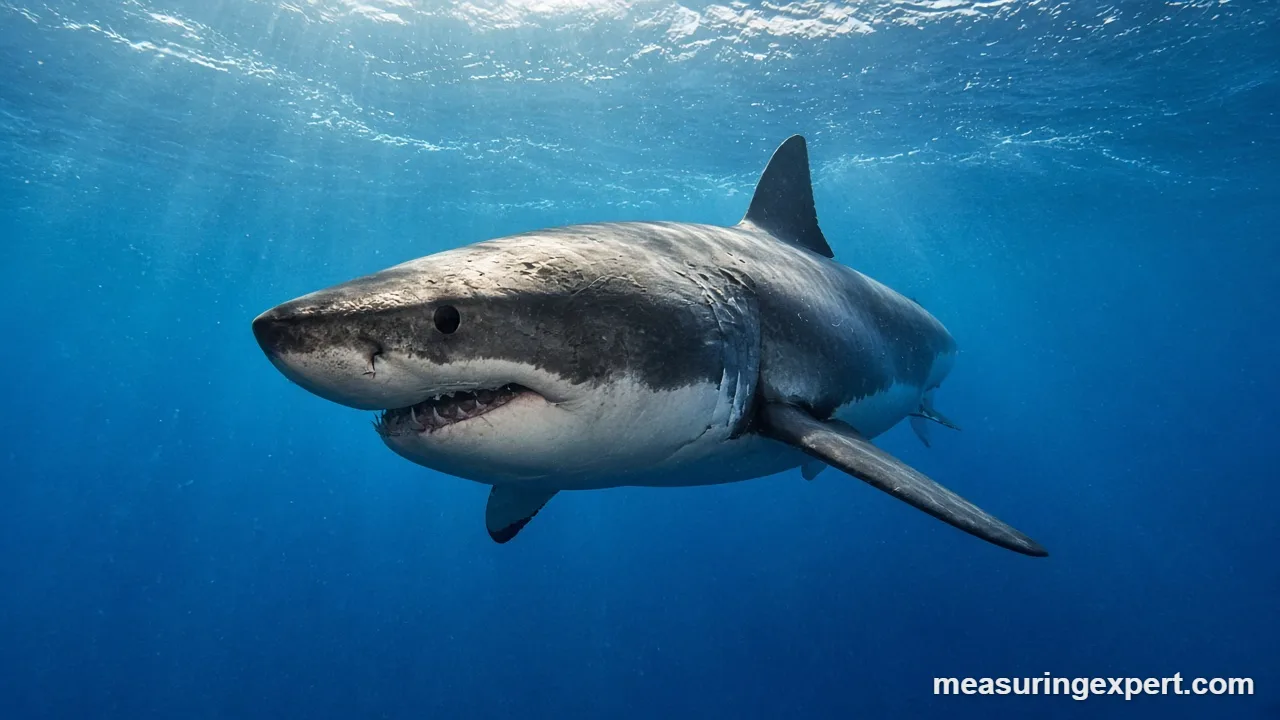
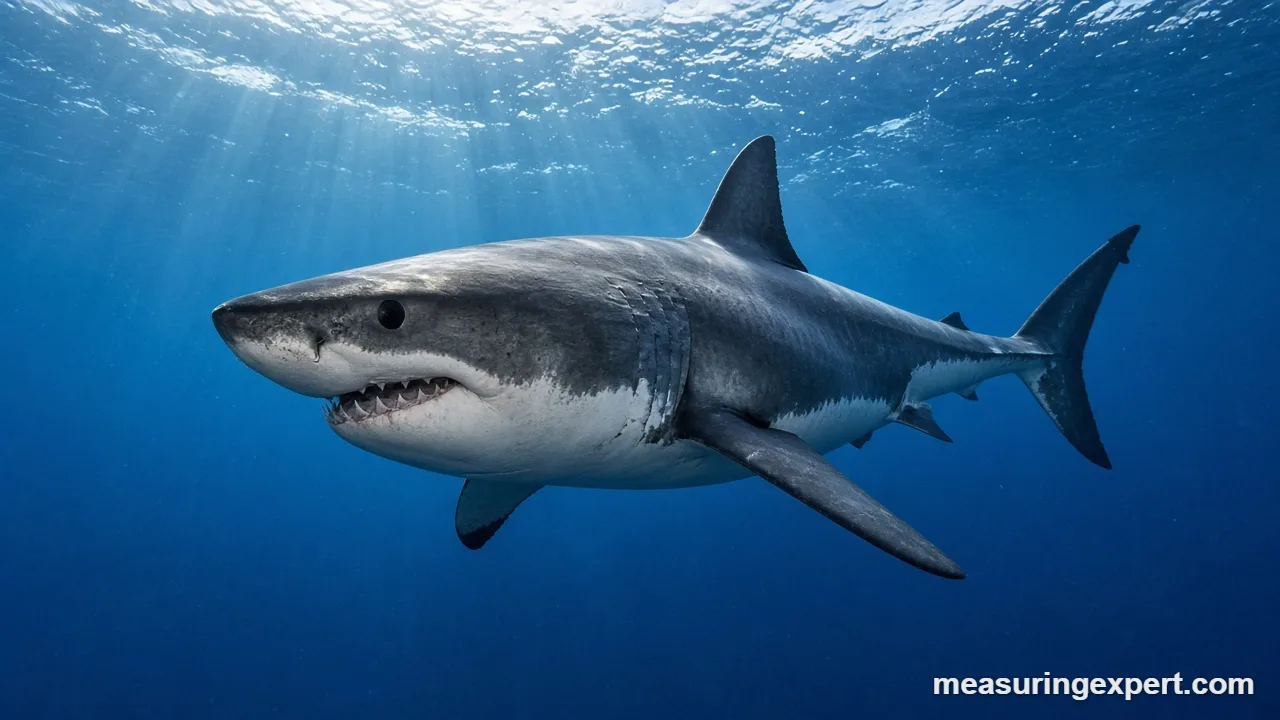
In fact, three features work together. First, the body is shaped like a torpedo: thick in the middle and tapering at both ends, which cuts drag. Next, the tail fin is a tall crescent with upper and lower lobes of nearly equal size. That shape is typical of fast, open-water fish such as makos and tuna, so it gives strong thrust with little wasted motion.
Finally, the great white is partly warm-blooded. According to the Florida Museum of Natural History, it is endothermic and keeps its body warmer than the surrounding water. As a result, warm muscles contract faster and recover sooner, which helps a shark hunt in cold seas.
Meanwhile, inside the body, two kinds of muscle split the work. Red muscle is rich in blood and oxygen, so it powers slow, steady cruising for long periods. White muscle, in contrast, makes up most of the body and supplies the sudden bursts. Because white muscle tires quickly, a great white cannot hold its top speed for long.
Great White Shark Speed vs Other Sharks and Ocean Animals
A great white is fast for its size, but it is not the fastest shark. In addition, the table below uses figures from shark researchers and from our other speed guides.
| Animal | Top burst (mph) | Top burst (km/h) | Note |
|---|---|---|---|
| Shortfin mako shark | 31 (reliably timed) | 49.89 | Claims of 45+ mph are unconfirmed |
| Orca (killer whale) | 35+ | 56.33+ | Short bursts only |
| Great white shark | 25+ | 40.23+ | Upper estimate 35 mph |
| Blue shark | 24.5 | 39.43 | One 6.5-foot shark, timed |
| Blue whale | 20+ | 32.19+ | Cruises near 5 mph |
| Bottlenose dolphin | about 18 | about 29 | Measured in captivity |
| Elite human swimmer | about 5.3 | about 8.6 | 50 m sprint average |
Older versions of this page claimed the common dolphin reaches 60 mph. However, no measurement supports that, so we dropped it. For measured figures, see our guide to how fast dolphins can swim. Similarly, our page on how fast whales can swim explains why even giant whales cruise at only a few miles per hour.
Recommended Tools for Watching Sharks and Marine Life
Of course, you do not need special gear to read a speed chart. Still, if you go whale or shark watching from a boat or a cliff, a few tools make the trip more useful. Binoculars bring distant fins into view, while a waterproof case or dry bag keeps your phone safe for timing and notes.


As an Amazon Associate, Measuring Expert earns from qualifying purchases.
How to Convert Great White Shark Speed Yourself
Research papers usually give speed in meters per second, while news stories use miles per hour. So, here is how to switch between them by hand.
- Find the unit. Check whether the figure is in m/s, km/h, mph or knots, and note whether it is a cruise or a burst.
- Convert m/s to km/h. Multiply by 3.6, because one hour has 3,600 seconds and one kilometer has 1,000 meters.
- Convert km/h to mph. Divide by 1.609344, the exact number of kilometers in a mile.
- Convert km/h to knots. Divide by 1.852, the exact number of kilometers in a nautical mile.
- Round sensibly. Keep two or three significant figures, since the original measurement is never more precise than that.
- Check with the converter. Enter your figure in the tool above to confirm the result.
For example, the 6.5 m/s breaching speed becomes 6.5 x 3.6 = 23.4 km/h. Then 23.4 / 1.609344 gives about 14.5 mph. Want more on boat units? Our explainer on how fast a knot is covers the nautical mile in detail.
How Researchers Measure a Shark’s Speed
Nobody can hold a radar gun on a shark underwater, so scientists rely on tags. However, each method answers a different question.
- Motion-sensing tags record acceleration and tail beats many times per second. As a result, they capture short bursts best.
- Acoustic tags send pings to underwater receivers. Researchers then divide the distance between receivers by the travel time.
- Satellite tags report positions when a shark surfaces. Because fixes can be hours or days apart, they show migration pace, not sprint speed.
A biologging study of breaching great whites at Seal Island, South Africa, used motion tags. In particular, it found that the sharks sped up from about 1.0 to 6.5 m/s as they rose toward their prey. That peak of about 14.5 mph is lower than 25 mph. However, it describes a steep upward rush from depth, not a flat-out horizontal chase.
How Far a Great White Shark Travels
Still, speed also matters over long distances. In 2003, a tagged female named Nicole left South Africa and reached Western Australia in 99 days, covering about 11,100 km (6,897 miles). NOAA’s Science On a Sphere page notes that she was back off South Africa less than nine months later, a round trip of about 20,000 km (12,400 miles).
Divide 11,100 km by 99 days and you get about 112 km per day. In turn, that equals an average of about 4.67 km/h, or 2.9 mph, held day and night for more than three months. In short, the endurance of a great white is just as impressive as its sprint.
Do and Don’t Around Shark Waters
Do
- Follow local beach flags and lifeguard advice.
- Swim in groups and stay close to shore.
- Book licensed operators for cage dives or boat trips.
- Keep a safe distance from seal colonies.
- Report sightings to local authorities.
Don’t
- Assume you can outswim any shark.
- Enter the water near fishing boats or bait.
- Swim at dawn or dusk where sharks are active.
- Wear shiny jewelry in murky water.
- Approach or feed wild sharks.
Honest Limits of Shark Speed Figures
Of course, every number on this page comes with caveats. For one thing, very few great whites have ever been timed at full sprint, so the 25 mph figure is a cautious estimate rather than a record. Also, speed depends on the shark’s size, water temperature and what it is doing. For example, a young shark and a 20-foot adult will not swim alike. Finally, tags change slightly how a shark moves, and each method has its own error. For these reasons, treat any single figure as a range, not an exact value.
When Accuracy Really Matters
For a school project, 25 mph and 40 km/h are fine. Divers, surfers and boat crews, on the other hand, need local advice more than a top speed. After all, shark behavior varies by place and season, so rely on lifeguards, dive operators and wildlife agencies for safety decisions.
Great White Shark Speed: FAQs
What is the top great white shark speed?
Shark researchers put the top burst speed at at least 25 mph (40 km/h). Some estimate it may reach 35 mph (56 km/h), but it has not been timed precisely.
How fast does a great white shark cruise?
Tagged great whites usually cruise at about 1 m/s, which is about 2.2 mph or 3.6 km/h. On long migrations, they average close to 3 mph.
Is great white shark speed faster than a human swimmer?
Yes, by a wide margin. Elite swimmers average about 5.3 mph over 50 meters, while a great white can burst to 25 mph or more.
Can a person outswim a great white shark?
No. A great white is far faster than any person in the water, so staying safe depends on avoiding risky areas, not on swimming speed.
Which shark is the fastest?
The shortfin mako is the fastest known shark. It has been reliably timed at 31 mph (50 km/h), and some claims go higher.
How is great white shark speed measured?
Scientists use motion-sensing tags for bursts, acoustic tags for local movement and satellite tags for migrations. As a result, each tag measures a different kind of speed.
How fast does a great white attack a seal?
In a study at Seal Island, South Africa, breaching sharks sped up from about 1.0 to 6.5 m/s, or about 14.5 mph, as they rose toward the surface.
How far can a great white shark swim?
A tagged shark named Nicole swam about 11,100 km from South Africa to Australia in 99 days, and about 20,000 km in her round trip.
Is a great white shark faster than a dolphin?
Usually, yes. Bottlenose dolphins have been measured at about 18 mph in short bursts, while a great white can likely reach 25 mph or more.
How many knots is 25 mph?
25 mph equals about 21.7 knots, 40.2 km/h or 11.2 meters per second.
Great White Shark Speed: The Bottom Line
To sum up, a great white shark cruises at about 2 to 3 mph and bursts to at least 25 mph (40 km/h), with some estimates reaching 35 mph. It is fast for its size, faster than dolphins and people, yet slower than the shortfin mako.
Finally, if you want any of these figures in other units, use the converter at the top of this page. In addition, it handles mph, km/h, m/s, knots and feet per second.