

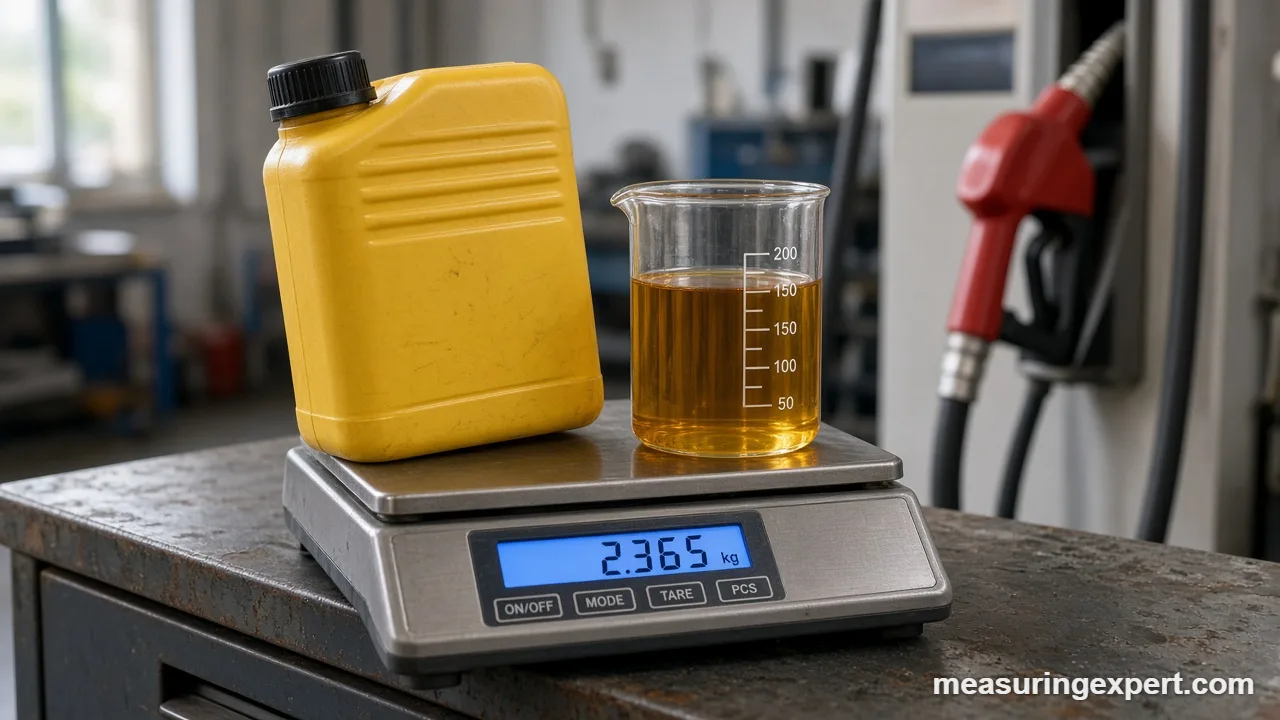
A gallon of diesel weighs about 7.1 pounds (3.2 kg) at 60 degrees F. That figure assumes a typical No. 2 diesel density of about 0.85 kg/L. However, real fuel ranges from roughly 0.82 to 0.85 kg/L, so one US gallon weighs between about 6.8 and 7.1 lb, depending on the blend and temperature.
Convert Diesel Density to Pounds per Gallon
Fuel data sheets list density in kg/L, kg/m3 or specific gravity, while truckers and farmers think in pounds per gallon. So type the density from your fuel ticket or spec sheet below, and the converter shows the same value in every common unit, along with the formula it used.
Diesel powers most trucks, buses, tractors, generators and boats, and its weight matters more than most drivers expect. For example, a semi with two full 150-gallon saddle tanks carries more than 2,100 pounds of fuel. As a result, that load counts against axle limits, payload and fuel economy, and it also changes how a boat or small aircraft balances.
In short, the quick answer is easy to remember: one gallon of diesel weighs a little over 7 pounds. Still, the exact figure moves with density, and density moves with the crude oil, the refinery, the season and the thermometer. As a result, two gallons pumped on different days can differ by a few tenths of a pound.
At the same time, the conversion itself rests on fixed definitions. A US gallon is exactly 3.785411784 liters, and a pound is exactly 0.45359237 kg, which is why the NIST guide to SI units lists 1 lb/gal as about 119.83 kg per cubic meter. Therefore, every 0.01 kg/L of density adds or removes about 0.083 lb per gallon.
Gallon of Diesel Weight Chart by Density
To begin with, this chart covers the density range you will see on most US and European fuel tickets. In addition, the values use the exact gallon and pound definitions and are rounded to two decimals.
| Density (kg/L) | Density (kg/m³) | Pounds per US gallon | Kilograms per US gallon | Pounds per cubic foot |
|---|---|---|---|---|
| 0.82 | 820 | 6.84 | 3.10 | 51.19 |
| 0.83 | 830 | 6.93 | 3.14 | 51.82 |
| 0.84 | 840 | 7.01 | 3.18 | 52.44 |
| 0.85 | 850 | 7.09 | 3.22 | 53.06 |
| 0.86 | 860 | 7.18 | 3.26 | 53.69 |
For a quick rule of thumb, use 7.1 lb per gallon, or 0.85 kg per liter. Similarly, 1,000 liters of diesel at that density weighs about 850 kg, or roughly 1,874 lb. Printable tip: for example, print this page and tape the chart near your fuel tank or in the shop.
Recommended Tools for Checking a Gallon of Diesel
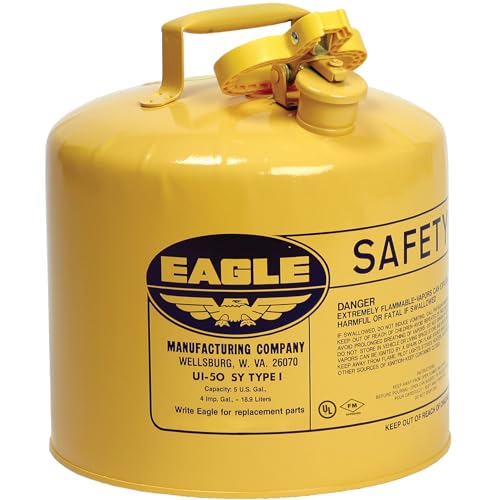
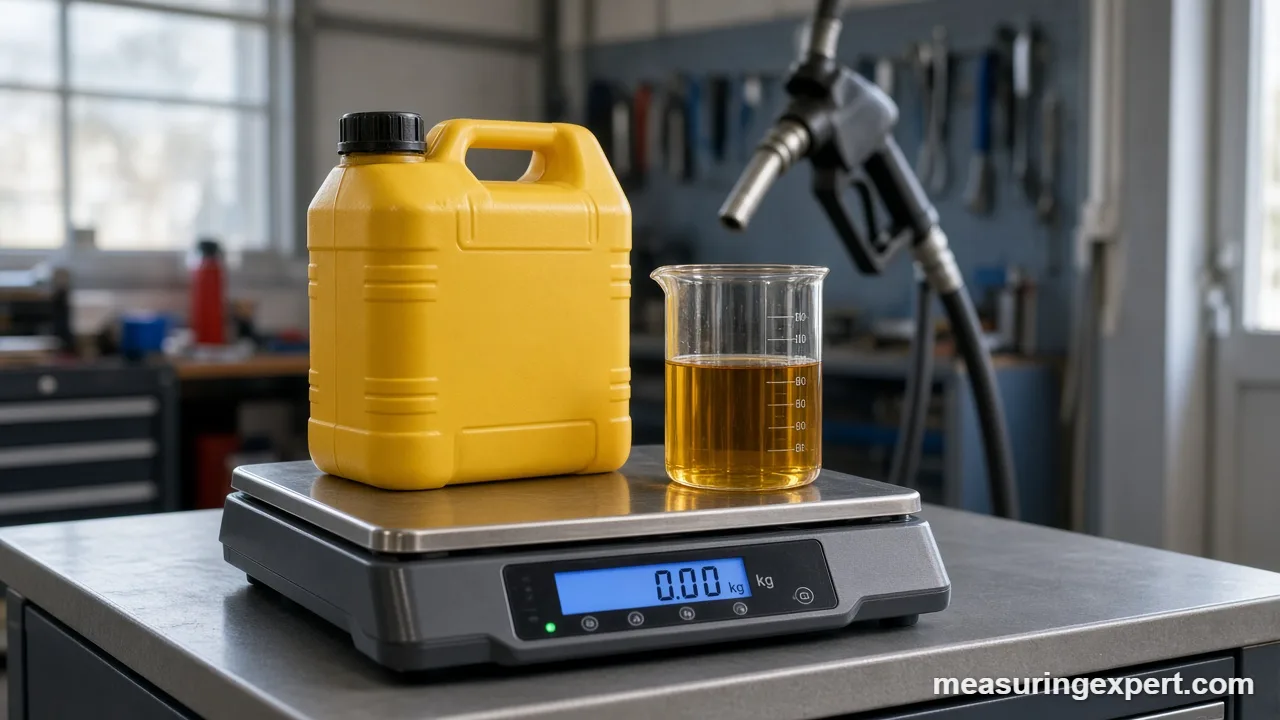
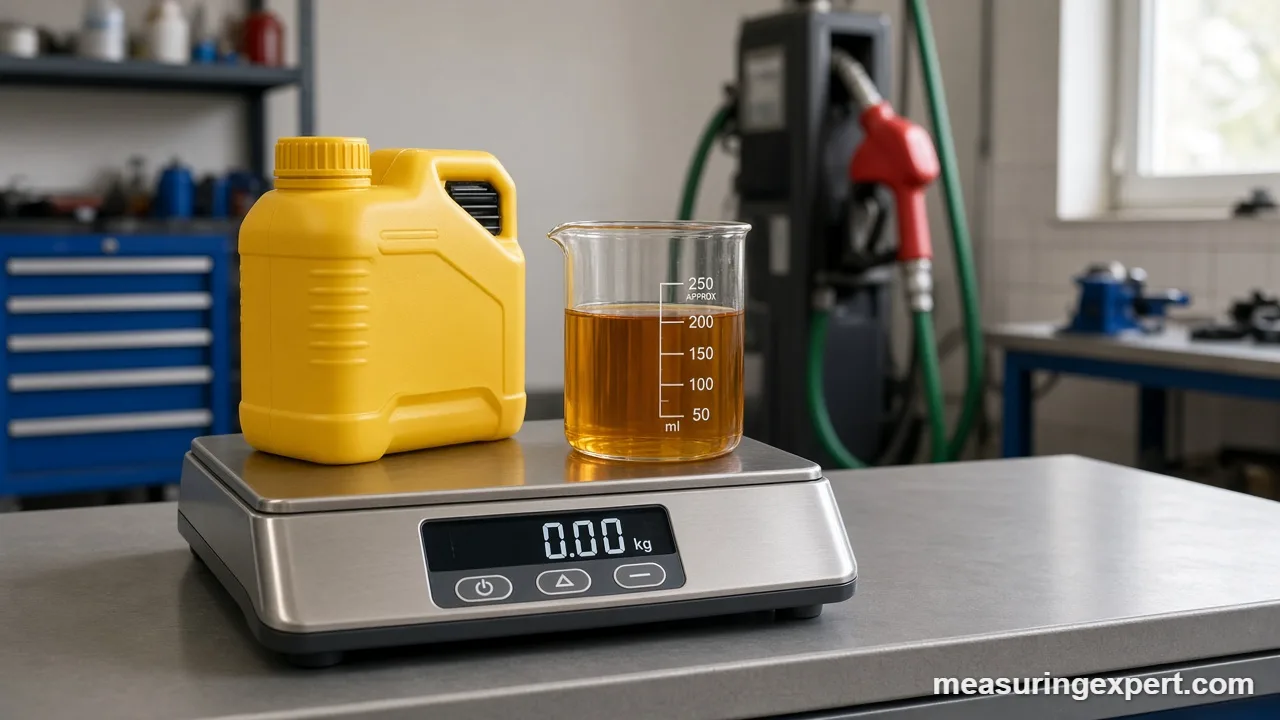
In fact, you do not need a lab to check fuel weight. First, a hydrometer made for liquids lighter than water reads specific gravity directly, so pick one whose scale starts near 0.700. Next, a hanging or crane scale lets you weigh a full can and subtract the empty weight. Finally, a proper yellow diesel can keeps the fuel clean and clearly separate from gasoline.




As an Amazon Associate, Measuring Expert earns from qualifying purchases.
Why the Density of a Gallon of Diesel Varies
To begin with, diesel is not a single chemical. Instead, it is a blend of hydrocarbons that boil at higher temperatures than gasoline, so each batch has a slightly different makeup. As a result, several things push the density up or down:
- Grade. For example, No. 2 diesel, the usual road fuel, is heavier than No. 1 diesel, which refiners blend in for winter.
- Crude source and refining. In general, heavier crude oils tend to yield denser fuel.
- Biodiesel blends. Biodiesel is slightly denser than petroleum diesel, so a B20 blend weighs a touch more per gallon.
- Renewable diesel. By contrast, hydrotreated renewable diesel is lighter than regular diesel.
- Temperature. Warm fuel expands and therefore weighs less per gallon (see the next section).
Indeed, product specification sheets show how wide the range can be. For instance, one US supplier’s sheet for No. 2 diesel lists a specific gravity of 0.81 to 0.88 at 60 degrees F. Meanwhile, the European EN 590 standard limits road diesel to 0.820 to 0.845 kg/L at 15 degrees C. Overall, most pump diesel lands near the middle of those ranges.
| People often confuse | What it actually means |
|---|---|
| Density (kg/L or kg/m³) | Mass per volume at a stated temperature, such as 0.85 kg/L at 15 °C |
| Specific gravity | Density compared with water at 60 °F; no units, and almost the same number as kg/L |
| API gravity | An oil industry scale where higher numbers mean lighter fuel |
| Weight per gallon (lb/gal) | Density multiplied by the volume of one US gallon |
| US gallon vs imperial gallon | 3.785 L vs 4.546 L; an imperial gallon of diesel weighs about 8.5 lb |
How Temperature Changes the Weight of a Gallon of Diesel
In the same way as most liquids, diesel expands when it warms. Because the same mass then fills more space, each gallon weighs a little less. In particular, typical petroleum tables put diesel’s expansion at roughly 0.08 percent per degree C, or about 0.045 percent per degree F. That sounds small; however, it adds up over a big temperature swing.
| Fuel temperature | Approx. density (kg/L) | Approx. weight per US gallon |
|---|---|---|
| 0 °F (-18 °C) | 0.874 | 7.3 lb (3.3 kg) |
| 32 °F (0 °C) | 0.861 | 7.19 lb (3.26 kg) |
| 60 °F (15.6 °C) | 0.850 | 7.09 lb (3.22 kg) |
| 90 °F (32 °C) | 0.838 | 7.0 lb (3.17 kg) |
| 100 °F (38 °C) | 0.834 | 6.97 lb (3.16 kg) |
This is also why the fuel industry corrects volumes to a reference temperature, usually 60 degrees F in the US and 15 degrees C in most other countries. So when you compare two density figures, check that they use the same temperature first.
A Gallon of Diesel vs Gasoline and Water
In general, diesel sits between gasoline and water. Typical US gasoline weighs about 6.2 lb per gallon, so diesel is roughly 15 percent heavier, or about 0.9 lb more per gallon. In addition, our guide to how dense gasoline is covers its own range and blends.
| Liquid (US gallon, about 60 °F) | Typical density | Weight per gallon |
|---|---|---|
| Gasoline | 0.74 kg/L | 6.2 lb (2.8 kg) |
| Diesel (No. 2) | 0.85 kg/L | 7.1 lb (3.2 kg) |
| Fresh water | 0.999 kg/L | 8.34 lb (3.78 kg) |
| Whole milk | about 1.03 kg/L | about 8.6 lb (3.9 kg) |
Water, on the other hand, is about 17 percent heavier than diesel. That is why diesel floats on water, and also why water that gets into a fuel tank sinks to the bottom where the fuel pickup sits. For water by the bucket, see how much 5 gallons of water weighs, or compare with the weight of a gallon of milk.
Tank Weight Examples for a Gallon of Diesel and More
To estimate a full tank, multiply the gallons by 7.1 lb (or by 3.22 kg). Accordingly, the table below uses that typical value. In addition, remember to add the weight of the tank or can itself.
| Amount of diesel | Volume (liters) | Weight (lb) | Weight (kg) | Typical example |
|---|---|---|---|---|
| 1 gallon | 3.8 | 7.1 | 3.2 | One gallon of diesel |
| 5 gallons | 18.9 | 35.5 | 16.1 | Standard fuel can |
| 10 gallons | 37.9 | 71 | 32.2 | Small tractor or generator tank |
| 26 gallons | 98.4 | 184.6 | 83.7 | Pickup truck tank (sizes vary) |
| 50 gallons | 189.3 | 355 | 161 | Large pickup or boat tank |
| 100 gallons | 378.5 | 710 | 322 | Transfer tank or one saddle tank |
| 150 gallons | 567.8 | 1,065 | 483 | Large semi saddle tank |
| 300 gallons | 1,135.6 | 2,130 | 966 | Two full 150-gallon saddle tanks |
How to Find the Weight of a Gallon of Diesel Yourself
- Get the density. First, read it from the fuel ticket or spec sheet, or measure specific gravity with a hydrometer in a clear test jar.
- Note the temperature. Next, check whether the figure is at 60 degrees F or 15 degrees C, and measure the fuel temperature if you used a hydrometer.
- Convert to kg/L if needed. Then divide kg/m3 by 1,000; specific gravity, however, is already almost the same number.
- Multiply by 8.3454. In other words, that factor turns kg/L into pounds per US gallon, so 0.85 x 8.3454 = 7.09 lb.
- Scale up to your tank. After that, multiply the weight per gallon by the gallons you plan to carry.
- Check with a scale. Finally, weigh a full can, subtract the empty can, and then divide by the gallons inside.
Alternatively, enter your density in the converter at the top of this page, which handles the arithmetic for you.
Do and Don’t When Weighing Fuel
Do
- Use 7.1 lb per gallon for quick load planning.
- Check the reference temperature on any density figure.
- Weigh fuel in a sealed, approved diesel can.
- Also add the tank or can weight to the fuel weight.
- Keep diesel cans yellow and gasoline cans red.
Don’t
- Mix up US and imperial gallons in a calculation.
- Assume winter and summer fuel weigh the same.
- Rely on a water hydrometer, since its scale starts at 1.000.
- Smoke or use open flames near open fuel.
- Overfill cans, because the fuel needs room to expand.
Honest Limits of a Single Number
The 7.1 lb figure is a convenient average, not a law of nature. For one thing, each refinery batch differs slightly, and seasonal blending changes the mix. Moreover, the temperature table above uses a typical expansion rate, while the real rate varies a little with the fuel. In short, expect any given gallon to weigh somewhere between about 6.8 and 7.3 lb. For rough planning, therefore, that spread hardly matters. For billing, aviation balance or legal weight limits, however, use the density printed on your delivery ticket instead.
When Accuracy Really Matters
Admittedly, most people only need a ballpark. Still, a few jobs call for real numbers:
- Commercial trucking. That is because fuel weight counts toward gross and axle weight limits at scales.
- Boats and aircraft. In this case, weight and balance calculations need the actual fuel density and quantity.
- Bulk fuel sales. Suppliers often correct volume to 60 degrees F, so check how your invoice states it.
- Generators and backup power. Likewise, floor loading and tank stands must carry the full weight of the fuel.
Frequently Asked Questions
How much does a gallon of diesel weigh in pounds?
A gallon of diesel weighs about 7.1 pounds at 60 degrees F. However, depending on the blend and temperature, it usually falls between about 6.8 and 7.3 pounds.
How much does a gallon of diesel weigh in kilograms?
One US gallon of diesel weighs about 3.2 kg. Specifically, at a density of 0.85 kg/L, the exact figure is about 3.22 kg.
Is diesel heavier than gasoline?
Yes. Diesel weighs about 7.1 lb per gallon and gasoline about 6.2 lb, so diesel is roughly 15 percent heavier.
Is diesel heavier than water?
No. Water weighs about 8.34 lb per gallon, so diesel is lighter and floats on top of it.
Does cold weather make a gallon of diesel heavier?
Yes, slightly. Cold diesel contracts, so a gallon at 0 degrees F weighs about 7.3 lb, compared with about 7.1 lb at 60 degrees F.
What is the density of diesel?
Diesel usually measures about 0.82 to 0.85 kg/L (820 to 850 kg/m3) at 15 degrees C, and 0.85 kg/L is a common working value.
How much do 5 gallons of diesel weigh?
Five gallons of diesel weigh about 35.5 lb (16.1 kg), plus the weight of the can.
How much does a 100 gallon diesel tank weigh when full?
The fuel alone weighs about 710 lb (322 kg). Then add the empty weight of the tank, which depends on its material and design.
Does biodiesel weigh more than regular diesel?
Slightly. Biodiesel is a little denser than petroleum diesel, so blends such as B20 weigh a touch more per gallon.
How much does an imperial gallon of diesel weigh?
An imperial gallon holds 4.546 liters, so at 0.85 kg/L it weighs about 3.86 kg, or about 8.5 lb.
A Gallon of Diesel: The Bottom Line
To sum up, a gallon of diesel weighs about 7.1 lb (3.2 kg) at 60 degrees F, with most fuel falling between about 6.8 and 7.1 lb at that temperature. In addition, cold fuel weighs a bit more and hot fuel a bit less, while gasoline is about 0.9 lb lighter per gallon and water about 1.2 lb heavier.
So for a full tank, simply multiply the gallons by 7.1 and then add the tank weight. If you have the density from a fuel ticket, the converter at the top of this page gives you the exact pounds per gallon in seconds.