

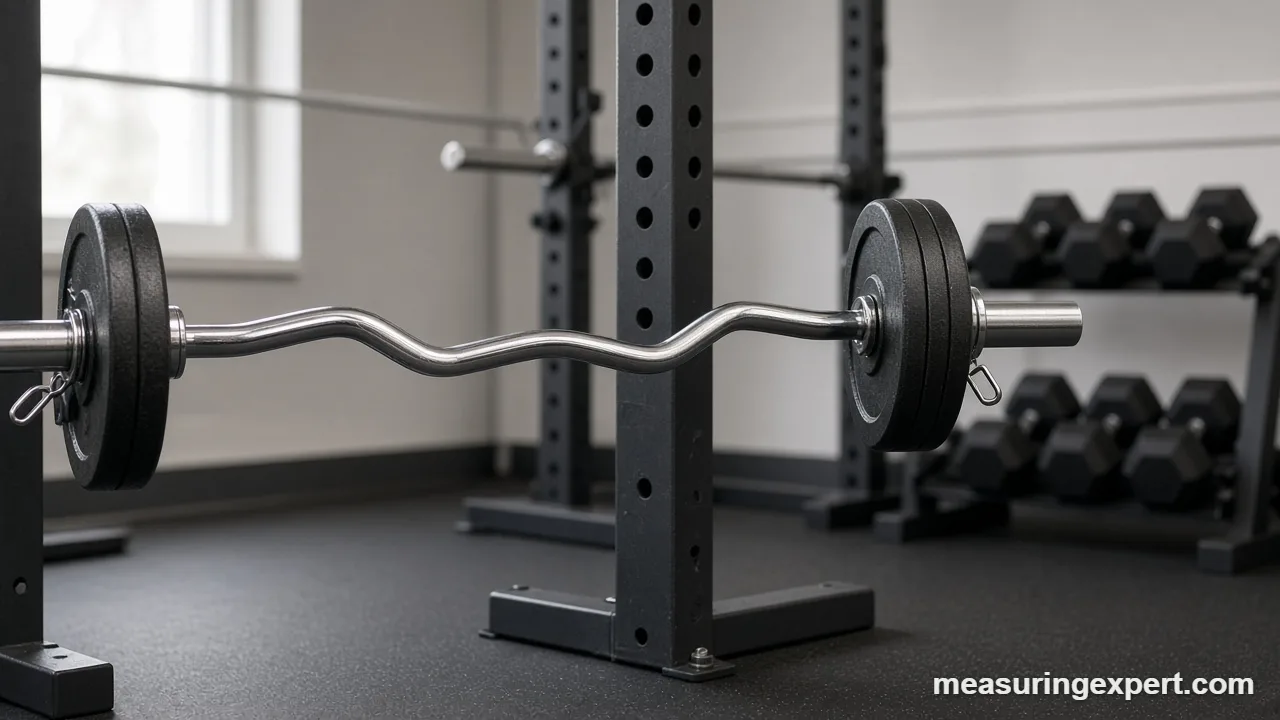
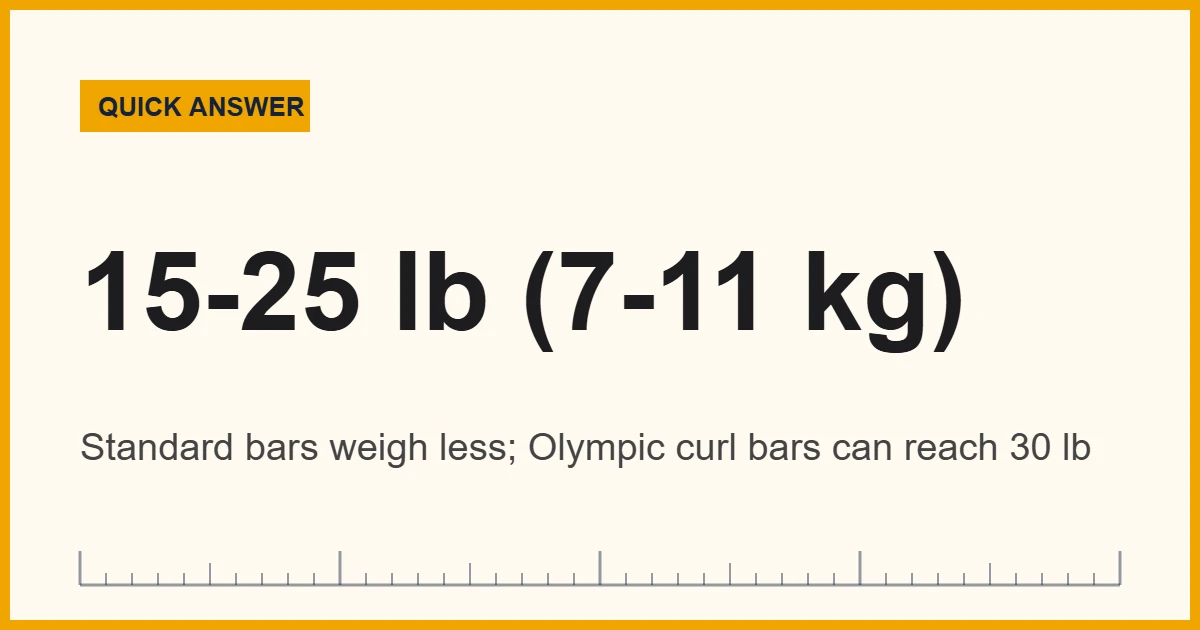
EZ bar weight depends on the bar type. Most EZ curl bars weigh about 15 to 25 lb (7 to 11 kg). Standard bars with 1-inch sleeves are lighter, often 10 to 15 lb, while Olympic EZ bars with 2-inch sleeves usually weigh 16 to 30 lb. So check the spec sheet or weigh your own bar.
Convert Your EZ Bar Weight to kg, oz and g
First, enter the weight printed on your bar, or the number from your own scale, and pick the unit. The converter then shows kilograms, ounces and grams using the exact definition of the pound (1 lb = 0.45359237 kg).
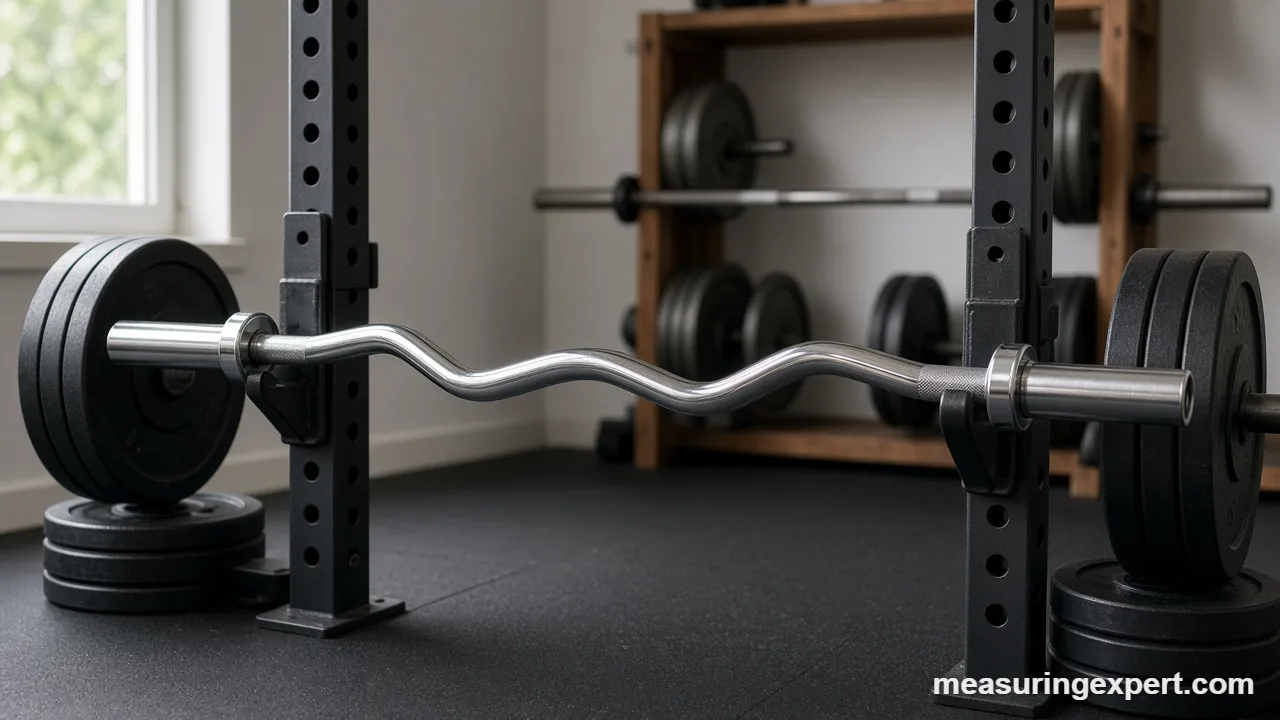
An EZ curl bar is the short, zigzag barbell you see next to the preacher bench. Its angled grips turn your wrists slightly inward, so curls and skull crushers feel easier on the joints than they do with a straight bar. However, there is no single official EZ bar. Unlike the 20 kg men’s competition barbell, which the weightlifting federations define, curl bars follow no shared standard. As a result, each brand picks its own length, sleeve size and steel thickness, and the empty weight changes with them.
This detail matters because many lifters log every set. For example, if your bar weighs 25 lb and you count it as 15 lb, every curl in your notebook reads 10 lb too low. In short, knowing your exact EZ bar weight keeps your training log honest and lets you compare numbers between gyms.
EZ Bar Weight by Brand: Published Specs
In general, manufacturer spec pages are the most reliable source. We opened each page below and copied the listed weight; the metric or US figure in brackets is our conversion.
| Bar (sleeve type) | Listed weight | Converted | Length |
|---|---|---|---|
| Titan Performance Series Olympic EZ Curl (50 mm) | 20 lb | 9.07 kg | 47.1 in |
| Eleiko Curl Bar (50 mm) | 12 kg | 26.46 lb | not listed |
| Rogue Curl Bar (Olympic) | 30 lb | 13.61 kg | 54.5 in |
| REP Fitness Curl Bar (Olympic) | 30 lb | 13.61 kg | 55 in |
| Typical budget 1-inch standard EZ bar | about 10 to 15 lb | 4.5 to 6.8 kg | about 47 in |
In short, the pattern is clear. Short 47-inch Olympic bars sit near 20 lb, while longer premium bars with bearings and thicker sleeves climb to 26 to 30 lb. Meanwhile, plain 1-inch bars made for home plate sets stay light. Therefore, the common “15 to 25 lb” range covers most bars you will meet, but not every one.
EZ Bar Weight: Standard vs Olympic Bars
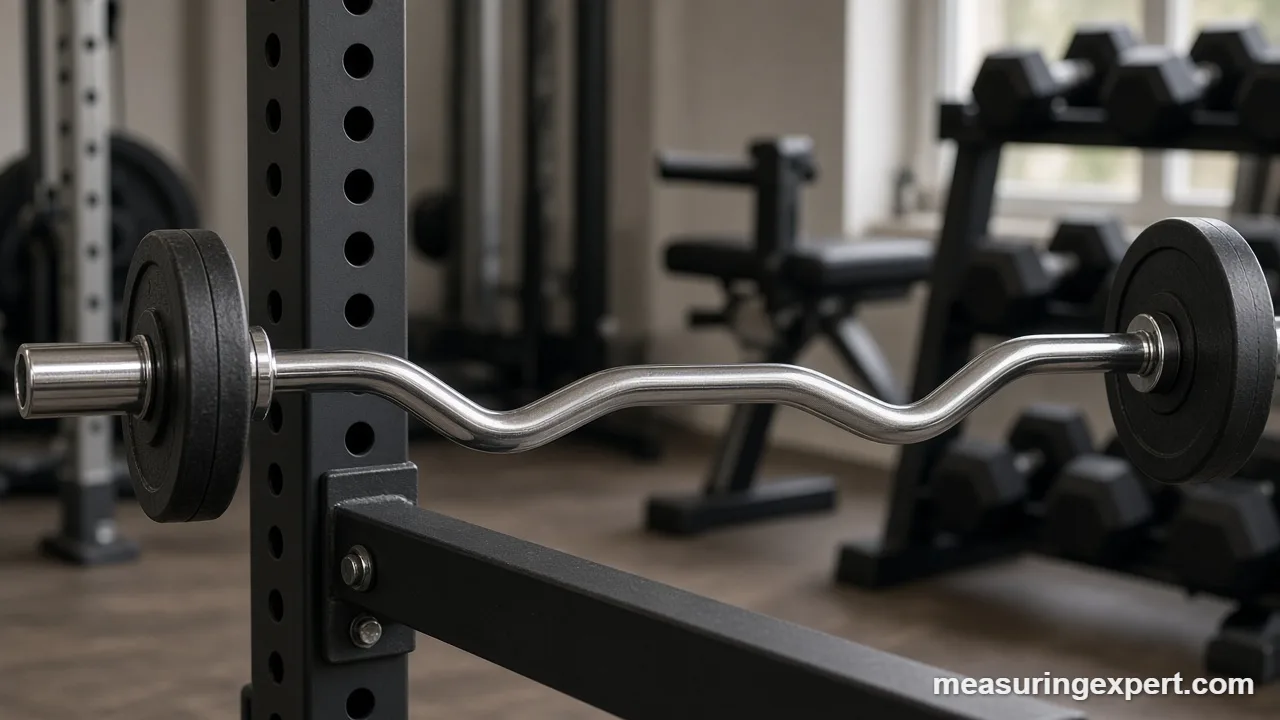
The biggest single factor is the sleeve, which is the part that holds the plates. Specifically, standard bars take plates with a 1-inch hole, and Olympic bars take plates with a 2-inch hole. Because Olympic sleeves are thicker, they usually rotate on bushings or bearings, and they add steel. Consequently, an Olympic EZ bar almost always weighs more than a standard one of the same length.
| Feature | Standard EZ bar | Olympic EZ bar |
|---|---|---|
| Plate hole | 1 in (about 25 mm) | 2 in (about 50 mm) |
| Typical weight | 10 to 15 lb (4.5 to 6.8 kg) | 16 to 30 lb (7.3 to 13.6 kg) |
| Sleeves | Usually fixed, threaded for spin-lock collars | Rotating, with bushings or bearings |
| Load rating | Lower; check the listing | Often 200 lb or more |
| Where you see it | Home plate sets | Commercial gyms, garage gyms |
In addition, some gyms stock pre-loaded fixed EZ bars. These come with the plates welded or bolted on, so the number printed on the end (20 lb, 30 lb and so on) is the total. In other words, you do not add the bar weight on top.
A few brands also sell a “super curl” bar with deeper bends. It works the same way, so its weight again depends on sleeve size and length rather than on the extra curves.
Recommended Tools for Checking EZ Bar Weight
Fortunately, you only need one scale to check your bar. First, a hanging luggage scale reads the bar directly and fits in a gym bag. Next, a flat bathroom scale works with the “weigh yourself twice” method shown below. Also, if you are still shopping, a bar with a published weight saves you the guesswork.
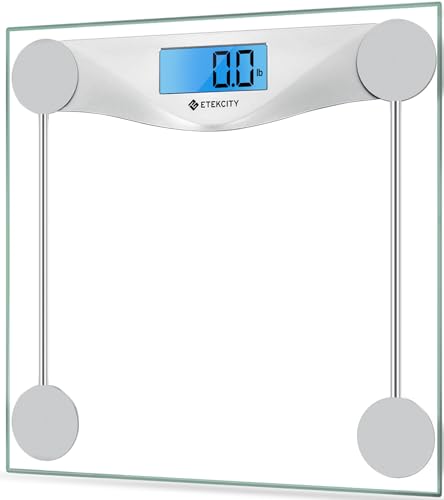

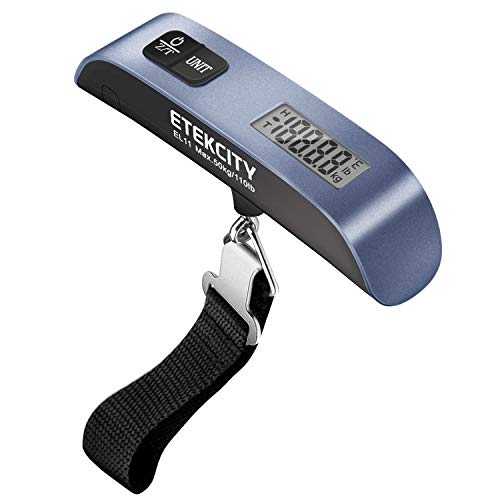

As an Amazon Associate, Measuring Expert earns from qualifying purchases.
How to Weigh Your Own EZ Bar
If the bar has no label, a home scale gives you a good answer in two minutes. Here is the method we suggest:
- Strip the bar. Remove every plate and collar, because metal lock collars can add a pound or more.
- Zero the scale. Next, place a bathroom scale on a hard, level floor and let it reset to zero.
- Weigh yourself alone. Then step on, stand still, and write down the reading.
- Weigh yourself holding the bar. After that, hold the bar close to your body at waist height and write down the second reading.
- Subtract the two readings. The difference is the bar. For example, 192.4 lb minus 172.6 lb gives 19.8 lb.
- Repeat and average. Also, do it three times, then take the average to smooth out scale wobble.
- Convert if needed. Finally, enter the result in the converter above to get kilograms or ounces.
EZ Bar Weight in Pounds, Kilograms and Ounces
Also, bar weights mix units constantly. American brands list pounds, while Eleiko and most European makers list kilograms. Fortunately, the conversion is exact: one pound equals 0.45359237 kg, and one pound equals 16 ounces. For instance, a 20 lb bar is 9.07 kg or 320 oz, and a 12 kg bar is 26.46 lb.
| Bar weight (lb) | Kilograms | Ounces | Grams |
|---|---|---|---|
| 10 lb | 4.54 kg | 160 oz | 4,536 g |
| 12 lb | 5.44 kg | 192 oz | 5,443 g |
| 15 lb | 6.80 kg | 240 oz | 6,804 g |
| 18 lb | 8.16 kg | 288 oz | 8,165 g |
| 20 lb | 9.07 kg | 320 oz | 9,072 g |
| 25 lb | 11.34 kg | 400 oz | 11,340 g |
| 30 lb | 13.61 kg | 480 oz | 13,608 g |
Similarly, small plates follow the same math. A 2.5 lb change plate, for example, is 40 oz, and a quarter pound is exactly 4 oz; see how many ounces are in a quarter pound for the full breakdown.
Is It Weight or Mass?
Strictly speaking, the “12 kg” stamped on a bar is its mass, and the force it presses on your hands is its weight. However, on Earth the two track each other so closely that gyms use the words interchangeably. Still, the difference explains why a spring scale and a balance can disagree slightly. Our guide to what mass is explains the idea in plain terms, and you can also read how much an ounce weighs if you work with small plates.
EZ Bar Weight Compared With a Straight Barbell
Overall, an EZ bar is lighter than a full-size barbell. A men’s Olympic barbell weighs 20 kg (about 44.09 lb), and the women’s version weighs 15 kg (about 33.07 lb). By contrast, most curl bars weigh roughly half of that or less. This happens because the EZ bar is shorter, about 47 to 55 inches instead of roughly 7 feet, and its shaft is thinner.
| Bar | Typical weight | Typical length |
|---|---|---|
| Standard 1-inch EZ bar | 10 to 15 lb (4.5 to 6.8 kg) | about 47 in |
| Olympic EZ bar | 16 to 30 lb (7.3 to 13.6 kg) | 47 to 55 in |
| Women’s Olympic barbell | 15 kg (33.07 lb) | about 6.6 ft |
| Men’s Olympic barbell | 20 kg (44.09 lb) | about 7.2 ft |
Do and Don’t When Logging Your Bar
Do
- Check the maker’s spec page for your exact model.
- Weigh unlabeled bars and write the number on tape.
- Count collars, because they add weight.
- Record kilograms and pounds in the same unit every session.
Don’t
- Guess 45 lb because it looks like a barbell.
- Trust a forum figure for a different brand.
- Weigh the bar with plates still loaded.
- Mix a fixed-weight bar total with a separate bar weight.
Honest Limits of These Numbers
Above all, every figure on this page is a nominal value. First, manufacturers round their listings, so a “20 lb” bar might weigh 19.6 or 20.4 lb on a precise scale. Second, chrome, cerakote or rubber end caps add a little. Finally, a home bathroom scale typically resolves only 0.1 to 0.2 lb, so the subtraction method carries some error. For a training log, though, these differences rarely matter. In short, if you need a precise figure for a competition or a coaching study, use a calibrated platform scale.
When Accuracy Really Matters
Generally, lifters only need the bar weight to the nearest pound. However, three cases call for more care. First, coaches who calculate training percentages need consistent totals. Next, physical therapy programs often prescribe very light loads, where a few pounds is a large share. Finally, sellers listing used equipment should state a measured weight rather than a guess.
EZ Bar Weight FAQs
What is the average EZ bar weight?
Most EZ curl bars weigh about 15 to 25 lb, or 7 to 11 kg. However, light standard bars can weigh 10 lb, and premium Olympic bars can reach 30 lb.
How much does an Olympic EZ curl bar weigh?
Olympic EZ bars usually weigh 16 to 30 lb. For example, Titan lists 20 lb for its 47-inch bar, while Rogue and REP list 30 lb for their longer curl bars.
How much does a standard EZ bar weigh?
A standard EZ bar with 1-inch sleeves usually weighs about 10 to 15 lb, or 4.5 to 6.8 kg. Check the label, because models vary.
Is the EZ bar weight the same in every gym?
No. There is no official standard for curl bars, so each brand chooses its own length and sleeves. As a result, two gyms can easily have bars 10 lb apart.
Does an EZ bar weigh 45 lb?
Almost never. The 45 lb figure belongs to the full-size men’s barbell, which is 20 kg. By contrast, curl bars are much shorter and lighter.
How do I find my EZ bar weight at home?
First, weigh yourself on a bathroom scale, then weigh yourself holding the empty bar, and subtract. Alternatively, a hanging luggage scale works too.
How many kg is a 20 lb EZ bar?
A 20 lb bar is about 9.07 kg, because one pound equals exactly 0.45359237 kg.
Should I count the bar when I log curls?
Yes. Add the bar to the plates so your log shows the real load. Otherwise, your numbers will not match on a different bar.
Do collars change the EZ bar weight?
Slightly. Spring clips are light, but metal lock collars can add about a pound or more per pair, so count them if you always use them.
Are fixed EZ bars labeled with the total weight?
Yes. On a pre-loaded fixed EZ bar, the number on the end already includes the bar and plates, so do not add anything.
The Bottom Line
To sum up, most EZ curl bars weigh 15 to 25 lb (7 to 11 kg), standard 1-inch bars sit lower, and premium Olympic curl bars can reach 30 lb. Because no standard exists, the only exact answer is your own bar’s spec sheet or your own scale.
So check the listing, weigh the bar once, and write the number on a strip of tape. Then use the converter at the top to switch between pounds, kilograms and ounces whenever you need to.