

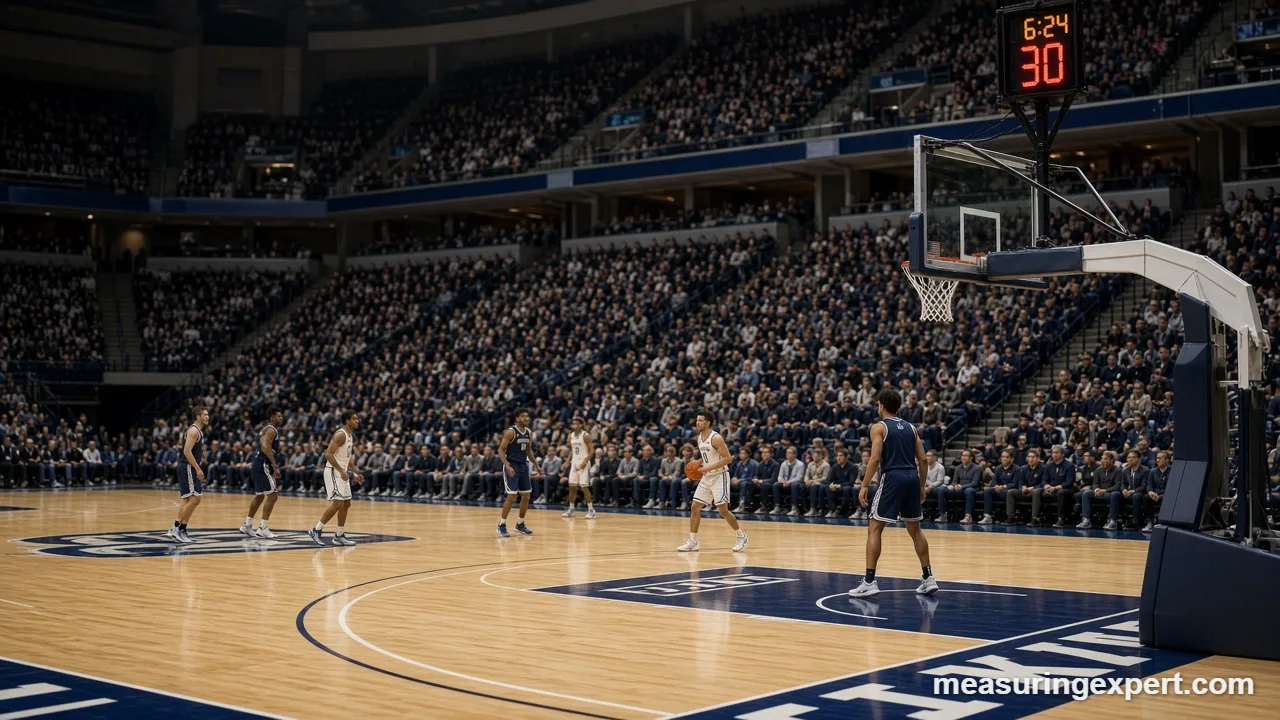
A college basketball game lasts about 2 hours from tip-off to the final horn. The game clock runs only 40 minutes: two 20-minute halves for men and four 10-minute quarters for women. Timeouts, fouls, reviews and a 15-minute halftime fill the rest, so power-conference men’s games averaged about 2 hours 5 minutes in 2024-25.
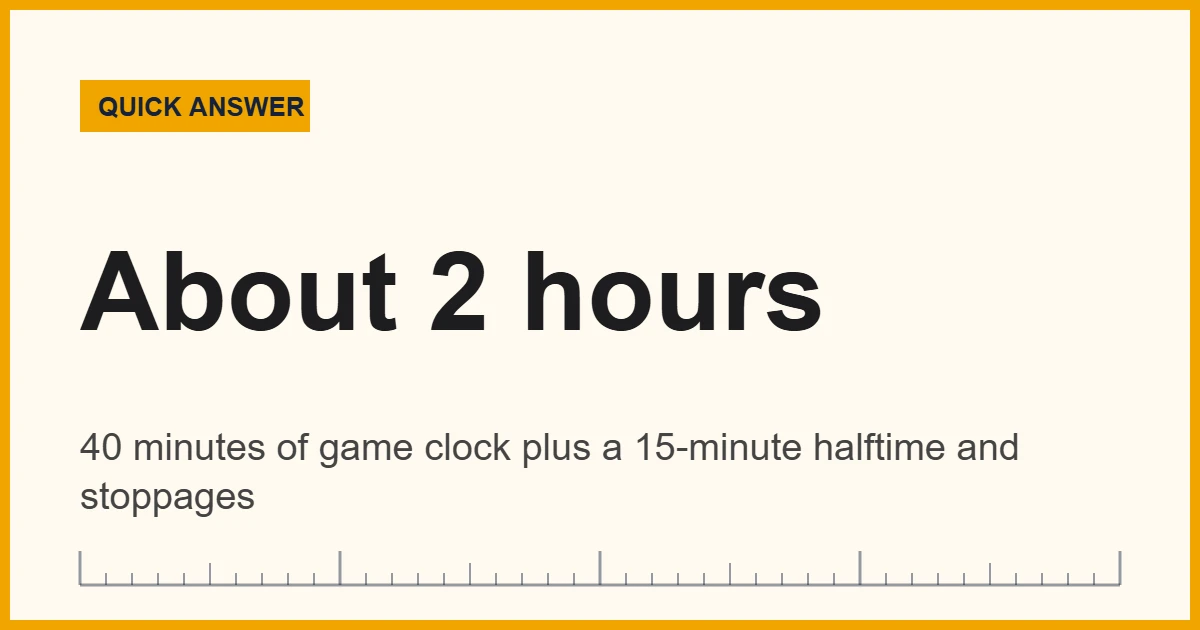
Convert a College Basketball Game Length to Hours
Type a game length in minutes below. For example, the 2024-25 average of about 124.6 minutes is already filled in. The converter then shows the same span in hours, seconds and days, so you can plan a ride home, a babysitter or a recording.
On the scoreboard, a college basketball game is short. After all, the official clock covers just 40 minutes of play. In real life, however, the clock stops on every foul, every ball out of bounds, every timeout and every trip to the replay monitor. As a result, the time on your watch runs about three times faster than the game clock.
Men and women play the same 40 minutes, but they split them differently. For instance, men still play two 20-minute halves. Women, by contrast, have played four 10-minute quarters since the 2015-16 season. Even so, both use a 30-second shot clock and 5-minute overtime periods.
Games have also been getting longer. For example, analyst Ken Pomeroy tracked power-conference game times and found that regulation games grew from about 1 hour 59 minutes in 2020 to 2 hours 4 minutes 35 seconds in 2025. In addition, he pointed mainly to replay reviews and late-game timeouts. Below, you will find the clock rules, a minute-by-minute breakdown, and what changes for 2026-27.
College Basketball Game Time in Numbers
First, here are the main time figures side by side. The real-time averages come from power-conference men’s regular-season games without overtime, so treat them as typical values, not promises.
| Measure | Time | In minutes |
|---|---|---|
| One half (men) | 20 min | 20 |
| One quarter (women) | 10 min | 10 |
| Full regulation game clock | 40 min | 40 |
| Halftime | 15 min | 15 |
| Each overtime period | 5 min | 5 |
| Shot clock (men and women) | 30 seconds | 0.5 |
| 2020 average, real time | 1 h 59 min 38 s | about 119.6 |
| 2025 average, real time | 2 h 4 min 35 s | about 124.6 |
| Ratio of real time to game clock (2025) | about 3.1 to 1 | 124.6 / 40 |
So if you subtract the 40 minutes of game clock and the 15-minute halftime from the 2025 average, about 70 minutes remain. In other words, that leftover hour and ten minutes goes to stoppages: free throws, timeouts, media breaks, substitutions and reviews.
Men’s vs Women’s College Basketball Game Format
An earlier version of this page said women play four quarters and men play halves, and that part was right. However, it also said each team gets three 30-second timeouts per game, which is not the current rule. Instead, the table below shows how the two formats differ today.
| Rule | Men (NCAA) | Women (NCAA) |
|---|---|---|
| Periods | 2 halves of 20 min | 4 quarters of 10 min |
| Halftime | 15 min | 15 min |
| Breaks between quarters | None | Short breaks after the 1st and 3rd quarters |
| Team timeouts | 4 per game | 4 per game |
| Media timeouts (TV games) | First dead ball under 16, 12, 8 and 4 min in each half | First dead ball under 5 min in each quarter, plus quarter breaks |
| Team foul bonus | One-and-one from the 7th foul per half; two shots from the 10th | Two shots from the 5th foul per quarter |
| Overtime | 5 min per period | 5 min per period |
The women’s rules, approved in 2015, reset team fouls every quarter and put one media timeout in each quarter, as this summary of the NCAA change explains. In practice, both formats land close to two hours on TV.
Recommended Tools for Timing a Game
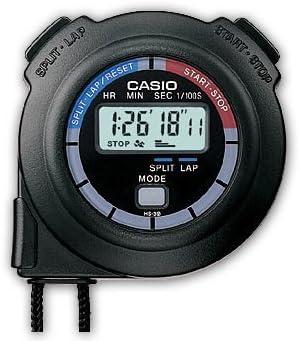
You do not need special gear to watch a game. Still, a stopwatch helps if you coach youth basketball, keep stats, or want to see how long each half really takes. First, look for a large display with a split or lap button. Next, check for a lanyard so it stays with you on the bench. Also, a flip score keeper is handy for pickup and youth games.



As an Amazon Associate, Measuring Expert earns from qualifying purchases.
What Stops the Clock in a College Basketball Game
In fact, basketball stops its clock far more often than most fans expect. Here are the main reasons the game clock sits still while real time keeps running:

- Fouls. Every whistle stops the clock. Not every foul leads to free throws, though; shooting fouls and fouls in the bonus do.
- Free throws. Players line up, shoot, and then the game restarts. Late in close games, teams often huddle with the coach before the shots.
- Out of bounds and violations. Similarly, the clock stops until the next inbound pass is touched.
- Team timeouts. Each team has four, and coaches often save them for the final minutes.
- Media timeouts. Networks use them for commercials. Each one usually runs a little over two minutes.
- Replay reviews. Officials go to the monitor for things like out-of-bounds calls, shot-clock issues and flagrant fouls.
Above all, most of this time piles up at the end. For instance, the last two minutes of a close game can take 10 to 15 minutes of real time, because the trailing team fouls on purpose to stop the clock.
College Basketball Game Rules for 2026-27
The NCAA changes basketball rules in two-year cycles, and 2026 is not a rules-change year. Even so, the men’s committees made a few tweaks that touch game flow. According to the NCAA’s May 2026 update, the clock must now run before a second media timeout can start when two would otherwise come back to back. Also, officials now call the 10-second backcourt violation when the shot clock reaches 19 seconds.
However, the bigger news is a proposal, not a rule. The men’s committees are studying a switch from two halves to four quarters, like the women’s game. They will gather more feedback first, so men still play two 20-minute halves in 2026-27. Meanwhile, the coach’s challenge added in 2025-26 stays in place: a team can challenge certain calls by using a timeout, and a successful challenge earns one more.
Because challenges and reviews add stoppages, they may keep games long. Therefore, expect a typical college basketball game to stay close to two hours this season.
College Basketball Game vs NBA and High School
People often assume all basketball games take the same time. In reality, the game clock changes with the level, and so does the real-time length. The table separates the three formats that fans mix up most.
| Level | Game clock | Halftime | Shot clock | Typical real time |
|---|---|---|---|---|
| College (NCAA) | 40 min | 15 min | 30 s | about 2 h |
| NBA | 4 x 12 min = 48 min | 15 min | 24 s | about 2 h 15 min |
| High school (most US states) | 4 x 8 min = 32 min | about 10 min | 35 s where used | about 1 h 30 min |
An NBA game has 8 more minutes of clock, yet it usually runs only about 15 minutes longer in real time. That is mainly because pro games have fewer fouls per minute and, in addition, fewer reviews. If you follow the pros, our guide to how many games are in the NBA season shows how those minutes add up.
Football is a different story. A college football game packs 60 minutes of clock into about three and a half hours, so it runs much longer. See our page on how long a college football game lasts for the numbers.
How to Time a College Basketball Game Yourself
- Start at tip-off. Begin your stopwatch at the opening jump ball, not at the listed broadcast start.
- Split each half or quarter. Press the lap button when the horn ends each period, so you can see which part ran longest.
- Log halftime separately. Take one split at the halftime horn and another at the second-half tip.
- Note the final four minutes. Take a split at the under-4 media timeout to see how long the finish takes.
- Stop at the final horn. End the timer when the clock hits zero, including any overtime.
- Convert the total. Finally, enter the minutes into the converter above to read the result in hours.
Game Night Planning: Do and Don’t
Do
- Budget about 2 hours from tip-off for the game.
- Add 30 to 60 minutes before tip for parking and security.
- Expect close games to run long at the end.
- Allow 15 to 20 more minutes for each overtime.
- Check whether the game is on national TV.
Don’t
- Plan as if 40 minutes of clock means 40 minutes.
- Assume halftime is shorter than 15 minutes.
- Count on the last two minutes being quick.
- Use NBA times for a college schedule.
- Forget postgame traffic in a big arena.
For example, at the 2025 average a 7:00 p.m. tip-off ends around 9:05 p.m., a 7:30 p.m. tip ends near 9:35 p.m., and a 9:00 p.m. tip ends near 11:05 p.m. Over a 30-game season, that adds up to about 62 hours of basketball.
Honest Limits of These Game Length Numbers
Of course, averages hide a wide range. For example, a blowout with few fouls can finish in well under two hours. On the other hand, a tight game with many reviews and a couple of overtimes can pass two and a half hours. Also, the 2025 average covers power-conference men’s games without overtime, so smaller conferences and non-televised games may run shorter. In short, use about 2 hours as a planning figure, not a guarantee. Women’s games follow a similar pattern, but published timing data for them is thinner, so we give no single average.
When the Exact Time Really Matters
For most fans, a few minutes either way is fine. However, some situations deserve a bigger cushion:
- Flights and trains after the game. Allow for overtime plus the time it takes to leave the arena.
- Tournament days. Conference and NCAA tournament sessions stack games back to back, so one long game pushes every later tip-off.
- Recording a game. Extend a recording by 30 to 60 minutes, because broadcasts often run past their slot.
College Basketball Game FAQs
How long is a college basketball game on average?
About 2 hours. Power-conference men’s games without overtime averaged 2 hours 4 minutes 35 seconds in 2025, according to tracking by Ken Pomeroy.
How many minutes of game clock are there?
There are 40 minutes of game clock in regulation. Men play two 20-minute halves, and women play four 10-minute quarters.
Does a college basketball game have quarters or halves?
It depends on the game. Men’s games use two halves, while women’s games have used four quarters since 2015-16. The men’s committees are studying quarters but have not adopted them.
How long is halftime in college basketball?
Halftime is 15 minutes for both men and women, the same length as an NBA halftime.
How long is overtime in college basketball?
Each overtime period lasts 5 minutes of game clock. In real time, one overtime usually adds about 15 to 20 minutes.
How many timeouts does each team get?
Each team gets four timeouts per game in both men’s and women’s play. Televised games also have media timeouts for commercials.
Is a college basketball game shorter than an NBA game?
Yes. College games have 40 minutes of clock against 48 in the NBA, and they usually finish about 15 minutes sooner in real time.
What is the shot clock in college basketball?
The shot clock is 30 seconds for both men and women. The NBA uses 24 seconds.
Why do the last two minutes take so long?
The trailing team fouls on purpose to stop the clock, which leads to free throws, timeouts and sometimes replay reviews.
Did the rules change for the 2026-27 season?
Only slightly. 2026 is not a rules-change year, but the clock must now run between back-to-back media timeouts, and the backcourt count ends at 19 on the shot clock.
The Bottom Line
To sum up, a college basketball game fits 40 minutes of game clock into about 2 hours of real time. The 2025 power-conference average was 2 hours 4 minutes 35 seconds, and reviews and late timeouts keep pushing it up.
So when you plan a game night, budget about two hours from tip-off and add time for overtime and traffic. Finally, if you timed a game yourself, use the converter at the top to turn your minutes into hours.
1 thought on “How Long Are College Basketball Games? Game Clock, Halftime and Real Time”