

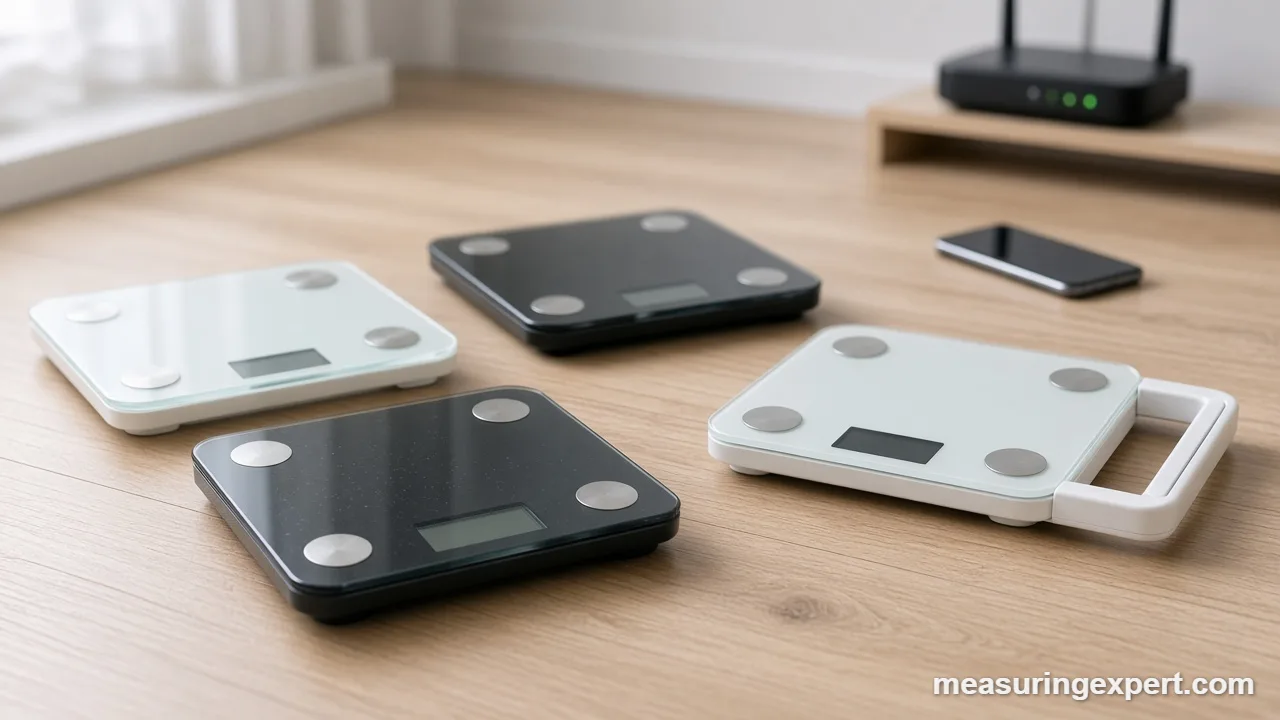
The best wireless weight scale for most homes is the Withings Body Comp, because it uploads every weigh-in over Wi-Fi without your phone, recognizes up to 8 people and states its weight accuracy. After that, the choice comes down to how many users share it, battery versus charging, and whether you want segmental estimates.
In short: buy the Withings Body Comp for hands-off accuracy, the Wyze Scale Ultra BodyScan for segmental estimates at a lower cost, and the Withings BodyScan 2 for the most detailed estimates.
As an Amazon Associate, Measuring Expert earns from qualifying purchases. Our picks are based on research, specifications and owner feedback, not paid placement.
Best Overall

Best Value
Best Premium
Quick Answer: The Best Wireless Weight Scale by Need
- Hands-off uploads with stated accuracy: Withings Body Comp.
- Weight data inside Garmin Connect: Garmin Index S2 Smart Scale.
- Segmental estimates plus a 6-lead ECG: Withings BodyScan 2.
- Arm and leg estimates at a mid-range cost: Wyze Scale Ultra BodyScan.
- More than 16 people in one home: Etekcity WiFi 8-Electrode Smart Scale.
Wireless here means Wi-Fi. If you only need Bluetooth sync, our guide to the best Bluetooth bathroom scale covers cheaper phone-only models. For training-focused body composition, see the best fitness scale roundup.
On This Page
- Comparison table
- The picks, reviewed
- How we chose
- Wi-Fi vs Bluetooth
- Specs that matter
- What the scale estimates
- How to set one up
- Keeping readings accurate
- Unit converter
- FAQ
- Bottom line
Best Wireless Weight Scale Comparison Table
| # | Product | Best For | Standout Feature | Amazon |
|---|---|---|---|---|
| 1 | Withings Body Comp | Most homes that want hands-off Wi-Fi uploads | Stated 50 g accuracy, Wi-Fi plus Bluetooth | View |
| 2 | Wyze Scale Ultra BodyScan | Arm, leg and torso estimates on Wi-Fi | 8 electrodes, 4.3 in color screen | View |
| 3 | Withings BodyScan 2 | Detailed segmental and heart data | 12 electrodes, 6-lead ECG handle | View |
| 4 | Garmin Index S2 Smart Scale | Garmin watch owners | Up to 16 users, Garmin Connect sync | View |
| 5 | Etekcity WiFi 8-Electrode Smart Scale | Big households on one scale | Unlimited users, 5-segment estimates | View |
The 5 Best Wireless Weight Scale Picks, Reviewed
Best Overall
1. Withings Body Comp
Best for: households that want weigh-ins to upload on their own, a published accuracy figure and a scale that up to 8 people can share.
The Withings Body Comp is our pick for the best wireless weight scale for most homes. It joins your home Wi-Fi (802.11 b/g/n) and also pairs over Bluetooth, so each reading reaches the Withings app even when your phone is in another room. In addition, it recognizes up to 8 users on its own.
On the measuring side, Withings lists a range of 9 to 440 lb (5 to 200 kg) and a graduation of 0.1 lb (50 g). More usefully, Withings states the weight is accurate to within 50 g, which few makers publish at all. The scale also estimates body fat, muscle, bone mass, water and visceral fat, and it adds standing heart rate and a vascular age estimate. Meanwhile, its 2.8-inch color screen shows readings, and Athlete, Pregnancy and Baby, and Eyes Closed modes adjust or hide the numbers.
- Range: 9 to 440 lb (5 to 200 kg); graduation 0.1 lb (50 g)
- Sync: Wi-Fi 802.11 b/g/n plus Bluetooth
- Users: up to 8, recognized automatically
- Display: 2.8 in color screen; units kg, lb and st lb
- Power: 4 AAA batteries, about 15 months on average
Pros
- Published weight accuracy figure
- Uploads over Wi-Fi without the phone nearby
- Very wide 440 lb range
- Long battery life
Cons
- Costs more than basic smart scales
- Some insights sit behind the optional Withings+ plan
- No segmental arm and leg estimates
Skip it if: you want arm, leg and torso estimates; the Wyze Scale Ultra BodyScan or Withings BodyScan 2 covers that.
Best Value
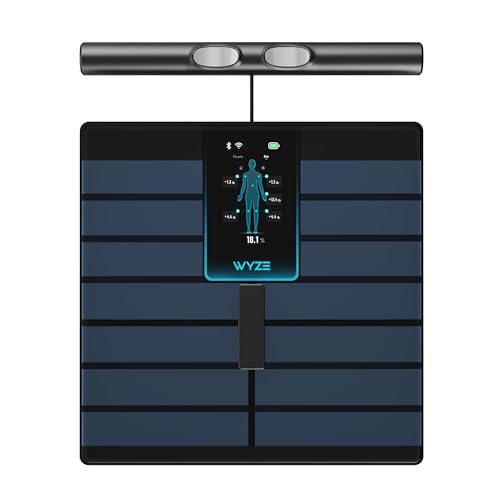
2. Wyze Scale Ultra BodyScan
Best for: people who want handle-based segmental estimates and Wi-Fi sync at a mid-range cost.
Wyze took its Scale Ultra, with its 4.3-inch full-color screen, and added a handle. As a result, the BodyScan uses 8 electrodes across the handle and feet to estimate the arms, legs and torso separately. Wi-Fi on the 2.4 GHz band is optional, and Bluetooth 5.0 handles setup and nearby syncing.
Wyze lists a range of 11 to 400 lb (5 to 180 kg) and up to 8 recognized users, plus unlimited guest weigh-ins. Also, it reports 13 metrics, 12 of them on the scale, and the app adds heart rate. In addition, Wyze states plainly that these are bioelectrical impedance estimates that may differ from professional medical instruments.
- Range: 11 to 400 lb (5 to 180 kg)
- Sync: optional 2.4 GHz Wi-Fi plus Bluetooth 5.0
- Electrodes: 8, across handle and feet
- Display: 4.3 in full-color TFT LCD
- Power: 4 AAA batteries, up to 8 months
Pros
- Segmental estimates for less than the BodyScan 2
- Large, readable color screen
- Guest mode for visitors
- Apple Health, Fitbit and Health Connect links
Cons
- Wi-Fi works on 2.4 GHz only
- Bulkier than a flat scale
- Wyze lists no weight increment
Skip it if: you only want weight and a simple trend; a flat scale such as the Garmin Index S2 is easier to store.
Best Premium
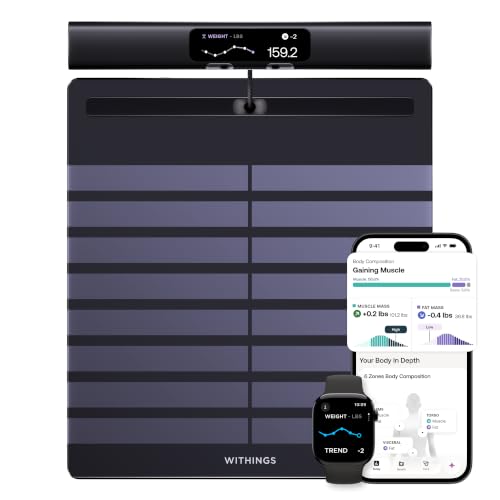
3. Withings BodyScan 2
Best for: people who want the most detailed home body composition estimates and a heart check in one Wi-Fi device.
The Withings BodyScan 2 is the most advanced scale on this list. A handle with its own color display pulls out of the base, so the current runs through both hands and feet. Withings lists 12 electrodes and multi-frequency bioimpedance at 13 frequencies up to 800 kHz. Therefore, it estimates muscle and fat across 6 body zones rather than mostly the legs.
Weighing matches the Body Comp: 9 to 440 lb (5 to 200 kg) in 0.1 lb (50 g) steps, with up to 8 recognized users. However, connectivity is different. Withings lists Wi-Fi 802.11 b/g/n and marks Bluetooth as coming soon, so this is a Wi-Fi scale today. Also, it stores up to 16 readings if Wi-Fi drops, and its Li-ion battery charges over USB-C and lasts up to a year on average. Finally, the handle records a 6-lead ECG.
- Range: 9 to 440 lb (5 to 200 kg); graduation 0.1 lb (50 g)
- Electrodes: 12, with a handle color display
- Sync: Wi-Fi 802.11 b/g/n (Bluetooth listed as coming soon)
- Power: rechargeable Li-ion, USB-C, up to 1 year
- Extras: 6-lead ECG, stores 16 readings offline
Pros
- Segmental estimates across 6 zones
- Year-long rechargeable battery
- Offline storage if Wi-Fi drops
- Same weighing specs as the Body Comp
Cons
- By far the most expensive pick
- Needs a recent phone (iOS 18 or Android 12 and up)
- Heavier at 7.5 lb
Skip it if: you mainly want a reliable weight trend; the Withings Body Comp weighs to the same 0.1 lb for much less.
Best for Garmin Users
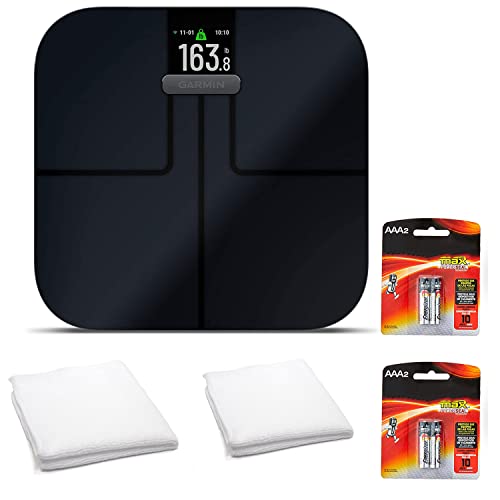
4. Garmin Index S2 Smart Scale
Best for: people who already train with a Garmin watch and want weight data in Garmin Connect next to their workouts.
The Garmin Index S2 connects over Wi-Fi and Bluetooth, and it also supports ANT. As a result, weigh-ins land in Garmin Connect, where they sit beside your runs, rides and sleep data.
Garmin rates it for up to 400 lb (181.4 kg) and up to 16 users, which is double the usual 8. Specifically, it shows weight and BMI, and it estimates body fat percentage, skeletal muscle mass, bone mass and body water on a color screen. However, its feature list is plainer than the Withings scales, with no heart rate or vascular age. Finally, it runs on 4 AAA batteries, which Garmin rates for up to nine months.
- Capacity: 400 lb (181.4 kg)
- Sync: Wi-Fi, Bluetooth and ANT to Garmin Connect
- Users: up to 16
- Metrics: weight, BMI, body fat, skeletal muscle, bone mass, body water
- Power: 4 AAA batteries, up to 9 months
Pros
- Best fit for the Garmin ecosystem
- 16 users, the most among fixed-slot picks
- Color screen
- Simple, focused feature set
Cons
- Less useful if you do not use Garmin Connect
- No heart rate or segmental estimates
- Shorter battery life than Withings
Skip it if: you use Apple Health or Fitbit as your main app; the Withings Body Comp or Wyze Scale Ultra BodyScan fit better.
Best for Large Families
5. Etekcity WiFi 8-Electrode Smart Scale
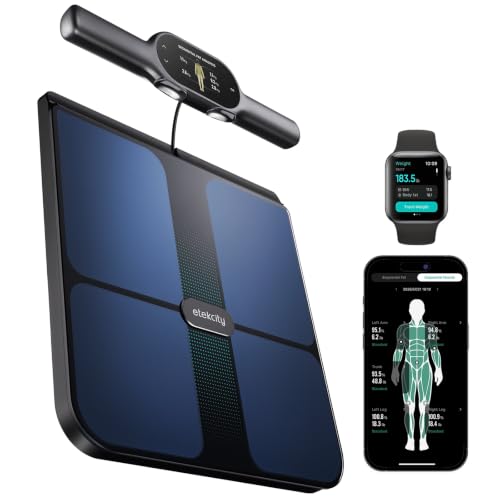
Best for: large households that want Wi-Fi uploads, handle-based segmental estimates and no cap on user profiles.
Etekcity is better known for budget Bluetooth scales, but this model (EFS-A791-KUS) syncs over Wi-Fi to the VeSync app, and Etekcity says it supports Bluetooth too. Above all, the key draw is sharing. Etekcity lists unlimited user profiles with automatic recognition, while most rivals stop at 8 or 16.
It uses 4 electrodes on the platform and 4 on the handles, so it estimates 5 segments: each arm, each leg and the torso. Meanwhile, results appear on a 3.5-inch color TFT display right after a weigh-in. In addition, a 700 mAh battery charges over USB-C, and Etekcity rates it for up to three months at two weigh-ins a day. For people with a pacemaker, and during pregnancy, Etekcity points to its Zero-Current Mode, which measures only weight and BMI.
- Sync: Wi-Fi auto sync to VeSync, plus Bluetooth
- Electrodes: 8 (4 platform, 4 handle), 5-segment analysis
- Users: unlimited, with automatic recognition
- Display: 3.5 in color TFT
- Power: 700 mAh battery, USB-C, up to 3 months
Pros
- No cap on user profiles
- Segmental estimates with a handle
- Zero-Current Mode for weight only
- Links to Apple Health, Google Fit, MyFitnessPal and Samsung Health
Cons
- Etekcity product page gives conflicting spec details
- Charge lasts months, not a year
- Newer model with a short track record
Skip it if: you want a published weight accuracy figure; the Withings Body Comp is the safer pick.
How We Chose the Best Wireless Weight Scale Picks
To be clear, we did not weigh people on these scales or run lab tests. Instead, this list is research-based. First, we narrowed the field to scales that join home Wi-Fi, because that is what sets a wireless weight scale apart from a phone-only Bluetooth model. Next, we kept to established makers that publish real specifications, such as Withings, Garmin, Wyze and Etekcity.
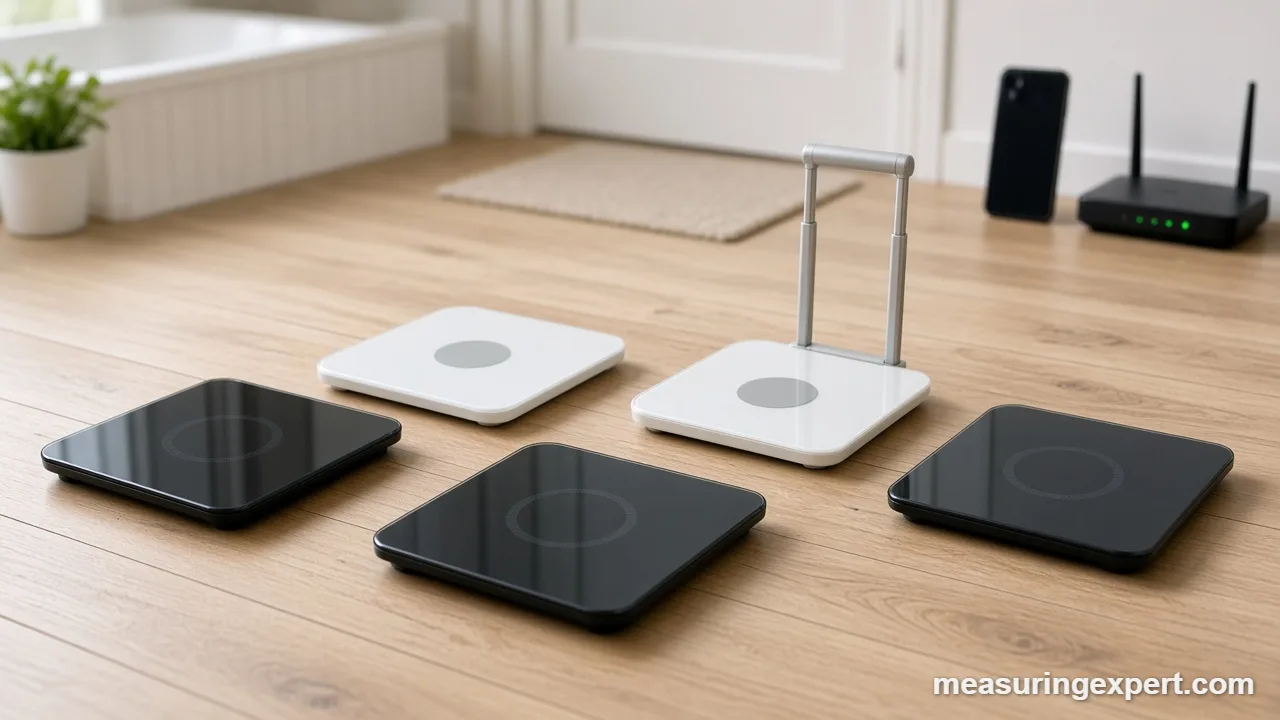
Then we checked each spec on the maker’s own product page, or on a detailed review where the maker’s page would not load. If we could not confirm a figure, we left it out. We also skipped the Bluetooth-only scales from our sister guide, so the two lists do not overlap. Finally, we left out Wi-Fi models from eufy and RENPHO, because we could not match a current listing to the maker’s spec page. We would rather rank five scales we could check than pad the page.
- Weighing: stated range in lb and kg, the display step, and any published accuracy figure.
- Wireless: Wi-Fi standard or band, Bluetooth as a backup, and offline storage.
- Sharing: how many users the scale recognizes and whether it has a guest mode.
- Honesty: whether the maker explains that body composition numbers are estimates.
- Daily use: screen, power source, battery life and app links.
For background on body composition methods, we used the Harvard T.H. Chan School of Public Health guide to measuring body fatness. For weighing specs, we relied on pages such as the Withings Body Comp technical specifications.
Wi-Fi vs Bluetooth: What Wireless Means on a Scale
First of all, both radios do the same job: they carry a finished reading from the scale to an app. However, they differ a lot in daily use, and that difference is why this guide focuses on Wi-Fi.
| Feature | Wi-Fi scale | Bluetooth-only scale |
|---|---|---|
| How readings sync | Straight to the cloud through your router | To your phone when the app is open nearby |
| Phone needed at weigh-in | No | Usually yes, or the scale holds the reading until later |
| Shared households | Easy; each person’s data uploads on its own | Each person must sync with their own phone |
| Setup | Harder; often needs a 2.4 GHz network | Simple pairing in the app |
In short, Wi-Fi pays off when several people share one scale. Bluetooth is fine for one person who opens the app daily anyway.
Specs That Decide the Best Wireless Weight Scale
In practice, a handful of spec lines tell you most of what you need. Below is what each one means in measurement terms.
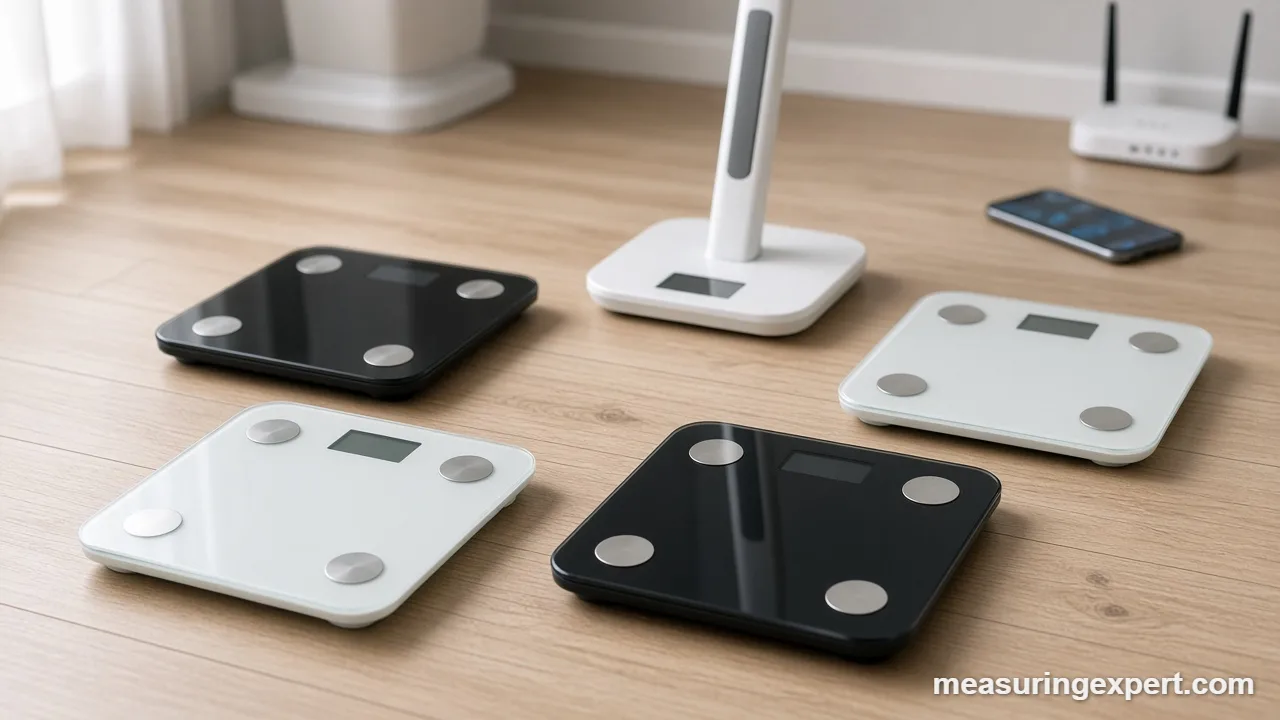
| Spec | What it tells you | What to look for |
|---|---|---|
| Capacity | The heaviest load the scale is rated to weigh | 400 lb (180 kg) is common; Withings lists 440 lb (200 kg) |
| Graduation | The smallest step the display shows | 0.1 lb or 0.05 kg is typical; it is not the same as accuracy |
| Stated accuracy | How far the reading may sit from the true weight | Rarely published; Withings states within 50 g |
| Electrodes | Contact pads for the BIA current | 4 for foot-to-foot estimates; 8 or more with a handle for segmental ones |
| Wi-Fi | The network the scale can join | Check for 2.4 GHz support and WPA2 |
| Users | Profiles the scale recognizes on its own | 8 is usual; Garmin lists 16, Etekcity unlimited |
| Power | AAA cells or a built-in battery | AAA picks here run 8 to 15 months; rechargeables 3 to 12 |
Graduation and accuracy often get mixed up. For example, a display can step in 0.1 lb while the real error is larger. Therefore, a published accuracy figure is worth more than a fine display.
Under the platform, four load cells bend slightly under your weight, and the scale converts that force into mass. Our explainer on what mass is covers the difference.
What a Wi-Fi Scale Measures, and What It Only Estimates
A smart scale measures two things directly: the force on its load cells, and the electrical resistance between its electrodes. Everything else, however, comes from a model. Body fat, muscle, water, bone mass, visceral fat, metabolic age and vascular age are all calculated from those inputs plus your height, age and sex.
This method is called bioelectrical impedance analysis, or BIA. Fat resists a small current more than lean tissue and water do, so the scale can infer how much of each you carry. However, the Harvard guide notes that BIA is hard to calibrate and less accurate than lab methods, especially at a BMI of 35 or more. It also points out that shifts in body water, such as during illness or dehydration, change the result.
Foot-only scales send the current mostly through the legs, while handle scales add the arms and torso. Even so, both rely on equations. As a result, compare a body fat number only with your own earlier readings, taken the same way.
How to Set Up a Wireless Weight Scale on Wi-Fi
Usually, setup takes a few minutes, and most problems come from the router rather than the scale. So work through these steps in order the first time.
- Check your router band. Confirm you have a 2.4 GHz Wi-Fi network available, since many scales cannot join 5 GHz, and note the network name and password.
- Place the scale on a hard floor. Set it on level tile, wood or concrete; avoid rugs, which let the platform flex and skew the load cells.
- Install the maker’s app. Download the app, create a profile with your height, age and sex, and turn on Bluetooth for the pairing step.
- Join the scale to Wi-Fi. Follow the in-app prompts to pass your Wi-Fi details to the scale, then wait for the scale to confirm the connection.
- Take a first reading. Step on barefoot with dry feet, stand still until the number locks, and check that the reading lands in the correct profile.
- Add other users and links. Invite family members, link Apple Health, Health Connect or Garmin Connect if you use them, and switch units if needed.
Keeping Your Wireless Weight Scale Accurate
You cannot recalibrate most smart scales at home, but you can check them. First, find a known load. For example, gym plates are marked, and one US gallon of water weighs about 8.34 lb (3.78 kg), not counting the jug. Next, weigh yourself, then weigh yourself holding the load, and compare the difference with the known value.
Then test repeatability. Step on three times in a row, stepping fully off between readings. A healthy scale should show nearly the same number each time. If it does not, check the floor, the feet and the batteries before you blame the load cells.
- Keep it in one spot. Moving the scale forces the load cells to settle on a new surface.
- Let it zero. After a move, tap the platform and wait for 0 before you step on.
- Mind the power. Weak cells or a low charge can cause drifting readings before any warning appears.
Convert Scale Readings: Pounds, Kilograms and Stone
Most smart scales switch between lb and kg, and some, like the Withings Body Comp, also show stone. By definition, 1 lb equals exactly 0.45359237 kg, so 1 kg is about 2.2046 lb. One stone is 14 lb, or about 6.35 kg. For smaller steps, see how many ounces are in a kilo.
Use the converter below to switch a reading between pounds, kilograms, grams and ounces. For example, enter 150 lb to see it in kg.
Best Wireless Weight Scale FAQ
What is the best wireless weight scale for most people?
For most homes, the Withings Body Comp is the best wireless weight scale. It syncs over Wi-Fi or Bluetooth, recognizes up to 8 users, weighs up to 440 lb, and Withings states its weight accuracy is within 50 g. The Wyze Scale Ultra BodyScan is a lower-cost Wi-Fi option with arm and leg estimates.
Is a Wi-Fi scale better than a Bluetooth scale?
Neither weighs more accurately, because the radio only moves the finished reading. However, a Wi-Fi scale uploads on its own, while a Bluetooth scale syncs when your phone and app are nearby. Wi-Fi suits shared homes; Bluetooth suits one person who always has a phone at hand.
Does the best wireless weight scale work on 5 GHz Wi-Fi?
Often not. Many smart scales join only 2.4 GHz networks; Wyze, for example, lists 2.4 GHz for the Scale Ultra BodyScan. So if your router combines bands under one name, you may need to enable a separate 2.4 GHz network during setup.
How accurate are body fat readings on a wireless scale?
They are estimates. Smart scales use bioelectrical impedance, which measures how a small current moves through the body and then applies an equation. Harvard notes the method is hard to calibrate and sensitive to hydration, so compare trends taken the same way rather than single numbers.
Is the weight reading more reliable than body composition?
Yes. Load cells measure the force of your body directly, while body fat, muscle and water come from a model. Therefore, a good scale can give a steady weight and a less steady body fat estimate on the same morning.
Can I use a smart scale with a pacemaker?
Use weight only unless your doctor says otherwise. Etekcity, for instance, points those users to a Zero-Current Mode that measures only weight and BMI.
What happens to my readings if the Wi-Fi goes down?
Most scales still show your weight on the screen. Some also store readings and upload them later; Withings says the BodyScan 2 keeps up to 16 readings when sync fails.
How many people can share the best wireless weight scale?
It depends on the model. Withings and Wyze recognize up to 8 users, Garmin lists 16, and Etekcity lists unlimited profiles for its WiFi 8-Electrode scale.
Do wireless scales need batteries or charging?
Both types exist. The Withings Body Comp, Garmin Index S2 and Wyze Scale Ultra BodyScan run on AAA cells, while the Etekcity WiFi 8-Electrode and Withings BodyScan 2 charge over USB-C.
How do I check if my wireless weight scale is accurate?
Weigh a known load and compare. For example, one US gallon of water weighs about 8.34 lb (3.78 kg) plus the jug. Also step on three times in a row; a healthy scale should give nearly the same number each time.
Bottom Line on the Best Wireless Weight Scale
For most readers, the Withings Body Comp is the best wireless weight scale to buy. It uploads over Wi-Fi without your phone, recognizes up to 8 people, reads in 0.1 lb steps and comes with a stated accuracy of 50 g. In addition, its batteries last about 15 months, so it rarely needs attention.
On the other hand, the Wyze Scale Ultra BodyScan adds arm and leg estimates for less, while the Withings BodyScan 2 suits anyone who wants segmental estimates and an ECG. Whichever you choose, keep it on a hard floor, weigh the same way each time, and treat body composition numbers as trends rather than facts.
1 thought on “Best Wireless Weight Scale: 5 Wi-Fi Smart Scales Compared”