

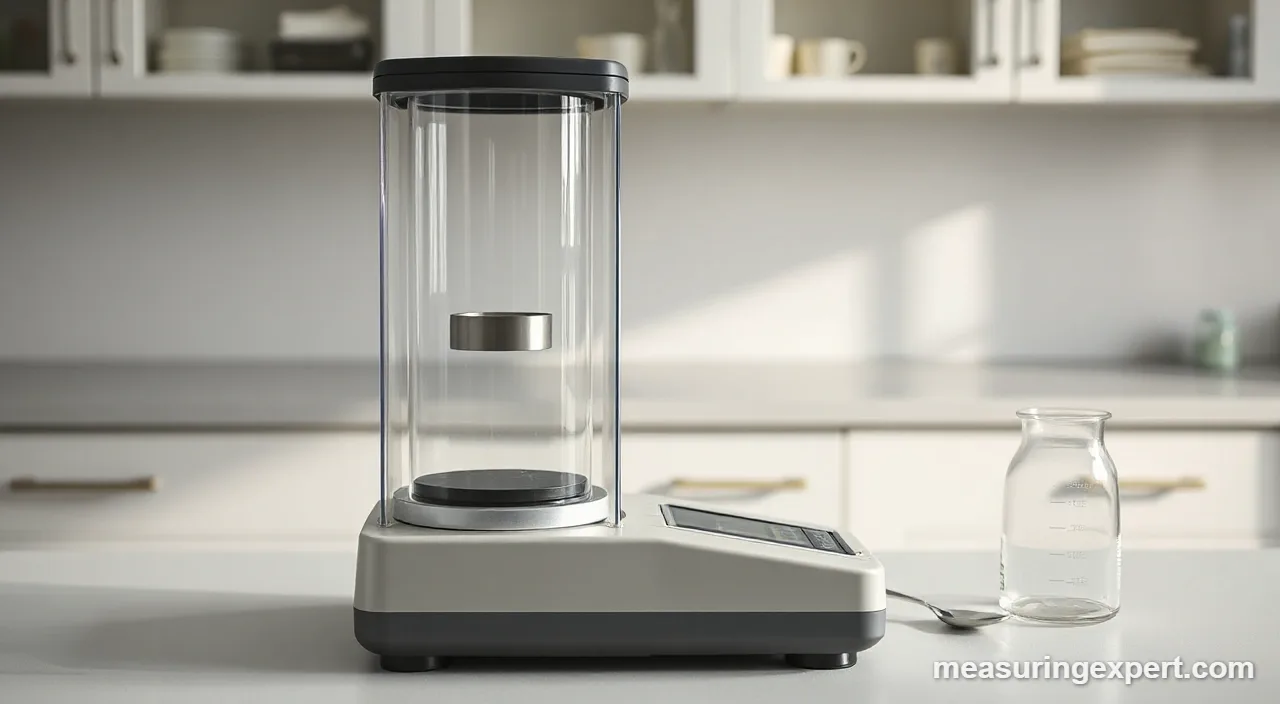
How much does a gram matter? On a kitchen scale, barely. In a lab, a tenth of a gram can mean a failed solution, a miscalibrated experiment or a lost sale. Lab scales exist to make small differences visible, and choosing one starts with a question about size: how small a change do you need to see?
The best lab digital scale for most home labs, classrooms and workshops is a 0.01 g balance such as the Ohaus SPX222 Scout, which offers a 220 g capacity and steps of one hundredth of a gram. If you need to see single milligrams, choose an analytical or milligram scale, but expect a lower capacity and more sensitivity to drafts. For rugged use, a 0.1 g scale like the My Weigh Triton T3 is easier to live with.
In short: match readability and capacity to your job, keep the scale level and calibrated, and do not pay for decimals you cannot use.
Scales that are used in trade are held to tolerances set in the NIST Handbook 44. The scales below are general-purpose lab-style tools, not legal-for-trade instruments, so check the manufacturer documents if you need that status.
For help with units and mass basics, see our guides on the best way to measure mass and accuracy versus precision. If your use is cooking, our best food scales list will fit better.
As an Amazon Associate we earn from qualifying purchases. Picks are based on manufacturer specs and buyer reports, not on lab testing, and we never type prices because they change.
220 g capacity with 0.01 g readabilityBest Fine ReadabilityU.S. Solid 1 mg Analytical Balance
1 mg readability in a lab-style balanceBest Compact Milligram ScaleMAXUS Digital Milligram Scale (50 g x 0.001 g)
50 g capacity with 0.001 g steps
Key Takeaways
- Best overall: the Ohaus SPX222 Scout (220 g x 0.01 g).
- Best fine readability: the U.S. Solid 1 mg analytical balance.
- Best compact milligram scale: the MAXUS 50 g x 0.001 g model.
- Readability is the step size of the display, not the accuracy of the scale.
- Capacity and readability trade off: finer steps usually mean lower maximum weight.
- Level the scale, avoid drafts and check it with known weights.
- Picks come from specs and buyer reports, not our own lab tests.
On this page
- How we chose
- The picks
- Readability, Accuracy and Repeatability Are Not the Same Thing
- Capacity vs Readability: Picking the Right Pair
- Units on Lab Scales: Grams, Milligrams, Grains and Carats
- How to Set Up and Check a Lab Scale
- Environment: Drafts, Vibration, Static and Temperature
- Honest Limits and When to Use a Professional Lab
- FAQ
- Bottom line
How We Chose These Picks
We shortlisted lab-style and precision scales from listings with strong ratings from many shoppers. We compared the specs each maker publishes, mainly capacity and readability, and left out listings with thin or unclear specs. This is research, not lab testing, and we did not run calibration trials on these scales.
Brands appear at most twice, near-duplicates are skipped and accessories such as calibration weights are mentioned in text but not ranked. We excluded scales that are marketed for activities outside science, craft, education and small business use.
The 10 Best Lab Digital Scales Right Now
Each card lists capacity and readability from the product title. We do not list prices because they change.
| # | Pick | Best for | Standout |
|---|---|---|---|
| 1 | Ohaus SPX222 Scout Analytical Balance (220 g x 0.01 g) | school labs, home science and small workshops | 220 g capacity with 0.01 g readability |
| 2 | U.S. Solid 1 mg Analytical Balance | jobs that need one-milligram steps | 1 mg readability in a lab-style balance |
| 3 | MAXUS Digital Milligram Scale (50 g x 0.001 g) | small samples on a desk | 50 g capacity with 0.001 g steps |
| 4 | Tanita 1479Z Digital Milligram Scale | people who prefer an established scale maker | Milligram scale from a long-running scale brand |
| 5 | Jennings JSR 150 (150 g x 0.1 g) | workshop and class use that needs 0.1 g steps | 150 g capacity, 0.1 g readability |
| 6 | My Weigh Triton T3 (660 g x 0.1 g) | workshops and field use | 660 g capacity with a rubber case |
| 7 | American Weigh Scales Digital Pocket Scale (600 g x 0.1 g) | portable weighing for craft, kitchen and school | Pocket size with 600 g capacity |
| 8 | Fuzion Pocket Gram Scale (1000 g x 0.1 g) | portable weighing up to a kilogram | 1000 g capacity in a mini scale |
| 9 | GemOro Platinum XP500 Pocket Scale | jewelry and gem weighing | Extra-precision pocket scale for gems and jewelry |
| 10 | Ohaus 750-S0 Triple Beam Balance (610 g) | classrooms and places without power | Mechanical beam balance with 610 g capacity |
Buying from this list? Get it fast, and catch Black Friday deals, with Prime
#1Best Overall
Ohaus SPX222 Scout Analytical Balance (220 g x 0.01 g)

Best for: school labs, home science and small workshops
Ohaus is a name found in teaching labs, and the Scout line is its portable, everyday range. The title gives the numbers that matter: a 220 g capacity and a 0.01 g readability, which is fine enough for most chemistry class work, soap making and small-batch mixing.
Readability of 0.01 g means the display moves in steps of one hundredth of a gram. That is plenty for typical hobby jobs, though not for milligram work. Give it a level, vibration-free table and allow time to warm up, and it will repeat well.
- Capacity: 220 g, per the title
- Readability: 0.01 g, per the title
- Type: portable electronic balance
- Brand: Ohaus
- Respected lab brand
- Good capacity for small projects
- Fine enough for most home science
- Not a milligram balance
- Needs a stable surface and calibration care
Skip it if you need to weigh to 1 mg or better.
#2Best Fine Readability
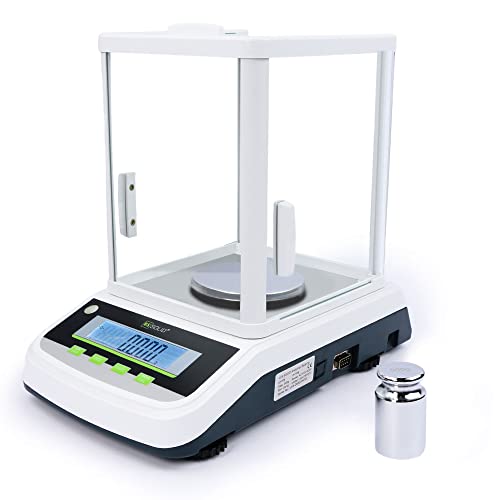
U.S. Solid 1 mg Analytical Balance
Best for: jobs that need one-milligram steps
When the title promises 1 mg, you are in analytical balance territory: the display steps in thousandths of a gram. That is the level used for small reagent amounts, fine supplements measured by qualified labs and precise formulation work.
Analytical balances are sensitive to drafts, vibration and temperature. Expect to use a draft shield, a level bench and regular calibration checks. For bulk weighing, this is overkill; for small quantities, it is the right class of tool.
- Readability: 1 mg, per the title
- Type: digital analytical balance
- Brand: U.S. Solid
- Lab-style precision scale
- Very fine readability
- Suits small-quantity work
- Lab-style design
- Sensitive to drafts and vibration
- Small capacity compared with kitchen scales
Skip it if you weigh anything heavier than a few hundred grams.
#3Best Compact Milligram Scale
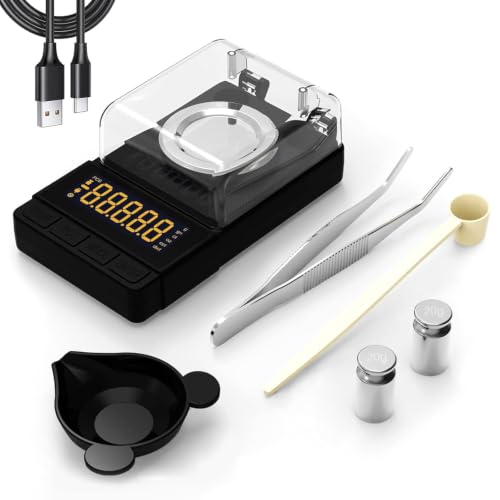
MAXUS Digital Milligram Scale (50 g x 0.001 g)
Best for: small samples on a desk
The title gives a 50 g capacity and a 0.001 g step, which means one milligram per step in a pocket-size body. Milligram pocket scales are popular for craft, jewelry and small-sample lab tasks.
Small size does not mean casual handling. These scales need a flat surface, still air and calibration weights to stay honest, and their readings drift if you handle the tray roughly. Treat it as a precision tool and it will serve well.
- Capacity: 50 g, per the title
- Readability: 0.001 g, per the title
- Type: compact milligram scale
- Brand: MAXUS
- Milligram steps in a small body
- Easy to store
- Good for small samples
- Low capacity
- Needs calibration care and still air
Skip it if you weigh anything over 50 g.
#4Best Brand-Name Milligram Scale
Tanita 1479Z Digital Milligram Scale

Best for: people who prefer an established scale maker
Tanita is best known for body and kitchen scales, and the 1479Z is its milligram model. The title promises Japan technology and accuracy, and the milligram class makes it suitable for craft and small-sample work.
As with any milligram scale, treat the readout with respect: use a stable table, use the tray gently and check it with a calibration weight. A brand name helps with manuals and support.
- Type: digital milligram scale, per the title
- Brand: Tanita
- Japan technology claim, per the title
- Pocket-size design
- Established brand
- Milligram class steps
- Compact
- Small capacity
- Needs calibration weights for confidence
Skip it if you want high capacity.
#5Best Budget-Style Basic Scale
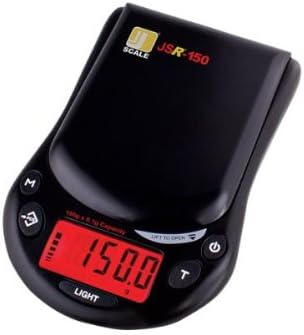
Jennings JSR 150 (150 g x 0.1 g)
Best for: workshop and class use that needs 0.1 g steps
A 0.1 g step is much coarser than a milligram scale, but it is enough for many classroom exercises, soap and candle recipes and shipping small items. The Jennings JSR 150 offers a 150 g capacity per the title.
Pick a scale like this when you need steady readings more than ultra-fine ones. It is also easier to keep accurate than a milligram scale because small air movements matter less at 0.1 g.
- Capacity: 150 g, per the title
- Readability: 0.1 g, per the title
- Type: compact digital scale
- Brand: Jennings
- Simple and steady
- Good for everyday classroom use
- Less sensitive to drafts
- Low capacity
- Not for small-sample work
Skip it if you need steps below 0.1 g.
#6Best Rugged Scale
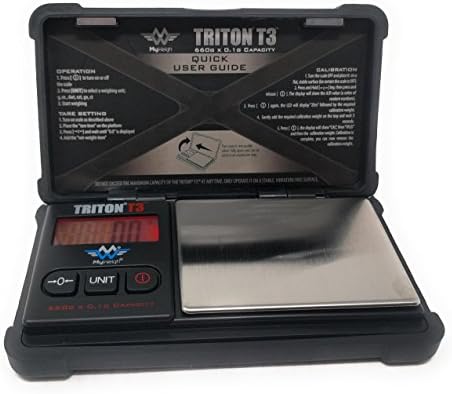
My Weigh Triton T3 (660 g x 0.1 g)
Best for: workshops and field use
The My Weigh Triton T3 is listed at 660 g x 0.1 g with a durable rubber case, which suits benches where scales get knocked around. The extra capacity versus the Jennings gives you more room for beakers and containers.
The rubber case protects it from bumps and spills, but the sensor is still a precision part. Use the tare button for containers, and let it warm up before a critical weighing.
- Capacity: 660 g, per the title
- Readability: 0.1 g, per the title
- Rubber case, per the title
- Brand: My Weigh
- Rugged body
- Good capacity for containers
- Simple controls
- Not a milligram scale
- Needs level surface
Skip it if you need fine readability.
#7Best Pocket Scale
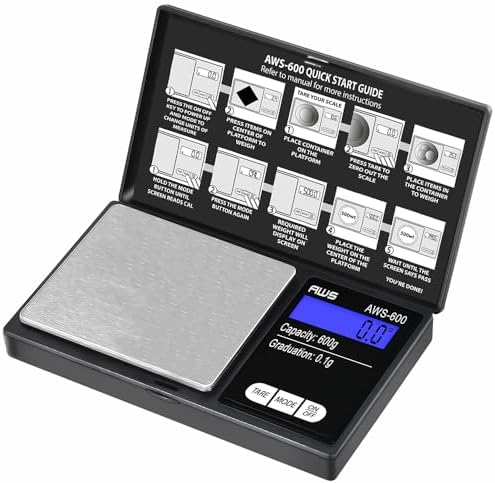
American Weigh Scales Digital Pocket Scale (600 g x 0.1 g)
Best for: portable weighing for craft, kitchen and school
Pocket scales are built to travel. This American Weigh model lists 600 g capacity with 0.1 g readability, a useful range for spices, mailing small items, craft supplies and basic science projects.
The small footprint can limit the size of containers you can weigh. For beakers and tall vessels, a larger platform is more practical, but for a tray-based job, pocket scales are hard to beat.
- Capacity: 600 g, per the title
- Readability: 0.1 g, per the title
- Type: pocket digital scale
- Brand: American Weigh Scales
- Small and portable
- Good capacity for its size
- Easy to operate
- Small platform
- Not for fine work
Skip it if you weigh in large beakers.
#8Best High-Capacity Pocket Scale
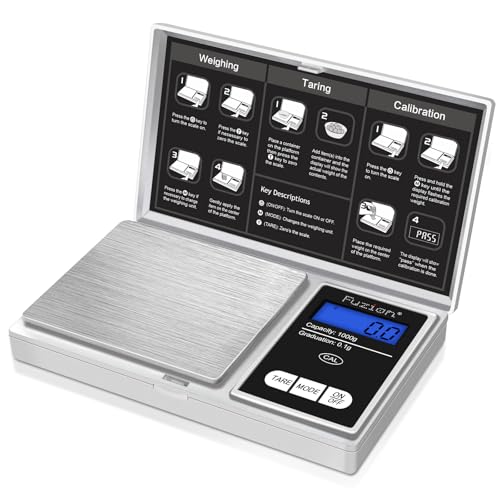
Fuzion Pocket Gram Scale (1000 g x 0.1 g)
Best for: portable weighing up to a kilogram
The Fuzion listing claims 1000 g capacity and 0.1 g readability in a mini travel body. If you need to weigh heavier items occasionally and still want a pocket size, this range is attractive.
Pair a high-capacity mini scale with careful habits: place items gently in the center and avoid overloading beyond the rated capacity. Calibrate when you notice drift.
- Capacity: 1000 g, per the title
- Readability: 0.1 g, per the title
- Mini travel size
- Brand: Fuzion
- High capacity for pocket size
- Portable
- Simple operation
- Coarser steps than milligram scales
- Small platform
Skip it if you need milligram precision.
#9Best for Small Valuable Items
GemOro Platinum XP500 Pocket Scale

Best for: jewelry and gem weighing
The GemOro XP500 targets jewelry users, with a 500 g capacity in the title. Gemstone weights are often given in carats, where one carat equals 0.2 g, and many scales offer a carat mode.
Pocket jewelry scales need a calm surface and a steady hand. For stones, use the carat function and verify with calibration weights.
- Capacity: 500 g, per the title
- Type: extra-precision pocket scale
- Jewelry-oriented design
- Brand: GemOro
- Made for small valuables
- Handy unit modes in the category
- Compact
- Not for heavy loads
- Sensitive to handling
Skip it if you weigh larger lab containers.
#10Best No-Battery Option
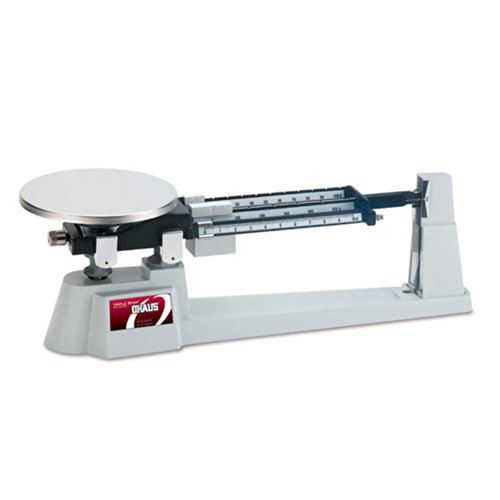
Ohaus 750-S0 Triple Beam Balance (610 g)
Best for: classrooms and places without power
A triple beam balance weighs by balancing sliding riders against the sample, so there are no batteries, displays or electronics to fail. This Ohaus model is listed at 610 g capacity in stainless steel.
Beam balances are slower than digital ones and are read by eye, but they make the physics of weighing visible, which is why teachers love them. They also keep working after a power failure.
- Capacity: 610 g, per the title
- Mechanical triple beam design
- Stainless steel build, per the title
- Brand: Ohaus
- No batteries or electronics
- Teaches how weighing works
- Long service life
- Slower to read
- Cannot match digital readability
Skip it if you want quick digital readouts.
Readability, Accuracy and Repeatability Are Not the Same Thing
A scale shows many digits, but not all digits are true. Three terms explain what you are buying.
| Term | Meaning | Example |
|---|---|---|
| Readability | The smallest step on the display | 0.01 g means steps of one hundredth of a gram |
| Accuracy | How close a reading is to the true mass | A 100 g weight reads 100.00 g |
| Repeatability | How closely repeated weighings agree | Five weighings of the same item differ by 0.01 g or less |
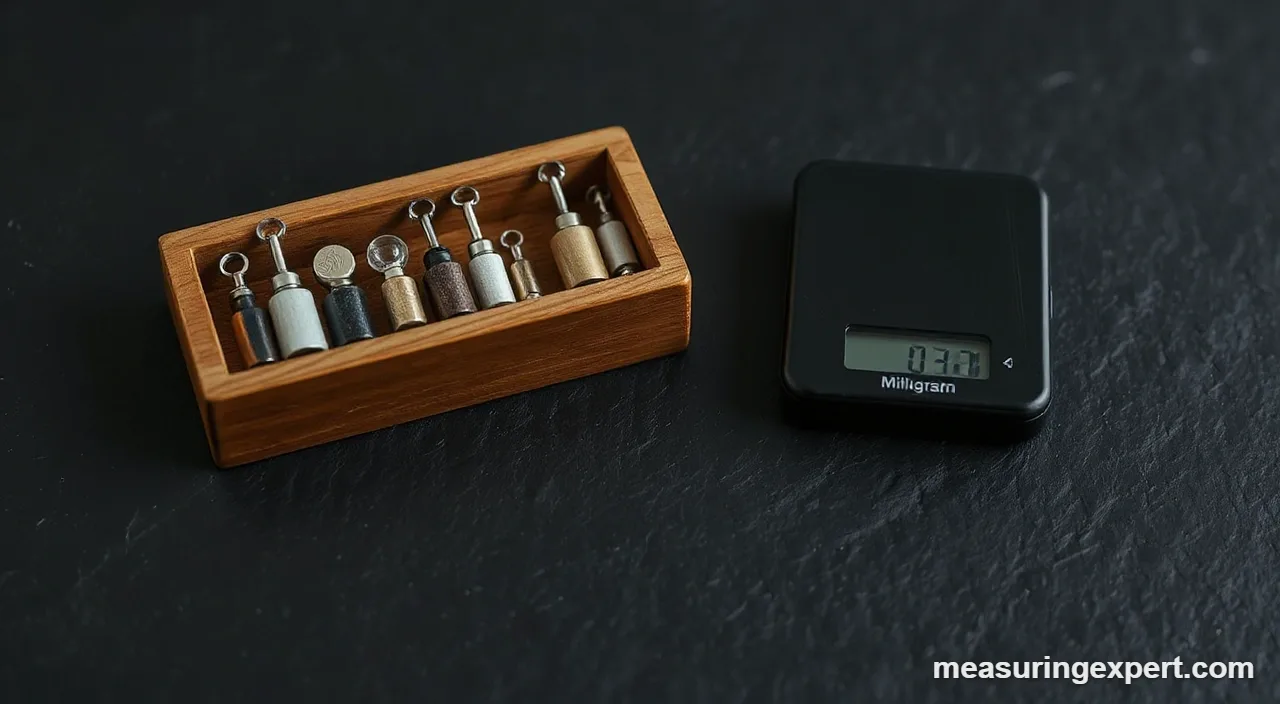
A scale can read to 0.001 g and still be inaccurate if it is out of calibration or sitting on a wobbly table. Calibration with traceable weights is what turns readability into trust.
Capacity vs Readability: Picking the Right Pair
Lab scales trade capacity for readability. A balance that steps by 0.001 g typically tops out at tens or hundreds of grams, while 0.1 g scales weigh up to kilograms.
| Readability | Typical capacity | Typical jobs |
|---|---|---|
| 0.001 g (1 mg) | About 50 g to 200 g | Small samples, jewelry, fine formulation |
| 0.01 g | About 200 g to 600 g | Classroom chemistry, soap, small batches |
| 0.1 g | About 150 g to 1000 g | Cooking science, shipping, general weighing |
| 1 g | Several kilograms | Bulk and heavy items |
Pick the coarsest readability that still meets your tolerance. If a recipe or procedure allows plus or minus 0.1 g, a 0.01 g scale already gives a safe margin.
Units on Lab Scales: Grams, Milligrams, Grains and Carats
Many scales let you switch units. A milligram is 0.001 g, a carat is 0.2 g and a grain is 64.79891 mg. One US ounce is 28.349523125 g. The converter above handles the math, and the table shows common values.
| Unit | In grams | Common use |
|---|---|---|
| Milligram (mg) | 0.001 g | Small samples |
| Grain (gr) | 0.06479891 g | Traditional weights |
| Carat (ct) | 0.2 g | Gemstones |
| US ounce (oz) | 28.349523125 g | US consumer goods |
How to Set Up and Check a Lab Scale
- Place the scale on a solid, level table away from vents, fans and doors.
- Level it using the bubble level or feet, if it has them.
- Power it on and let it warm up for the time the manual states, often 10 to 30 minutes for fine balances.
- Press tare with the empty pan to zero it.
- Place a certified calibration weight close to your working range, such as 100 g on a 220 g scale.
- Compare the display with the weight value; if it is off by more than the manual tolerance, run the calibration routine.
- Repeat with a smaller weight to check linearity.
- Level the scale and warm it up first.
- Use tare for the container.
- Check with certified calibration weights.
- Handle weights with tweezers or gloves.
- Keep the pan clean and dry.
- Overload the pan beyond capacity.
- Weigh warm or wet items.
- Place the scale near fans or doors.
- Press on the pan while it reads.
- Use it for medical dosing.
Environment: Drafts, Vibration, Static and Temperature
Fine scales respond to everything. Air currents move a light pan, vibration from a washing machine appears as jitter, static electricity can pull on plastic containers and temperature changes cause drift. A heavy table, a draft shield and a consistent room temperature solve most issues.
Always place samples in the center of the pan, use clean tweezers or gloves for small items and let warm items cool before weighing, because warm air rising from a container can shift the reading.
Honest Limits and When to Use a Professional Lab
Consumer lab scales are good for teaching, hobby science and small business uses, but they are not substitutes for certified instruments in regulated work. If you weigh for commerce, medicine or compliance, use a scale approved for that purpose and have it calibrated by an accredited service. Never use a hobby scale to measure doses of medicine or supplements. Ask a pharmacist or doctor about dosing, and use the dosing tools that come with the product.
Lab Scale Questions
What readability do I need for a home lab?
For classroom chemistry, soap making and general experiments, 0.01 g is a good level. Use 0.001 g only when your procedure demands milligram steps, and expect lower capacity and more sensitivity.
What is the difference between accuracy and readability?
Readability is the smallest display step. Accuracy is how close the reading is to the true mass. A scale with fine readability can still be inaccurate if it is not calibrated or is placed on a wobbly surface.
Do I need calibration weights?
Yes if you rely on the results. A certified weight near your working range lets you check the scale and run its calibration routine. Check the manual for the weight value and class it needs.
How often should I calibrate?
Check before important work and any time you move the scale. Many users also verify weekly or monthly. Follow the manual and any rules that apply to your work.
Why does my scale reading drift?
Common causes are drafts, temperature changes, static electricity, vibration, low battery and not allowing warm-up. Fix the environment first, then recalibrate.
Is a triple beam balance still useful?
Yes. It needs no power, teaches weighing and lasts for years, though it reads slower and with coarser steps than digital scales.
Can I use a lab scale for cooking?
Yes, but a food scale with a larger platform is easier for bowls. Lab scales shine for small amounts like spices and yeast, where steps of 0.1 g or finer help.
How do I convert grams to ounces?
Divide grams by 28.349523125 to get US ounces. For example, 100 g is 3.527 oz. The converter above does this and other unit conversions.
What does a carat weigh?
A metric carat is 0.2 g, so five carats make one gram. Many jewelry scales have a carat mode for gemstones.
Can a lab scale weigh medicine or supplements?
Do not use hobby scales for dosing. Use the dosing device that came with the product and ask a pharmacist or doctor when in doubt.
Bottom Line
Lab scales reward you for knowing what you need. Decide the smallest step you need to see, pick a capacity that fits your containers and then care for the scale: level table, warm-up, tare and calibration weights.
For most home labs, the Ohaus SPX222 at 0.01 g gives a good balance of capacity and readability. Step up to a milligram scale for small samples, and drop to a 0.1 g scale for rugged, higher-capacity work.
Our verdict: the Ohaus SPX222 Scout for general lab-style work, the U.S. Solid 1 mg balance for fine samples, the My Weigh Triton T3 for rugged jobs and the Ohaus triple beam when you want no electronics.
Listen to a free audiobook while you cook, work or wait