

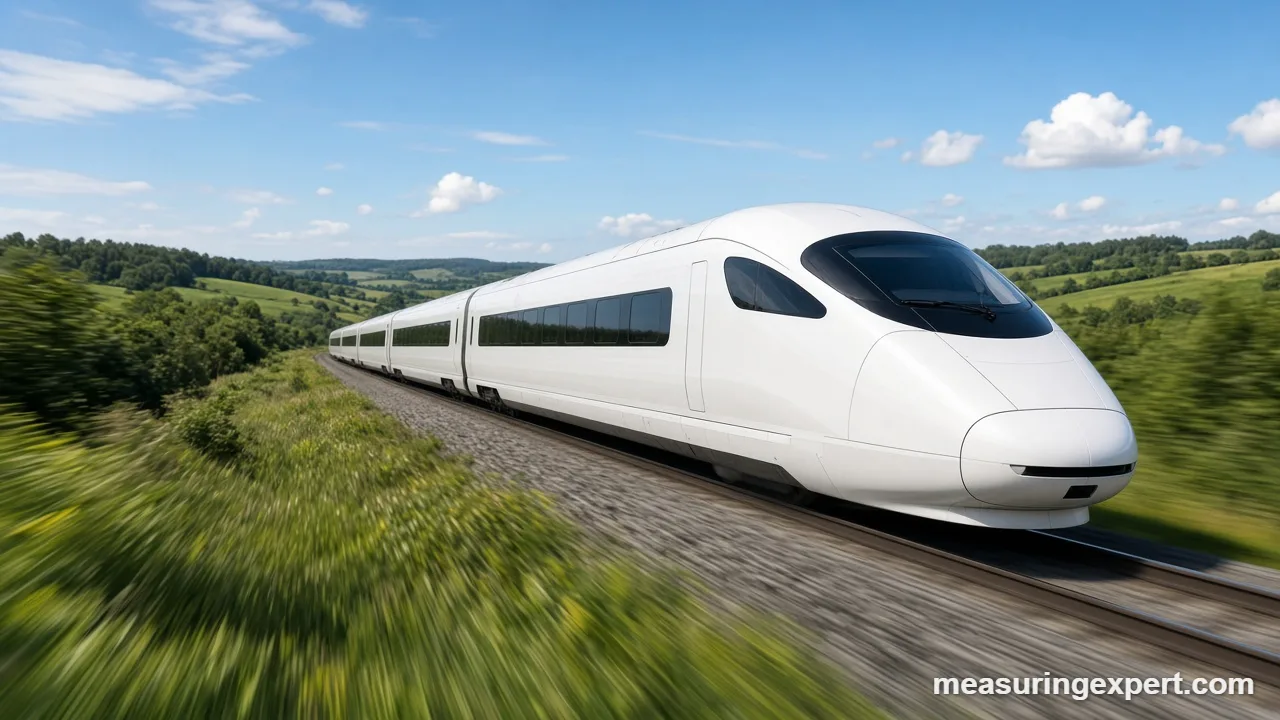
300 km per hour equals about 186.4 miles per hour, 83.3 meters per second, 273.4 feet per second or 162 knots. In other words, you cover one kilometer every 12 seconds. Also, that is the cruising speed of many high-speed trains and close to the top speed of a Formula 1 car on a long straight.
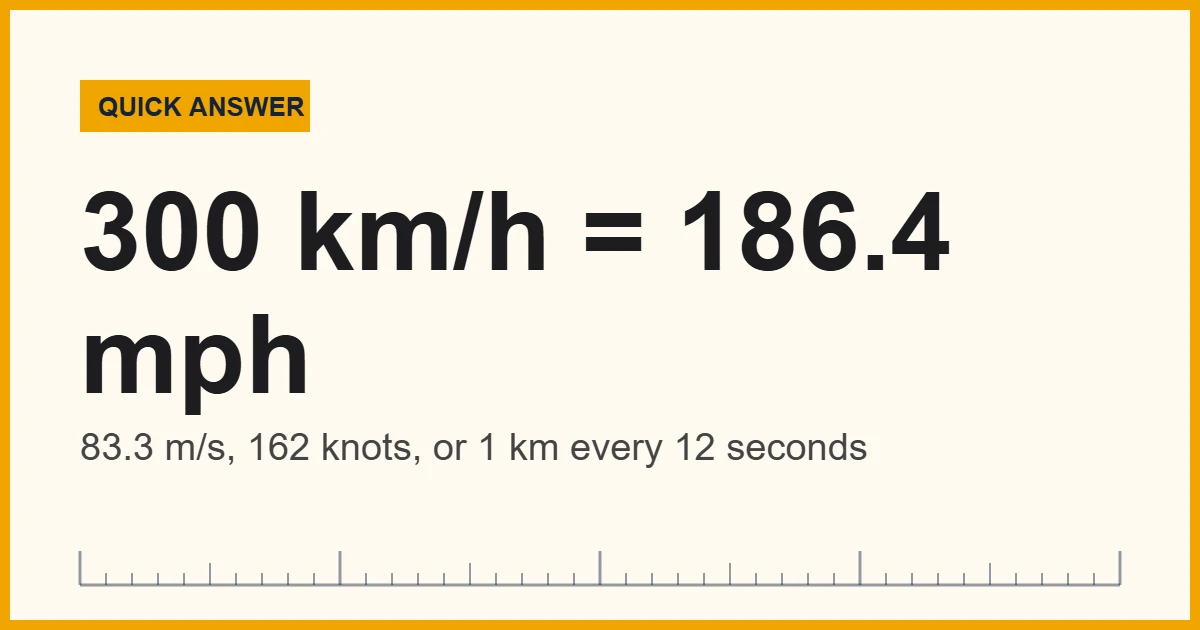
Convert 300 km per Hour to mph, m/s and Knots
First, the converter starts at 300 km/h. Then change the number or the unit, and it instantly shows the same speed in miles per hour, meters per second, knots and feet per second. In addition, it uses the exact definitions, so the results match the tables below.
For example, numbers like 300 km/h show up in train timetables, racing broadcasts and car spec sheets. However, a figure on a screen rarely tells you how fast it feels. That is why this guide turns the number into things you can picture: seconds per kilometer, football fields per second and real machines that travel at that pace.
Fortunately, the conversion itself is fixed by definition. The US National Institute of Standards and Technology (NIST) lists the exact factors in its guide to SI conversion factors: one mile per hour is 0.44704 m/s, and one knot is 1.852 km/h. Therefore, the math below involves no rounding until the final step.
300 km per Hour Conversion Chart
Next, this chart puts 300 km/h next to the speeds around it. As a result, you can see at a glance how a train at 320 km/h or a race car at 350 km/h compares.
| km/h | mph | m/s | Knots | Where you meet it |
|---|---|---|---|---|
| 100 | 62.1 | 27.78 | 54.0 | For example, highway driving in many countries |
| 150 | 93.2 | 41.67 | 81.0 | Fast regional trains |
| 200 | 124.3 | 55.56 | 108.0 | Many family cars near their top speed |
| 250 | 155.3 | 69.44 | 135.0 | Electronic limit on many German sedans |
| 280 | 174.0 | 77.78 | 151.2 | Airliner takeoff range |
| 300 | 186.4 | 83.33 | 162.0 | Eurostar and also many bullet trains |
| 320 | 198.8 | 88.89 | 172.8 | Fastest Shinkansen and TGV service |
| 350 | 217.5 | 97.22 | 189.0 | China’s Fuxing trains; F1 on long straights |
| 400 | 248.5 | 111.11 | 216.0 | Hypercar territory, so rare on public roads |
Also, values are rounded to one or two decimals. For a printable copy, use your browser’s print option on this page.
300 km per Hour in Every Speed Unit
Different fields measure speed in different units, so people often mix them up. For example, pilots and sailors work in knots, scientists use meters per second, and US drivers think in mph.
| Unit | What it means | 300 km/h equals | Who uses it |
|---|---|---|---|
| km/h | Kilometers covered in one hour | 300 | Most of the world’s road signs and trains |
| mph | Statute miles (1.609344 km) per hour | 186.41 | US and UK roads |
| Knot | Nautical miles (1.852 km) per hour | 161.99 | Aviation, shipping, weather |
| m/s | Meters per second, the SI unit | 83.33 | Physics and engineering |
| ft/s | Feet per second | 273.40 | US engineering, ballistics |
| Mach | Fraction of the speed of sound | about 0.24 (at sea level, 15 °C) | Aircraft |
Real-World Examples of 300 km per Hour
In fact, very few things on the ground move this fast. Still, a handful of trains, race cars and natural events hit or pass 300 km/h, so they make useful reference points.
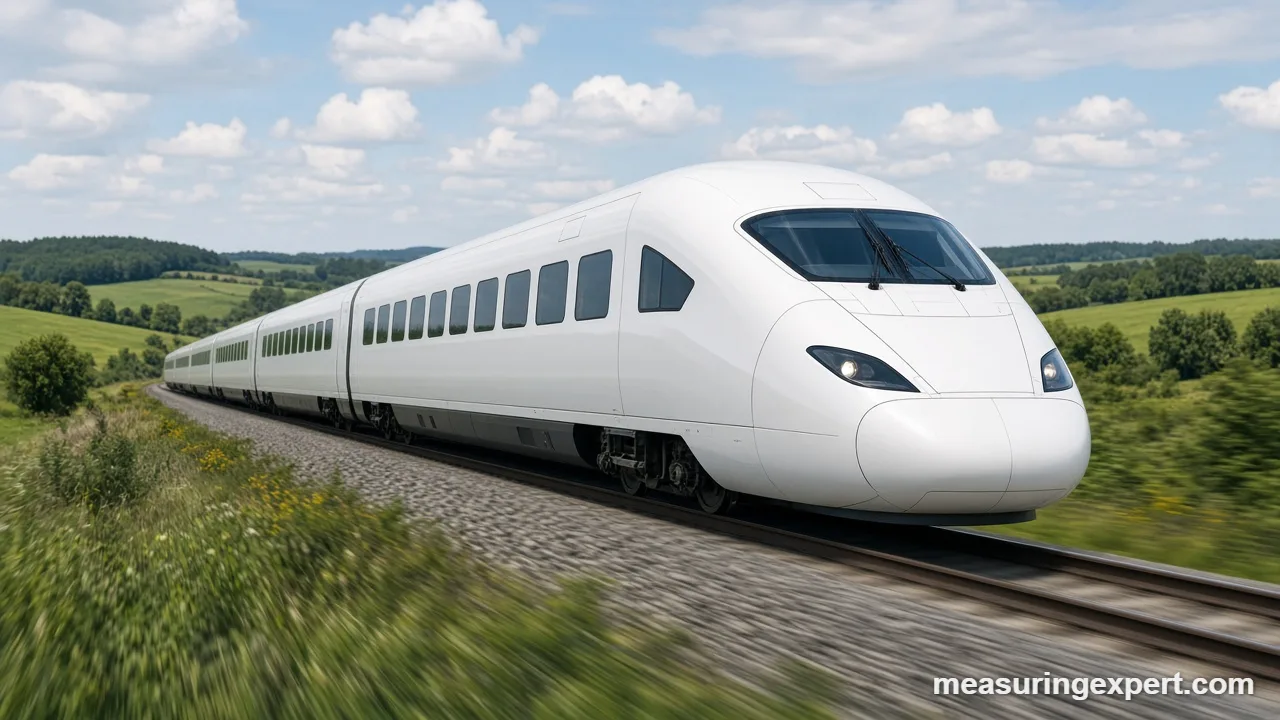
High-speed trains
Above all, rail is where most people actually experience 300 km per hour. Indeed, many bullet trains cruise at or just above this speed for long stretches.
| Train | Country | Max service speed | In mph |
|---|---|---|---|
| Eurostar | UK, France, Belgium | 300 km/h | 186 mph |
| Shinkansen (E5 series) | Japan | 320 km/h | 199 mph |
| TGV | France | 320 km/h | 199 mph |
| Fuxing (CR400) | China | 350 km/h | 217 mph |
| NextGen Acela | United States | 257 km/h | 160 mph |
For comparison, the newest Amtrak Acela trains, which entered service in 2025, top out at 160 mph. Therefore, even America’s fastest train runs about 26 mph slower than 300 km/h.
Cars and Formula 1
First, most family cars top out somewhere between about 180 and 250 km/h, often because of an electronic limiter. By contrast, a Formula 1 car regularly passes 300 km/h and can reach roughly 350 km/h on long straights such as Monza. Meanwhile, road-going supercars like the Lamborghini Aventador claim about 350 km/h, and the Bugatti Veyron was rated at 407 km/h. In short, 300 km/h is race-track and hypercar territory, not everyday driving.
Planes, birds and storms
- Airliner takeoff: For instance, a loaded jet typically lifts off at roughly 240 to 300 km/h, depending on its type and weight. After that, it climbs to a cruise of about 850 to 930 km/h, which is three times faster. See how fast planes fly for the full range.
- Small planes: By comparison, a trainer such as the Cessna 172 cruises at around 120 knots (about 220 km/h), so a bullet train would pass it.
- Peregrine falcon: Likewise, this bird is often credited with hunting dives above 320 km/h (200 mph).
- Hurricane winds: The National Hurricane Center rates winds of 252 km/h (157 mph) or more as Category 5. Thus, 300 km/h sustained wind sits well inside the top category.
How to Convert 300 km per Hour Yourself
Of course, you do not need a calculator for a rough answer. However, the exact method takes only a few steps.
- Start with the speed in km/h. In this case, the value is 300.
- For mph, divide by 1.609344. 300 / 1.609344 = 186.41 mph. As a quick check, multiply km/h by 0.62.
- For m/s, divide by 3.6. An hour has 3,600 seconds and a kilometer has 1,000 meters, so 300 / 3.6 = 83.33 m/s.
- For knots, divide by 1.852. Thus 300 / 1.852 = 161.99 knots.
- For feet per second, divide the m/s value by 0.3048. Then 83.33 / 0.3048 = 273.4 ft/s.
- Round only at the end. In other words, keep full precision during the math, then round to one or two decimals.
How Far You Travel at 300 km per Hour
Above all, distance per second is the easiest way to feel this speed. At 83.3 meters per second, you cross a 100-meter track in 1.2 seconds. Similarly, a 100-yard football field (91.44 m) passes in about 1.1 seconds.
| Time | Distance at 300 km/h | In miles or feet |
|---|---|---|
| 1 second | 83.3 m | 273 ft |
| 12 seconds | 1 km | 0.62 mi |
| 19.3 seconds | 1.61 km | 1 mi |
| 1 minute | 5 km | 3.1 mi |
| 1 hour | 300 km | 186.4 mi |
| 2 hours | 600 km | 372.8 mi |
Of course, real trips take longer. For example, the rail route from New York to Washington, DC is roughly 225 miles (about 362 km). At a steady 300 km/h, then, it would take about 72 minutes, but no train holds top speed the whole way because of stops, curves and slow zones. The old claim that 300 km/h gets you there “in one hour” is therefore a little optimistic.
What 300 km per Hour Means for Stopping
However, speed raises danger faster than most people expect. Specifically, kinetic energy grows with the square of speed, so a vehicle at 300 km/h carries nine times the energy it has at 100 km/h. In addition, a driver who needs 1.5 seconds to react covers about 125 meters before the brakes even engage.
For that reason, high-speed trains run on dedicated tracks with no road crossings, and they rely on in-cab signaling instead of trackside lights. Similarly, F1 cars use carbon brakes, runoff areas and crash structures that ordinary cars lack. Meanwhile, on public roads, the highest posted US limit is 85 mph (about 137 km/h), and even Germany’s unlimited autobahn sections carry an advisory speed of 130 km/h.
Recommended Tools for Measuring Speed
Even so, you can check speeds yourself with the right instrument. First, a sports radar gun measures balls, bikes and slow vehicles by the Doppler shift. Next, a handheld GPS unit logs your own ground speed on a train, boat or plane. Finally, a radar chronograph measures fast projectiles such as arrows and pellets.




As an Amazon Associate, Measuring Expert earns from qualifying purchases.
Do and Don’t When Converting Speeds
Do
- Use 1.609344 for miles and 1.852 for knots.
- Then divide by 3.6 to get meters per second.
- Also label every result with its unit.
- Round only after the last step, because early rounding adds error.
- Check whether a figure is top speed or average speed.
Don’t
- Treat knots and mph as the same thing.
- Round 1.609 to 1.6 for precise work, since the error adds up.
- Compare a train’s top speed with a plane’s average, because they measure different things.
- Ignore that wind speeds are often given in knots.
- Trust a car speedometer at very high speed, because most read slightly high.
Honest Limits of These Numbers
To begin with, the conversions on this page are exact, because the units have fixed definitions. The real-world examples, however, come with caveats. For example, top speeds depend on track, wind and load, and manufacturers often quote maximums that vehicles rarely hold. Also, train timetables use average speeds that sit well below the peak. Similarly, Mach numbers change with air temperature, so “Mach 0.24” applies only near sea level on a mild day. Finally, animal speeds such as the falcon’s dive come from a small number of measurements and vary between studies.
When Accuracy Really Matters
Generally, for a casual comparison, 186 mph is close enough. In some settings, though, precision counts:
- Aviation and boating. Because charts, wind reports and airspeed indicators use knots, you should convert carefully before planning.
- Engineering and physics. Instead, use m/s in formulas, because mixing km/h into SI equations is a classic source of errors.
- Speed records and timing. Because record bodies measure over set distances in both directions, a single GPS reading is not proof.
Frequently Asked Questions
What is 300 km per hour in mph?
300 km/h equals 186.41 mph. To get it, divide the km/h value by 1.609344, or multiply by about 0.621 for a quick estimate.
What is 300 km per hour in knots?
300 km/h equals about 162 knots, because one knot is exactly 1.852 km/h.
How many meters per second is 300 km/h?
So it is 83.33 meters per second. To find it, divide 300 by 3.6, since one hour has 3,600 seconds and a kilometer has 1,000 meters.
Is 300 km per hour fast for a train?
Yes. In fact, it is a typical cruising speed for high-speed lines such as Eurostar, and only a few trains run faster, at 320 to 350 km/h.
Can a normal car reach 300 km per hour?
No. For example, most family cars top out between about 180 and 250 km/h. Instead, only supercars, hypercars and race cars reach 300 km/h.
Is 300 km/h faster than a plane?
Overall, it is faster than a small trainer plane but much slower than an airliner, which cruises at about 850 to 930 km/h. However, it is close to a jet’s takeoff speed.
How long does it take to travel 100 km at 300 km/h?
So it takes 20 minutes at a constant 300 km/h. After all, each kilometer takes 12 seconds.
How fast does an F1 car go?
Generally, F1 cars pass 300 km/h at many tracks and reach roughly 350 km/h on the longest straights, such as Monza in Italy.
Is a 300 km per hour wind a hurricane?
Yes. According to the NHC, sustained winds of 252 km/h (157 mph) or more are Category 5 on the Saffir-Simpson scale, so 300 km/h is well inside that category.
What is 300 mph in km/h?
300 mph equals 482.8 km/h. So do not confuse it with 300 km/h, which is only 186.4 mph.
300 km per Hour: The Bottom Line
To sum up, 300 km/h is 186.4 mph, 83.3 m/s or 162 knots. As a result, that means one kilometer every 12 seconds, a football field in about a second, and the everyday cruising speed of bullet trains such as Eurostar.
So if you need another value, the converter at the top of this page handles any speed in km/h, mph, knots, m/s or feet per second. Finally, keep top speeds and average speeds apart when you compare them.