

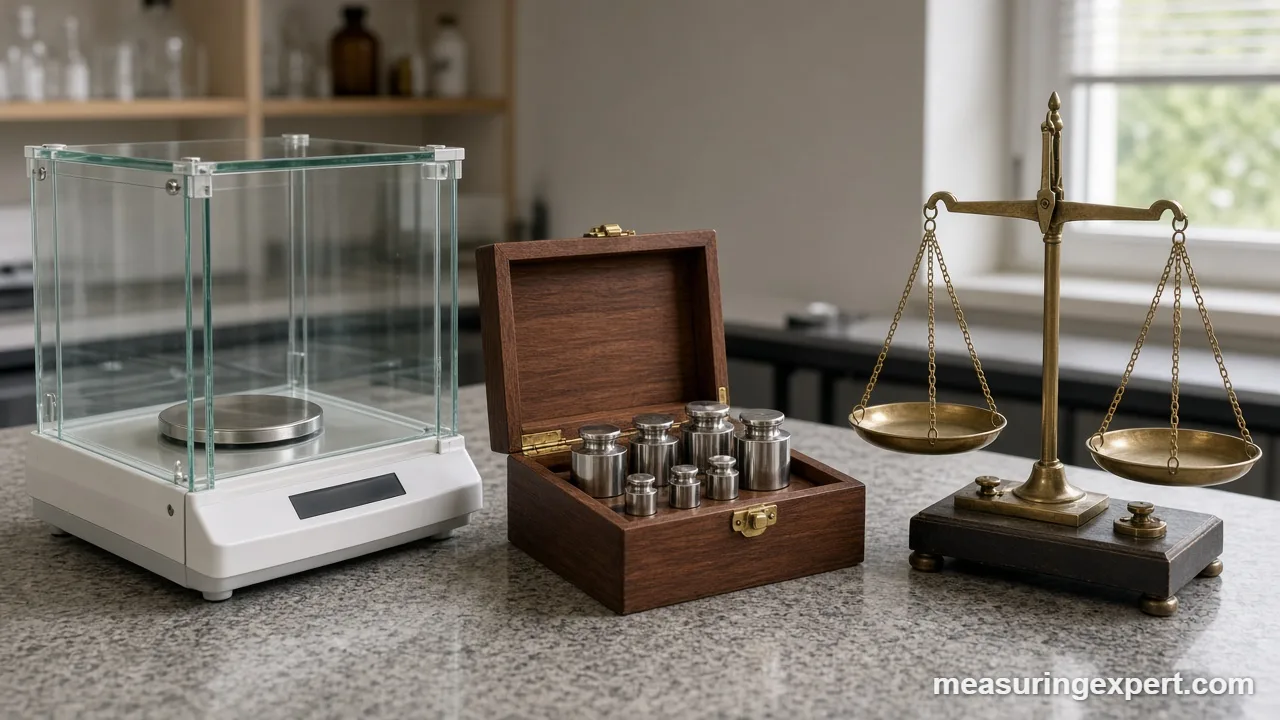
To measure mass, use a balance or a calibrated scale. A triple beam balance reads to 0.1 g, a lab analytical balance reads to 0.1 mg (0.0001 g), and a digital kitchen scale reads to 1 g (about 0.04 oz). Balances compare an object with known masses, while spring scales and most digital scales sense the force of gravity.
Mass is the amount of matter in an object, and it stays the same whether the object sits on a lab bench in Ohio or on the Moon. Weight, however, is different. It is the pull of gravity on that mass, so it changes with location. Because of this, the tool you pick decides whether you read mass directly or read a force that the instrument then converts into grams or pounds.
Why the Tool You Use to Measure Mass Matters
So which tool is right? It depends on how small the sample is and how close you need to be. For example, a chemist weighing 25 mg of a reagent needs an analytical balance inside a draft shield. Similarly, a student in a science class can measure mass with a triple beam balance. Meanwhile, a baker gets by with a digital kitchen scale, and a shipping dock relies on load cells under a floor platform.
In short: balances compare masses, scales measure force, and both work well once you calibrate them against known weights at the place where you use them.
The US National Institute of Standards and Technology (NIST) puts the distinction plainly on its SI units page for mass: mass describes how much matter an object contains, while weight is the force gravity exerts on it. NIST also explains that the kilogram has been defined through the Planck constant since 2019, and that its Kibble balance links mass to that constant with electrical measurements.
Next, you will find a unit converter, a side-by-side table of readability and capacity, a step-by-step method for a digital balance, and finally the calibration weight classes that labs and inspectors rely on.
Convert a Mass Reading to Other Units
Enter a reading in grams, or pick another unit, and the converter shows the same mass in milligrams, kilograms, ounces, pounds, grains and carats. For accuracy, it also uses the exact definitions 1 lb = 453.59237 g and 1 oz = 28.349523125 g.
Recommended Tools to Measure Mass
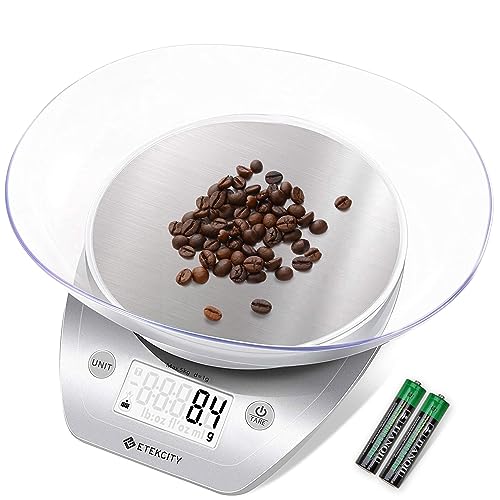
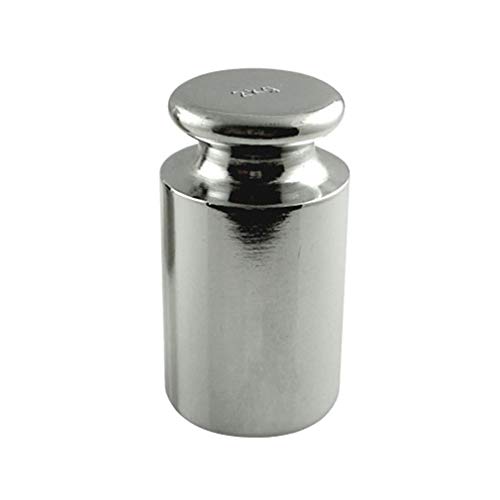
The list below covers three jobs. First, there are digital kitchen scales for everyday cooking and shipping. Next come a triple beam balance and a milligram scale for school and hobby work. Finally, there are calibration weights to check any scale you already own. So pick the readability you need first, and then the capacity. Also, descriptions come from manufacturer listings, not from our own testing.


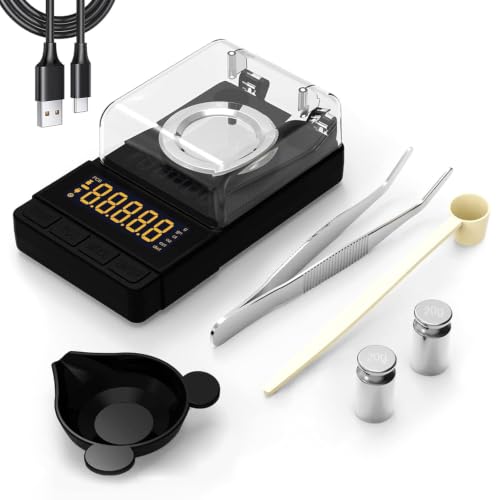
As an Amazon Associate, Measuring Expert earns from qualifying purchases.
Key Takeaways
- Mass is the amount of matter; weight, however, is the force of gravity on it.
- Beam balances compare masses, so gravity cancels out of the result.
- Spring scales and load-cell scales sense force and need calibration where they are used.
- Analytical balances read to 0.1 mg; triple beam balances read to 0.1 g.
- Kitchen and postal scales, by contrast, usually read to 1 g or 0.1 oz.
- OIML R111 weight classes (E1 to M3) set how close a test weight must be to its nominal value.
- Readability is not accuracy, so check any scale with a known weight.
Mass vs Weight: Why It Matters When You Measure Mass
Gravity is not the same everywhere on Earth. It is roughly 0.5% stronger at the poles than at the equator, and it also drops slightly with altitude. On the Moon, for example, it is only about 16.5% of the standard Earth value. Your mass, however, does not change at all. For a deeper look at the concept itself, see our explainer on what mass is and how it differs from weight.
| Property | Mass | Weight |
|---|---|---|
| What it is | Amount of matter (inertia) | Force of gravity on that matter |
| SI unit | kilogram (kg) | newton (N) |
| Changes with location? | No | Yes (about 0.5% across Earth; about 1/6 on the Moon) |
| Typical tool | Beam balance, calibrated electronic balance | Spring scale, force gauge |
| Everyday units | g, kg, oz, lb | N, pound-force (lbf) |
In daily life, however, people say “weight” when they mean mass, and that rarely causes trouble. For instance, a digital scale shows grams because the maker calibrated it so that a known mass gives the right reading. As a result, you can measure mass with a digital scale as long as you calibrate it where you use it. A spring scale moved from Miami to Anchorage, by contrast, can read a little high, because gravity is slightly stronger farther north.
Tools Used to Measure Mass, Compared
The table gives typical figures from common models. However, individual products vary, so always check the readability, capacity and stated accuracy on the spec sheet.
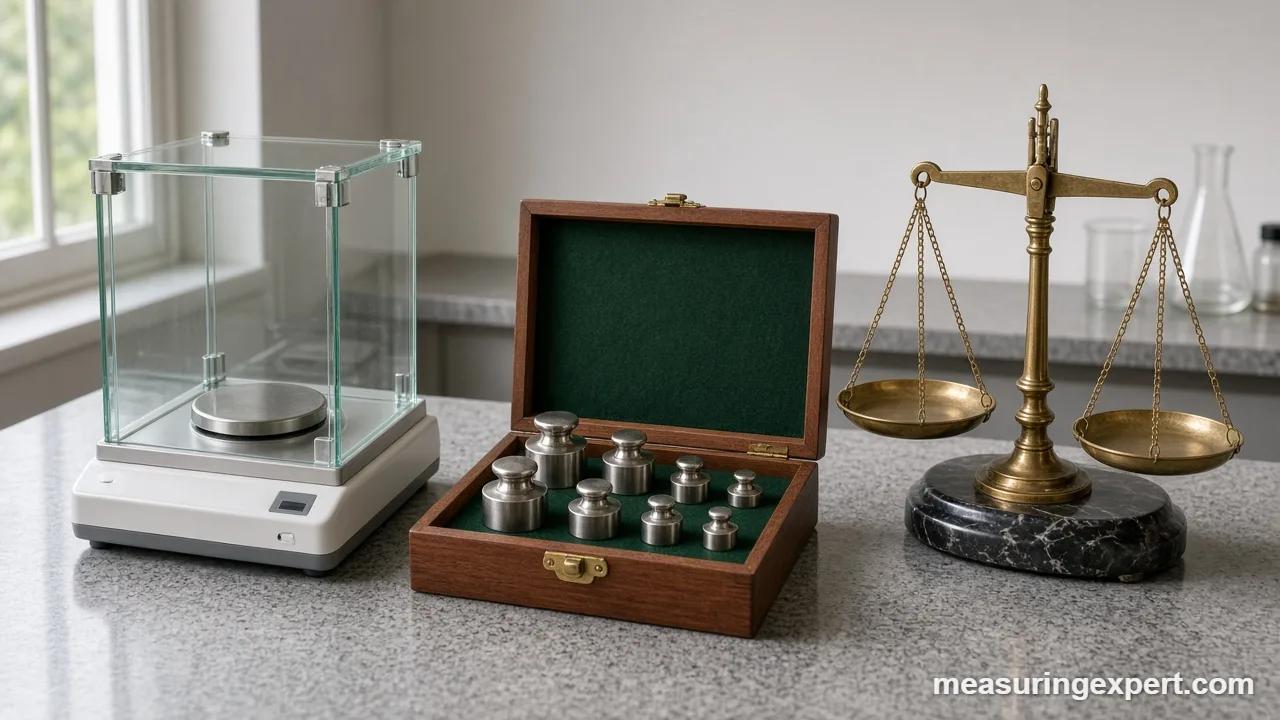
| Tool | Typical readability | Typical capacity | How it works | Best for |
|---|---|---|---|---|
| Analytical balance | 0.1 mg (0.0001 g) | 100 to 320 g | Electromagnetic force restoration, draft shield | Chemistry, pharmacy, research |
| Top-loading precision balance | 0.001 to 0.1 g | 200 g to about 10 kg | Force restoration or strain-gauge load cell | General lab work, schools, QC |
| Triple beam balance | 0.1 g | 610 g (2,610 g with add-on weights) | Compares the sample with sliding riders on three beams | Classrooms, field use without power |
| Milligram (pocket) scale | 0.001 g | 20 to 100 g | Small load cell | Hobby, reloading, jewelry |
| Digital kitchen scale | 1 g or 0.1 g (0.05 or 0.1 oz in ounce mode) | 5 to 15 kg (11 to 33 lb) | Strain-gauge load cell | Baking, portioning, coffee |
| Postal / shipping scale | 0.1 oz or 1 g | about 25 to 75 kg (55 to 165 lb) | Load cell | Packages and postage |
| Industrial floor or truck scale | coarse steps (pounds or more) | hundreds of kg to tens of tons | Several load cells under a platform | Warehouses, farms, freight |
Triple Beam Balance: A Classic Way to Measure Mass
A triple beam balance has one pan and three beams, each with a sliding rider. First, you move the riders until the pointer lines up with the zero mark, then add up the three beam readings. Because the riders balance the sample by leverage, the same reading holds anywhere, so it compares mass rather than weight. Also, it needs no batteries, which is why schools still use it.
Analytical Balances Measure Mass to 0.1 mg
An analytical balance reads to four decimal places in grams. Inside, an electromagnet also pushes back against the pan with exactly enough force to hold it level, and the current needed tells the balance the load. Even so, a person breathing nearby can shift the last digit. That is why these balances sit inside glass draft shields on heavy, vibration-free benches.
Top-Loading Precision Balances
A top-loading balance trades a decimal place for more capacity and toughness. As a result, most read to 0.01 g or 0.001 g and handle a few hundred grams to several kilograms. In addition, many models have an internal calibration weight that the balance applies at the push of a button.
Digital Kitchen and Postal Scales
These scales use a strain-gauge load cell: a metal beam that bends very slightly under load, with foil gauges that change resistance as it bends. Then the electronics turn that signal into grams or ounces. Typical kitchen models therefore read to 1 g, while coffee and baking scales often read to 0.1 g.
Load Cells and Industrial Scales
Floor, pallet and truck scales put several load cells under a steel or concrete deck and add their signals. Similarly, crane scales hang a single load cell from a hook. In the US, for example, scales used to sell goods by weight must meet NIST Handbook 44 and pass local weights and measures inspection.
How to Measure Mass With a Digital Balance
These steps suit a lab balance, a pocket scale or a good kitchen scale. However, your balance manual comes first if it says something different.
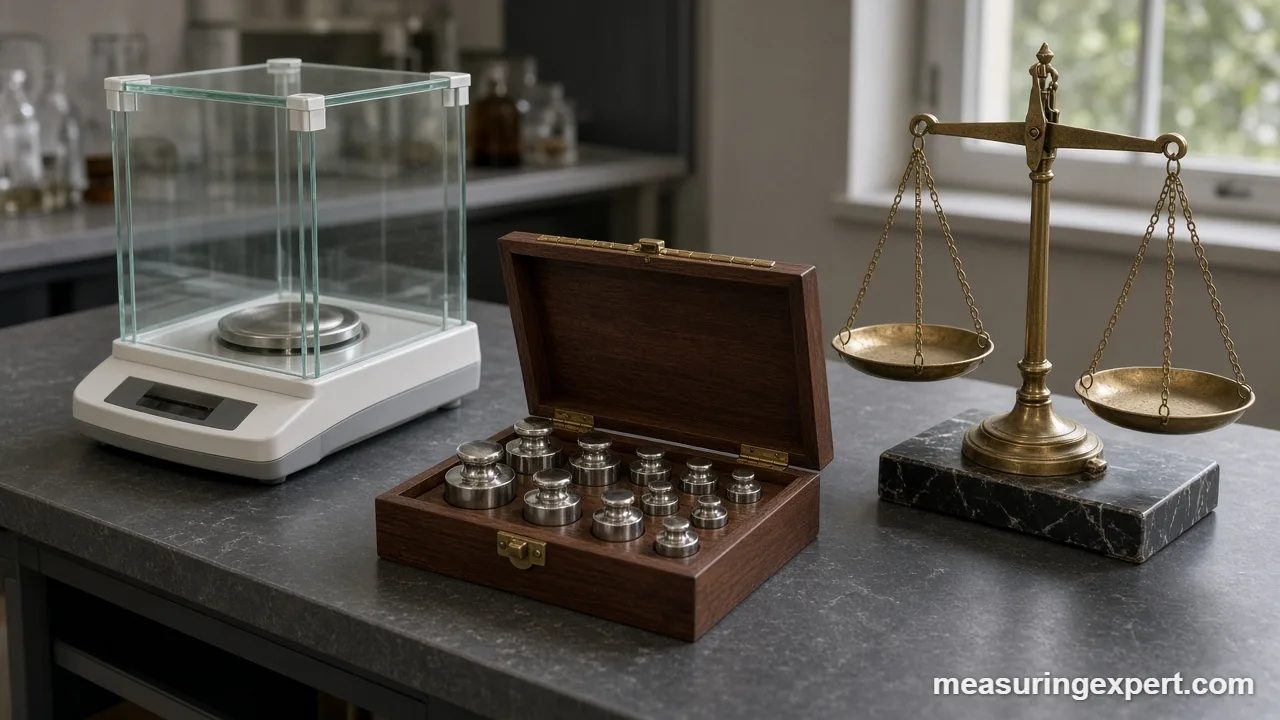
- Set it on a firm, level surface. Center the level bubble with the adjustable feet, and keep the balance away from fans, vents and doors.
- Let it warm up. Turn the balance on and wait the time the manual gives, often 30 minutes or more for analytical models.
- Check calibration. Run the internal calibration, or place a known test weight on the pan and confirm the reading.
- Tare the container. Put your empty dish, boat or bowl on the pan and press Tare so the display reads zero.
- Add the sample. Place it in the center of the pan and close the draft shield doors if there are any.
- Wait for a stable reading. Record the value when the stability indicator appears, including the unit.
- Clean up and re-zero. Remove the sample, wipe up any spills, and confirm the display returns to zero.
Calibration Weights and Accuracy Classes
A scale is only as trustworthy as the weights you check it against. The international standard OIML R111 sorts test weights into classes from E1 (most exact) to M3 (coarsest), and each class sets a maximum permissible error for every nominal value. In the US, ASTM E617 defines a similar set of classes, numbered 0 to 7. Therefore, the table shows the limits from OIML R111-1 (2004), Table 1.
| OIML class | Max error, 1 kg weight | Max error, 100 g weight | Typical use |
|---|---|---|---|
| E1 | ±0.5 mg | ±0.05 mg | National metrology labs |
| E2 | ±1.6 mg | ±0.16 mg | Checking analytical balances |
| F1 | ±5 mg | ±0.5 mg | Precision balances |
| F2 | ±16 mg | ±1.6 mg | Commercial and lab scales |
| M1 | ±50 mg | ±5 mg | Kitchen, postal and trade scales |
| M2 | ±160 mg | ±16 mg | Coarse industrial scales |
| M3 | ±500 mg | ±50 mg | Heavy-duty weighing |
An M1 kilogram, for example, may be off by up to 50 mg, which is 0.005% of its mass. That is also far better than a kitchen scale can show, so an M1 set is fine for checking one. To check an analytical balance, however, you need E2 or F1 weights with a calibration certificate.
Lab Methods That Measure Mass Indirectly
Some laboratory techniques find a mass without putting the substance itself straight on a pan. Even so, they still rely on balances or on physics that trace back to the kilogram.
- Gravimetric analysis. A chemist turns the substance of interest into a solid of known formula, then filters, dries and weighs it. As a result, the mass of that solid reveals how much of the original substance was present.
- Mass spectrometry. A mass spectrometer measures the mass-to-charge ratio of ions, not the bulk mass of a sample. So it identifies molecules and their isotopes, while a balance is still needed to weigh the sample itself.
- Kibble balance. This NIST instrument balances a mass against an electromagnetic force and links it to the Planck constant. Therefore, it does not serve everyday weighing; instead, it anchors the kilogram itself.
Volume, by contrast, is a separate job with its own tools. If you need to convert a sample’s volume into mass using its density, our guide to tools that measure volume covers cylinders, pipettes and burettes.
Do and Don’t When You Measure Mass
Do
- Level the balance before each session.
- Tare the container every time.
- Check readings with a known test weight.
- Let warm or cold samples reach room temperature first.
- Finally, record the unit along with the number.
Don’t
- Put chemicals straight on the pan.
- Weigh in a draft or next to a vent.
- Exceed the stated maximum capacity.
- Assume readability equals accuracy.
- Move a scale and then skip recalibration.
Honest Limits
The last digit on a display is the readability, not the accuracy. For example, a kitchen scale that shows 0.1 g may still be off by a gram or more, especially near its capacity or with low batteries. Temperature also matters, because load cells drift as they warm up. In addition, a warm sample creates rising air currents that make it read light on a sensitive balance. Similarly, static charge on plastic dishes or dry powders can also pull the pan and give unstable readings. Finally, buoyancy matters at the highest precision. Air pushes up on every object, so a liter of water reads about 1 g less than its true mass. Metrology labs therefore correct for that; everyday weighing does not need to.
When to Call a Calibration Lab
First, call an accredited calibration lab if your scale is used for trade (selling goods by weight), for pharmaceutical or medical work, or for a quality system such as ISO 9001 or ISO/IEC 17025. Also call one if a balance fails a check with a certified weight or if someone dropped it. Likewise, contact your state or local weights and measures office about legal-for-trade questions. In addition, a lab can issue a calibration certificate that traces back to national standards, which a home check cannot.
Frequently Asked Questions
What is the best tool to measure mass?
For most labs, an electronic balance is best. First, pick an analytical balance (0.1 mg) for tiny samples or a top-loading balance (0.01 to 0.1 g) for larger ones. A triple beam balance works well in classrooms.
Can a bathroom or kitchen scale measure mass?
Yes, roughly. These scales sense force, but makers calibrate them to show mass in pounds or kilograms, so the reading is close to the true mass at normal locations on Earth.
What is the difference between a balance and a scale?
A balance compares an unknown mass with known masses, so gravity cancels out. A scale, however, measures the force an object exerts and converts it to mass through calibration.
How accurate is a triple beam balance?
For example, a typical triple beam balance reads to 0.1 g. However, its accuracy depends on zeroing it carefully and keeping the pivots clean and undamaged.
Why does an analytical balance have glass doors?
The glass draft shield blocks air currents because, at this level, air movement matters. At a readability of 0.1 mg, even a gentle breeze or your breath can change the reading.
Do you measure mass in grams or newtons?
Mass is measured in grams or kilograms (or ounces and pounds in the US). Newtons, by contrast, are units of force, which is what weight is.
How often should I calibrate a scale?
Follow the manual and your quality system. A common practice is a quick check with a test weight before each session, and a full calibration whenever you move the scale or a check fails.
What calibration weight class do I need?
M1 weights suit kitchen, postal and many trade scales. For precision balances, however, use F1 or F2, and for analytical balances use E2 or F1 weights with a certificate.
Would my mass be different on the Moon?
No. Your mass stays the same, but your weight on the Moon is about one sixth of your weight on Earth. A beam balance would read the same there; a spring scale would not.
Can a mass spectrometer measure mass of everyday objects?
No. A mass spectrometer measures the mass-to-charge ratio of ions to identify molecules. So you still need a balance to measure the mass of a whole object.
Measure Mass With Confidence: The Bottom Line
To sum up, pick the tool by the smallest amount you need to see. An analytical balance resolves 0.1 mg, a top-loading balance 0.001 to 0.1 g, a triple beam balance 0.1 g, and a kitchen scale about 1 g. In addition, balances compare masses directly, whereas spring and load-cell scales sense force and rely on calibration.
Whatever you use, level it, tare it and check it with a known weight from the right OIML or ASTM class. Finally, use the converter at the top of this page to turn your reading into ounces, pounds or any other unit you need.
1 thought on “What Tools Are Used to Measure Mass? Balances, Scales and Lab Methods”