

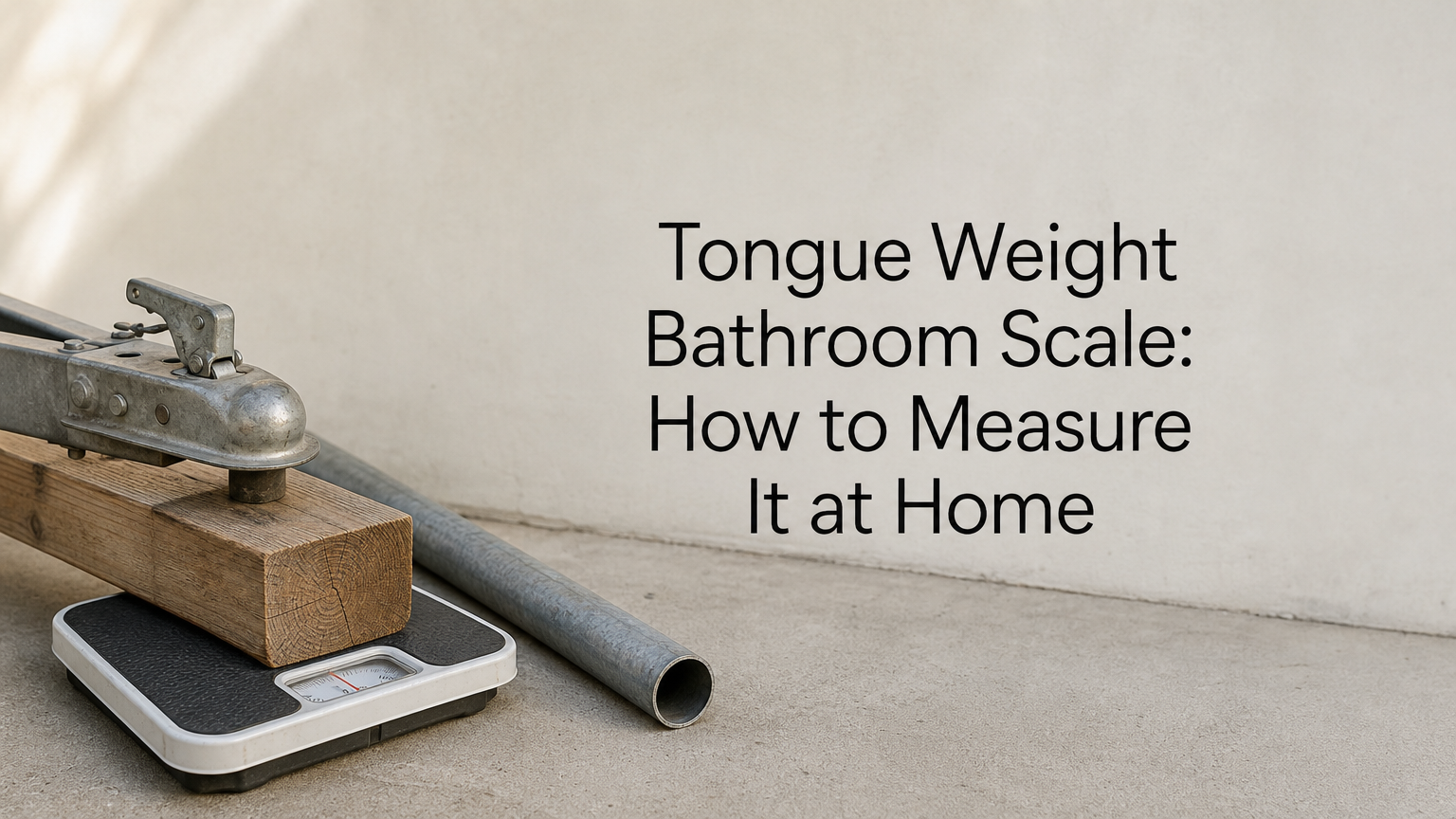
A tongue weight bathroom scale setup works like this: rest the trailer tongue on a rigid beam, put the scale at the far end, and multiply the reading by the lever ratio. If the scale sits four times farther from the pivot than the tongue does, a 600 lb tongue shows up as 150 lb. Built carefully, this method lands within about 5% of the true figure.
The problem is the scale itself. Most bathroom scales are rated for roughly 300 to 400 lb, while the tongue of a loaded travel trailer often weighs 500 to 1,000 lb. Set the coupler straight on the platform and you can wreck the scale. Guessing is no safer. Too little tongue weight lets the trailer sway, and too much sags the back of your tow vehicle and lightens its front tires.
Measuring Expert covers measuring tools and how far to trust them, and this job tests both. Below you get the lever math, the parts to use, four steps from setup to final number, and an honest look at the error to expect. The guide covers bumper-pull trailers. Fifth-wheel and gooseneck pin weights are much higher and need a different method.
Why a bathroom scale needs a lever
A bathroom scale can read tongue weight directly only when the load is under about 300 lb. For anything heavier, you use a lever that cuts the force the scale sees.
What tongue weight should be
Tongue weight is the downward force the trailer coupler puts on your hitch ball. For a conventional bumper-pull trailer, the usual target is 10% to 15% of the loaded trailer weight. Also check your hitch and vehicle ratings, because the lowest limit in your towing setup is the one that counts.
- Under 10%: the trailer tends to sway at highway speed.
- 10% to 15%: the working range for most bumper-pull trailers.
- Over 15%: the rear of the tow vehicle sags and the front tires carry less weight, which hurts steering and braking.
How the lever math works
A lever trades distance for force. Rest a beam on a pivot at one end, put the scale at the other end, and set the tongue load between them. The scale then carries only a fraction of the load.
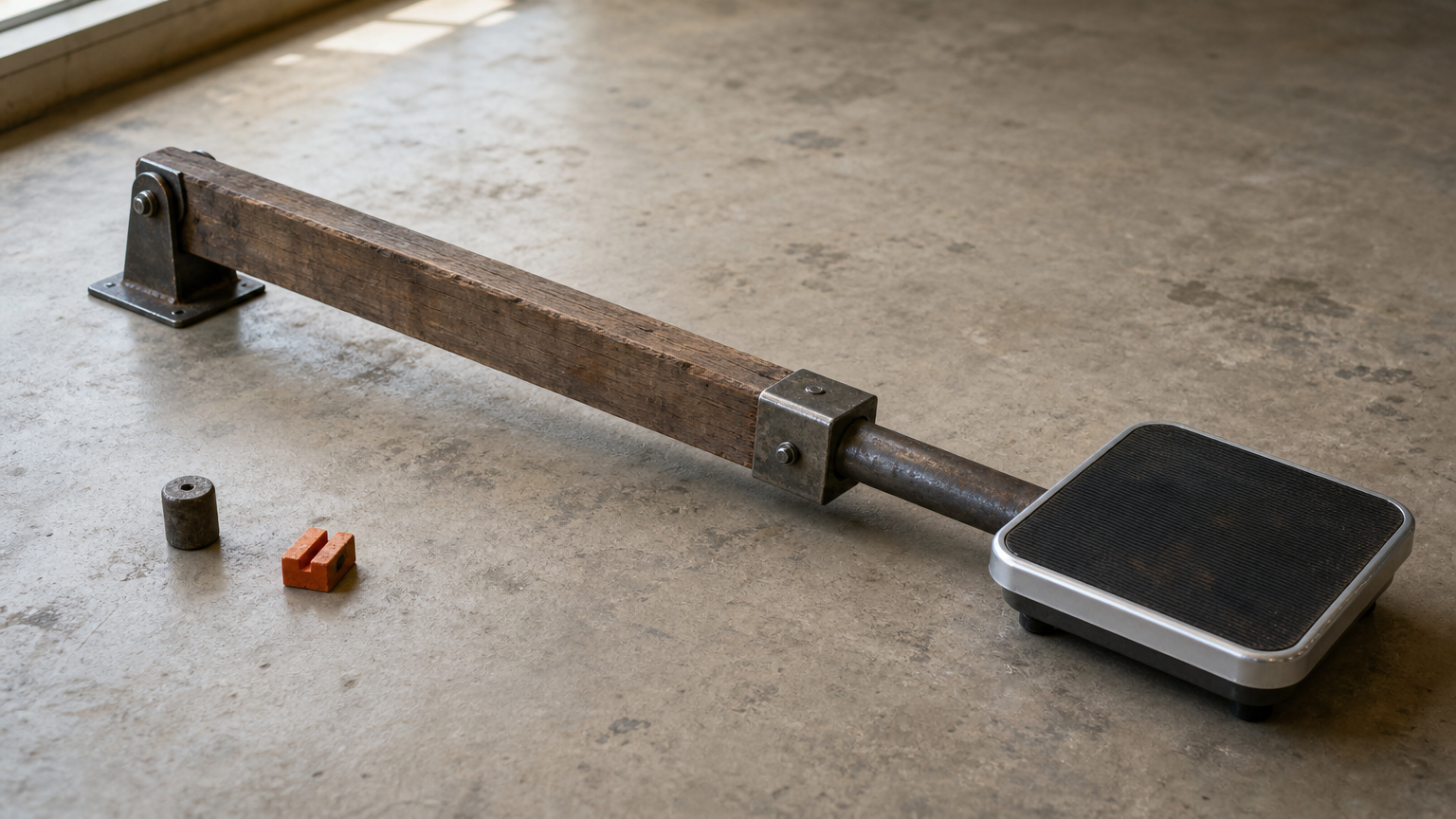
Tongue weight = scale reading × (scale arm ÷ load arm)
The scale arm runs from the pivot to the scale. The load arm runs from the pivot to the spot where the coupler rests. Use the same units for both. The beam’s own weight also pushes on the scale, so step 2 has you record a baseline reading and subtract it.
A lever lets a scale that reads 150 lb stand in for a 600 lb load.
Step 1. Build the lever
Build the lever from a stiff beam, a pivot, and a contact point on the scale, then pick a ratio that keeps the reading well inside the scale’s rating.
Gather the parts
You need only common shop items. A lone 2×4 is too weak for a 600 lb load over a 4 ft span, so choose a stiff beam and round contact points.
- A bathroom scale on a hard, flat surface. Note its rated capacity.
- A straight 4×4, or a 2×6 set on edge, about 5 to 6 ft long.
- Two short pieces of steel pipe or round bar, one for the pivot and one for the scale contact.
- Blocks or a stand to bring the pivot up to the height of the scale plus its pipe.
- A solid block or short post for the coupler to sit on.
- A tape measure, a 4 ft level, and wheel chocks.
Pick a ratio
Choose the ratio so the expected reading stays at or below three quarters of the scale’s rating. For a trailer with a 600 to 900 lb tongue, 4:1 is a good default. It puts 150 to 225 lb on the scale.
| Ratio | Load arm | Scale arm | Scale reads at 600 lb | Multiply reading by |
|---|---|---|---|---|
| 3:1 | 12 in | 36 in | 200 lb | 3 |
| 4:1 | 12 in | 48 in | 150 lb | 4 |
| 6:1 | 8 in | 48 in | 100 lb | 6 |
Keep the load arm at 12 in or more when you can. A short load arm magnifies every measuring mistake, as step 4 shows.
Pick the ratio first, so the scale never sees more than about three quarters of its rating.
Step 2. Set up the trailer and the beam
Load the trailer the way you travel, park it level and chocked, then lay the beam so the pivot, load point, and scale sit in a straight line.
Prepare the trailer
Tongue weight only matters for a trailer in towing condition. Fill the fresh tank to your normal travel level, load propane, batteries, and cargo, and unhitch from the tow vehicle. Water weighs about 8.34 lb per gallon, so a 40-gallon tank holds roughly 334 lb, and where that tank sits changes your tongue weight.
Park on firm, level ground and chock the wheels. Put the 4 ft level on the frame and check side to side and front to back. If the coupler will sit too low on the beam, raise the whole beam assembly on blocks until the trailer sits level near towing height.
Place the beam and take a baseline
Follow these steps in order:
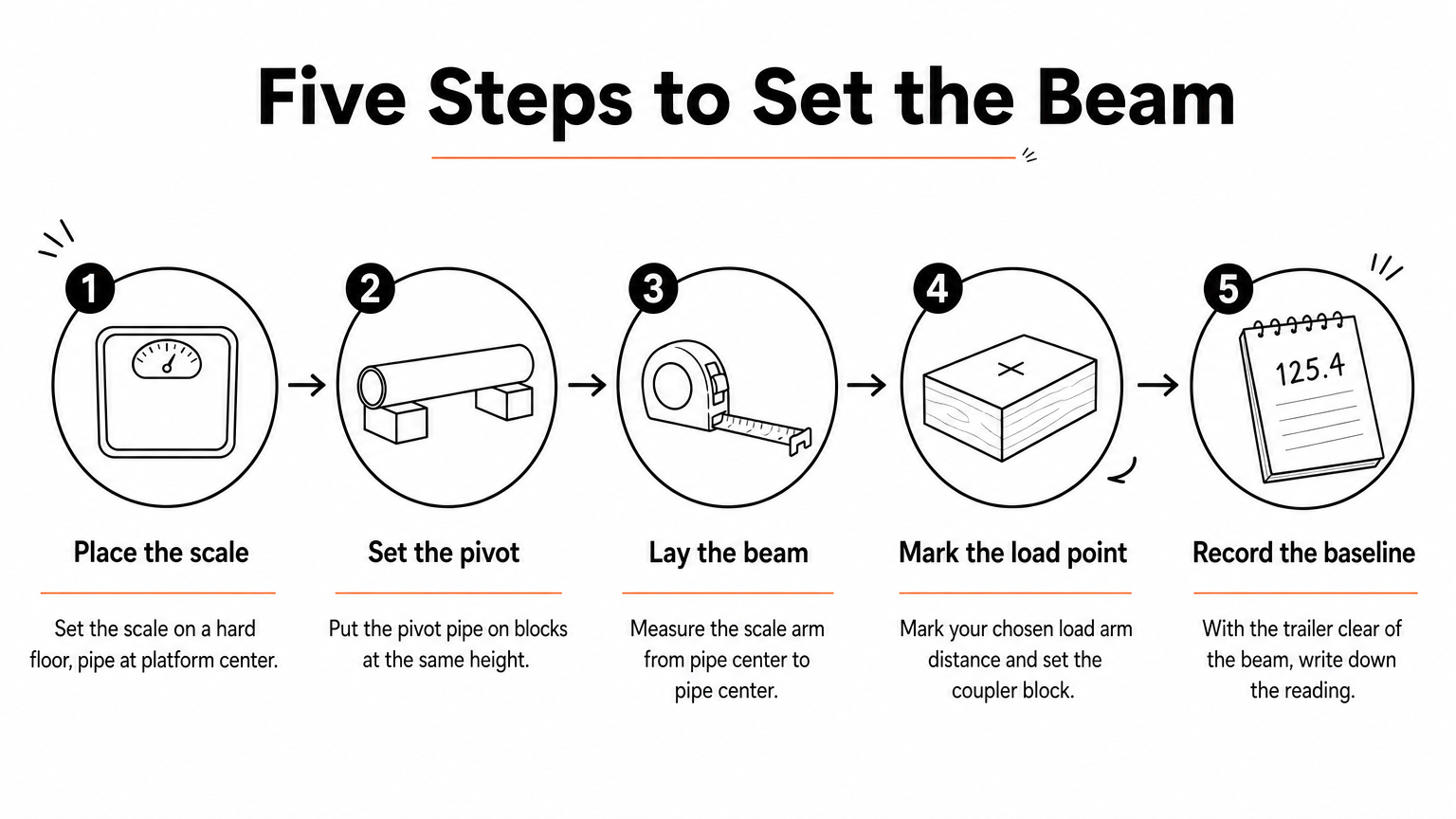
- Set the scale on a hard floor or plywood sheet, not carpet. Put the scale pipe at the center of the platform.
- Set the pivot pipe on its blocks at the other end, at the same height, so the beam sits level.
- Lay the beam across both pipes. Measure the scale arm from the center of the pivot pipe to the center of the scale pipe.
- Mark the load point at your chosen load arm distance from the pivot, and set the coupler block there.
- With the trailer not touching the beam, write down the scale reading. This is your baseline reading.
Measure arm lengths from pipe center to pipe center, because every inch of error becomes a percentage error in your answer.
Step 3. Lower the tongue and calculate
Lower the coupler onto the block until the jack foot lifts clear, read the scale, then run three short calculations.
Take the reading
Raise the jack so the coupler clears the block, then slide the beam under it. Lower the jack slowly until the coupler rests on the block and the jack foot is just off the ground. Check that the frame is still level, wait for the number to settle, and read the scale. Raise the tongue, lower it again, and repeat three times. Average the readings.
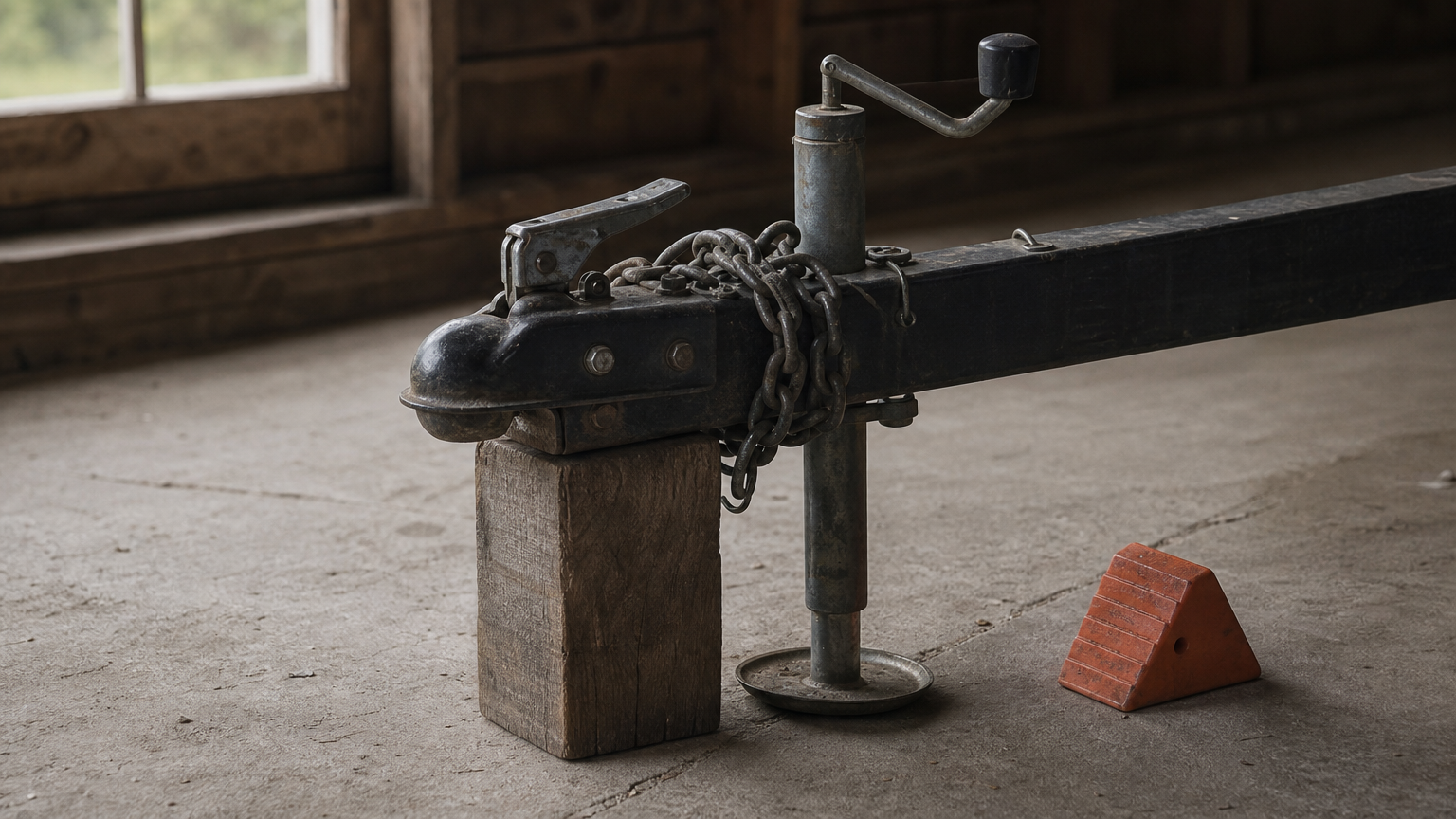
Keep hands and feet out from under the tongue. If the beam slides, twists, or tilts, raise the jack at once and reset. Never work on a slope.
Calculate tongue weight
Say your baseline reading was 6 lb and the loaded reading was 166 lb on a 4:1 setup (48 in scale arm, 12 in load arm). The loaded trailer weighs 6,000 lb, which you can get from a public truck scale.
- Net reading: 166 − 6 = 160 lb
- Tongue weight: 160 × (48 ÷ 12) = 640 lb
- Percentage: 640 ÷ 6,000 = 10.7%
That falls inside the 10% to 15% window.
Suppose you let the jack foot carry the load instead of the coupler. The jack sits closer to the axle than the coupler does, so the reading comes out too high. Multiply it by (axle-to-jack distance ÷ axle-to-coupler distance). With 13.5 ft and 15 ft, the factor is 0.90, so a 711 lb jack reading becomes 640 lb at the coupler. Measure from the center of the axle, or the middle of a tandem axle group.
Measure at the coupler when you can, and correct the number when you cannot.
Step 4. Check accuracy and act on the result
Expect a careful lever setup to land within roughly 5% of the true tongue weight, and a rushed one to miss by 10% or more.
Where the error comes from
Every source below is something you can control. The scale error row matters most, because the ratio multiplies any scale error. A 2 lb error at 4:1 becomes 8 lb. Check the scale with known weights, such as five 1-gallon water jugs at about 41.7 lb total.
| Source | Typical effect | Fix |
|---|---|---|
| ½ in arm error on a 12 in load arm | About 4% | Longer load arm, center-to-center measuring |
| Scale error | Multiplied by the ratio | Test with known weights |
| Beam flex or sliding pivot | Arms change under load | 4×4 or 2×6 on edge, pivot pinned with blocks |
| Trailer not level | Shifts the load split | Level the frame |
| Reading at the jack | About 10% high in step 3’s example | Apply the axle correction |
What to do with the number
Compare your result with the 10% to 15% window and with the limits in your hitch and vehicle manuals. If it runs high, move heavy items rearward. If it runs low, move them forward. Then measure again.
When the result sits near a rated limit, bathroom scale accuracy is not enough. Use a dedicated tongue weight scale with a capacity comfortably above your tongue weight, since scales read best in the middle of their range. This guide is for general information, so confirm your limits with the manufacturers.
A homemade lever is good for balancing a load, but a number near a rated limit needs a better scale.
Measure twice, then tow
A bathroom scale can measure tongue weight if you add a lever. Build a stiff beam, pick a ratio that keeps the reading under three quarters of the scale’s rating, load the trailer for travel, and subtract the baseline before you multiply. Take care with arm lengths and the scale itself, and you can expect a result within about 5%.
Aim for 10% to 15% of the loaded trailer weight, adjust your load, and measure again. If you want more help choosing and trusting measuring tools, browse the guides at Measuring Expert.