

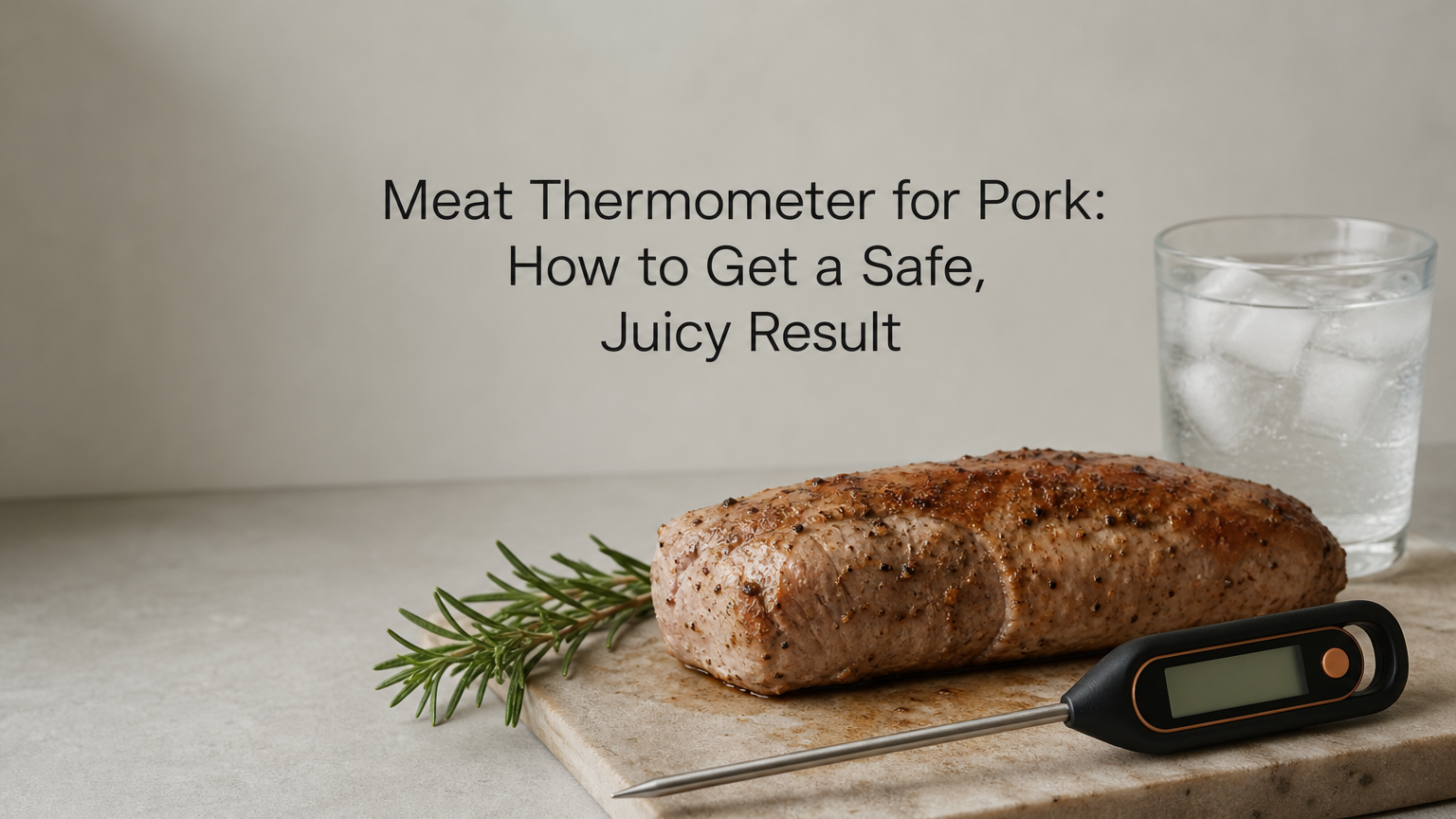
To use a meat thermometer for pork, push the probe into the center of the thickest part of the cut, keep the tip away from bone and fat, and cook it to 145°F (63°C). Then let whole cuts such as chops, loin and roasts rest for 3 minutes before you carve. Ground pork, sausage and meatballs need 160°F (71°C).
Most dry pork comes from fear, not bad cooking. Cooks remember the old 160°F and 165°F rules, cut into the meat to check the color, and keep cooking until the center turns gray. The result is a chop that is safe and tough. A badly placed probe causes the opposite problem, with a reading that runs too high or too low and tells you the pork is done when it is not.
This guide covers the whole process in three steps: choose and calibrate your thermometer, place the probe correctly for each cut, and read the result and rest the meat. Measuring Expert focuses on measuring tools and accuracy, and a thermometer is only as useful as the number it shows, so calibration gets its own step.
Why pork needs a thermometer and the target temperatures
Pork needs a thermometer because color and cooking time both mislead, while temperature tells you exactly when the meat is safe. Whole cuts are done at 145°F (63°C) followed by a 3-minute rest. Ground pork is done at 160°F (71°C).
The safe internal temperatures for pork
USDA guidance sets different targets for different forms of pork. Keep this table nearby when you cook.
| Type of pork | Internal temperature | Notes |
|---|---|---|
| Chops, loin, tenderloin, roasts | 145°F (63°C) | Rest 3 minutes before carving |
| Fresh ham | 145°F (63°C) | Rest 3 minutes before carving |
| Ground pork, sausage, meatballs, meatloaf | 160°F (71°C) | Check the center of the thickest piece |
| Fully cooked ham, reheated | 140°F (60°C) | For ham packaged in a USDA-inspected plant. Other cooked ham should reach 165°F (74°C) |
| Pulled pork shoulder | 195 to 205°F (90 to 96°C) | For shreddable texture, not for safety |
Pork is done when the thermometer reads 145°F and the rest is over, not when the color changes.
Why color and time fail you
Pork cooked to 145°F can still look slightly pink in the middle, and that is normal. Meat that looks gray may already be overcooked. Time charts also break down, because thickness, starting temperature, pan material and oven accuracy all change how fast the center heats up.
So is pork done at 145 or 165? For whole cuts it is 145°F. The USDA lowered its recommendation for whole cuts from 160°F to 145°F in 2011. The 165°F figure you may remember applies to poultry and leftovers, and it will dry out a chop.
Step 1. Choose and calibrate your thermometer
Pick an instant-read digital thermometer for chops and tenderloin, or a leave-in probe for roasts, then check its accuracy in ice water before you cook. A pork meat thermometer does not need to be expensive, but it does need to be correct.
Pick the right type
The type you need depends on what you cook most often.
- Instant-read digital: Gives a reading in seconds and has a thin tip that suits chops, tenderloin and patties. This is the best all-round choice.
- Leave-in probe with a cable: Stays in a roast while it cooks and sounds an alarm at your target temperature.
- Dial thermometer: Reads slowly and senses temperature over the last 2 inches of the stem, so it works poorly on thin chops.
Calibrate with the ice water test
Calibration takes two minutes and removes the biggest source of error.
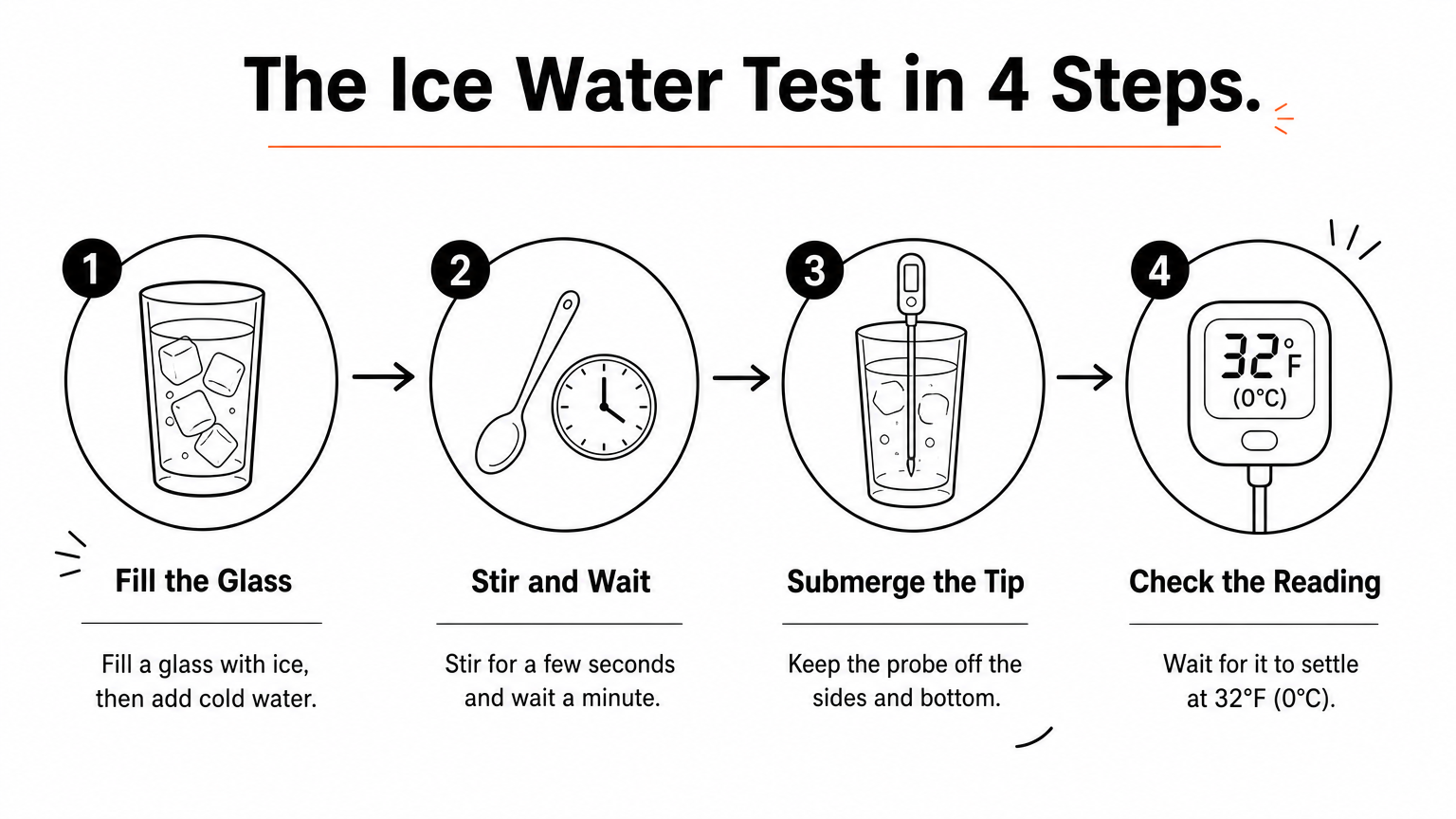
- Fill a glass to the top with ice, then add cold water.
- Stir for a few seconds and wait a minute.
- Submerge the probe tip without touching the sides or bottom of the glass.
- Wait for the reading to settle. It should show 32°F (0°C).
If it is off by a degree or two, adjust it as your manual describes, or remember the offset. If it is off by more and cannot be adjusted, replace it. A thermometer that reads 5°F low turns your 145°F target into 150°F of overcooked pork.
Check your thermometer in ice water before you trust it with dinner.
Step 2. Insert the probe in the right spot
Insert the probe into the center of the thickest part of the meat, with the tip clear of bone, fat and the pan. For a thin cut, go in from the side so the sensing tip sits in the middle.
Rules that apply to every cut
Bone conducts heat faster than meat, so a probe touching bone reads high. Pockets of fat and gristle give false readings in both directions. The center of the thickest part is the slowest place to heat, which makes it the one number that matters.
Insert far enough that the sensor sits in the middle. A thin digital probe needs about half an inch of depth, while a dial stem needs about 2 inches. If you are unsure, push the probe in slowly while watching the display, and use the lowest number you see.
Where to place it by cut
| Cut | Where to insert | Watch for |
|---|---|---|
| Pork chops | Through the side edge, horizontally into the center | Keep the tip off the bone |
| Tenderloin | Through the side into the thickest section | Check two spots, since the ends are thinner |
| Loin or shoulder roast | Through the top or end into the center | Avoid the pan and any bone |
| Ground pork patties, meatballs | Through the side into the center | Check the largest one |
| Sausage links | Lengthwise from the end into the center | Do not poke through the other side |
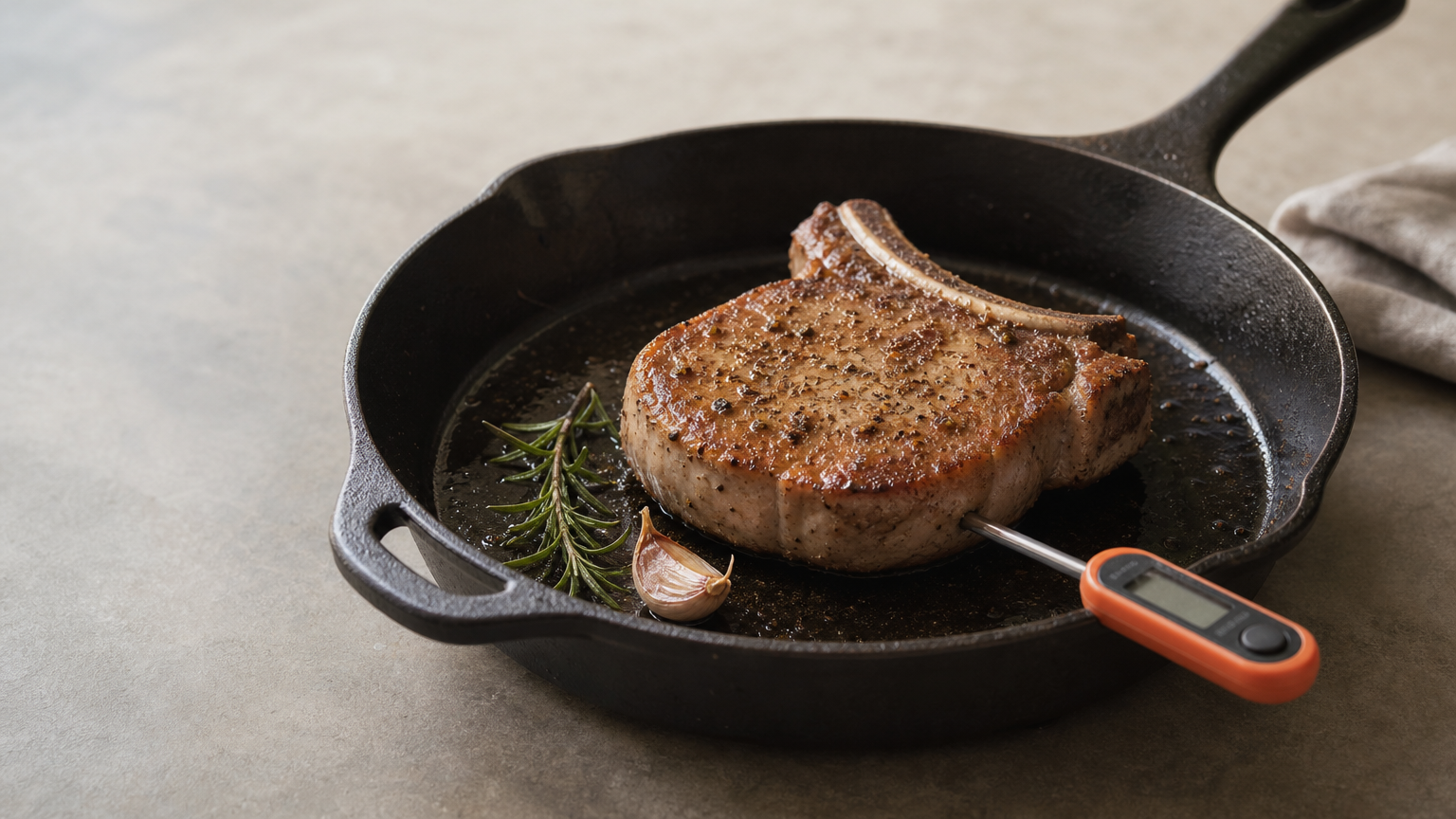
The reading you can trust comes from the center of the thickest part, away from bone.
Step 3. Read the temperature and rest the pork
Wait until the number stops climbing, confirm it in a second spot, take the pork off the heat at 145°F, and rest it for at least 3 minutes. The rest is part of the safety standard, not just a juiciness trick.
Wait for a stable reading and check twice
Digital instant-read thermometers settle in a few seconds, and dial models take longer. Do not read the first number you see. Check a second spot a couple of inches away, because heat is uneven, and clean the probe between pieces of raw and cooked meat.
Pull on time and rest the meat
During the rest, heat from the outer layers keeps moving inward. Chops gain a few degrees, and large roasts commonly gain 5 to 10°F. If you like to pull a roast a few degrees early for extra juiciness, keep the probe in and confirm it reaches at least 145°F before you carve. If it stalls below that, return it to the heat.
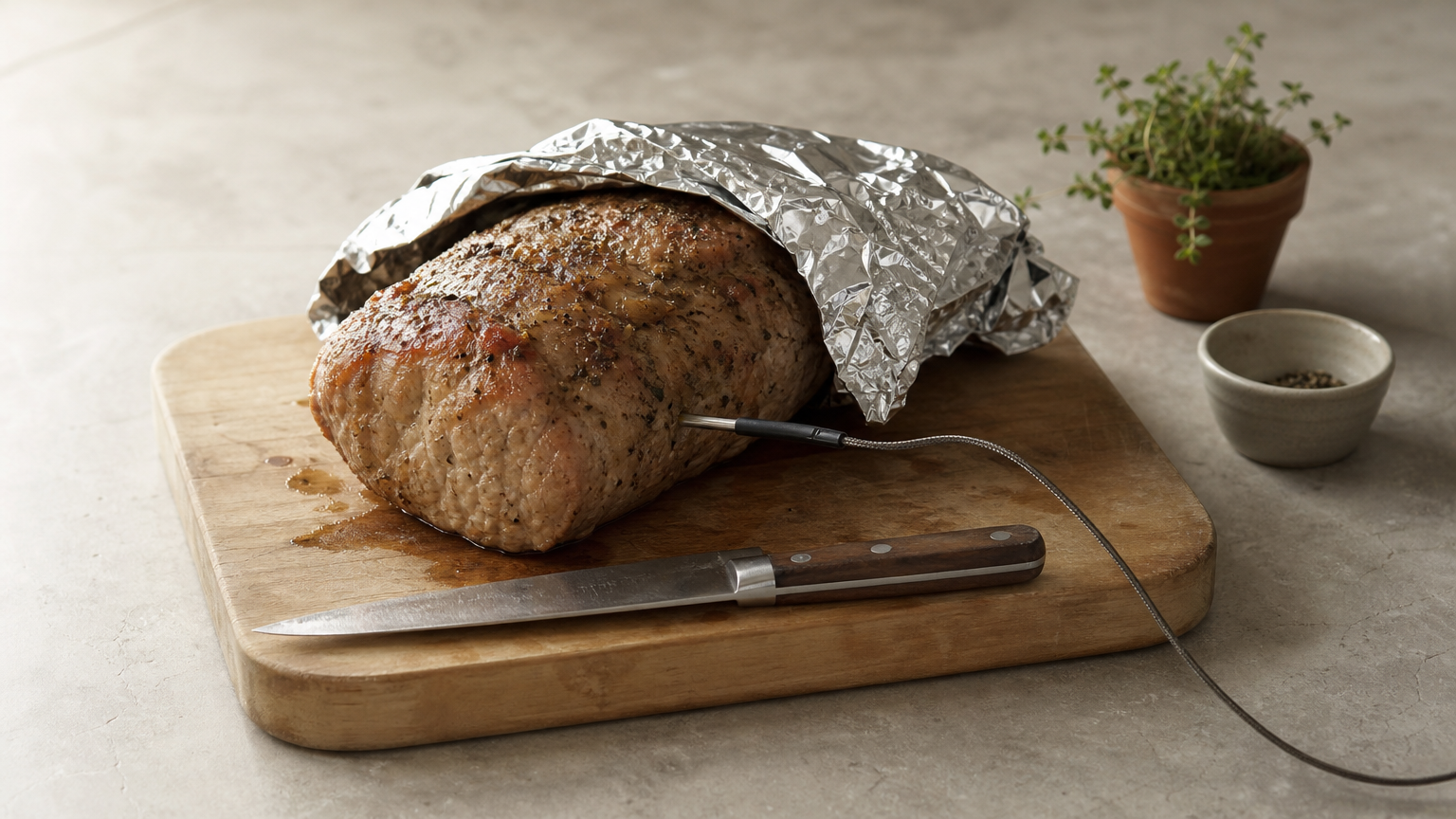
Here is a worked example. You roast a boneless loin with a leave-in probe and pull it at 142°F. After 10 minutes of resting under loose foil, the probe peaks at 148°F. That is above 145°F and well past the 3-minute rest, so the roast is safe and still juicy. A chop reaching 145°F in the pan can go straight to the plate and rest there for 3 minutes.
Rest the pork for 3 minutes after it reaches 145°F, and it will be both safe and juicier.
Fixes for common pork thermometer problems
When a reading surprises you, check the probe placement first and the thermometer second. Most problems come from a spot that touched bone or from a thermometer that has drifted out of calibration.
What to do when the number looks wrong
Is it safe to eat pork at 135°F? Not by USDA guidance, which sets 145°F for whole cuts. Some chefs pull pork a little early and let it coast, but the final temperature should still reach 145°F. Is pork safe at 180°F? Yes, but a chop at that temperature is overcooked and dry. Save 195 to 205°F for shoulder you plan to shred.
If the reading jumps around, you are probably touching bone or the pan, so reposition the probe. If two thermometers disagree, run both through the ice water test. If a rested chop reads below 145°F, put it back in the pan and check again.
Can you check pork without a thermometer?
You can guess, but you cannot confirm. Pressing the meat, watching for clear juices, or cutting into the center all vary too much with the cut and the cook. Cutting also lets juices escape. An instant-read thermometer costs little compared with a ruined roast, and the ice water test keeps it honest.
A thermometer is the only reliable way to know pork is done.
Cook pork to 145°F and let it rest
Using a meat thermometer on pork comes down to three habits. Calibrate it, put the probe in the center of the thickest part, and stop at 145°F for whole cuts or 160°F for ground pork. Then rest whole cuts for 3 minutes and carve.
Do this once and you will stop overcooking pork out of habit. If you are choosing a thermometer or want to double-check other tools in your kitchen, explore more measuring guides at Measuring Expert for practical advice on accuracy and testing.