

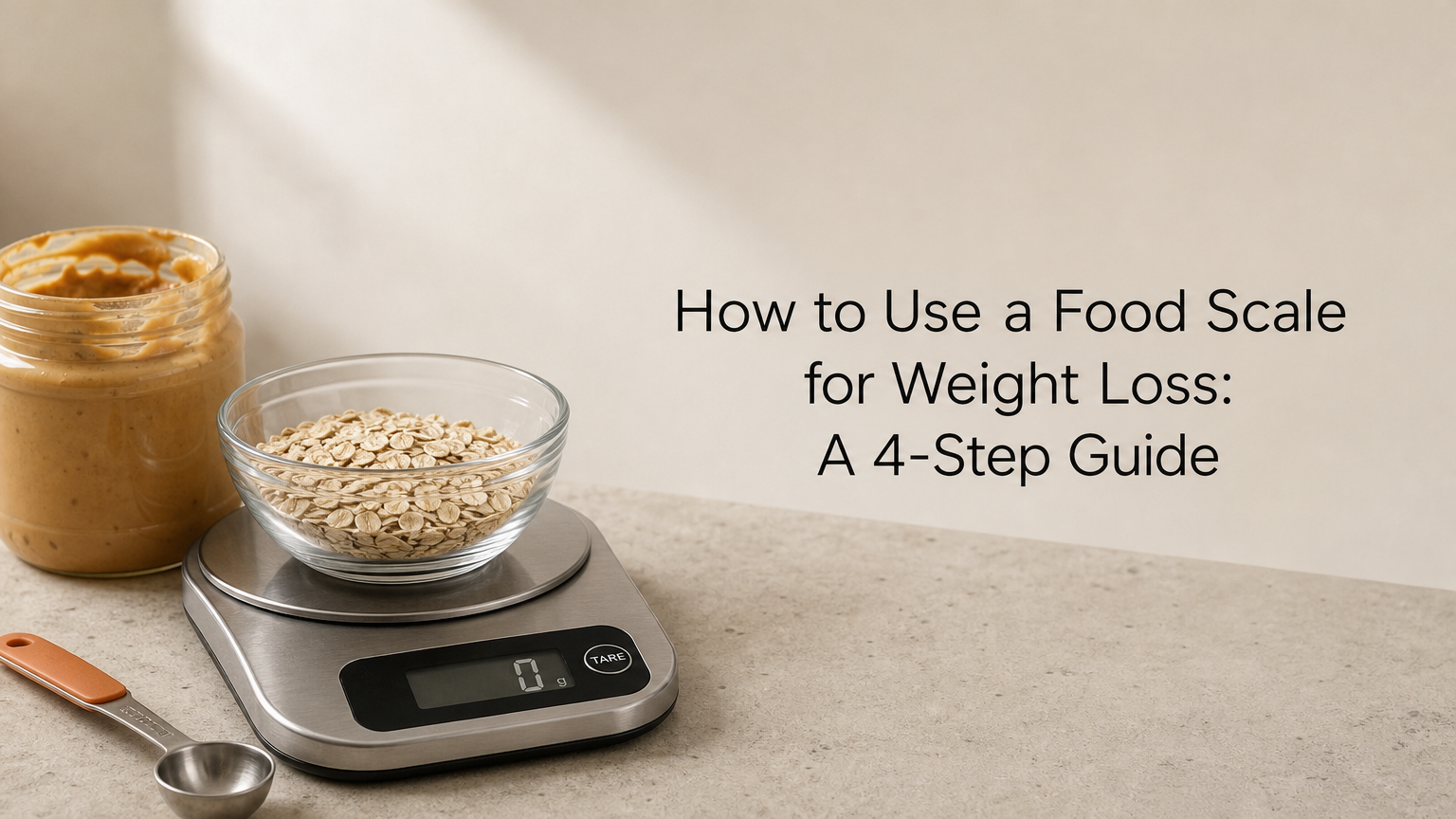
The food scale weight loss method is simple. Buy a basic digital scale with a tare button, weigh everything you eat in grams, log each weight against a reliable calorie source, and compare your daily total to a calorie target. The scale does not burn fat. It makes your calorie counting accurate, and an accurate count is what a calorie deficit depends on.
The problem is that eyeballing portions fails in a predictable direction. Measuring cups hold very different amounts depending on how you scoop. A "tablespoon" of peanut butter can be a level spoonful or a heaping one, and the gap is often over 100 calories. Most people who say they are eating 1,700 calories a day but not losing weight are really eating more than they logged. The extra calories hide in oils, nut butters, cereal, cheese, and pasta.
This guide walks you through four steps: choosing a scale, weighing food correctly, turning grams into calories, and keeping the habit accurate without letting it take over your life. You will get worked examples with real arithmetic, a buying checklist, and a simple test to confirm your scale is honest. Measuring Expert publishes guides on kitchen and portion control scales, so accuracy is the thread running through every step.
Why a food scale helps you hit a calorie deficit
A food scale helps with weight loss because it replaces estimates with grams, and grams convert directly into calories. You still have to eat fewer calories than you burn. The scale just stops you from fooling yourself about how many you ate.
What a scale fixes that measuring cups cannot
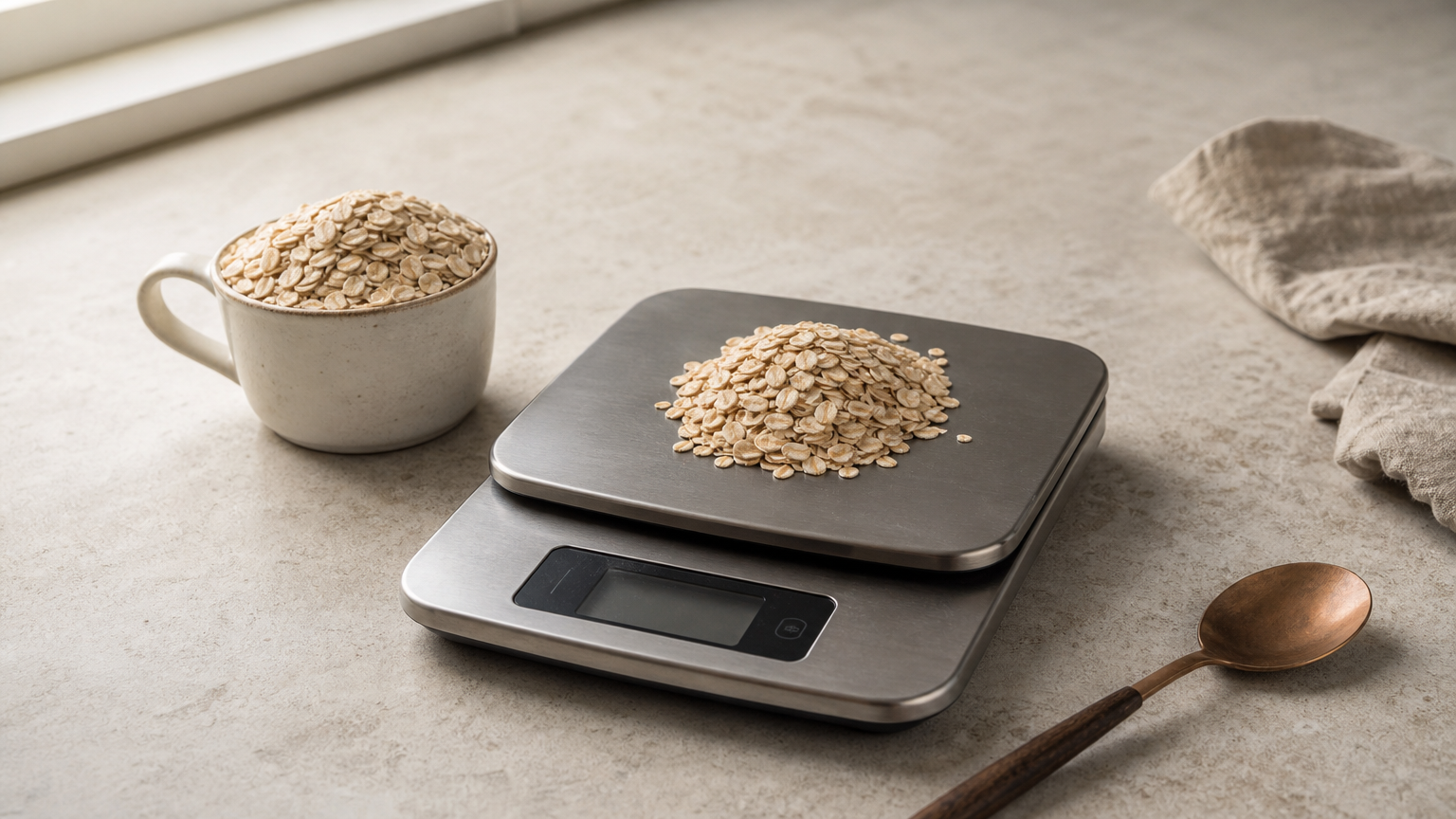
Volume is a poor stand-in for weight, which is why grams beat cups in cooking. A cup of flour scooped straight from the bag can weigh noticeably more than a cup spooned in and leveled, and the same problem hits rice, oats, granola, and shredded cheese. Weight does not change with how you pack the cup.
The foods where eyeballing fails most are also the most calorie-dense:
- Nut butters and oils
- Cereal, granola, and oats
- Dry pasta and rice
- Cheese and nuts
- Chips and crackers
Research reviews on portion size point the same way. Smaller served portions lead to lower daily calorie intake, and restaurant-size servings skew your sense of what a normal portion looks like. Weighing for a few weeks recalibrates your eye, which is why many dietitians recommend a scale to people who are just starting out.
A food scale does not make you lose weight. It makes your calorie log true, and a true log is what a deficit runs on.
Who benefits most, and who should skip it
You will get the most from a scale if you already log food in an app, if your weight has stalled despite "eating right," or if you track protein and macros for training. In each case, the numbers only help if they are accurate. Many dietitians suggest adding a scale after you have the basics in place, such as regular meal timing and sensible meal composition. A scale refines a plan. It does not replace one.
Skip it, or talk to a professional first, if you have a history of disordered eating or if weighing food makes you anxious. In that case a visual method such as the USDA’s MyPlate plate model is a safer way to manage portions. No weight loss tool is worth damaging your relationship with food. This guide is educational and is not medical advice, so check your calorie target with your doctor or a registered dietitian.
Step 1. Choose the best food scale for weight loss
The best food scale for dieting is a basic digital model that reads in 1-gram steps, holds at least 11 pounds (5 kg), and has a tare button. Everything beyond that is optional. Kitchen scales typically cost between about $5 and $50, and plenty of decent ones sell for under $20.
Features that matter for dieting
Use this table as a buying checklist. If a scale fails the first three rows, move on.
| Feature | What to look for | Why it matters |
|---|---|---|
| Tare (zero) button | Required | Lets you weigh in a bowl and add foods one at a time |
| Increment | 1 gram or finer | One ounce is about 28 g, and 0.1 oz is about 2.8 g, so grams are more precise |
| Capacity | 11 lb (5 kg) or more | Handles heavy bowls, pots, and meal prep batches |
| Units | Grams and ounces, switchable | Matches food labels and app entries |
| Display | Backlit LCD with large digits | Readable in dim kitchens; a pull-out display helps when big bowls block the screen |
| Platform | Flat stainless steel or tempered glass | Wipes clean and sits steady on non-slip feet |
| Power | AAA batteries with auto-off | Easy to replace; button-cell batteries are harder to find |
Grams are the unit to use for tracking. A scale that only moves in 0.1 oz steps can hide 2 or 3 g per reading, which adds up across a day of weighing. Also check that the tare button is hard to hit by accident, because touch-sensitive controls can reset your reading when you brush them.
Which type to buy
For most dieters, a basic digital scale at $10 to $25 is the right buy. Pair it with a calorie-tracking app and you have everything you need. Here is how the other types compare.
- Scale with a bowl: Convenient for mixing and pouring, but bulkier. The bowl nests on top for storage.
- Nutrition-database scale: Shows calories and macros for a set list of foods, often roughly 1,000 to 2,000 entries, with no app or internet needed. The built-in list is smaller than a good app database, and these scales have more buttons to learn. Buy one only if you dislike using a phone while cooking.
- Large-platform scale with a pull-out display: Worth the extra cost if you cook big batches or weigh heavy containers.
- 0.1 g coffee-style scale: Very precise, but capacity is usually only a few kilograms and the platform is small. It suits tiny amounts, not whole meals.
Skip any scale that does not list a tare function, and read reviews for complaints about drifting readings. You will test the one you buy in Step 4.
For a calorie deficit, a plain 1-gram scale with a tare button beats any scale with extra features you will not use.
Step 2. Weigh your food the right way
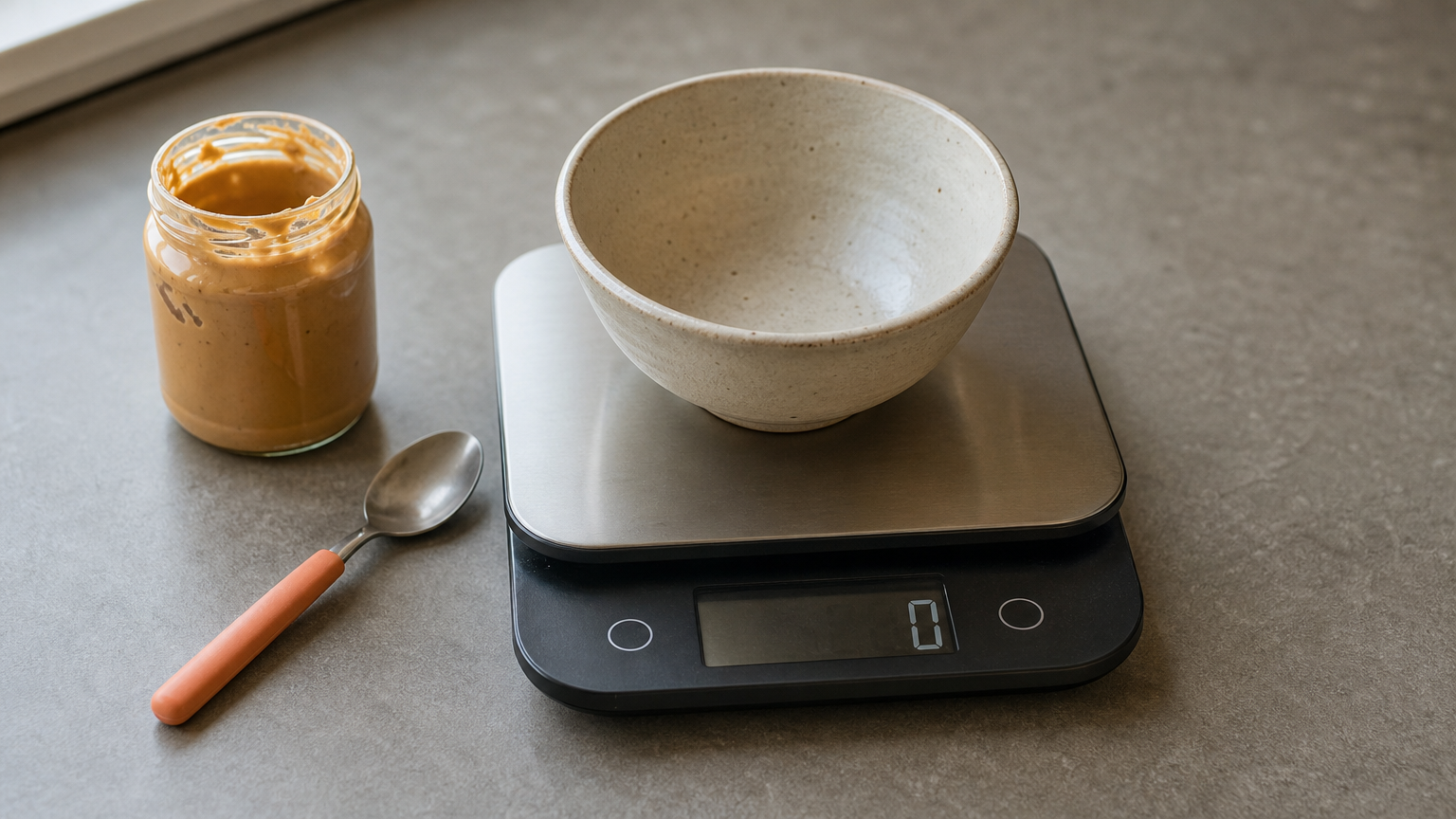
To weigh food correctly, place the scale on a hard flat surface, set it to grams, put your empty container on it, press tare, and add food until you reach the weight you want. Log the number before you eat. The tare function does the rest.
The basic weigh-in routine
Follow these steps every time until they become automatic:
- Put the scale on a flat, hard counter. A towel or tilted surface throws off the reading.
- Switch the unit to grams.
- Turn the scale on and wait until it reads 0.
- Set your plate or bowl on the platform, then press tare so it reads 0 again.
- Add the first food and read the weight.
- Press tare again, then add the next food. Each ingredient is weighed on its own, with no math.
- Write the weight down or enter it in your app before you eat.
Weigh into the bowl you will eat from. That saves dishes and means nothing gets lost in transfer. If your app entry says 120 g and your scale reads 135 g, either change the entry to 135 g or remove 15 g from the plate. Rounding to "close enough" defeats the purpose of owning a scale.
Raw, cooked, and loose foods
Raw and cooked weights differ, so match the state of the food to the entry you log. Meat loses water as it cooks and gets lighter. Rice and pasta absorb water and get heavier. The easiest rule is to weigh food raw or dry, before cooking, and use a raw or dry entry.
For a big pot of chili, soup, or curry, weigh the finished batch and divide:
- Weigh the empty pot and note it.
- Cook the recipe and weigh the full pot. Subtract the pot weight to get total food weight.
- Add up the recipe’s total calories from the ingredients.
- Weigh your portion. Calories = portion weight ÷ total food weight × recipe calories.
For example, a chili totals 2,400 calories and weighs 1,600 g cooked. Your bowl weighs 400 g. That is 400 ÷ 1,600 × 2,400 = 600 calories.
For sticky or loose items, put the jar on the scale, take off the lid, and press tare. Scoop out your portion and read the number. The display will show a negative weight, so ignore the minus sign and log that amount. This works for peanut butter, honey, and oil, and it avoids a messy spoon on the platform. As a reference point, a tablespoon of oil weighs about 14 g and carries roughly 120 calories.
Weigh food in the same state your calorie entry describes, raw with raw and cooked with cooked.
Step 3. Turn weights into calories
Once you know how much you ate in grams, multiply by the calories per gram from the food label or a database, then add everything up and compare it to your daily target. Start by setting a target you can actually hold.
Set a daily calorie target you can hold
A common starting point is to eat about 500 calories a day below your maintenance level. Over a week that adds up to roughly 3,500 calories, which is often quoted as about one pound of weight loss. Treat that as a rough guide, because real results vary from person to person and slow over time. If you maintain your weight at 2,200 calories, a 500-calorie deficit puts your target at 1,700 calories a day.
The NIH’s Body Weight Planner can estimate calorie needs for a goal and timeline. Avoid very low targets, since eating too little backfires on energy, muscle, and consistency. Check your number with a doctor or registered dietitian, especially if you have a medical condition.
Convert grams to calories
For packaged food, use this formula: calories = your weight in grams ÷ label serving weight × label calories. The label values below are typical examples, so check your own package.
| Food | Label serving | Weight you measured | Calories to log |
|---|---|---|---|
| Rolled oats | 40 g = 150 cal | 55 g | 150 × 55 ÷ 40 = 206 |
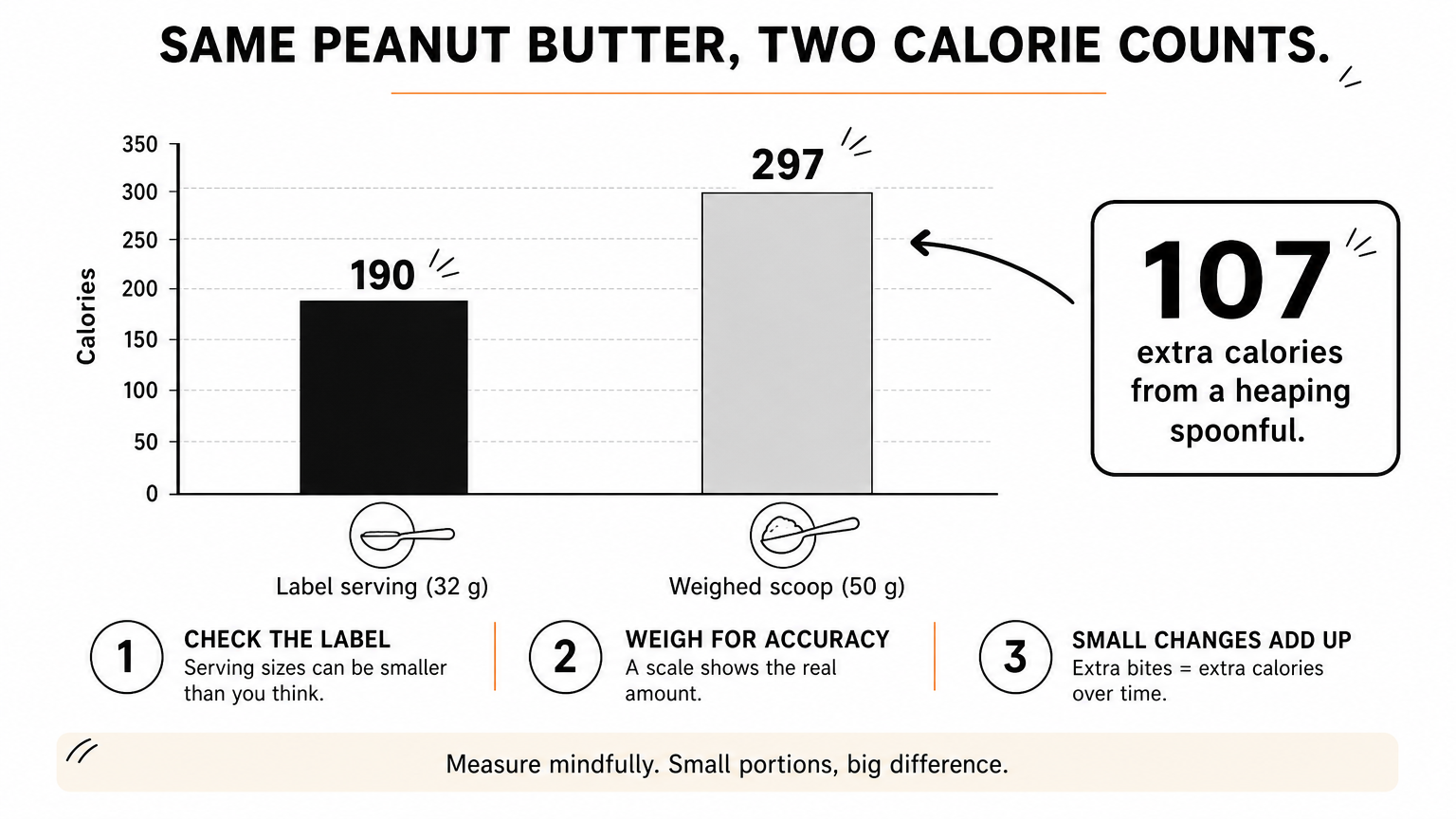
| Peanut butter | 32 g = 190 cal | 50 g | 190 × 50 ÷ 32 = 297 |
| Dry pasta | 56 g = 200 cal | 85 g | 200 × 85 ÷ 56 = 304 |
Look at the peanut butter row. A label serving of 190 calories became 297 calories once the scoop was weighed. That 107-calorie gap is typical of a "heaping" spoonful, and it is exactly what a scale catches.
For foods with no label, such as fresh meat, fish, and produce, use a reliable database. The USDA’s FoodData Central is the standard source. Pick the entry that matches your food’s state. Raw chicken breast runs about 120 calories per 100 g, while cooked chicken breast runs about 165. If you weigh 150 g of cooked chicken but log it with the raw entry, you record about 180 calories instead of about 248, a mistake of roughly 70 calories.
Prefer entries listed in grams, and choose a specific brand when your app offers one, since calories differ between brands. Avoid entries that only offer "cups" or "servings." The same weights also give you accurate protein and macro numbers if you track them.
Calories per gram times grams eaten is the whole method. The scale only supplies the second number.
Step 4. Keep it accurate and sustainable
Keep the habit working by testing the scale, having a fallback for days you cannot weigh, and easing off on low-calorie foods once your eye is calibrated. Accuracy matters most on calorie-dense foods.
Test your scale before you trust it
A scale you have not checked is a guess with a display. A US nickel weighs 5 grams, which makes coins a handy test weight. Run this kitchen scale accuracy test on a new scale, and again if your numbers ever look off:
- Place 5 nickels on the platform. It should read 25 g.
- Add more to reach 20 nickels. It should read 100 g.
- Remove everything and confirm it returns to 0.
- Weigh the same item twice, and check that the readings match.
Within about 1 g is fine for food. If the scale is off by more, swap in fresh batteries and retest, since low power can make readings drift. If it still fails, replace it. Cheap scales are cheap to swap.
What to do on days you cannot weigh
You will eat out and travel. On those days, search for the food, find the middle value among the entries, and add a buffer of about 20% to cover underestimating. For example, if you land on a 950-calorie burger entry, log about 1,140. It looks high, but people consistently guess low. The MyPlate model also helps: fill half your plate with fruits and vegetables, a quarter with protein, and a quarter with grains.
When to ease off
You do not need to weigh everything forever. Many dietitians suggest using the scale until you can judge portions with confidence, then spot-checking about once a month. Keep weighing the foods that swing your total most: oils, nut butters, grains, cheese, and meat. You can stop weighing leafy greens and most vegetables.
If your weight stalls for two to three weeks, go back to weighing everything for a week. The leak is usually cooking oil, snacks, or portions that have crept up. If weighing food starts to feel stressful or controlling, stop and talk to a healthcare professional.
Weigh the foods that carry the calories, spot-check the rest, and retest your scale whenever a reading looks wrong.
Weigh it, log it, adjust
A food scale works for weight loss because it makes your calorie log accurate. Pick a basic 1-gram scale with a tare button, weigh food in grams in the state your entry describes, convert weights to calories, and hold a target you can sustain. Test the scale with nickels, and ease off to spot checks once your eye improves.
Start this week with the three foods you suspect you under-measure, such as oil, peanut butter, and cereal. To pick the right tool for your next step, compare the best food scales for calorie counting, then browse the other measuring guides at Measuring Expert.