

The best food digital scale for most home cooks is a flat platform scale that reads in 1 gram steps, holds about 11 pounds, and has a tare button. If you bake, start with the Ozeri Pronto. If you portion meals for weight loss on a tight budget, the Greater Goods scale is the pick. Choose the Taylor waterproof model for messy prep, and a 0.01 g pocket scale for spices and yeast.
Shopping for one is harder than it looks. Listings promise "high precision" but rarely say what the scale can actually resolve, how much it holds, or how it copes with wet dough and spilled flour. A digital food scale is cheap, but the wrong match ends up in a drawer.
Below are four picks, each covered with the same details: specs, who it suits, and what it costs. A final section explains how to choose and how to check accuracy at home. Prices are the ones listed by the makers and they change often. Measuring Expert is an Amazon Associate, so a purchase through our links may earn us a small commission at no cost to you.
1. Ozeri Pronto: best for baking and cooking
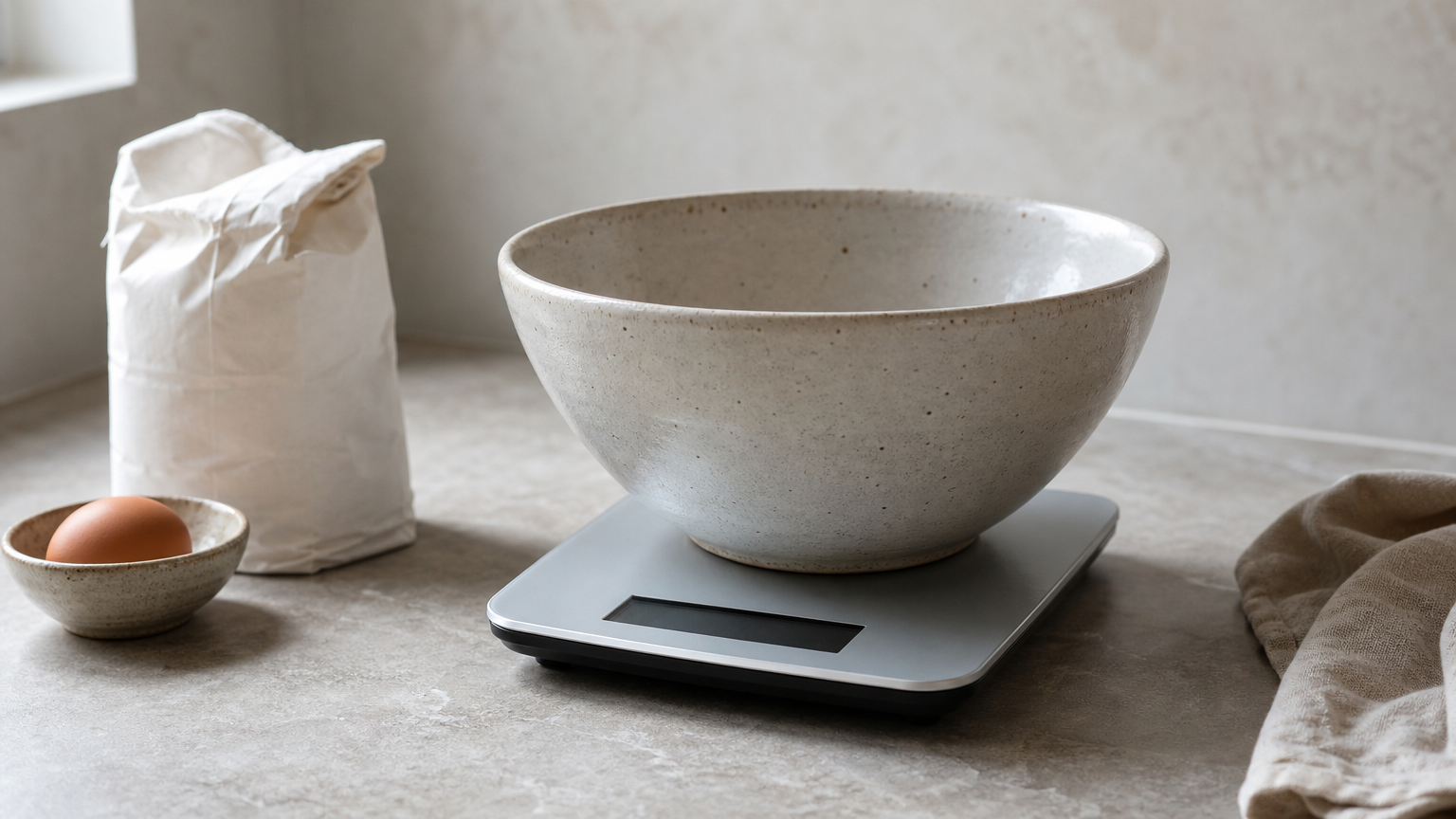
The Ozeri Pronto Digital Multifunction Kitchen and Food Scale is the best all-round pick for baking and everyday cooking. It combines a low price with accuracy that independent product testers have called dependable.
Specs and performance
The Pronto is a standard flat-platform scale. It switches between grams and ounces, and its tare button zeroes out your bowl so you can add ingredients one after another. Check the listing for capacity before you buy. 11 pounds (5 kg) is the standard to look for, and it covers a large mixing bowl full of dough.
- Units: grams and ounces
- Tare: yes, for weighing straight into the bowl
- Display: digital readout, no app needed
A cheap scale that reads true beats an expensive one you never trust.
Who it suits and what it costs
This scale suits bakers who want to switch from cups to grams. A recipe that calls for 285 g of flour is easy to hit on a scale. A scooped cup can land well over or under that amount.
It sits in the budget tier, so check the current Amazon price. The trade-off is simplicity: you get no app and no extras, only a scale that does the job.
2. Greater Goods scale: best for portion control
The Greater Goods Digital Kitchen Scale (Gray, 2025 model) is the best low-cost portion control scale for weight loss. It is listed at $9.99 on the maker’s shop.
Specs and performance
Per the maker, it uses four sensors and reads to 1 gram or 0.1 ounce. It holds 11 pounds and shows grams, ounces, milliliters, and pounds and ounces. It also has a tare function and a low-profile body that wipes clean and stores flat.
- Capacity: 11 lb
- Readability: 1 g or 0.1 oz
- Units: g, oz, ml, lb:oz
- Power: button battery
For portion control, a $10 scale that reads in grams does the same job as a $50 one.
Who it suits and what it costs
A 4 oz serving of chicken is about 113 g, and this scale shows it at a glance. If you track portions, weigh in grams to avoid rounding errors. That makes it a good fit for meal prep and for anyone who wants a first scale without spending much.
Two cautions apply. It runs on a button battery, so keep spares out of children’s reach. The maker also notes an earlier version had a battery cover recall over a choking hazard. If you own an older unit, contact Greater Goods. The scale comes with a limited warranty that starts when you register it.
3. Taylor 11 lb waterproof scale: best for messy prep
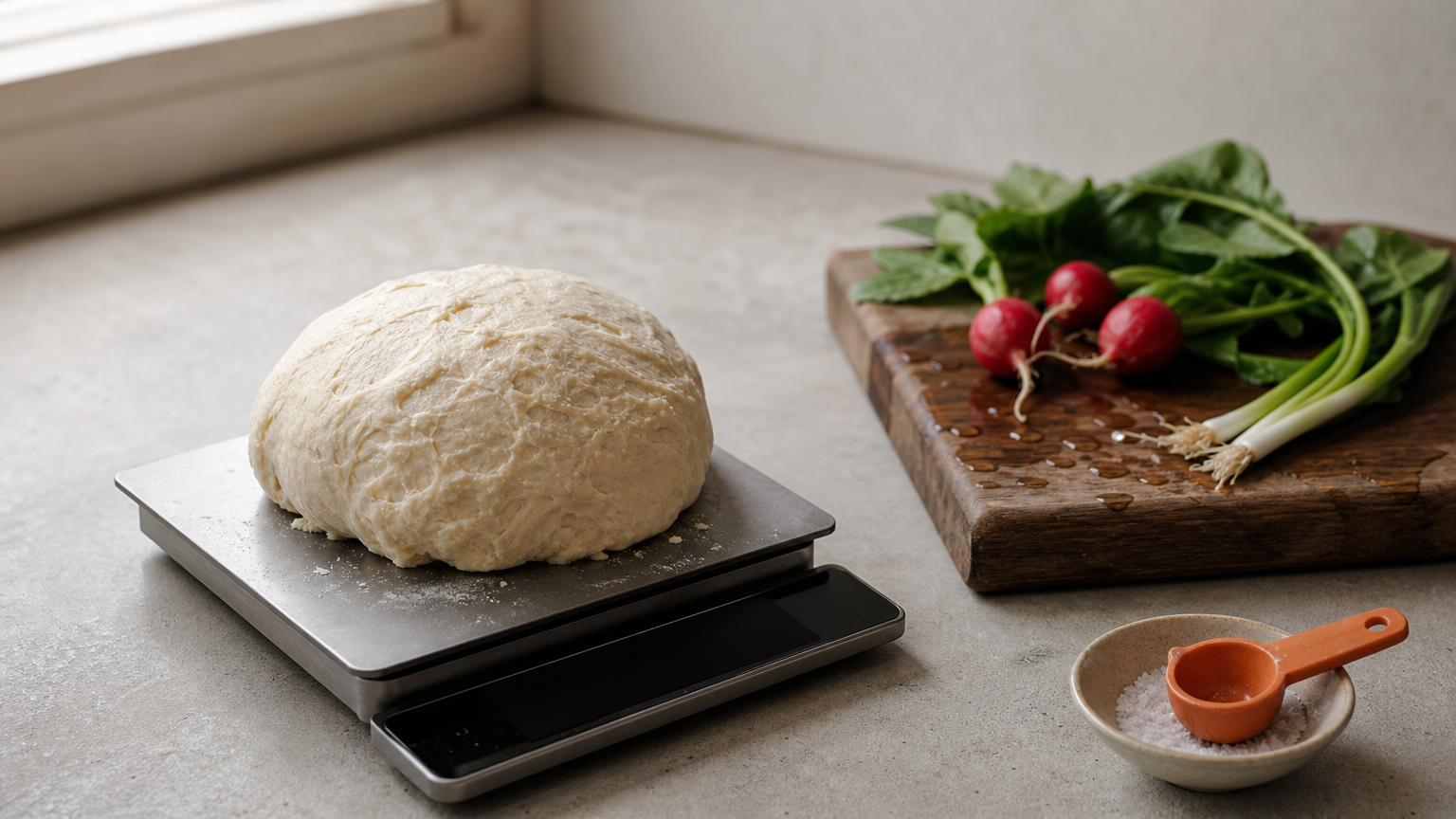
The Taylor 11lb Waterproof Kitchen Scale is the best pick if you handle raw meat, dough, or wet produce. It is listed at $29.99 on Taylor’s site, about three times the price of the Greater Goods scale.
Specs and performance
It holds 11 pounds, which suits bowls, cutting boards loaded with produce, and bread dough. The waterproof design is the reason to buy it. You are paying for easier cleaning, not for better accuracy, so confirm 1 g readability on the listing.
Read how the maker defines "waterproof." Splash-proof and fully submersible are different claims, and you should not dunk a scale unless the instructions say you can.
Pay extra for a waterproof scale only if cleanup, not accuracy, is your problem.
Who it suits and what it costs
It suits cooks who weigh sticky or raw ingredients and want to rinse or wipe the surface without worry. It also works well in a busy family kitchen.
If you dislike replacing batteries, Taylor also lists a 4.4 lb USB-C rechargeable container scale with a lid for $39.99. It holds less, but you never buy batteries.
4. 0.01 g pocket scale: best for small amounts
A pocket scale rated 200 g x 0.01 g, the kind sold with a 100 g calibration weight and an LCD display, is the best pick for tiny quantities. It is a second scale to sit beside your main one, not a replacement for it.
Specs and performance
The 0.01 g readout shows hundredths of a gram, which helps with yeast, spices, salt, and coffee. A standard 7 g yeast packet is easy to portion out.
Readability is not accuracy, though. A scale that displays 0.01 g can still drift, so calibrate it with the included weight. Use it on a level surface and shield it from drafts, because even a breath from the fan can move the reading.
- Capacity: 200 g, so it is useless for flour
- Needs calibration with the included weight
- Sensitive to air currents and uneven counters
A 0.01 g display tells you how finely the scale reads, not how right it is.
Who it suits and what it costs
It suits bread bakers, coffee brewers, and anyone scaling recipes down. Prices vary by seller, so compare a few listings.
Skip it as your only scale. Anything over 200 g overloads it, and that includes a bowl of flour.
How to choose and test a digital food scale
Choose by capacity, readability, and use. For general cooking, buy 11 lb capacity and 1 g readability. Add a fine scale only if you measure spices or yeast.
What to look for
Digital food scales are worth buying because weight beats volume. A scooped cup of flour weighs more than a spooned and leveled one, but 285 g is always 285 g. Use this table to match your use to a pick.
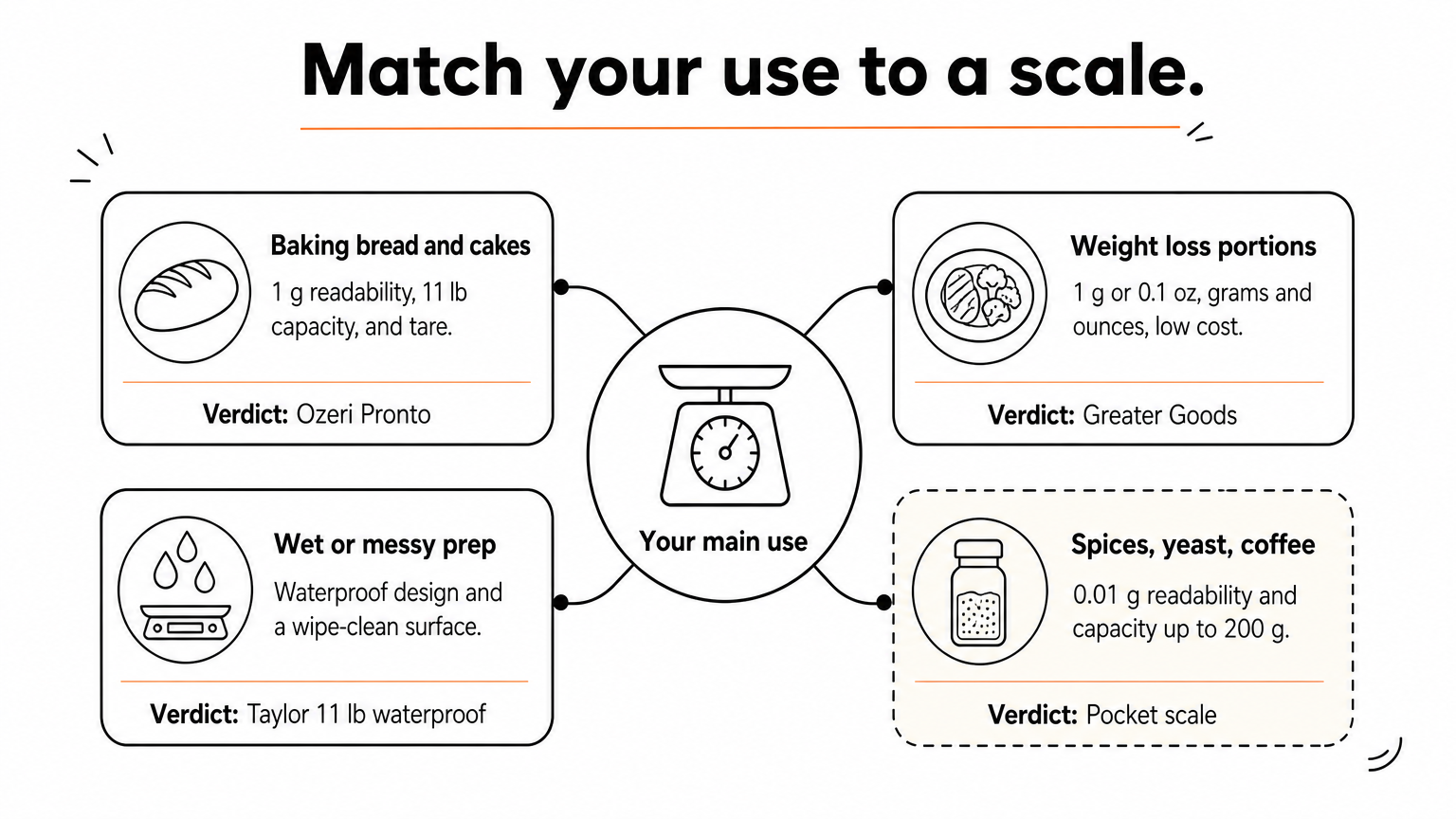
| Your main use | What to look for | Pick |
|---|---|---|
| Baking bread and cakes | 1 g readability, 11 lb capacity, tare | Ozeri Pronto |
| Weight loss portions | 1 g or 0.1 oz, grams and ounces, low cost | Greater Goods |
| Wet or messy prep | Waterproof design, wipe-clean surface | Taylor 11 lb waterproof |
| Spices, yeast, coffee | 0.01 g readability, capacity up to 200 g | Pocket scale |
Also consider power (a rechargeable model or a spare battery) and platform size. If you are weighing for weight loss, make sure the scale shows both grams and ounces.
Test accuracy at home
A U.S. nickel weighs 5 g. Weigh one, then five, and you should read about 5 g and 25 g. Repeat the test to check consistency, then try it with the display near its limit. A good scale gives the same number each time.
Digital scales tend to read small weights better. Analog (non-digital) scales do fine above roughly 20 g and need no battery, but you must zero and calibrate them yourself.
Which scale to buy
Match the scale to the job. The Ozeri Pronto is the default for baking and cooking, and the Greater Goods scale is the cheapest way to start portioning in grams. The Taylor waterproof model earns its price in messy kitchens, and a 0.01 g pocket scale handles the tiny amounts a big scale cannot.
Whichever you choose, check its accuracy with the nickel test when it arrives and keep spare batteries on hand. For more measuring tool comparisons and conversion guides, browse Measuring Expert.