

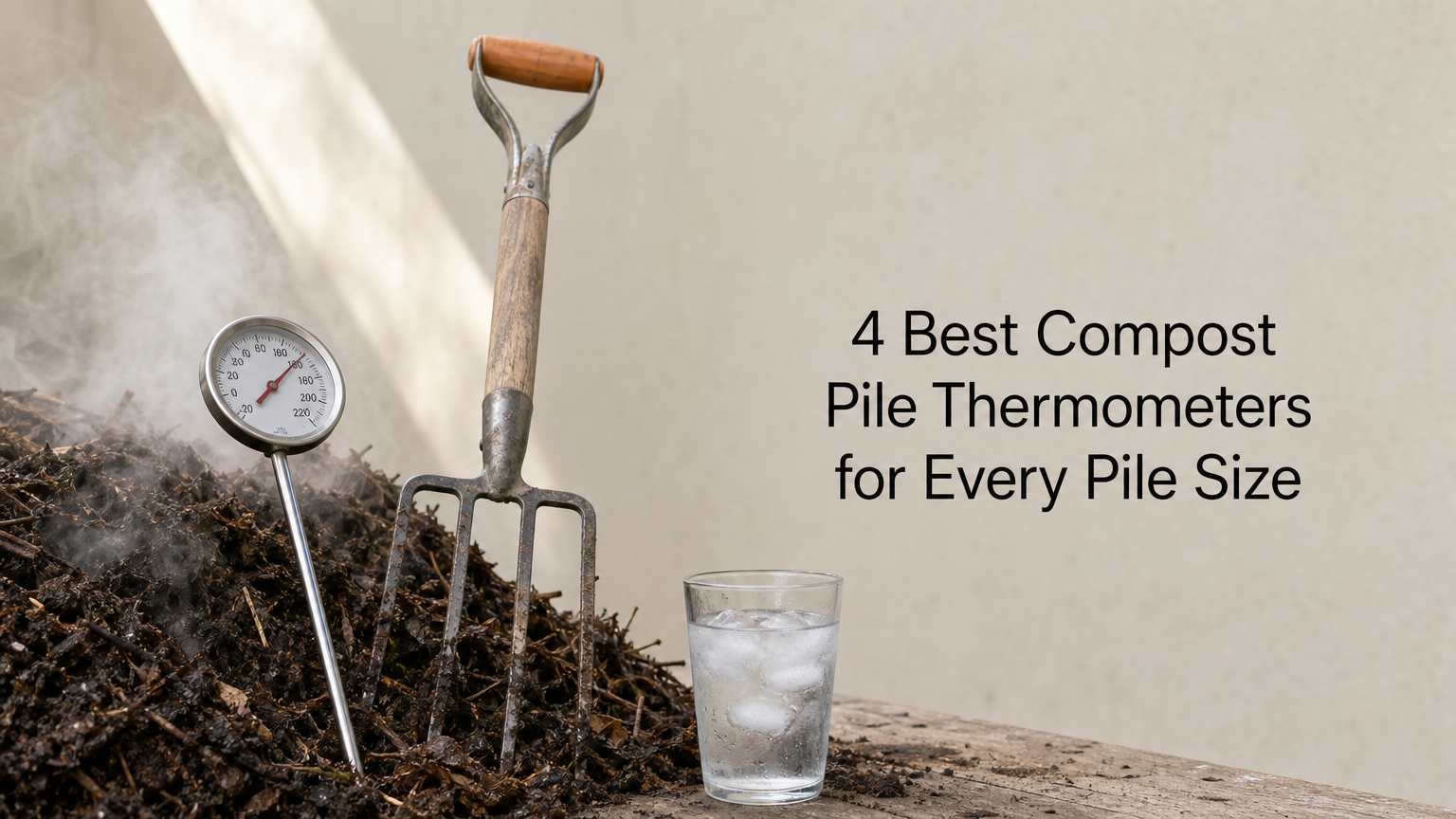
The best compost pile thermometer for most backyard heaps is a 16-inch stainless steel dial with a sealed face. It reaches the hot core of a typical pile and sells for around $16. Large heaps need a 36-inch heavy-duty probe. Insulated bins work better with a 12-inch stem. A basic budget dial is enough if you only want to learn how your pile heats and cools.
The problem with choosing one is that a stem that is too short reads the cool outer layer and tells you nothing useful. A cheap dial can fog up or corrode after a few weeks outside. Temperature is how a hot pile tells you when to turn it, water it, or leave it alone. Working heat sits roughly between 130°F and 150°F, so you want a tool you can trust in that range.
Below you will find four thermometers compared on stem length, build, readout, and price, followed by a short guide to picking the right length and using the probe correctly. Measuring Expert covers measuring tools and accuracy, so the focus here is on the specs that decide whether a reading is reliable.
1. Reotemp 16-inch backyard compost thermometer
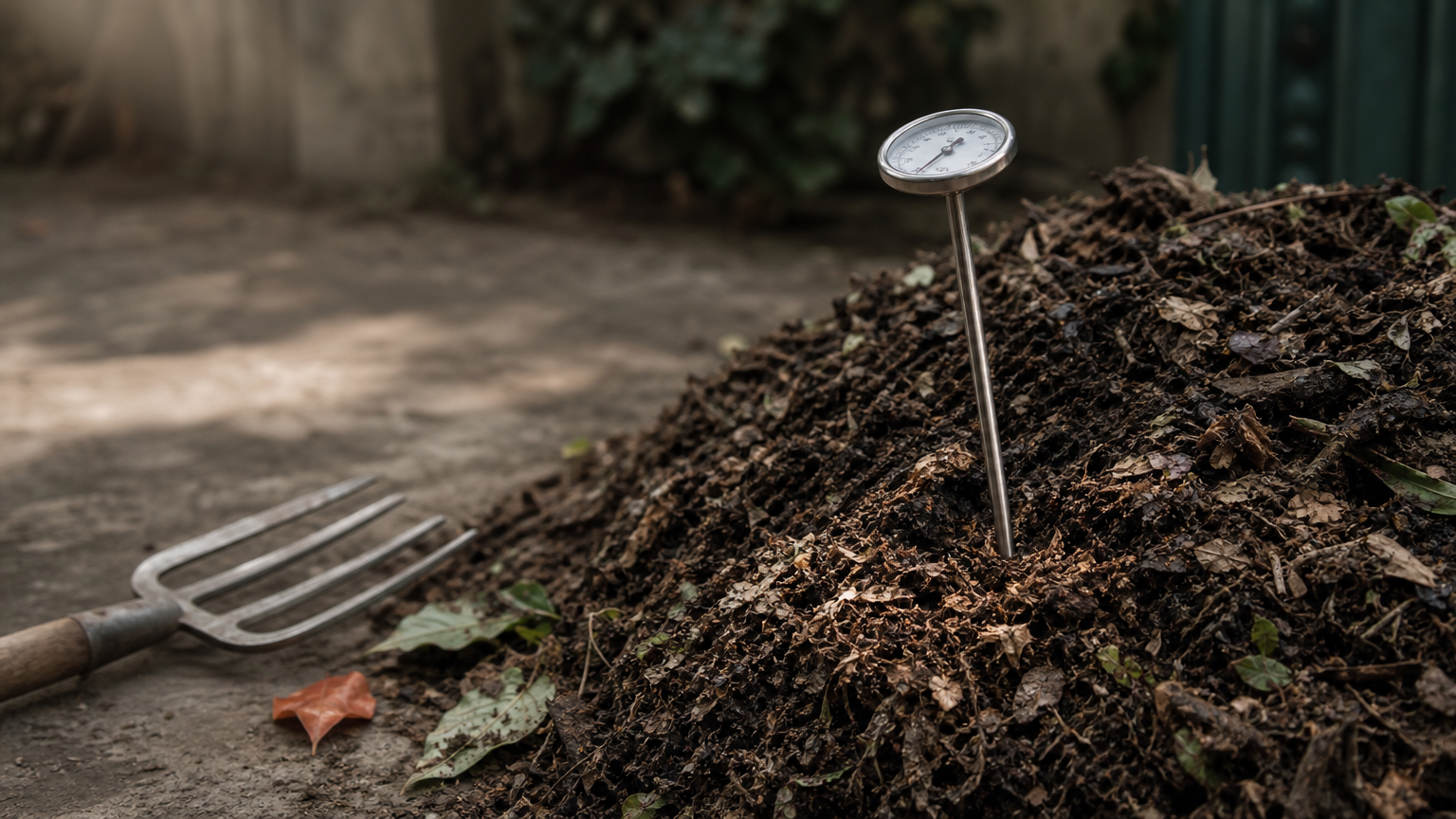
This is the best all-round pick for a typical backyard heap or open bin. It is long enough to reach the active zone and easy to read at a glance.
What you get
A 16-inch stainless steel stem with a dial that marks steady, active, and hot ranges, so you can read the pile without knowing the numbers by heart. The dial is sealed to resist fogging, and the unit is sturdy enough to leave in the pile between checks.
- Length: 16 inches
- Readout: analog dial with color zones
- Price: around $16 in recent listings
- Extra: some models come with a digital composting guide
Who it suits
Pick this if you have a standard heap or a bin about 3 feet across and want reliable everyday accuracy without paying for professional gear. Beginners benefit most from the color zones.
For most home composters, a 16-inch sealed dial is the right balance of reach, readability, and price.
Check the scale before you buy, because some versions show only Fahrenheit or only Celsius. The color zones can be hard to read in low light, and 16 inches is slightly long for some insulated bins.
2. Reotemp 36-inch heavy duty compost thermometer
This is the pick for large or deep piles, where a short probe never touches the core. It is built for years outdoors and is the most durable option here.
What you get
A 36-inch stainless steel stem and a hermetically sealed dial that stays clear instead of fogging. The stem will not bend in dense, woody material, and the dial can be recalibrated. That matters if you want accurate readings for years.
- Length: 36 inches
- Readout: analog dial
- Price: well over $100 (roughly $130 to $150 for the base model)
- Note: a probe handle is not included
Who it suits
Choose it if you build large, high-volume piles or run a small farm or community site where the thermometer gets daily use. Deep windrows are where a long probe pays for itself.
If your pile is taller than 4 feet, a 36-inch probe is the only length that reads the true core.
For a single backyard heap this is overkill, and the cost is hard to justify. Without a handle, pushing a 36-inch stem into a dense pile also takes some grip, so plan for that.
3. VeeGee 12-inch dial compost thermometer
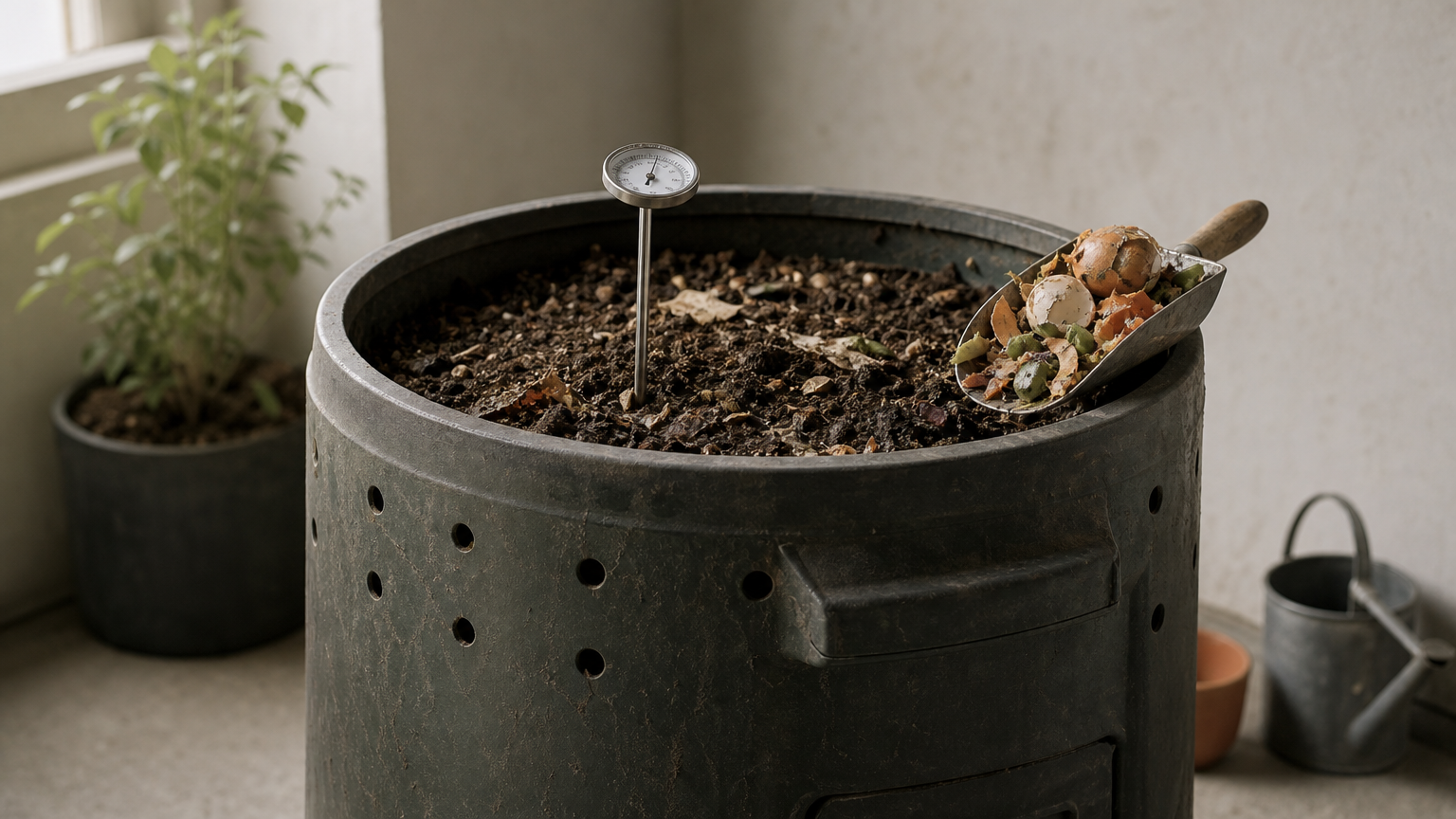
This is the best short-stem choice for insulated or tumbling-style bins. In those bins the heat often builds near the top, so a long probe overshoots the active zone.
What you get
A 12-inch stem with a large, easy-to-read dial and solid build quality for regular checks. It is a plain, accurate tool rather than a beginner’s guide.
- Length: 12 inches
- Readout: large analog dial
- Color zones: none
- Price: check the current listing, as it varies by seller
Who it suits
Buy this if you compost in an insulated bin where material is added at the top and removed from the bottom. The short stem measures where the heat forms.
In a bin that is fed from the top, a short stem often gives a more useful reading than a long one.
The dial has no color coding, so it is less friendly for beginners who do not yet know the target numbers. It can also still feel long in some compact bins.
4. Thermometer World compost thermometer
This is the budget option for learning how your pile behaves. It is a low-cost compost thermometer for sale at a price that suits a first-time composter.
What you get
A color-coded dial that shows warm, ideal, and hot ranges at a glance. It is simple and affordable, and good enough for occasional spot checks as you learn how your pile heats and cools.
- Readout: analog dial with color zones
- Price: the cheapest of the four
- Best use: short, occasional checks, not permanent installation
Who it suits
Get it if you are new to hot composting and want to watch the temperature curve for a few weeks before spending more. It also works as a backup probe.
A budget dial teaches you what a hot pile does, but it is not a tool to leave outside all season.
It is less accurate than higher-end models. It can fog if left outside permanently, and it is not robust enough for heavy long-term use. Pull it out after each reading.
How to choose the right length and use it
Match the stem to your pile: short for top-fed bins, 16 to 20 inches for standard heaps, and 36 inches for large ones. Then insert it correctly and check it on a schedule.
How long should a compost thermometer be
Heat in a bin sits near the top, while heat in a heap built in one go sits near the center. That is why stem length matters more than any other spec. The same rule applies if you prefer a digital probe, so look for a metal probe that will not flex in dense material.
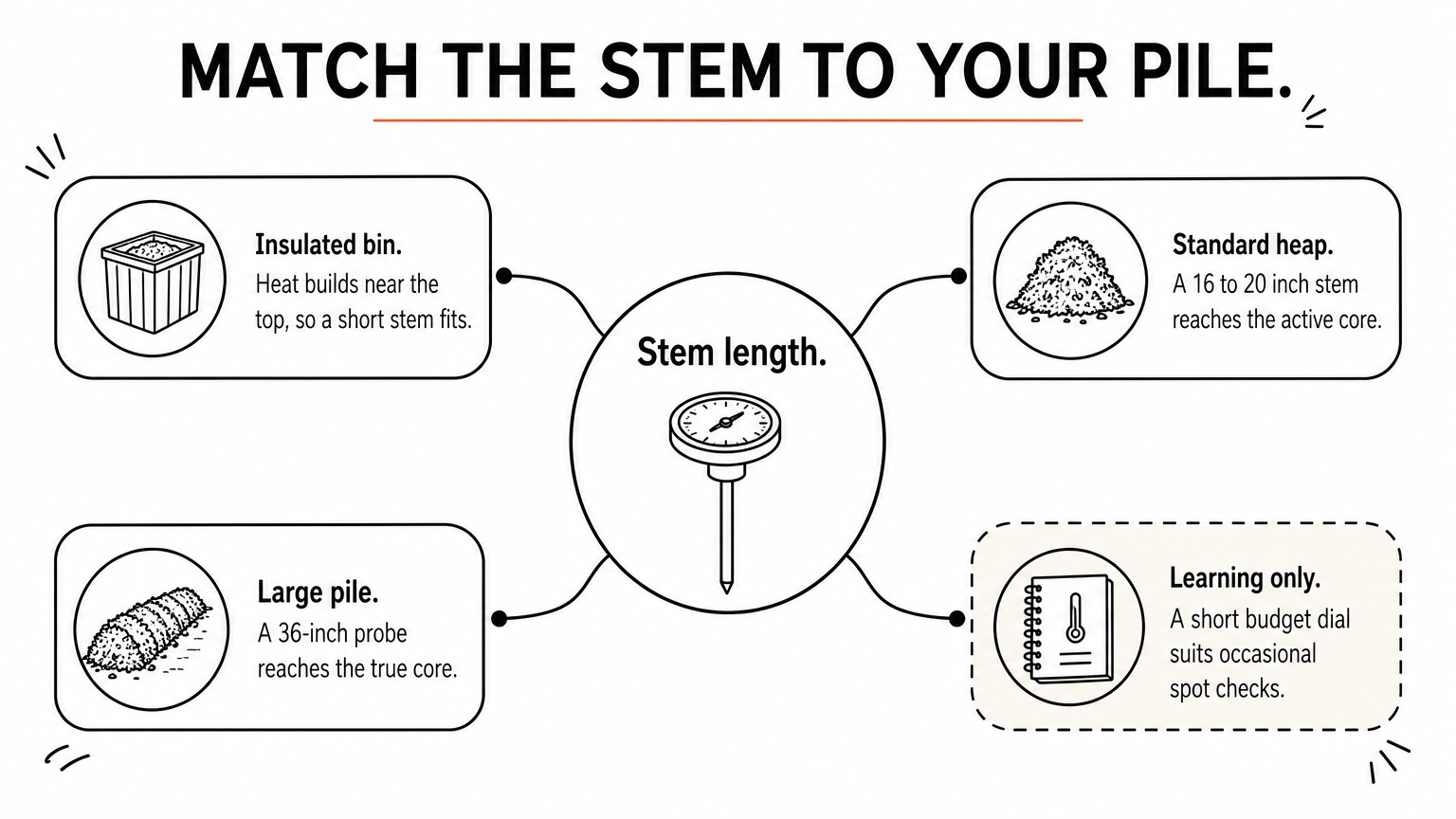
| Your setup | Stem length | Example from this list |
|---|---|---|
| Insulated or tumbling bin | 12 inches | VeeGee dial |
| Standard backyard heap | 16 to 20 inches | Reotemp 16-inch |
| Large pile or windrow | 36 inches | Reotemp heavy duty |
| Learning only | Short, occasional use | Thermometer World |
Choose the stem for where your pile’s heat actually builds, not for the longest number on the box.
A 20-inch Reotemp model sits between the first two lengths and ran about $24 in recent listings. It suits piles around 4 feet wide. Amazon, garden supply stores, and manufacturer websites all sell these thermometers.
How to use a compost thermometer
Push the probe into the pile and wait a few minutes for the needle to settle. Aim for the center, not the edge. Keep the working range at roughly 130 to 150°F, and turn the pile if it climbs past about 150°F (66°C), since extreme heat can kill beneficial microbes.
- Check 2 to 3 days after building a new heap to confirm it is heating.
- Check every other day, or daily, during the hot phase.
- Check again after each turn to see whether it reheats.
- Stop checking once the pile cools and starts to mature.
To test accuracy, stir a glass of ice water, wait three minutes, and submerge the probe without touching the glass. It should read 32°F (0°C). If the dial fogs, dry it in a warm indoor spot until it clears.
Pick by pile size, then check often
The right compost thermometer depends on your pile. A sealed 16-inch dial covers most backyard heaps, a 36-inch heavy-duty probe suits large ones, a 12-inch stem fits top-fed bins, and a budget dial is a fine way to learn. Pick the length first, then the budget, and read the scale before you buy.
Once it is in your pile, check it on a schedule and trust the numbers. If you want more help choosing and testing tools, browse the measuring tool guides at Measuring Expert.