

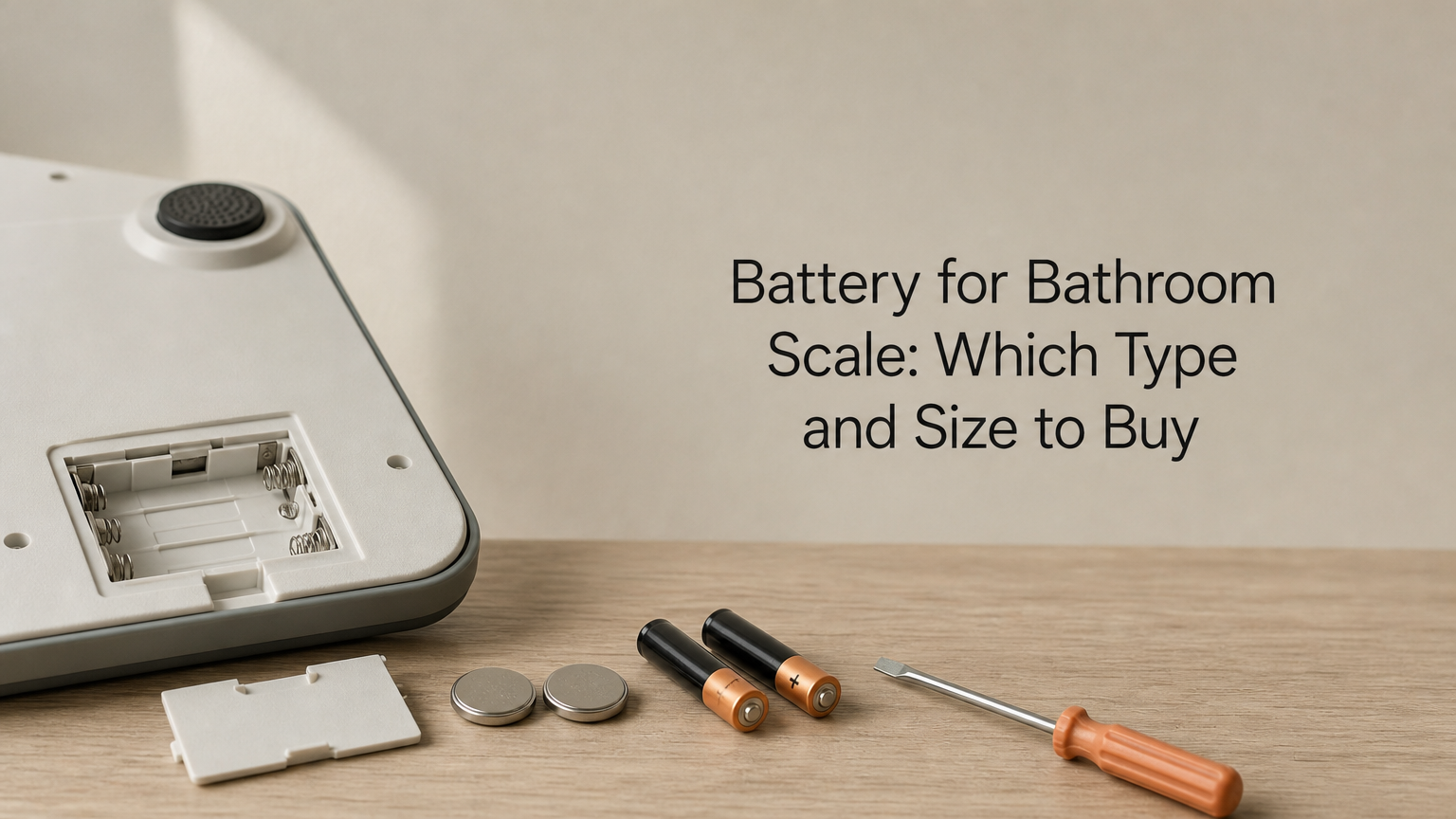
Most digital bathroom scales take a CR2032 lithium coin cell, and many use two of them. Others take AAA or AA alkaline batteries. The right battery for bathroom scale use is printed inside the battery compartment on the underside, and the old cell has its code stamped on top.
A bathroom scale battery is the small power cell that runs the scale’s display and its weight-sensing electronics. Your weight does not power anything. The cell supplies the voltage that lets the sensors read your weight and the screen show it. Voltage, size and cell count must all match what the scale was designed for.
This guide covers why the right cell matters, the common battery types with their sizes, how to identify yours, and how to replace it safely. You will also find buying tips and fixes for a scale that stays dead after a swap. If you also weigh ingredients, Measuring Expert’s other scale guides cover kitchen scale accuracy and how to test it.
Listen to a free audiobook while you cook, work or wait
Why the right bathroom scale battery matters
The right battery matters because a bathroom scale is built around one exact voltage. A wrong or weak cell causes bad readings, a dead display or a scale that never turns on.
What a wrong or weak battery does
A low battery is the most common reason a scale flickers, shows "Lo" or an error code, or gives readings that jump between steps. The electronics need steady voltage to measure small signals from the load sensors. When the cell sags, the numbers wander.
A wrong cell type causes different trouble. A CR2025 is thinner than a CR2032 and may not touch the contacts firmly. A 1.2V rechargeable AAA can look right but deliver less voltage than the 1.5V alkaline the scale expects. The scale may then claim a low battery right after you installed new ones.
The battery does not weigh you, but a weak one can make the scale lie to you.
Signs your scale battery is dying
Watch for these before the scale quits completely:
- Dim or flickering digits
- A "Lo," "Err" or battery icon on the display
- Slow start-up or needing several steps to wake the scale
- Readings that change by a pound or more between back-to-back steps
- A scale that works only after you press it a few times
Bathroom scale battery types and sizes
Bathroom scales use four common battery types: CR2032, CR2025, AAA and AA. A few use the CR2450 or small button cells. The table below shows each one with its voltage and size.
The common battery types compared
| Battery | Voltage | Size | Typical use |
|---|---|---|---|
| CR2032 | 3V lithium | 20 mm wide, 3.2 mm thick | Slim digital scales, often two cells |
| CR2025 | 3V lithium | 20 mm wide, 2.5 mm thick | Slim digital scales, thinner cell slot |
| CR2450 | 3V lithium | 24.5 mm wide, 5 mm thick | Some larger or smart scales |
| AAA | 1.5V alkaline | Standard AAA | Glass and larger digital scales |
| AA | 1.5V alkaline | Standard AA | Larger digital and body-composition scales |
| LR44 / A76 | 1.5V alkaline | 11.6 mm wide, 5.4 mm thick | Small compact scales |
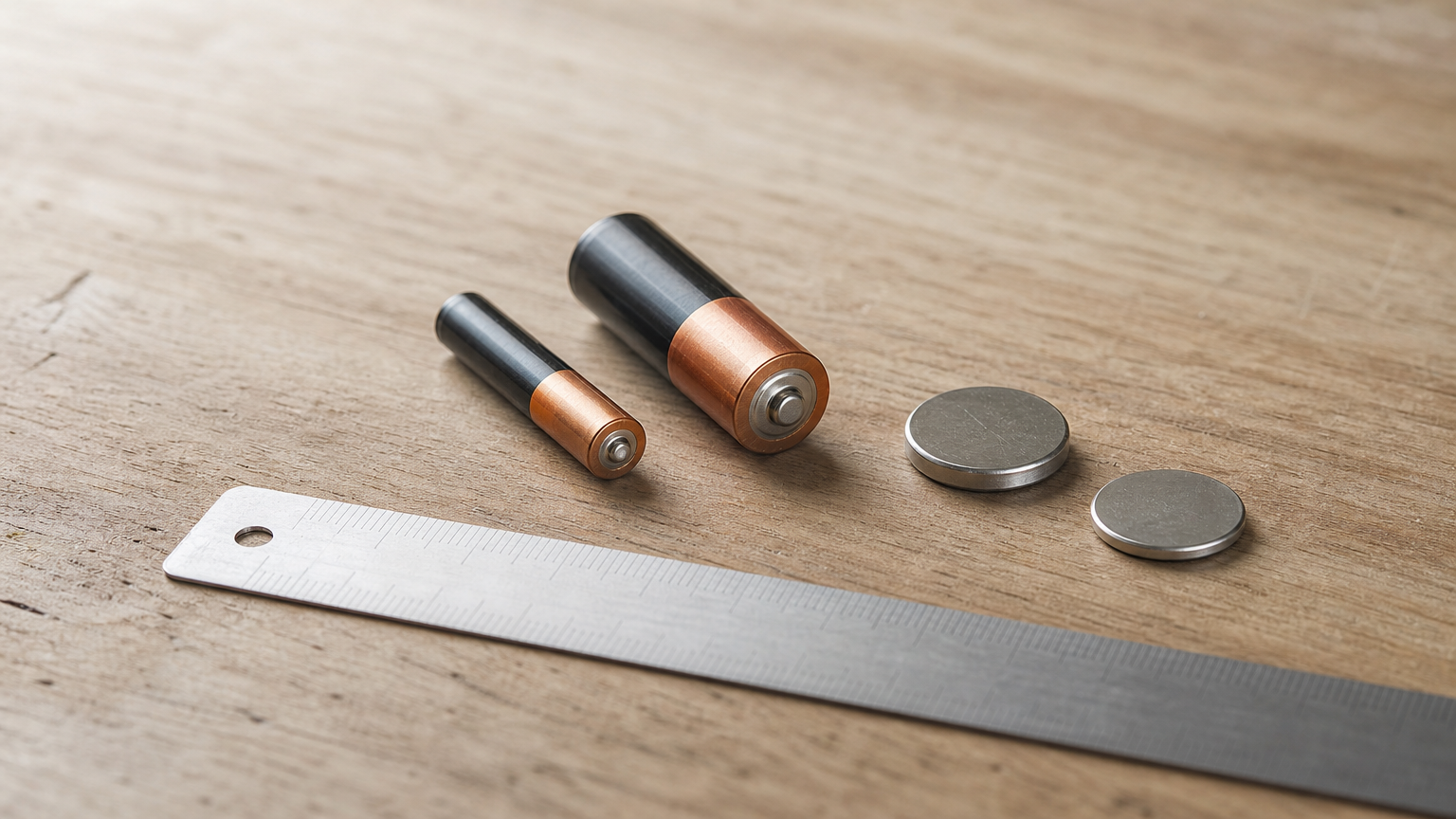
The numbers in a coin cell code tell you the size. In CR2032, "20" is the diameter in millimeters and "32" is the thickness in tenths of a millimeter. That is how you can check a cell with a ruler if the code has worn off.
Lithium, alkaline or rechargeable
For coin-cell scales, buy lithium cells from a known brand. They hold their voltage steady and sit on the shelf for years. For AAA and AA scales, standard alkaline batteries are the safe default.
Rechargeable NiMH cells put out 1.2V instead of 1.5V. Some scales run on them fine and others show a low battery warning, so check the manual first. Some smart scales charge by USB and have a sealed internal battery. Those have no cell for you to swap.
Match the exact code or size on your old cell, not just the shape.
How to find the battery your scale takes
Look inside the battery compartment first. Almost every scale prints the battery type and count there or on the cover. If it doesn’t, the old battery and the manual will tell you.
Check the compartment, cell and model number
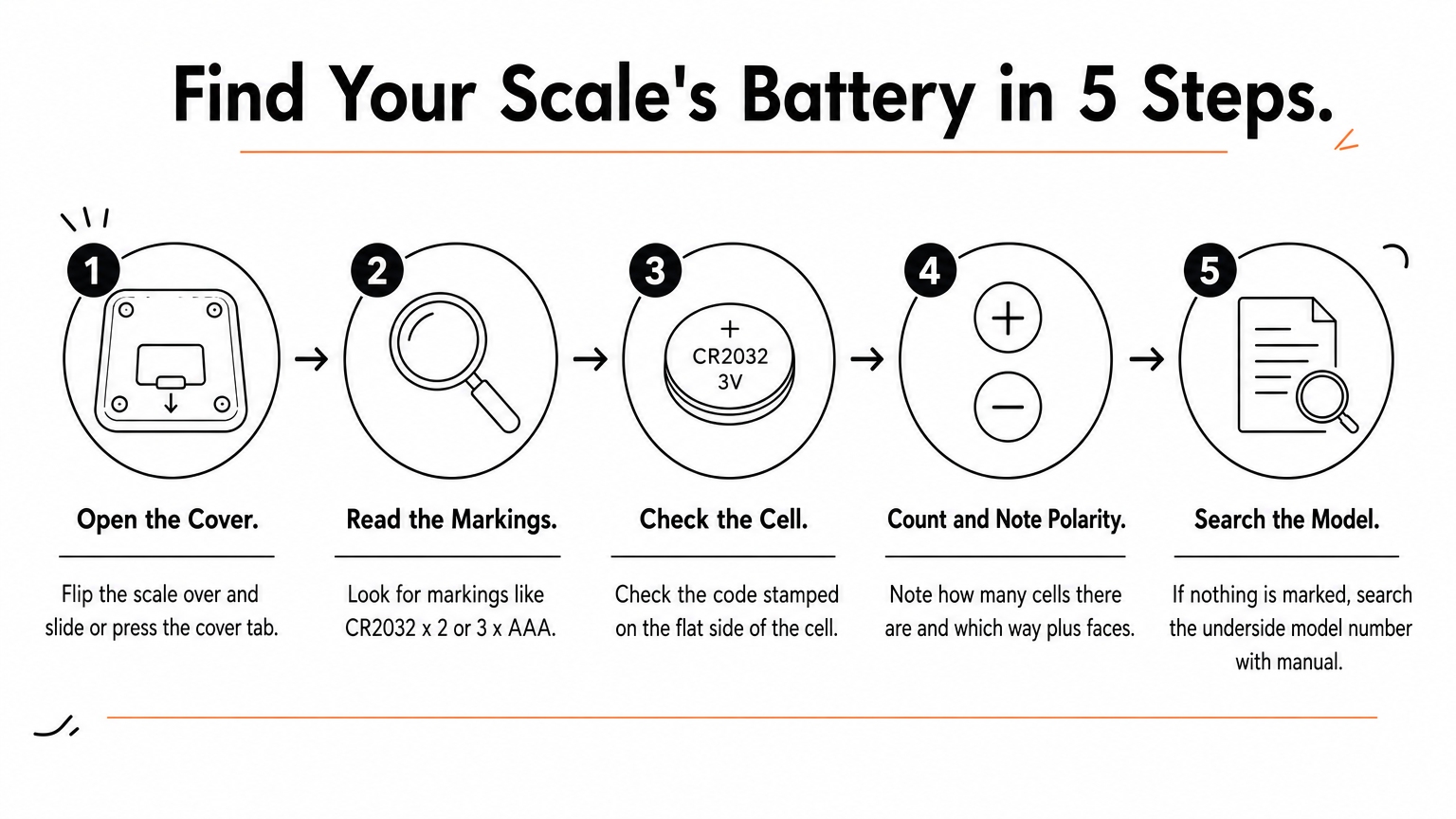
- Flip the scale over and open the battery cover. Slide it or press the tab, depending on the model.
- Read the markings molded into the plastic. You will often see something like "CR2032 x 2" or "3 x AAA."
- Read the code stamped on the flat side of the old cell, or the label on an AAA or AA.
- Count the cells and note which way the plus sign faces.
- If nothing is marked, find the model number on the underside and search it with "manual."
Take a quick photo of the open compartment before you remove anything. It shows the polarity and the count when you are standing in a store aisle.
Measure when the markings are gone
A worn-out label is common on older scales. Measure the coin cell’s diameter with a ruler. A 20 mm cell is a CR20xx, and its thickness narrows it down to 2032 or 2025.
Don’t swap a CR2025 for a CR2032 just because it fits. A thinner cell can sit loose and make poor contact, which gives a scale that works only when you tap it. Buy the exact code your scale calls for. The same goes for LR44 and A76. They are the same size, so those two can substitute for each other.
Same diameter does not mean same battery. Thickness decides whether the contacts hold.
How to replace the battery in a bathroom scale
Replacing the battery takes about two minutes and no tools in most cases. Remove the old cells, check the contacts, insert the new ones with the plus side correct, and close the cover.
Step-by-step battery swap
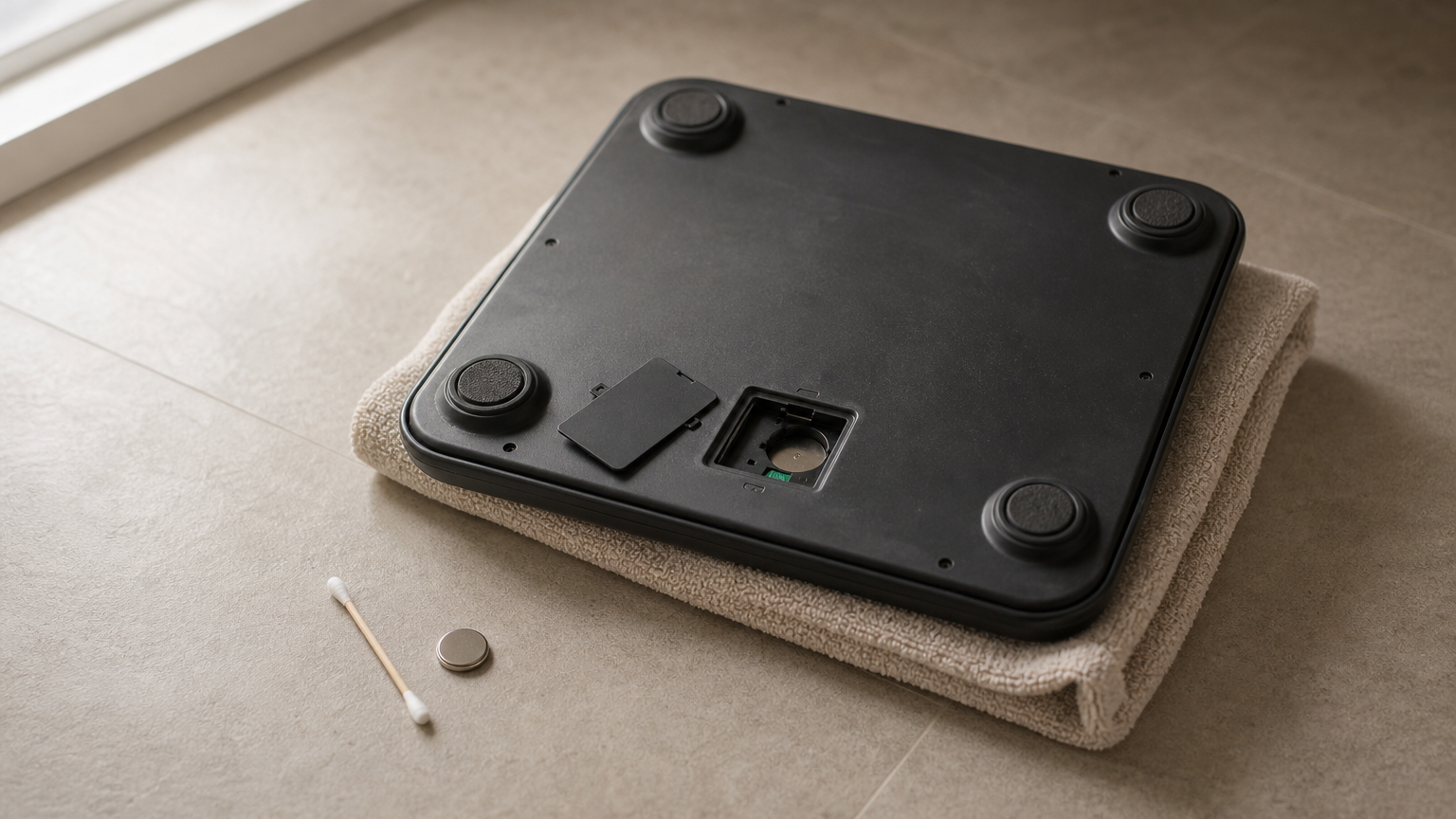
- Place the scale face down on a towel so you don’t scratch the glass or display.
- Open the cover. Use a small flat screwdriver only if it is screwed on.
- Note the polarity, then remove the old batteries. For a coin cell, lift it by the edge with a fingernail or a plastic tool.
- Wipe the metal contacts with a dry cloth. Light corrosion can be cleared with a cotton swab that is only slightly damp, then dried fully.
- Insert fresh cells with the plus side facing the way the compartment shows. Replace all cells at the same time, and never mix brands or old with new.
- Close the cover, turn the scale upright on a hard, flat floor, and step on it to test.
After the swap, safety and disposal
Many scales need to zero themselves after new batteries. Set the scale on a hard floor, let the display show 0.0, and then step on. Carpet makes readings drift, so use a hard surface. If the unit shows "Err," remove the batteries for about a minute and reinstall.
Keep coin cells away from children and pets. A swallowed lithium button cell can cause serious internal burns within hours. Call your local emergency number or Poison Control at 1-800-222-1222 right away if one is swallowed. Recycle spent batteries at a retailer drop-off or household hazardous waste site. Don’t toss them in the trash.
Fresh cells, correct polarity, clean contacts. Those three things fix most scale problems.
Buying bathroom scale batteries and fixing problems
Buy the exact cell your scale calls for from a store with fast turnover. Fresh stock from a drugstore, supermarket, hardware store, big-box store or online seller works. If the scale still fails after a swap, the cause is usually polarity, contact or a weak cell.
Where to buy and what it costs
Coin cells are the cheapest when bought in multipacks, usually at about $1 to $2 per cell. A 6-pack of CR2032 batteries at $9.55 works out to about $1.59 per cell. A scale that takes two cells costs about $3.18 per swap, and that pack covers three swaps.
Check the expiration date on the package. Choose name brands over unmarked bulk cells, since weak cells give the same symptoms as a dying one. Single-pack blister cards cost more per cell, but they make sense if you only need one swap. A box of 15 or 20 makes sense if you have several devices that use the same coin cell.
If the scale still won’t work
Work through this list in order:
- Check that every cell faces the right way.
- Check that the cell sits snug against both contacts. Bend a loose contact tab gently toward the cell.
- Clean the contacts again with a dry cloth.
- Test the new cells in another device or with a battery tester, or use cells from a fresh pack.
- Try a different battery code only if the manual allows it.
- Make sure the cover is fully latched, because some scales cut power when it is not.
If none of that works, the problem is probably the scale itself and not the battery, and it may be time to pick a new bathroom scale.
A new battery that fails is usually a contact or polarity problem, not a bad scale.
A simple rule for scale batteries
Find the code in the compartment, buy that exact cell, and install it with the plus side correct. That covers almost every case, whether your scale wants a CR2032, a CR2025, AAA or AA batteries. Clean contacts and fresh cells from a trusted brand keep readings steady.
If you are weighing a new scale instead of a new battery, look at the measuring tool guides on Measuring Expert for accuracy tips and buying advice.
Black Friday is coming: shop the deals with Prime