

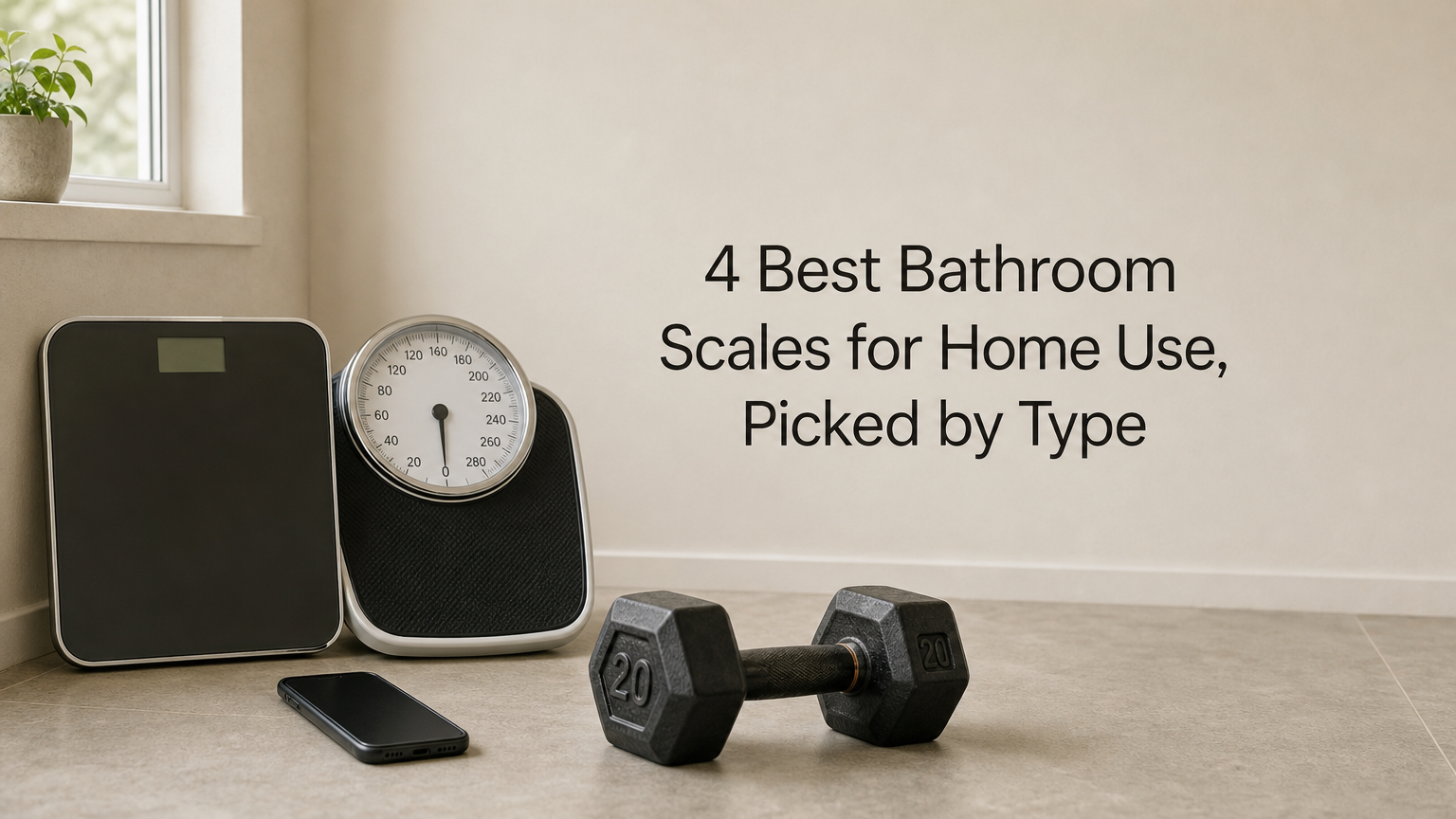
The best bathroom scale for most homes is a basic digital model with four sensors under the platform, a clear display, and a price under $30. If you want to track trends in an app, a smart scale is worth the extra money. If you hate replacing batteries, a mechanical scale works. If you need a higher weight limit or an easier read, buy a high-capacity scale with large digits.
The real problem is that scales range from $15 to over $100 and all of them show a confident number. You cannot tell by looking which one is right. Accuracy matters because you make decisions from that number, whether you are tracking a diet, a medication, or a training block.
This guide ranks four types of bathroom scale by who they suit and what they cost. It then gives you a side-by-side table and a five-minute test you can run at home. At Measuring Expert we write about measuring tools and accuracy, and the same rules that apply to a kitchen scale apply here.
1. Basic digital bathroom scale
A basic digital scale is the best choice for most households. It is cheap, simple, and accurate enough to show real change in your weight.
How it works
Inside the platform, strain gauge load cells (usually one at each corner) turn your weight into an electrical signal. A chip converts that signal into the number on the display. More sensors spread the load better, so a four-sensor scale handles uneven foot placement better than a cheap two-sensor one.
Most basic models read in 0.2 lb steps, and better ones read in 0.1 lb. Finer steps are not the same as better accuracy, but they make small day-to-day changes easier to see.
Who it suits and what it costs
This type suits anyone who wants a reliable number without an app, including households where several people share one scale. Expect to pay roughly $15 to $30. Before you buy, check for:
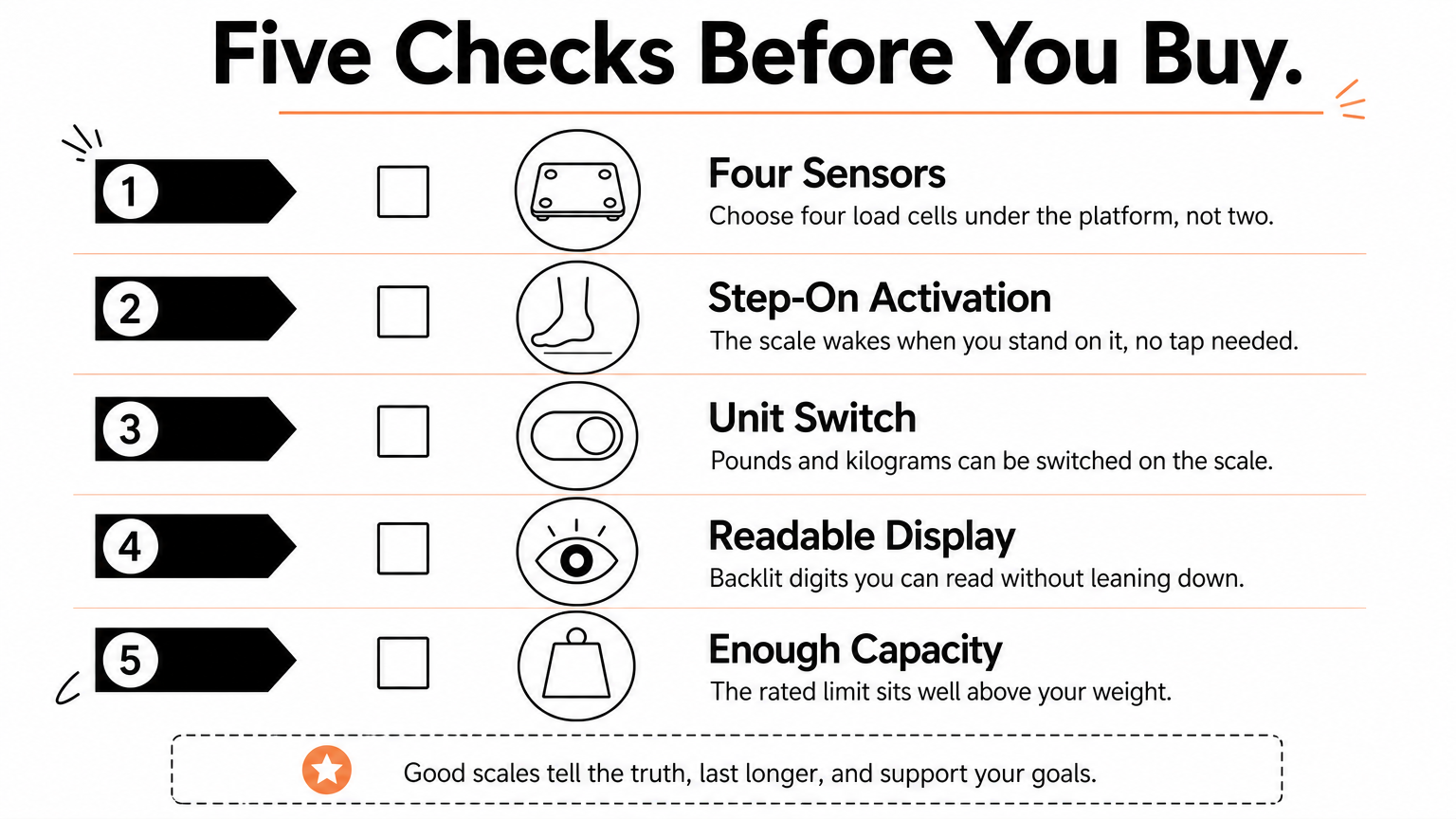
- Four sensors, not two
- Step-on activation, so you do not tap the scale first
- A pounds and kilograms switch
- A readable display, ideally backlit
- A capacity that clears your weight with room to spare
A plain four-sensor digital scale gives you 90% of what you need for a fraction of the smart-scale price.
2. Smart body composition scale
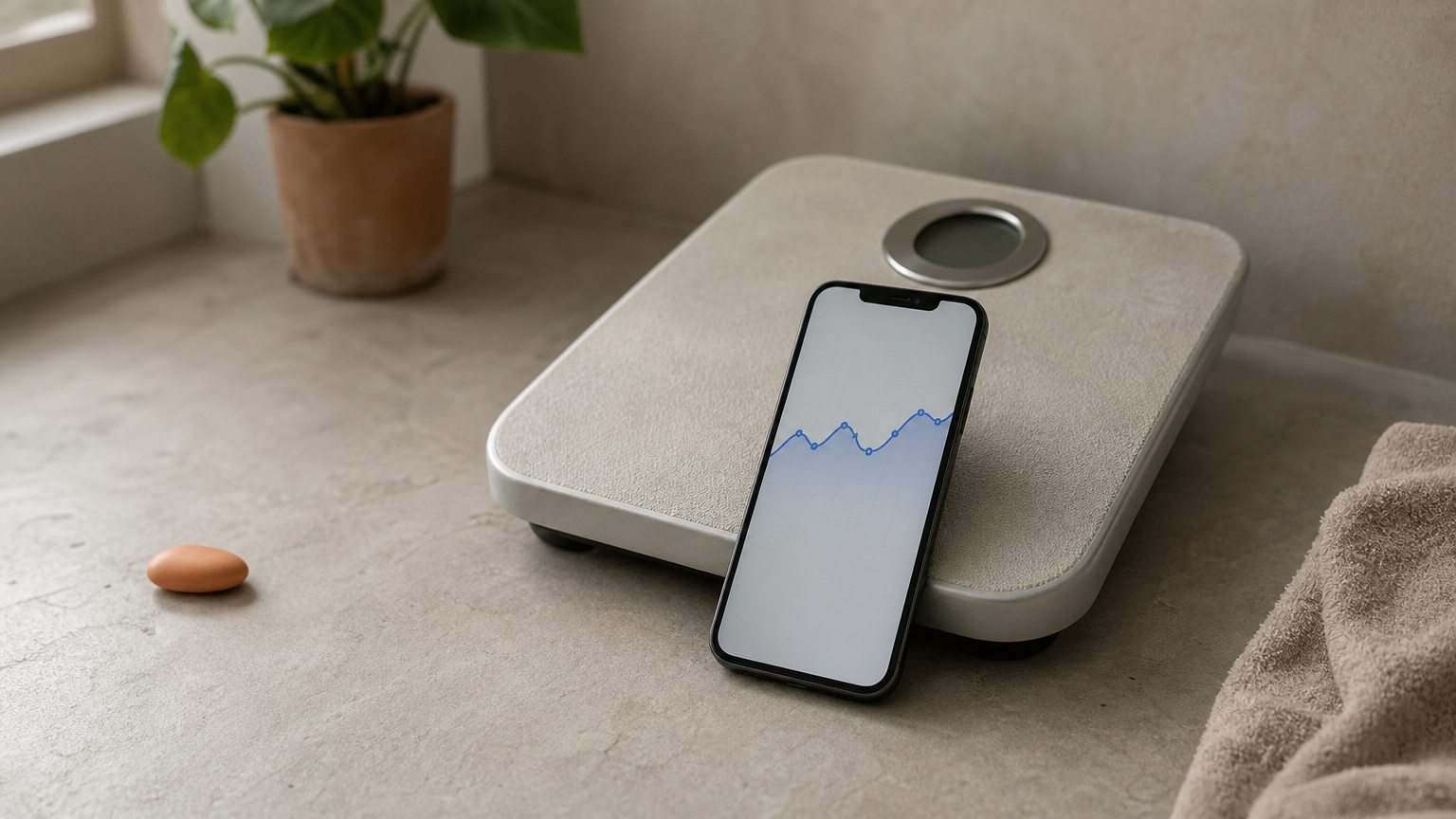
A smart scale syncs your weight to a phone app and estimates body fat and muscle. It is the best pick if you care about long-term trends more than a single reading.
How it works
These scales send a small, harmless electrical current through your feet to estimate body composition, a method called bioelectrical impedance. They connect through Bluetooth or Wi-Fi and log each weigh-in automatically. Models such as the Withings Body+ and the Garmin Index S2 work this way, and many also support several user profiles.
The weight reading comes from the same kind of load cells as a basic digital scale. The body fat figure is an estimate, not a medical measurement. Hydration, recent meals, and exercise all shift it, so watch the direction of the trend instead of any single value.
Who it suits and what it costs
This type suits people who track fitness, share data with a coach, or want a weight history without writing anything down. Prices typically run from about $30 for entry-level models to well over $100 for premium ones. Check the app’s data export and account requirements before you buy.
Manufacturers usually warn that body composition scales are not suitable for people with a pacemaker or other implanted medical device, and often for pregnant users. Ask your doctor if either applies to you.
Buy a smart scale for the trend line, not for the body fat percentage.
3. Analog mechanical bathroom scale
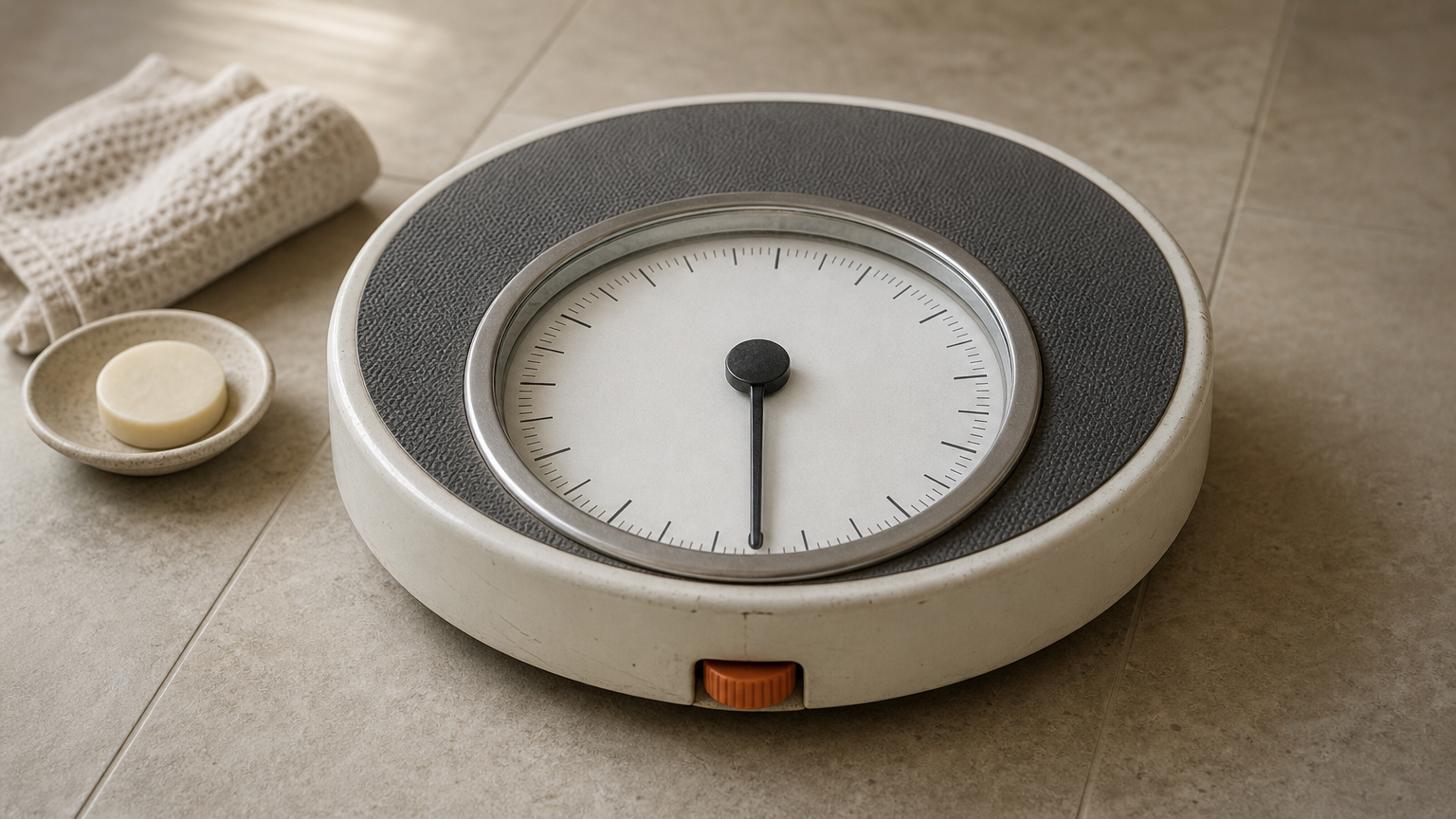
An analog scale uses a spring and a dial instead of electronics. It is the best choice if you want something with no batteries, no app, and nothing to configure.
How it works
When you step on the platform, a spring compresses and rotates a dial through a lever system. The pointer shows your weight against a printed scale. Because it is purely mechanical, it never needs power, and it works the moment you stand on it.
Springs wear and drift over time. Good models include a zero adjustment wheel, so set the pointer to zero before you step on. Read the dial straight on, because looking from an angle shifts the number.
Who it suits and what it costs
An analog scale suits people who dislike batteries, want a backup, or find a dial easier to read than small digits. It typically costs about $15 to $40. The tradeoff is lower resolution: most dials show whole-pound or half-pound marks, so small changes are harder to spot. Check the dial’s marking size and the zero wheel before you buy.
An analog scale never runs out of battery, but you will read it to the nearest pound at best.
4. High-capacity, large-display bathroom scale
A high-capacity scale is built for heavier users or anyone who struggles to read small digits. It is also the best fit for older adults who want a wide, stable platform and a big readout.
How it works
The sensing technology is the same as in a basic digital scale, but the build differs. The frame is reinforced and the platform is wider. The display is larger, often with digits more than two inches tall, sometimes with a talking option. Many standard scales top out around 400 lb, while high-capacity models commonly go to 500 lb or more. Check the exact limit on the product page.
A wider platform also helps with balance. A low profile makes stepping on easier and safer.
Who it suits and what it costs
This type suits people whose weight is near the limit of a standard scale, people with low vision, and caregivers who weigh a family member regularly. Prices typically run from about $25 to $60. Look for a rated capacity well above your weight, a non-slip surface, and a display you can read from standing height without bending.
If your weight is close to a standard scale’s limit, buy for capacity first and features second.
How to choose and test a bathroom scale
Pick the type that matches how you will use it, then confirm it is accurate before you trust it. Cheaper scales can be accurate, and expensive ones can be wrong.
Side-by-side comparison
| Type | Typical price | Best for | Main tradeoff |
|---|---|---|---|
| Basic digital | $15 to $30 | Most households | No app or body data |
| Smart body composition | $30 to $100+ | Trend tracking | Body fat is an estimate |
| Analog mechanical | $15 to $40 | No batteries, simple use | Coarser readings, spring drift |
| High-capacity, large display | $25 to $60 | Higher weights, low vision | Bulkier platform |
For the most accurate result with any type, use a hard, flat floor such as tile or wood. Carpet softens the feet and skews the reading. Weigh at the same time each day, ideally in the morning, with similar clothing.
A five-minute accuracy test
Run these checks when the scale is new, and again if it has been moved or dropped.
- Check repeatability. Step on, note the number, step off, and repeat three times. The readings should match within 0.2 to 0.4 lb.
- Check position. Stand slightly left, right, forward, and back. A good scale reads the same wherever your feet land.
- Check with a known weight. Weigh yourself, then hold a 20 lb dumbbell or similar object whose weight you know. If you read 180 lb alone, you should read about 200 lb holding it.
- Check the floor. Move the scale to another spot. A big change means the floor, not the scale, is the problem.
Fail the repeatability or known-weight check and the scale is not worth keeping. The known-weight check matters most because it tests whether the scale is correct, not just consistent.
A scale that gives the same wrong number every time is repeatable, but it is not accurate.
Pick the scale that fits how you weigh
For most people, a four-sensor digital scale is the best bathroom scale to buy. Choose a smart model only if you will actually use the app, an analog model if you want zero electronics, and a high-capacity model if you need the extra weight limit or bigger digits. Whatever you choose, run the known-weight test before you trust the number.
If you want more help choosing and checking the tools in your home, browse more measuring tool guides on Measuring Expert.