

A league is an old unit of distance. In English-speaking countries, one land league equals 3 statute miles, or 4.828 km (15,840 feet). However, at sea, a nautical league is 3 nautical miles, or 5.556 km (about 3.45 miles). Older Roman, Spanish and French leagues had different lengths, so always check which one a text means.
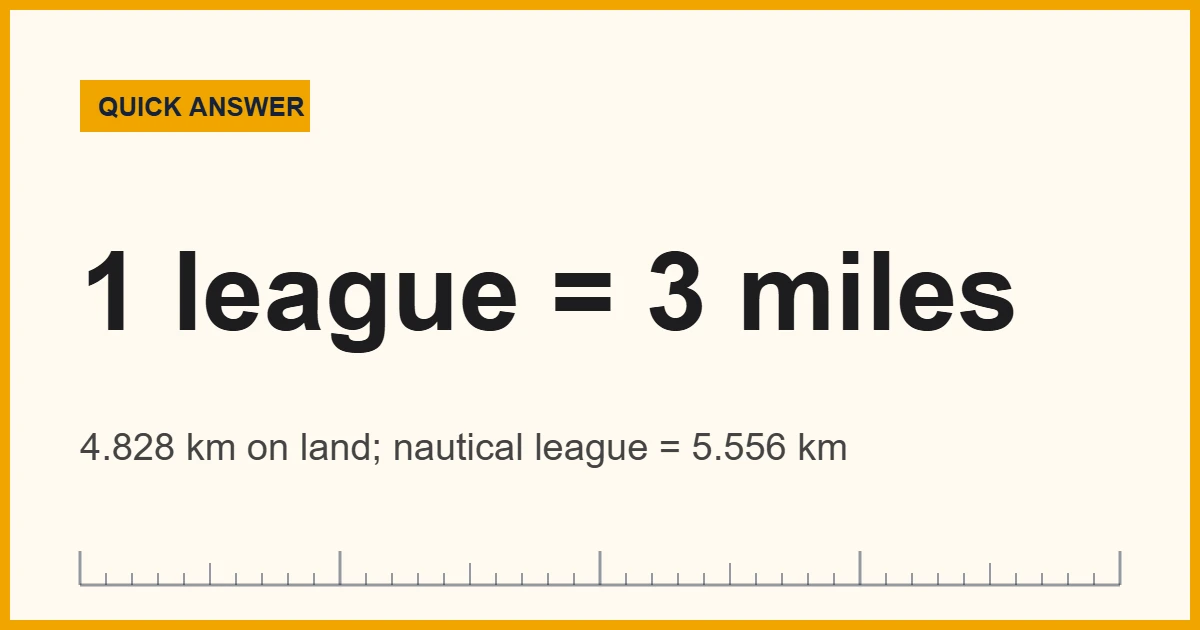
Convert League Distances to Miles and Kilometers
The converter starts at 3 miles, which is one English land league. To convert a larger count, multiply it by 3 and enter the result in miles. For instance, 5 of them make 15 miles, so type 15 and read the kilometers, meters, feet and yards below.
You probably met the word in a novel, a fantasy game or an old map rather than on a road sign. That makes sense, because no country uses it as an official unit today. Still, it shows up often enough in books, history and sailing that a clear number helps.
The short version is simple. English and American writers almost always mean the 3-mile land version. Sailors, by contrast, counted in units of 3 nautical miles. In addition, many European countries had their own versions, ranging from about 2.4 to 4.6 miles, according to Encyclopaedia Britannica. Because the mile is now defined exactly as 1,609.344 m, the English version works out to exactly 4,828.032 m.
Below, you will find a quick chart, a table that separates the different versions, the story behind the unit, and finally what Jules Verne really meant by “twenty thousand leagues”.
League Conversion Chart
This chart covers the values readers ask about most. The land columns use 3 statute miles per unit, and the nautical column uses 3 nautical miles per unit (1 nautical mile = 1,852 m exactly). Also, kilometers are rounded to three decimals or fewer. In addition, feel free to print it or save it for later.
| Count | Land (miles) | Land (km) | Nautical (km) |
|---|---|---|---|
| 1/2 | 1.5 mi | 2.414 km | 2.778 km |
| 1 | 3 mi | 4.828 km | 5.556 km |
| 2 | 6 mi | 9.656 km | 11.112 km |
| 3 | 9 mi | 14.484 km | 16.668 km |
| 5 | 15 mi | 24.14 km | 27.78 km |
| 10 | 30 mi | 48.28 km | 55.56 km |
| 20 | 60 mi | 96.56 km | 111.12 km |
| 100 | 300 mi | 482.8 km | 555.6 km |
| 1,000 | 3,000 mi | 4,828 km | 5,556 km |
Going the other way, one mile is 1/3 of the land unit, and one kilometer is about 0.207 of it. Similarly, the land unit contains 5,280 yards, which is the same as 3 miles of 1,760 yards each. For the yard and mile relationship, see how many yards are in a mile.
Recommended Tools for Measuring Map Distances
Nobody sells a ruler marked in this old unit, but a map measurer does the same job. First, you roll its small wheel along a route on a paper map. Next, you read the distance in miles or kilometers at the map’s scale, and then divide the miles by 3. A digital plan measure also handles custom scales, while a measuring wheel covers real ground distances on foot.


As an Amazon Associate, Measuring Expert earns from qualifying purchases.
Land League vs Nautical and Historical Versions
In practice, most confusion comes from mixing up these versions. So before you convert a distance from an old source, find out where and when the author wrote. For this reason, the table below compares the common ones with their approximate lengths.
| Version | Length | In miles | Where you meet it |
|---|---|---|---|
| English land | 4.828 km (3 statute miles) | 3 | English and American books, old land descriptions |
| Nautical | 5.556 km (3 nautical miles) | about 3.45 | Sailing and naval history |
| Roman/Gallic leuga | about 2.2 km (1 1/2 Roman miles) | about 1.4 | Roman roads in Gaul |
| Spanish legua (older) | about 4.18 km | about 2.6 | Spanish colonial surveys, the American Southwest |
| Spanish legua (from 1568) | about 5.57 km | about 3.46 | Later Spanish sources |
| French lieue de poste | about 3.9 km | about 2.42 | French postal roads before the metric system |
| French metric lieue | 4 km exactly | about 2.49 | 19th-century French texts, including Jules Verne |
Values for the historical versions come from this reference article on the unit and Britannica, and they are approximate because local standards varied.
Where the League Came From
The word comes from the Late Latin leuga, which the Romans borrowed from the Gauls. In other words, the Romans did not invent it. Instead, they adopted a local Gallic unit while governing Gaul, and they set it at 1 1/2 Roman miles. Similarly, Britannica describes it as 1,500 Roman paces, which is close to 2.2 km.
Many sources also say the unit first meant roughly the distance a person could walk in one hour. Indeed, that idea fits the numbers well. For example, an adult walking at about 3 miles per hour covers the English land distance in an hour, and at 5 km/h the trip takes about 58 minutes. However, it remains a rule of thumb rather than a formal definition.
Over the centuries, each country fixed its own length. For example, Spain had several versions, and its older legua shows up in surveys of what is now Texas, New Mexico and California. Meanwhile, France switched to metric units and then defined a convenient lieue of exactly 4 km. Finally, England settled on 3 miles, and that is the value English dictionaries still give.
Today, the word survives mainly in literature, fantasy fiction and phrases such as “leagues ahead”. As a result, you will not find it on any modern road sign, chart or official document.
The Jules Verne Title: Distance, Not Depth
Jules Verne’s 1870 novel, Twenty Thousand Leagues Under the Sea, is the reason many people search this word. However, a common mistake is to read the title as a depth. In fact, 20,000 leagues straight down is impossible, since the deepest known point of the ocean lies only about 11 km below the surface.
Instead, Verne meant the distance the submarine Nautilus travels during the story. Because he wrote in French, he used the metric lieue of 4 km. So 20,000 of them make 80,000 km, or about 49,700 miles. In other words, that is roughly twice the distance around the Earth at the equator (about 40,075 km). If you instead used the English 3-mile unit, the trip would be about 96,560 km, which shows how much the choice of unit matters.
How to Measure a League Distance on a Map
As a result, you can convert any map route with a few simple steps:
- Check the map scale. First, find the scale bar or ratio, such as 1:24,000 or 1 inch = 1 mile.
- Trace the route. Next, roll a map measurer along the path, or lay a string along it and straighten it against the scale bar.
- Read the distance in miles or kilometers. Then use the matching dial on the measurer, or set the scale on a digital model.
- Convert to the land unit. Divide miles by 3, or divide kilometers by 4.828.
- Use the nautical unit at sea. On a nautical chart, however, divide nautical miles by 3 instead.
- Check your answer. Finally, enter the miles in the converter above to confirm the kilometer value.
Conversion Do and Don’t
Do
- Assume 3 miles for English and American texts.
- Use 3 nautical miles for sea distances.
- Look up the country and date for older sources.
- Give a range, instead of one figure, when the source is unclear.
- Keep the original figure next to your conversion.
Don’t
- Mix nautical and statute miles in one result.
- Read Verne’s title as an ocean depth.
- Treat the one-hour walk as exact, since it is only a rule of thumb.
- Apply the English figure to Spanish land grants.
- Quote more decimals than the source supports.
Honest Limits of These Conversions
The English land and nautical versions convert exactly, because miles and nautical miles now have exact metric definitions. Older versions are a different story. For one thing, local standards drifted, scribes rounded, and the same name covered several lengths even inside one country. For that reason, the historical values in this article are best read as close estimates. Also, a distance in an old travel account may have been guessed rather than measured, so a precise conversion can suggest more accuracy than the original ever had.
When Accuracy Really Matters
For a novel or a game, 3 miles per unit is close enough. Some situations, however, need more care:
- Historical land records. Old Spanish and Mexican grants in the Southwest used the legua and the vara, so check the specific local standard that applied.
- Academic writing. State which version you used, and also cite where its length comes from.
- Sea history. Confirm whether a logbook used nautical units or another national unit before you plot a route.
Frequently Asked Questions
How many miles is a league?
An English land league is 3 statute miles. The nautical version is 3 nautical miles, which is about 3.45 statute miles.
How many kilometers is a league?
The land version is about 4.828 km, and the nautical one is exactly 5.556 km.
How many feet are in a league?
There are 15,840 feet in an English land league, because each of its 3 miles has 5,280 feet.
Is a league still used today?
No country uses it as an official unit today. Instead, you mainly see it in literature, history, games and phrases like “leagues ahead”.
What is the nautical version?
It is 3 nautical miles, or 5.556 km. In fact, sailors used it before modern charts standardized on the nautical mile.
How long is a league in the Jules Verne novel?
Jules Verne used the French metric lieue of 4 km, so 20,000 of them equal 80,000 km, about twice around the Earth. In other words, the title describes distance traveled, not depth.
How long did it take to walk one league?
About an hour at a normal pace, so the unit was handy for travelers. At 3 miles per hour, the English land distance takes 60 minutes.
How long was the Roman version?
The Roman leuga, borrowed from the Gauls, was 1 1/2 Roman miles, or roughly 2.2 km (about 1.4 miles).
How many leagues are in a mile?
One mile is one third of the land unit, or about 0.33 of it.
What does “leagues ahead” mean?
It means far ahead of others. The phrase borrows the unit because it was a long distance.
Bottom Line
In short, a league in English is 3 miles or 4.828 km, while the nautical version is 3 nautical miles or 5.556 km. Meanwhile, older Roman, Spanish and French versions ran from about 2.2 to 5.6 km, so the source decides which number is right.
Finally, for quick conversions, multiply by 3 and use the converter at the top of this page. And when you next pick up Verne, remember that his 20,000 leagues describe a voyage of about 80,000 km, not a dive to the bottom of the sea.
2 thoughts on “What Is a League in Measurement? Length in Miles and Kilometers”