

To use a meat thermometer for pork chops, slide a digital probe into the center of the thickest part of the chop, about an inch away from the bone. Take the chops off the heat when the display reads 145°F (63°C), then rest them for at least three minutes before you cut. That is the USDA safe minimum for whole cuts of pork, and it leaves the meat juicy with a slightly rosy center.
Most dry pork chops come from old habits. Many of us learned to cook pork until it turned gray, because the advice used to be 160°F or higher. Modern pork is lean, so those extra 15 degrees drain the moisture. Chops also make probe placement tricky. They are often under an inch thick, and a tip that touches bone or pokes through the meat gives a false reading.
This guide covers four steps: checking your thermometer, placing the probe, pulling the chops at the right number, and resting them. At Measuring Expert we write about measuring tools of every kind, and a thermometer is one of the most useful in your kitchen. You will also get a doneness table with Celsius conversions and fixes for the usual mistakes.
Why a thermometer beats color and timing
A thermometer beats color and timing because internal temperature is the only reliable sign of a safe, juicy pork chop. Thickness, pan heat and how cold the chops were at the start all change cooking time. Color changes with them, and it misleads.
The safe pork chop temperature
The USDA sets the safe minimum for whole cuts of pork, including chops, at 145°F (63°C), measured before you remove the meat from the heat, followed by a rest of at least three minutes. Ground pork, such as patties, needs 160°F (71°C). Grinding spreads surface bacteria through the meat.
Color tells you very little. A chop cooked to 145°F can be rosy pink in the center and fully safe. The old 160°F rule dates from a time when parasites in pork were a bigger worry. Farming and feeding practices have changed, and the guidance changed with them. You can check the current numbers on the USDA safe temperature chart.
| Pork type | Safe minimum | Rest |
|---|---|---|
| Chops, loin, tenderloin, roasts | 145°F / 63°C | At least 3 minutes |
| Fresh ham | 145°F / 63°C | At least 3 minutes |
| Ground pork and patties | 160°F / 71°C | None required |
Pull whole-cut pork chops at 145°F, rest them for three minutes, and ignore the color.
Which thermometer to use
A digital instant-read thermometer is the best choice for chops. It reads in a few seconds and has a thin tip that leaves a small hole. Look for a thin probe, a fast reading and a display you can see over a hot pan.
Dial instant-read models work, but they often need a longer stretch of the stem inside the food. On a thin chop, that means going in from the side. A leave-in probe suits thick or double-cut chops that spend a long time in the oven, but only if the maker says it is oven or grill safe.
Step 1. Check that your thermometer is accurate
Test your thermometer in ice water before you trust it. A properly made ice bath should read 32°F (0°C) at sea level. The test takes two minutes, and it matters because a thermometer that reads even a few degrees off turns a good chop into a dry or undercooked one.
Run the ice water test
Follow these steps:
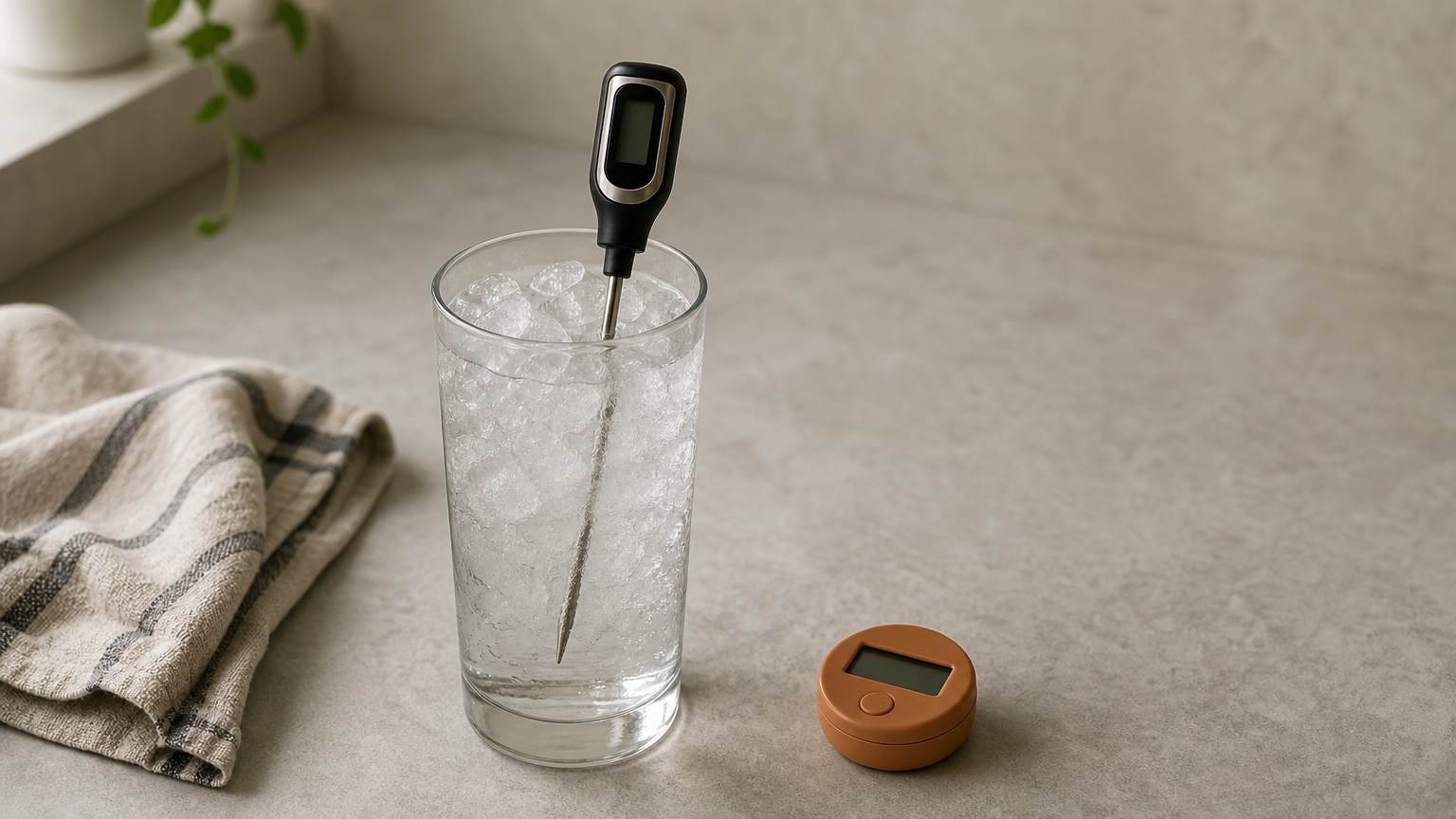
- Fill a tall glass to the top with crushed ice, then add cold water.
- Stir and let the glass sit for a minute.
- Put the probe in the center of the glass. Keep the tip off the sides and the bottom, and submerge the whole sensing area.
- Wait until the reading stops moving.
- Compare it to 32°F (0°C).
What to do if the reading is off
Some digital models have a calibration button or an offset setting, so check the manual. Many cannot be adjusted at all. In that case, you either do the math or replace the unit. I would retire any thermometer that reads more than about 2°F off and cannot be corrected.
Here is why the math matters. Say your thermometer reads 36°F in ice water. It runs 4°F high, so a displayed 145°F is really about 141°F, which is below the safe minimum. If it reads 4°F low, you will overcook every chop without knowing why.
A thermometer you have not tested is a guess with a display.
Step 2. Insert the probe in the right spot
Put the probe in the center of the thickest part of the chop, with the tip about an inch away from the bone and clear of the pan. Placement decides whether the number on the display describes the coolest part of the chop. That is the part you need to measure.
Thick chops, three-quarters of an inch and up
Push the probe in from the top or edge until the sensing area sits in the middle of the meatiest part. On a bone-in chop, stay about an inch from the bone. Meat next to the bone usually reads lower than the rest, which gives you a misleading number. Check your thermometer’s manual to see how far the sensing area extends from the tip.
Avoid these common errors:
- Touching the bone, which can read too high or too low.
- Resting the tip against the pan or grill grate.
- Stopping in a pocket of fat instead of muscle.
- Going in so shallow that the sensing area is partly outside the meat.
Thin chops, under three-quarters of an inch
For a thin chop, insert the probe from the side. Slide it horizontally through the edge until the tip reaches the center. From the top, the probe passes through a thin chop or leaves part of the sensing area in the air.
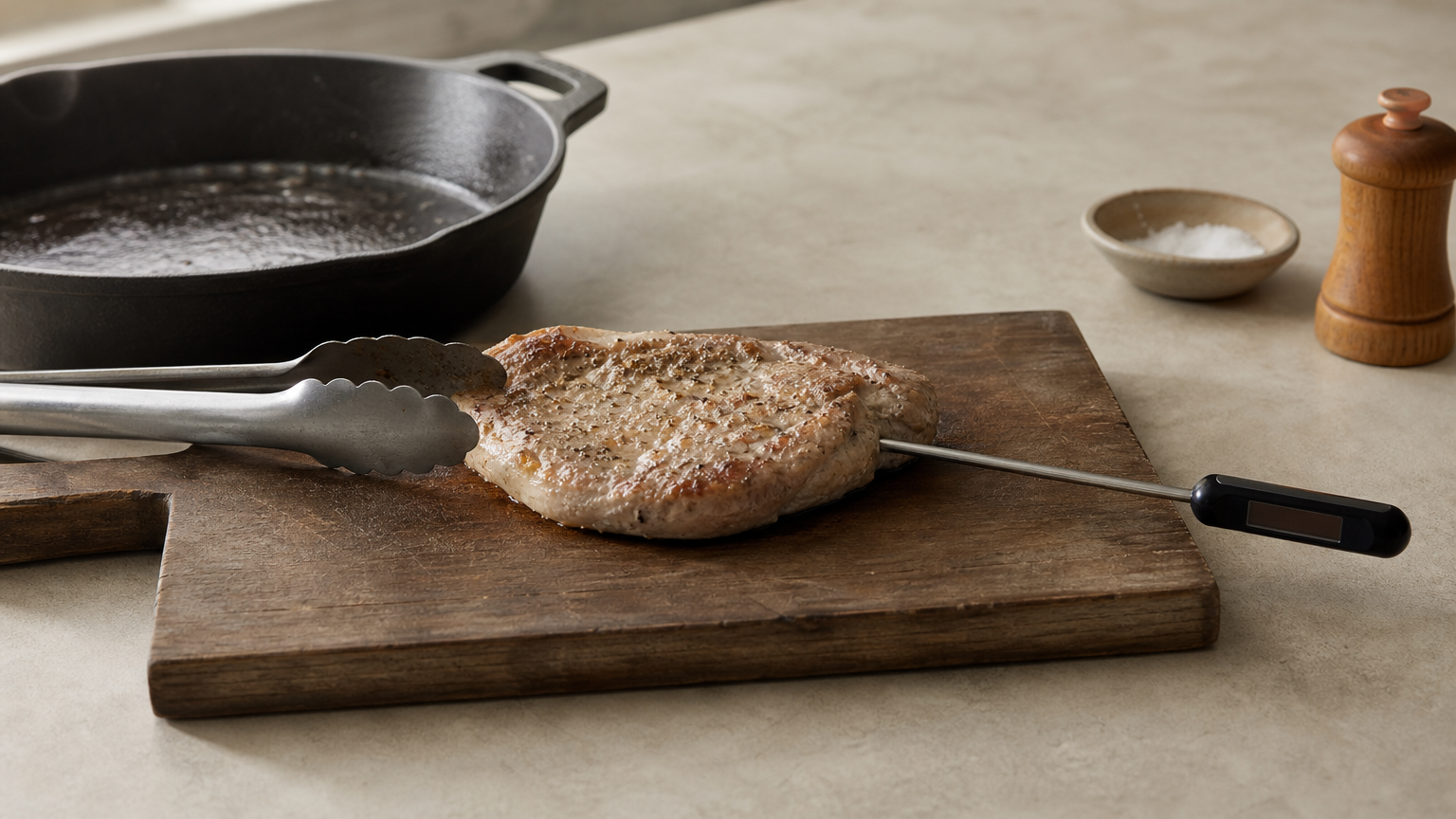
Take the reading while the chop is still on the heat, or right after you lift it off. If the number comes up short, put the chop back and check again in a minute. Hold the chop steady with tongs so the probe does not shift.
Thin chop, side entry. Thick chop, top entry, one inch from the bone.
Step 3. Pull the chops at the right temperature
Take the chops off the heat when the thermometer reads 145°F (63°C) in the center. Go a little higher only if you want a firmer bite. Your target depends on how you like your pork, but 145°F is the floor for every level.
Doneness by temperature
| Doneness | Fahrenheit | Celsius |
|---|---|---|
| Medium-rare | 145 to 150°F | 63 to 66°C |
| Medium | 150 to 155°F | 66 to 68°C |
| Medium-well | 155 to 160°F | 68 to 71°C |
| Well done | 160°F | 71°C |
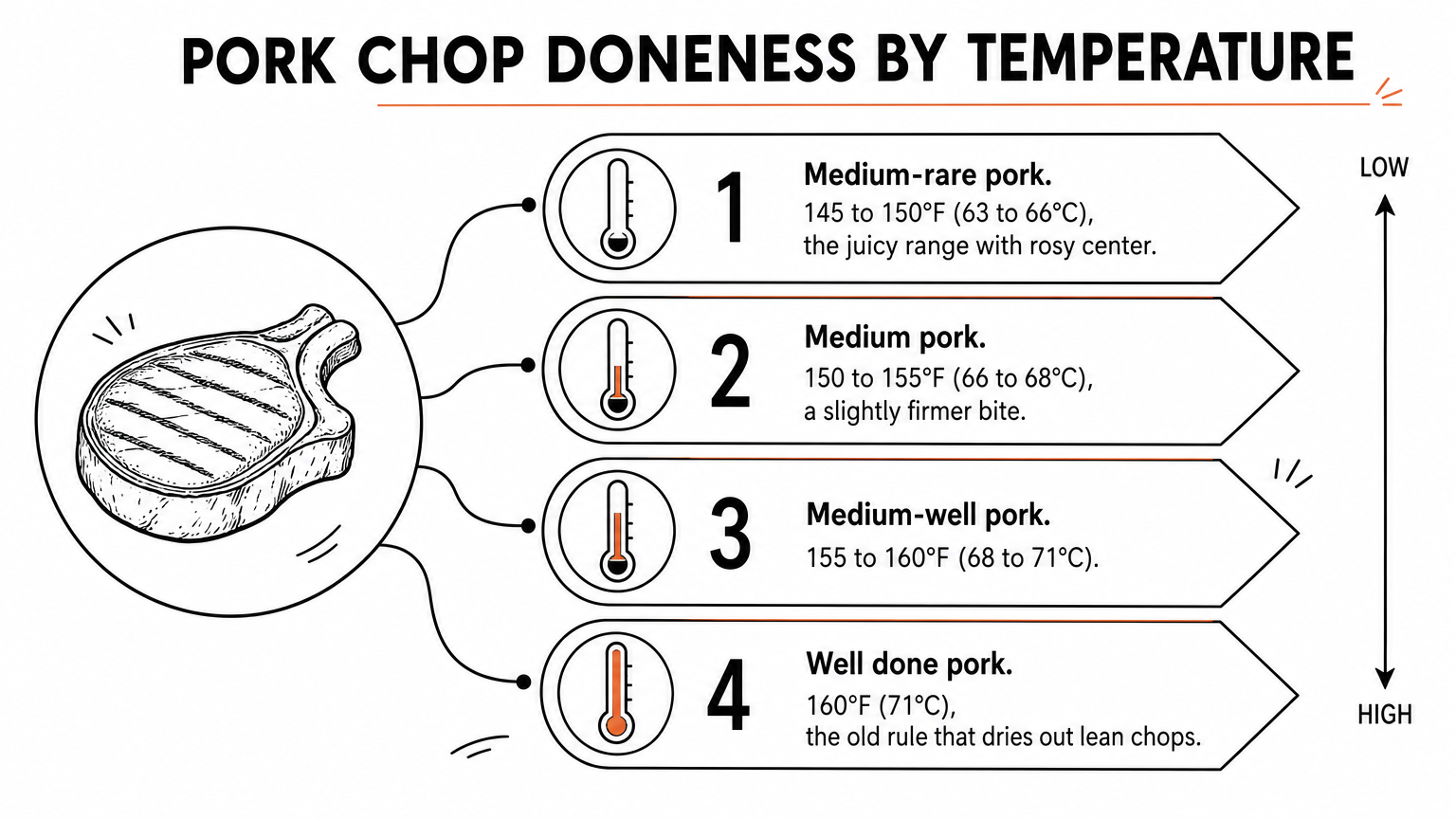
For most chops, I would aim for the 145 to 150°F range, where the meat stays juicy. Readers often ask whether pork is done at 145 or 165. It is done at 145. The 165°F figure applies to poultry, and chops cooked that far end up dry.
Pulling at 135°F is a different matter. That is under the USDA minimum, and you should not rely on the rest to close the gap.
When to start checking
Start checking a minute or two before the earliest time your recipe gives. These times are for 1-inch chops, and they are a guide only, since the thermometer decides when they are done.
| Method | Typical time for 1-inch chops |
|---|---|
| Grill, medium heat | 4 to 6 minutes per side |
| Pan sear | 4 to 5 minutes per side |
| Sear, then bake at 350°F | 15 to 20 minutes in the oven |
Here is a worked example. You pan-sear a 1-inch bone-in chop at 4 to 5 minutes per side, so it finishes around 8 to 10 minutes total. Check at 8 minutes through the edge, then every minute until it reads 145°F. Boneless chops cook a little faster than bone-in, so check them earlier.
Start checking early, then check again every minute until you reach 145°F.
Step 4. Rest the chops and confirm the result
Rest the chops on a plate for at least three minutes. The rest is part of the USDA standard, and it keeps the juices in the meat instead of on your cutting board. Skipping it is the most common way people ruin a well-timed chop.
Why resting matters
While the chop rests, heat from the outer layers moves toward the center, a process called carryover cooking. The internal temperature rises a few degrees. The juices also redistribute through the muscle. Cut a chop straight off the heat and they run out onto the plate.
The three-minute rest is part of the safety standard, not an optional extra.
Fix common problems
Use this list when the numbers do not behave:
- The reading jumps around or looks low. The probe is probably near bone or touching the pan. Move it to the center of the meatiest part.
- The chop is under 145°F after you pulled it. Return it to the heat for a minute and check again.
- The chop is dry even though you used a thermometer. You likely pulled it too high. Try 145 to 150°F next time.
- A thin chop reads wrong. The sensing area is probably partly outside the meat. Go in from the side.
- You are cooking ground pork. Aim for 160°F, not 145°F.
Wash the probe in hot, soapy water between raw and cooked checks. A probe that touches raw pork and then your finished chop can spread bacteria.
Cook by the number, not the color
A good result with pork chops comes down to four habits. Test the thermometer in ice water, place the probe in the center of the thickest part, pull at 145°F (63°C), and rest for three minutes. Do that and you get chops that are safe and juicy, with a faint blush of pink that you no longer need to worry about.
If you found this useful, you will probably want the same precision in the rest of your kitchen. Browse more kitchen measurement guides at Measuring Expert for help with scales, conversions and the tools that make cooking repeatable.