

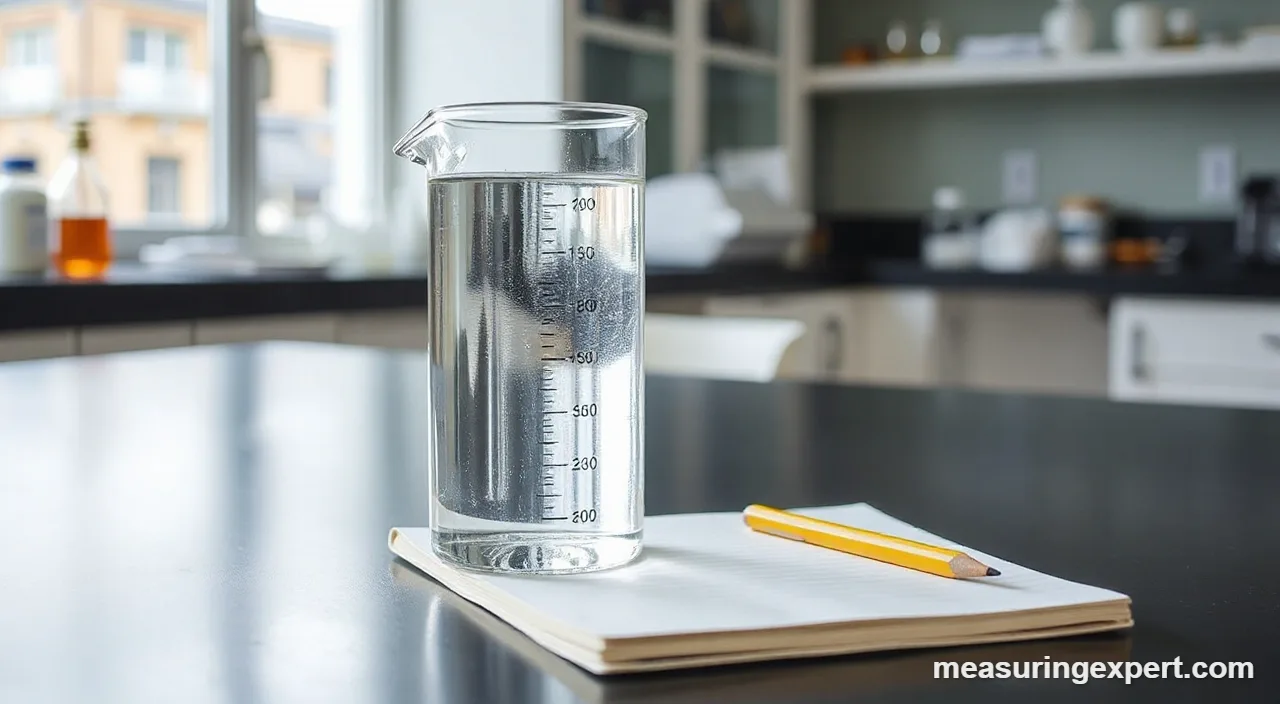
Someone writes 1.050 L on a lab sheet, and a classmate asks why the last zero is there. It is not decoration. That one zero tells every reader how finely the volume was measured, and dropping it quietly changes the claim you are making.
1.050 L has four significant figures. Count the 1, the 0 between the 1 and the 5, the 5, and the final 0. The zero in the middle counts because it sits between nonzero digits, and the zero at the end counts because the number has a decimal point, which shows the volume was read to the nearest thousandth of a liter, or one milliliter. In scientific notation it is 1.050 x 10^3 mL, which keeps the same four digits. If you wrote 1.05 L instead, you would have only three significant figures and would be claiming less precision than you actually measured.
In short: all four digits in 1.050 count, and the answer is 4. The leading “1.” is the first significant digit, and nothing in this number is a placeholder. A significant figure is simply a digit that carries real information about the measurement, and in 1.050 every digit does.




Buying from this list? Get it fast, and catch Black Friday deals, with Prime
Convert 1.050 L to Other Volume Units
Enter a volume in liters and choose a target unit. Remember that a converter shows many digits, and you should trim the result to the same number of significant figures as your starting value.
Rounding and reporting rules are taken seriously in calibration work. For example, NIST guidance on rounding (Good Laboratory Practice 9) tells laboratories to round a result to the same decimal place as the last retained digit of its uncertainty, and to avoid rounding intermediate values. NIST also states that the symbol for the liter in the United States is the capital L, which is why this article writes L and not l.
Below you can convert a volume such as 1.050 L into other units, then read how to count digits, carry them through math, and decide whether a number claims more than the instrument can give. If you want to know which glassware reads to a milliliter, see our guide to laboratory beakers and the explainer on cc and mL.
The formula is milliliters = liters x 1000, and US gallons = liters / 3.785411784. For example, 1.050 L / 3.785411784 = 0.27738 gal, which rounds to 0.2774 gal at four significant figures.
Recommended Lab Glassware and Tools for Reading Volume
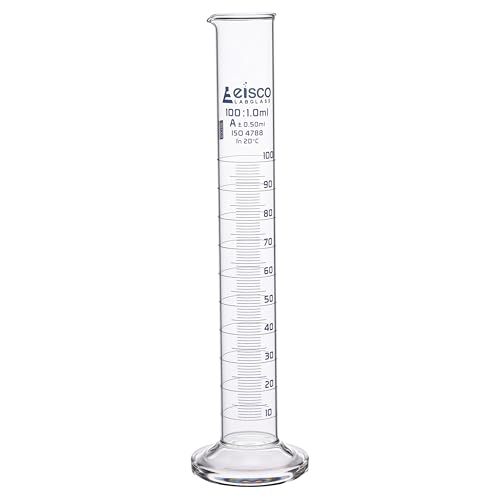
A number can only have as many significant figures as the tool can deliver. For milliliter-level work, a graduated cylinder or a burette reads far more finely than a kitchen jug. The tools below suit chemistry classes, home labs and careful food work, based on manufacturer specs and buyer reports. Check the stated tolerance of any item you buy, because that figure tells you how many digits you can trust.
As an Amazon Associate, Measuring Expert earns from qualifying purchases.
- 1.050 L has four significant figures: 1, 0, 5 and the final 0.
- The zero between nonzero digits always counts.
- A trailing zero counts when the number has a decimal point.
- Leading zeros, such as in 0.001050, never count.
- 1.050 L equals 1.050 x 10^3 mL, not just 1050 mL.
- In multiplication, keep as many digits as the least precise factor.
- Your instrument decides how many digits you are allowed to claim.
The Count for 1.050 L, Digit by Digit
The fastest way to be sure is to walk through the number one character at a time. The table shows what each digit does.
| Digit | Position | Counts? | Why |
|---|---|---|---|
| 1 | Ones place | Yes | A nonzero digit always counts |
| . (point) | Decimal point | Not a digit | It marks where the whole part ends and also makes trailing zeros count |
| 0 | Tenths place | Yes | It sits between the 1 and the 5, so it is a captured zero |
| 5 | Hundredths place | Yes | A nonzero digit always counts |
| 0 | Thousandths place | Yes | A trailing zero after a decimal point is significant |
Four digits count, so the number has four significant figures. The last one tells you the measurement was good to about plus or minus one thousandth of a liter, which is 1 mL. The decimal point is what rescues that final zero. Take the point away and the same digits written as 1050 become ambiguous.
The Five Rules That Cover Almost Every Number
You do not need to memorize hundreds of cases. These five rules settle nearly every number you will meet in a chemistry or physics class, or in a technical report.
| Rule | Example | Sig figs |
|---|---|---|
| Nonzero digits always count | 2.57 L | 3 |
| Zeros between nonzero digits count | 1.050 L (the middle zero) | 4 in total |
| Leading zeros never count | 0.0042 L | 2 |
| Trailing zeros count if there is a decimal point | 2.500 L | 4 |
| Trailing zeros in a whole number are ambiguous unless marked | 1500 mL | 2 to 4, depending on notation |
The fifth rule causes most of the arguments. If you write 1500 mL, a reader cannot tell whether the measurement was good to the nearest 100 mL or the nearest 1 mL. Writing 1.5 x 10^3 mL (two figures) or 1.500 x 10^3 mL (four figures) removes the doubt. A bar over the last significant zero, or a trailing decimal point as in 1500. mL, also works in many textbooks.
Look-Alike Numbers: Significant Figures vs Decimal Places
People often mix up significant figures and decimal places. They are not the same thing. Decimal places count digits after the point. Significant figures count meaningful digits in total. The two only line up in some numbers, as this table shows.
| Number | Decimal places | Significant figures | Notes |
|---|---|---|---|
| 1.050 L | 3 | 4 | Our number, precise to the nearest mL |
| 1.05 L | 2 | 3 | The trailing zero was dropped, so precision was lost |
| 1.0500 L | 4 | 5 | Claims precision to 0.1 mL |
| 0.001050 L | 6 | 4 | Leading zeros are placeholders only |
| 1050 L | 0 | 3 to 4 | Ambiguous without notation |
| 1050. L | 0 | 4 | The point makes the last zero count |
| 1.050 x 10^3 mL | 3 | 4 | Same measurement in scientific notation |
Notice that 1.050 L and 0.001050 L both have four significant figures, but they have 3 and 6 decimal places. That difference matters when you add or subtract, because the rules for addition use decimal places, while multiplication uses significant figures.
Converting 1.050 L Without Losing Digits
A unit conversion should not change how many digits you trust. Your starting number has four, so your answer should have four, unless the conversion factor has fewer. Exact factors, such as 1000 mL per liter, have unlimited significant figures and never limit your result.
| Convert 1.050 L to | Result (4 sig figs) | Factor used |
|---|---|---|
| Milliliters | 1.050 x 10^3 mL | 1 L = 1000 mL (exact) |
| US gallons | 0.2774 gal | 1 US gal = 3.785411784 L |
| US quarts | 1.110 qt | 4 qt = 1 US gal |
| US cups | 4.438 cups | 1 US cup = 236.5882365 mL |
| US fluid ounces | 35.50 fl oz | 1 US fl oz = 29.5735295625 mL |
All of the factors in the table come from the exact definitions listed in NIST conversion tables, so only the 1.050 L limits the answer. A calculator would show 0.2773811 gallons, but reporting more than four digits would claim precision that the original measurement never had.
Convert first, then round once at the end. Rounding at every step can pile up small errors, and NIST rounding guidance specifically warns against rounding intermediate values.
Doing Math With 1.050 L
Different operations follow different rules. For adding and subtracting, the answer can only be as precise as the least precise decimal place. For multiplying and dividing, the answer keeps as many significant figures as the factor with the fewest.
| Operation | Calculation | Calculator shows | Reported answer |
|---|---|---|---|
| Add | 1.050 L + 0.25 L | 1.3 L | 1.30 L (2 decimal places) |
| Subtract | 1.050 L – 0.5 L | 0.55 L | 0.6 L (1 decimal place) |
| Multiply | 1.050 L x 0.998 kg/L | 1.04790 kg | 1.05 kg (3 sig figs) |
| Divide by a measurement | 1.050 L / 0.250 L | 4.2 | 4.20 (3 sig figs) |
| Divide by an exact count | 1.050 L / 3 servings | 0.35 L | 0.3500 L (4 sig figs) |
The last row surprises many students. A count of 3 servings is an exact number, so it does not limit precision, and the result keeps the four significant figures of 1.050 L. The multiplication row uses 0.998 kg/L, which is a typical value for water near room temperature, so the answer is limited to three figures.
How to Count Significant Figures, Step by Step
Use this routine on any number and you will rarely get it wrong.
- Write the number out. Copy the measurement exactly as recorded, including every zero, such as 1.050 L.
- Find the first nonzero digit. Cross out any zeros at the far left. In 0.001050 L, the three zeros after the decimal point are only placeholders.
- Count every digit from there. Starting at the first nonzero digit, count each digit to the right, including zeros trapped between other digits.
- Look at the end of the number. Zeros at the end count when the number has a decimal point. They do not automatically count in a whole number such as 1050.
- Use scientific notation if unsure. Rewrite as 1.050 x 10^3. Every digit in front of the “x 10” is significant, so you can count them easily.
- Check the instrument. Ask whether the tool could really read that last digit. If it could not, the number claims too much precision.
Counting always starts at the first nonzero digit and moves right. Zeros before that digit are placeholders, so they do not count.
Do and Do Not
Do
- Keep trailing zeros that came from a real reading.
- Write scientific notation when a whole number is ambiguous.
- Round only at the end of a calculation.
- Use exact conversion factors without letting them limit digits.
- Record readings straight from the instrument scale, plus one estimated digit.
Do not
- Drop a final zero because it looks unnecessary.
- Report every digit your calculator displays.
- Count leading zeros as significant.
- Mix up decimal places and significant figures.
- Claim milliliter precision from a measuring jug with coarse marks.
A number with too many digits is a false claim. Reporting 1.05000 L from a beaker marked every 50 mL tells readers the volume is known far better than it is.
Honest Limits: Significant Figures Are a Shortcut
Significant figures are a quick, rough way to show uncertainty. They are not a full statement of it. A value of 1.050 L implies about plus or minus 0.001 L, but the real uncertainty of a measurement could be larger or smaller, depending on calibration, temperature and how carefully the liquid level was read.
Glassware is a good example. Beaker markings are generally approximate, so a beaker cannot justify four digits, even if you can read the scale very closely. A graduated cylinder or a volumetric flask is designed for better accuracy, and the manufacturer states a tolerance. Also, rounding to a given number of figures can shift a result by up to half of the last digit, which is another small, built-in error.
For formal work, labs report an uncertainty value next to the result and round the result to match it, which is what the NIST practice described above does. For homework and everyday use, significant figures are the accepted shortcut.
When to Ask a Teacher or a Calibration Lab
If your grade depends on a rule, follow the one your instructor teaches, since a few courses treat ambiguous trailing zeros differently. If you measure liquids for something that must meet a standard, such as a food formula, a pool chemical dose or a laboratory procedure, have the glassware checked or calibrated, and follow the written method for that task.
This article is general education about numbers and units. It is not a substitute for laboratory procedures, product instructions or professional advice, and nothing here should be used to dose medicine. For medicines, use the device supplied with the product and ask a pharmacist or doctor.
Frequently Asked Questions
How many significant figures are in 1.050 L?
Four. The 1, the middle 0, the 5 and the final 0 all count, because the middle zero is between nonzero digits and the final zero follows a decimal point.
Why does the last zero in 1.050 count?
It follows a decimal point, which shows it was a measured digit. It tells readers the volume was read to the nearest milliliter.
What is 1.050 L in milliliters with the right sig figs?
1.050 x 10^3 mL. Writing 1050 mL alone is ambiguous, because a reader cannot tell if the last zero was measured.
How many significant figures are in 1.05 L?
Three. It claims precision to the nearest hundredth of a liter, which is 10 mL, so it says less than 1.050 L does.
Do leading zeros count as significant figures?
No. In 0.001050 L the three zeros after the point only place the decimal, so only 1, 0, 5 and 0 count, giving four.
What is the difference between 1.050 and 1.0500?
1.0500 has five significant figures and claims precision to 0.1 mL, while 1.050 has four. Never add a zero unless you actually measured it.
How do I round 1.050 L to two significant figures?
Round to 1.1 L. The digit after the second figure is a 5 followed by a zero, so by the common round-half-up rule the 1.0 becomes 1.1.
Do exact numbers like 3 servings limit significant figures?
No. Counted and defined numbers are exact, so they do not limit the result. Dividing 1.050 L by 3 servings keeps four figures: 0.3500 L.
How many significant figures does 1050 mL have?
At least three, and possibly four. Without a decimal point or scientific notation, the final zero is ambiguous. Writing 1.050 x 10^3 mL makes it four.
Which glassware can read to 1 mL?
A graduated cylinder, burette or volumetric flask can, depending on its size and class. A kitchen measuring jug is generally too coarse for a four-figure liter value.
The Short Version
1.050 L has four significant figures, and every one of them is doing work. The middle zero is trapped between nonzero digits, and the final zero is held in place by the decimal point. Dropping it would turn a milliliter-level measurement into a ten-milliliter one.
When you convert, add or multiply, keep the digits the data supports and no more. Convert with exact factors, round once at the end, and let your instrument, not your calculator, decide how many figures you report.
Listen to a free audiobook while you cook, work or wait