


A cubic foot of normal-weight concrete weighs about 140 to 150 pounds (63 to 68 kg), according to the Iowa DOT concrete testing procedure. A cubic yard, which is 27 cubic feet, therefore weighs roughly 3,780 to 4,050 pounds. Lightweight and foamed concrete weigh far less.




Buying from this list? Get it fast, and catch Black Friday deals, with Prime
As an Amazon Associate, Measuring Expert earns from qualifying purchases.
Concrete Density Converter: lb per Cubic Foot to kg per Cubic Meter
Enter a density in pounds per cubic foot (the box starts at 145, the middle of the normal range) to see the same figure in kg per cubic meter, grams per cubic centimeter and pounds per gallon.
Concrete looks solid and uniform, so its weight tends to surprise people. A single wheelbarrow load can top 800 pounds, a small patio slab can outweigh a car, and a delivery truck carrying a few yards of mix is working near its limit.
The Iowa Department of Transportation, which tests fresh concrete by weighing a known volume of it, describes normal-weight concrete as typically 140 to 150 pounds per cubic foot at 5 to 8 percent air content. That range is the number behind almost every estimate on this page. Multiply the volume you plan to pour by it and you have the weight.
The sections below give a chart for common volumes, the weight of typical slabs and footings, the reasons real concrete can fall above or below the range, a way to turn bags of mix into a volume, and the points where a calculation should pass to a structural engineer.
- Concrete Density Converter: lb per Cubic Foot to kg per Cubic Meter
- Concrete Weight Chart
- Weight of Common Slabs and Footings
- Why Concrete Is Not Always 145 Pounds
- Turning Bags of Mix Into Weight
- How to Estimate the Weight of a Pour
- Measuring Tools Worth Having for Pours
- Do and Don’t
- Honest Limits
- When to Call a Professional
- FAQs
Concrete Weight Chart
The two columns bracket the normal range. Use the lower number when you want a safe minimum for ordering, and the higher one when you are checking whether a truck, a trailer or a floor can carry the load.
| Volume of concrete | At 140 lb/ft3 | At 150 lb/ft3 |
|---|---|---|
| 1/2 cubic foot | 70 lb (32 kg) | 75 lb (34 kg) |
| 1 cubic foot | 140 lb (64 kg) | 150 lb (68 kg) |
| 2 cubic feet | 280 lb (127 kg) | 300 lb (136 kg) |
| 5 cubic feet | 700 lb (318 kg) | 750 lb (340 kg) |
| 1 cubic yard (27 ft3) | 3,780 lb (1,715 kg) | 4,050 lb (1,837 kg) |
| 1 cubic meter (35.31 ft3) | 4,944 lb (2,243 kg) | 5,297 lb (2,403 kg) |
Weight of Common Slabs and Footings
Slab volume is length times width times thickness, with the thickness converted from inches to feet. Weight then follows from the same density range.
| Pour | Volume | Weight (140 to 150 lb/ft3) |
|---|---|---|
| 4 in thick, 4 x 4 ft pad | 5.3 ft3 | 747 to 800 lb |
| 4 in thick, 10 x 10 ft patio | 33.3 ft3 | 4,667 to 5,000 lb |
| 6 in thick, 10 x 10 ft slab | 50.0 ft3 | 7,000 to 7,500 lb |
| 4 in thick, 20 x 20 ft garage floor | 133.3 ft3 | 18,667 to 20,000 lb |
| 12 in wide x 36 in deep post hole | 2.4 ft3 | 330 to 353 lb |
For a 4-inch slab, each square foot holds one third of a cubic foot of concrete, which is where the figure of roughly 47 to 50 pounds per square foot comes from. If you need the area first, the area formula guide and the concrete volume guide walk through the measuring.
Why Concrete Is Not Always 145 Pounds
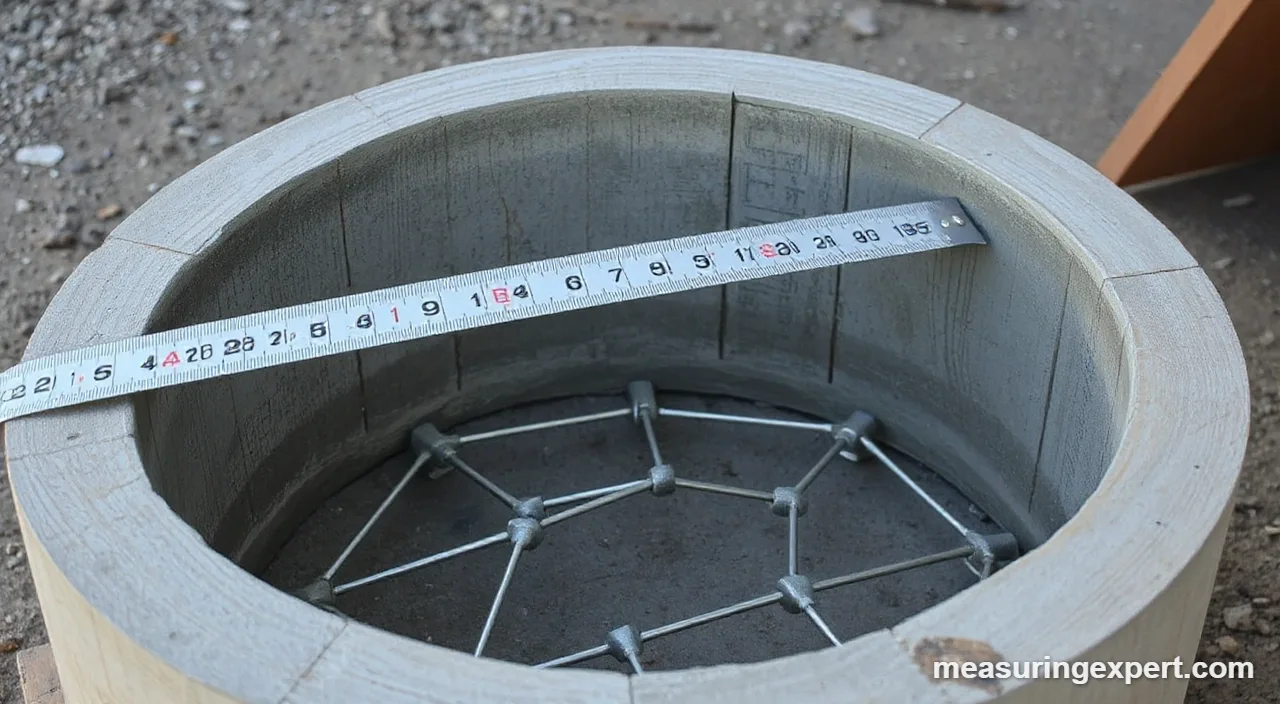
Concrete weight depends mostly on its air content and the density of the stone in it. Air adds volume but no weight, so the Iowa DOT procedure uses unit weight as a check: a change of about 1.5 lb per cubic foot corresponds to roughly 1 percent change in air content for normal-weight concrete. Its worked example weighs a sample at 141.4 lb per cubic foot against a theoretical air-free weight of 151.7, which gives an air content of 6.8 percent.
| Material | Typical unit weight | Where the figure comes from |
|---|---|---|
| Normal-weight concrete | 140 to 150 lb/ft3 | Iowa DOT testing procedure |
| Concrete with more entrained air | toward 140 lb/ft3 or below | Iowa DOT unit weight and air relationship |
| Foamed cellular concrete (example sample) | 51.1 lb/ft3 (818.75 kg/m3) | Iowa DOT worked example |
| Structural steel, for comparison | about 490 lb/ft3 (7,850 kg/m3) | standard density of steel |
Turning Bags of Mix Into Weight
Bagged mix is sold by dry weight, and the yield printed on the bag is the volume of finished concrete you get after adding water. A common 80-pound bag lists a yield of about 0.6 cubic feet, but yields vary by brand and product, so read your own label. On that basis, a cubic yard needs about 45 bags, and a 4-inch, 10 by 10 foot patio needs about 56. Buy a few extra for uneven ground.
Because the finished concrete is heavier than the dry mix, remember that the pour on the ground weighs more than the bags that went into it, since the mix water adds to the total.
How to Estimate the Weight of a Pour
- Measure length, width and depth with a tape or measuring wheel and write them in feet. Divide inches by 12.
- Multiply the three numbers to get cubic feet.
- Divide by 27 if you need cubic yards for ordering.
- Multiply the cubic feet by 140 and by 150 to get a low and a high weight in pounds.
- Divide by 2.205 for kilograms, or use the converter above.
- Compare the high figure with the rating of whatever carries it: trailer, truck bed, deck, floor or wheelbarrow.
- Normal concrete: 140 to 150 lb per cubic foot (2,243 to 2,403 kg per cubic meter).
- One cubic yard weighs about 1.9 to 2.0 US tons.
- A 4-inch slab adds roughly 47 to 50 lb for every square foot.
- Air in the mix lowers the weight; steel reinforcement raises it slightly.
- Foamed cellular concrete can weigh around 51 lb per cubic foot.
Measuring Tools Worth Having for Pours
A steel tape handles forms and footings. For driveways and long walkways, a measuring wheel saves time and reduces tape-sag errors. A rebar locator helps when you are drilling into an existing slab, since it shows where bars sit. The tools near the top of this page are the ones that fit this job.
Do and Don’t
Do
- Use 140 to 150 lb/ft3 for planning and say which end you used.
- Add reinforcement and any aggregate base to load estimates.
- Check axle, trailer and floor ratings before moving or placing concrete.
- Lift and push heavy loads in small batches.
Don’t
- Fill a wheelbarrow to the brim; 6 cubic feet of concrete is over 800 pounds.
- Mix up the weight of dry mix with the weight of the finished pour.
- Treat lightweight or foamed concrete as if it were normal weight.
- Rely on a general figure for a structural load.
Honest Limits
The range here describes normal-weight concrete made with common stone and sand. A mix made with lightweight aggregate, extra air or foaming agents falls well below it, and a mix with heavy aggregate for radiation shielding goes above it. Weight also drifts a little as mix water evaporates while the concrete cures, so a freshly poured slab and a cured one are close but not identical.
The pound and kilogram figures are converted with exact factors and then rounded, so the last digit can differ by one when you convert back and forth.
When to Call a Professional
Estimating the weight of a pour for ordering is simple arithmetic. Deciding whether a deck, a roof, a suspended slab or an old floor can carry that weight is a structural question. Ask a licensed structural engineer, and follow the local building authority for permits and inspections. For hauling, use the vehicle manufacturer ratings, not a guess. Wear gloves and eye protection when you handle wet concrete, because it is caustic to skin.
FAQs
How much does a cubic foot of concrete weigh?
Normal-weight concrete weighs about 140 to 150 pounds per cubic foot, or 63.5 to 68 kg, according to the Iowa DOT testing procedure.
How much does a cubic yard of concrete weigh?
A cubic yard is 27 cubic feet, so it weighs about 3,780 to 4,050 pounds, which is roughly 1.9 to 2.0 US tons (1,715 to 1,837 kg).
How many kilograms per cubic meter is concrete?
About 2,243 to 2,403 kg per cubic meter, which is 2.24 to 2.40 grams per cubic centimeter.
Does wet concrete weigh more than dry concrete?
Slightly, because the mix water is part of fresh concrete and some of it leaves as the concrete cures. For planning, the same 140 to 150 lb range is used for both.
How many bags of concrete make a cubic yard?
About 45 bags if each 80-pound bag yields 0.6 cubic feet. Check the yield printed on your bag, because brands differ.
How much does a 4-inch concrete slab weigh per square foot?
About 47 to 50 pounds per square foot, since a 4-inch slab holds one third of a cubic foot of concrete per square foot.
Does rebar add weight to concrete?
Yes, a little. Steel is about 490 lb per cubic foot, but bars take up a small part of the slab volume, so estimates often ignore them.
How much does lightweight or foamed concrete weigh?
It varies widely. The Iowa DOT procedure includes a foamed cellular sample at 51.1 lb per cubic foot, far below normal concrete.
Can my truck or trailer carry a yard of concrete?
One cubic yard is about 2 tons, so check payload, axle and tire ratings before loading, and do not rely on a guess.
Can I weigh concrete directly?
For small samples, yes: fill a container of known volume and weigh it, which is how the field unit weight test works. For a whole pour, calculate from volume.
The short version
Plan on 140 to 150 pounds for every cubic foot of normal concrete, 3,780 to 4,050 pounds for a yard, and about 47 to 50 pounds per square foot of a 4-inch slab. Lightweight, foamed and heavy-aggregate mixes sit outside that range.
Do the arithmetic with measured dimensions, round up for uneven ground, and send load-bearing questions to an engineer. The test method behind these numbers is explained in the Iowa DOT concrete unit weight procedure.
Listen to a free audiobook while you cook, work or wait