

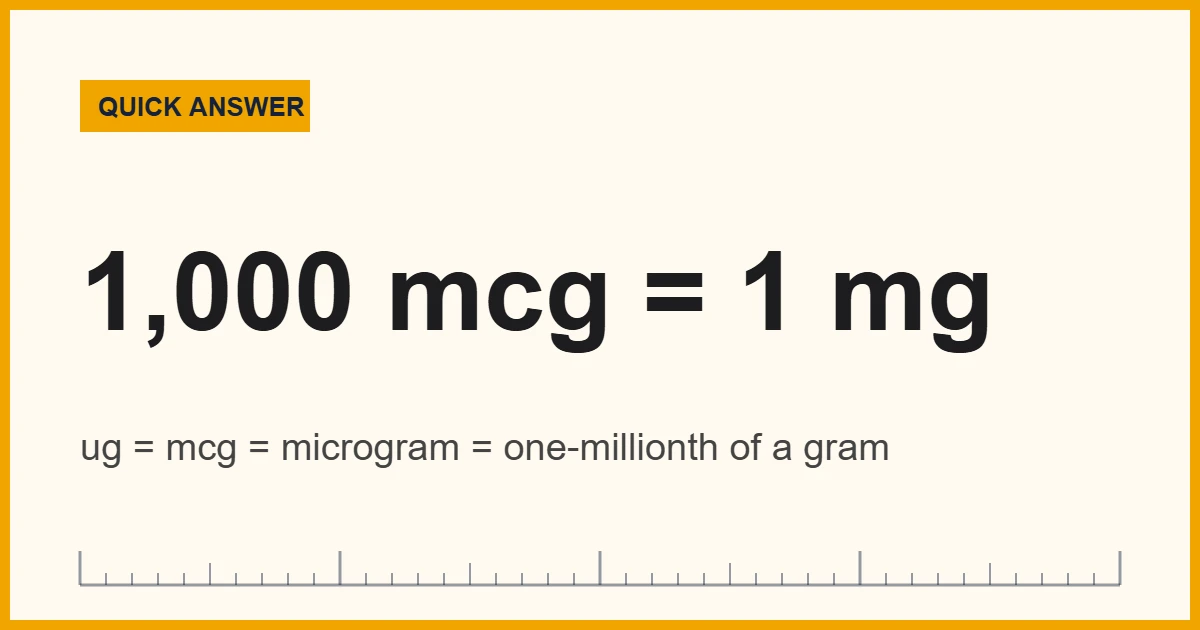
A ug measurement is a microgram: one-millionth of a gram (0.000001 g), also written mcg or with the Greek letter mu. So 1,000 mcg equals 1 milligram (mg), and 1,000,000 mcg equals 1 gram, or about 0.035 ounce. Vitamin D, vitamin B12 and folate are listed in mcg on US labels.
Convert Micrograms to Milligrams, Grams and Grains
First, enter an amount in micrograms, or switch the unit to milligrams or grams. The converter then uses the exact metric prefixes and the defined grain of 64.79891 mg, so you can check a supplement label or a lab note in a second.
The letters “ug” are a keyboard stand-in for the symbol µg. Specifically, the prefix micro means one-millionth, and it comes from the Greek letter mu. Because many keyboards, lab printers and older computer systems cannot type mu, people simply swapped in a “u”. As a result, ug, µg and mcg all name the same tiny amount of mass.
Overall, you will meet ug measurement in three places. First, on supplement and food labels, where vitamins such as D and B12 come in micrograms. Second, you will see it on prescriptions and pharmacy labels for potent drugs. Third, in air-quality reports, where fine particles are given in micrograms per cubic meter of air (ug/m3).
Still, US labels almost always print “mcg” instead of “ug” or the Greek symbol. The reason, above all, is safety. Specifically, the Institute for Safe Medication Practices (ISMP) puts the microgram symbol on its list of error-prone abbreviations, because a handwritten or blurred mu can be read as “mg”. Instead, ISMP advises writing “mcg”.
Ug Measurement Conversion Chart
Generally, each step on the metric ladder is a factor of 1,000. So to go from micrograms to milligrams, divide by 1,000. To go from milligrams to grams, divide by 1,000 again. Then the chart below covers the amounts that show up most often on labels.
| Micrograms (mcg / µg) | Milligrams (mg) | Grams (g) | Where you might see it |
|---|---|---|---|
| 1 mcg | 0.001 mg | 0.000001 g | Lab and air-quality data |
| 2.4 mcg | 0.0024 mg | 0.0000024 g | Vitamin B12 Daily Value |
| 10 mcg | 0.01 mg | 0.00001 g | Small vitamin D dose |
| 20 mcg | 0.02 mg | 0.00002 g | Vitamin D Daily Value |
| 25 mcg | 0.025 mg | 0.000025 g | Common vitamin D softgel |
| 50 mcg | 0.05 mg | 0.00005 g | Higher vitamin D softgel |
| 100 mcg | 0.1 mg | 0.0001 g | Many tablet strengths |
| 400 mcg | 0.4 mg | 0.0004 g | Folate Daily Value (as DFE) |
| 500 mcg | 0.5 mg | 0.0005 g | B12 supplements |
| 1,000 mcg | 1 mg | 0.001 g | B12 supplements |
| 5,000 mcg | 5 mg | 0.005 g | Biotin supplements |
| 1,000,000 mcg | 1,000 mg | 1 g | About 0.035 oz |
Printable tip: copy this chart into a note on your phone, because label math is easiest when the ladder is in front of you. Next, for the step up the scale, see our guide to how much an ounce weighs in grams.
Ug Measurement vs mcg: Why Labels Avoid the Symbol
Scientifically, the correct SI symbol for a microgram is µg. However, in medicine a single misread letter can mean a 1,000-fold dosing error. For example, if “50 µg” is smudged and read as “50 mg”, the patient would get 1,000 times the intended amount. Consequently, ISMP lists the symbol as error-prone and recommends “mcg” in its place.
For the same reason, “ug” is rare on US packaging. Still, you will see it in lab reports, spreadsheets, environmental data and research papers, where staff are trained to read it. In short, ug, µg and mcg are equal in value, but mcg is the safest way to write a ug measurement on anything a patient or shopper will read.
Microgram, Milligram and Other Units People Mix Up
Several units look alike on a label, especially in small print. Also, some of them are not even pure mass units. Therefore, this table separates them.
| Written as | What it means | Size |
|---|---|---|
| ug, µg, mcg | Microgram | 0.000001 g (one-millionth) |
| mg | Milligram | 0.001 g = 1,000 mcg |
| ng | Nanogram | 0.001 mcg (one-billionth of a gram) |
| mcg DFE | Micrograms of dietary folate equivalents | Adjusts folic acid for how well the body absorbs it |
| mcg RAE | Micrograms of retinol activity equivalents (vitamin A) | Adjusts for the source of vitamin A |
| IU | International Unit | Activity rather than mass; the factor depends on the nutrient |
| ug/m3 | Micrograms per cubic meter | Concentration in air rather than an amount you swallow |
Ug Measurement on Vitamin Labels: Real Examples
First, the FDA sets the units used on the Nutrition Facts and Supplement Facts labels. Its Daily Value table lists several nutrients, such as vitamin D, in micrograms. Below are the ones you will see most often, so you can compare them with mg:
| Nutrient | Daily Value (adults and children 4+) | Same amount in mg |
|---|---|---|
| Vitamin D | 20 mcg | 0.02 mg |
| Vitamin B12 | 2.4 mcg | 0.0024 mg |
| Folate | 400 mcg DFE | 0.4 mg DFE |
| Vitamin A | 900 mcg RAE | 0.9 mg RAE |
| Vitamin K | 120 mcg | 0.12 mg |
| Biotin | 30 mcg | 0.03 mg |
| Iodine | 150 mcg | 0.15 mg |
| Selenium | 55 mcg | 0.055 mg |
However, folate needs one more step. According to the FDA’s unit conversion guidance, 1 mcg of added folic acid counts as 1.7 mcg DFE. For example, a supplement with 400 mcg of folic acid shows 680 mcg DFE, with “400 mcg folic acid” in parentheses. So the bigger number on the label is the adjusted one, not a different dose.
Vitamin D Ug Measurement: Converting IU to mcg
Previously, bottles listed vitamin D in International Units. Now, however, the FDA requires vitamin D in mcg, and IU may appear only in parentheses next to it. In addition, the same FDA guidance gives the factor: 1 mcg of vitamin D equals 40 IU. Therefore, divide IU by 40 to get mcg, or multiply mcg by 40 to get IU.
| Vitamin D (mcg) | Vitamin D (IU) |
|---|---|
| 10 mcg | 400 IU |
| 20 mcg (Daily Value) | 800 IU |
| 25 mcg | 1,000 IU |
| 50 mcg | 2,000 IU |
| 125 mcg | 5,000 IU |
How to Read a Microgram Amount Step by Step
- Find the unit next to the number. First, check whether it says mcg, ug, mg or IU before you look at the amount.
- Note any qualifier. Also, words such as DFE or RAE mean an adjusted amount, not a raw weight.
- Convert to one unit. Then divide mcg by 1,000 for mg, or enter the amount in the converter above.
- Compare with the Daily Value. The %DV column already does this math, so use it to compare products.
- Check the serving size. Remember that the amount is per serving, which may be two or more tablets.
- Ask when unsure. Finally, a pharmacist can confirm any unit that looks smudged or unusual.
Recommended Scales for Small Amounts
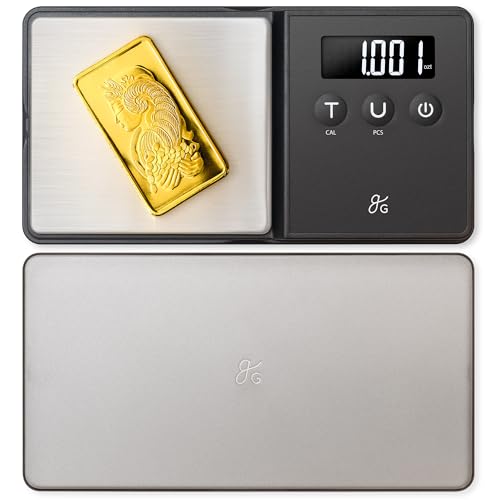
To be clear, no home scale can weigh a single microgram. Even so, a good pocket scale helps with powders, reloading, jewelry and hobby work at the milligram level. For example, a 0.01 g scale reads to 10 mg, which is 10,000 mcg. Similarly, a 0.001 g scale reads to 1 mg, or 1,000 mcg. In comparison, laboratory microbalances in controlled rooms read down to about 1 mcg.



As an Amazon Associate, Measuring Expert earns from qualifying purchases.
Overall, choose based on manufacturer specs and buyer reports. Look for a calibration weight in the box, a tare button and a draft shield or lid, because air currents move the reading on sensitive scales.
Ug Measurement Do and Don’t
Do
- Write mcg whenever a patient or shopper will read the label.
- Check the unit before the number.
- Use the %DV column when you compare products.
- Calibrate a sensitive scale before each session.
- Keep the converter handy, especially for label math.
Don’t
- Treat mg and mcg as the same unit, because they differ 1,000-fold.
- Reuse the vitamin D IU factor for other vitamins, since each has its own.
- Expect a kitchen scale to weigh micrograms.
- Split or crush tablets to change a dose unless a pharmacist says so.
- Guess when a mu symbol is smudged.
Honest Limits of Microgram Numbers
Of course, a label value is a declared amount, not a measurement of your exact tablet. Manufacturers add a margin for losses during storage, so a vitamin may contain a little more than the label states. Also, adjusted units such as DFE and RAE describe how the body uses a nutrient, so they are not a direct weight. Finally, home scales cannot verify any of this. After all, weighing a whole tablet tells you the tablet’s mass, which includes fillers, not the micrograms of vitamin inside it.
When Accuracy Really Matters
Above all, micrograms show up where small amounts have big effects. For instance, thyroid hormone, some heart drugs and some pain patches are dosed in mcg. Consequently, in those cases a mg-for-mcg mix-up is a 1,000-fold error. Likewise, labs that handle potent reagents weigh them on calibrated microbalances, not pocket scales. Meanwhile, for everyday vitamins, the main risk is stacking several products that each contain the same nutrient. For a closer look at the same unit from the pharmacy side, read what mcg means on a prescription.
Frequently Asked Questions
What does a ug measurement mean?
It means micrograms. In other words, one microgram is one-millionth of a gram, so 1,000,000 ug make 1 gram.
Is ug the same as mcg?
Yes, because both stand for microgram, as does the Greek symbol mu followed by g. However, labels and prescriptions use mcg because it is harder to misread.
How many ug are in 1 mg?
There are 1,000 ug (mcg) in 1 milligram. So to convert mcg to mg, divide by 1,000.
Is 1,000 mcg the same as 1 mg?
Yes. In fact, 1,000 mcg equals exactly 1 mg, which is also 0.001 g.
Which is bigger, mg or mcg?
A milligram is bigger. In fact, one mg is 1,000 times larger than one mcg.
How do I convert vitamin D IU to mcg?
Divide IU by 40. For example, 1,000 IU of vitamin D is 25 mcg, and 2,000 IU is 50 mcg.
Why does my folate label show two different numbers?
The first is mcg DFE, which adjusts for absorption. Meanwhile, the number in parentheses is the actual folic acid, because 1 mcg of folic acid counts as 1.7 mcg DFE.
What is ug measurement in air quality?
Generally, air reports use micrograms per cubic meter (ug/m3) to show how much fine particle pollution, such as PM2.5, is in each cubic meter of air.
Can I weigh a ug measurement at home?
No, because home pocket scales read to 0.01 g or 0.001 g, which is 10,000 or 1,000 mcg. Instead, weighing single micrograms takes a lab microbalance.
How many micrograms are in a grain?
By definition, one grain is exactly 64.79891 mg. Therefore, it equals 64,798.91 mcg.
The Bottom Line
To sum up, a ug measurement is a microgram, one-millionth of a gram, and 1,000 of them make a milligram. Also, labels write it as mcg because the Greek symbol is easy to misread as mg.
So when you check a vitamin, look at the unit first, watch for qualifiers such as DFE, and use the converter above for any amount. For medicines, however, let your pharmacist confirm the dose.
2 thoughts on “What Is ug Measurement? Micrograms (mcg) Explained, With a Converter”