

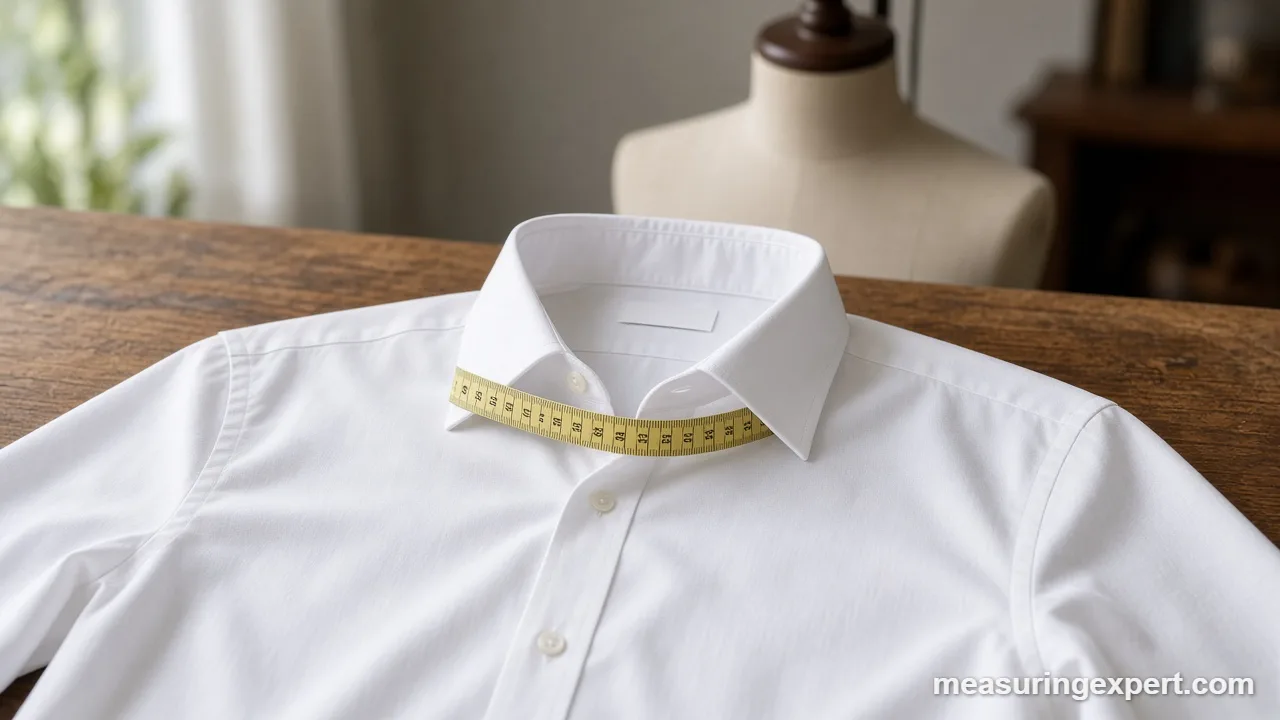
To measure neck size for a dress shirt, wrap a soft tape around the base of your neck at Adam’s apple level, keep it level and snug, and then add about 1/2 inch (1.3 cm). For example, a 15-inch (38.1 cm) neck usually wears a 15 1/2 collar, which European brands label 39 cm.
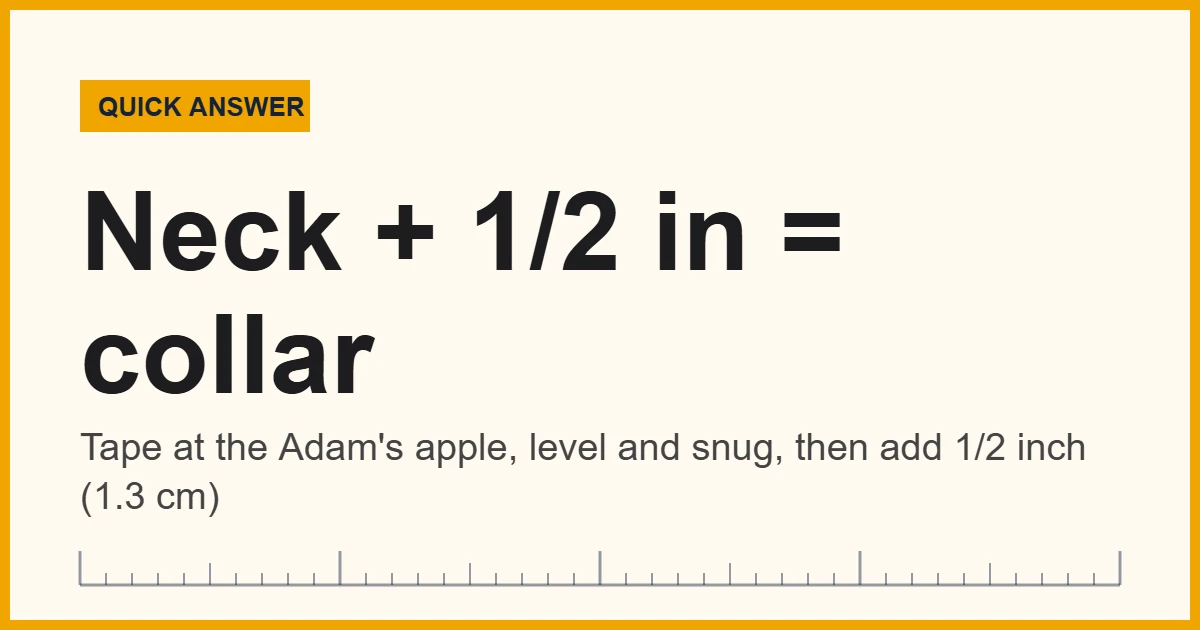
Unlike many clothes, a shirt collar has almost no room for error. If it is half an inch too small, the top button pulls and the tie knot sits crooked. On the other hand, half an inch too big leaves a gap that shows under a jacket. That is why shirt makers sell collars in half-inch steps, and why a careful tape reading pays off.
In short: measure the bare neck, add half an inch for breathing room, and then match that number to the collar size on the label. Your neck measurement and your collar size are two different numbers, so keep both written down.
Tailors and shirt retailers agree on the basic method. For instance, the menswear brand The Tie Bar tells readers to place the tape at the bottom of the Adam’s apple and add 1/2 inch to get the collar size. Similarly, the CDC’s NHANES body measurement manual asks examiners to keep the tape snug without compressing the skin and in a horizontal plane, which is the same idea for any body circumference.
Next, you will find a converter, a size chart in inches and centimeters, a step-by-step method, and a way to check a shirt you already own.
Convert Your Neck Size From Inches to Centimeters
First, enter your neck or collar number and pick the unit. The converter then shows the same length in centimeters, millimeters and fractional inches, so you can read US and European size labels side by side.
Tools You Need to Measure Neck Size
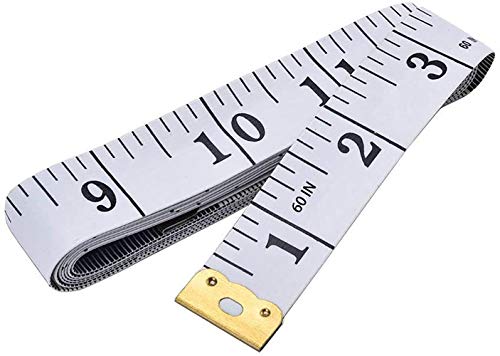
Overall, a soft, flexible tape is the only real requirement. First, choose one with inches on one side and centimeters on the other. Next, check that the zero sits right at the metal tip, because some cheap tapes start the scale a little way in. Also, a retractable tape stays flat and untangled in a drawer, so it lasts longer.



As an Amazon Associate, Measuring Expert earns from qualifying purchases.
- Wrap the tape around the base of the neck, at Adam’s apple level.
- Keep the tape level and snug, but never tight enough to dent the skin.
- Add about 1/2 inch (1.3 cm) to the neck reading to get your collar size.
- US collars come in half-inch steps; European collars come in 1 cm steps.
- A 16-inch collar equals 40.64 cm, so brands label it 40 or 41.
- One or two fingers should slide under a buttoned collar.
- Check your number against a shirt that already fits well.
How to Measure Neck Size for a Dress Shirt, Step by Step
Ideally, ask someone to help, because they can see whether the tape stays level at the back. Still, you can do it alone in front of a mirror.
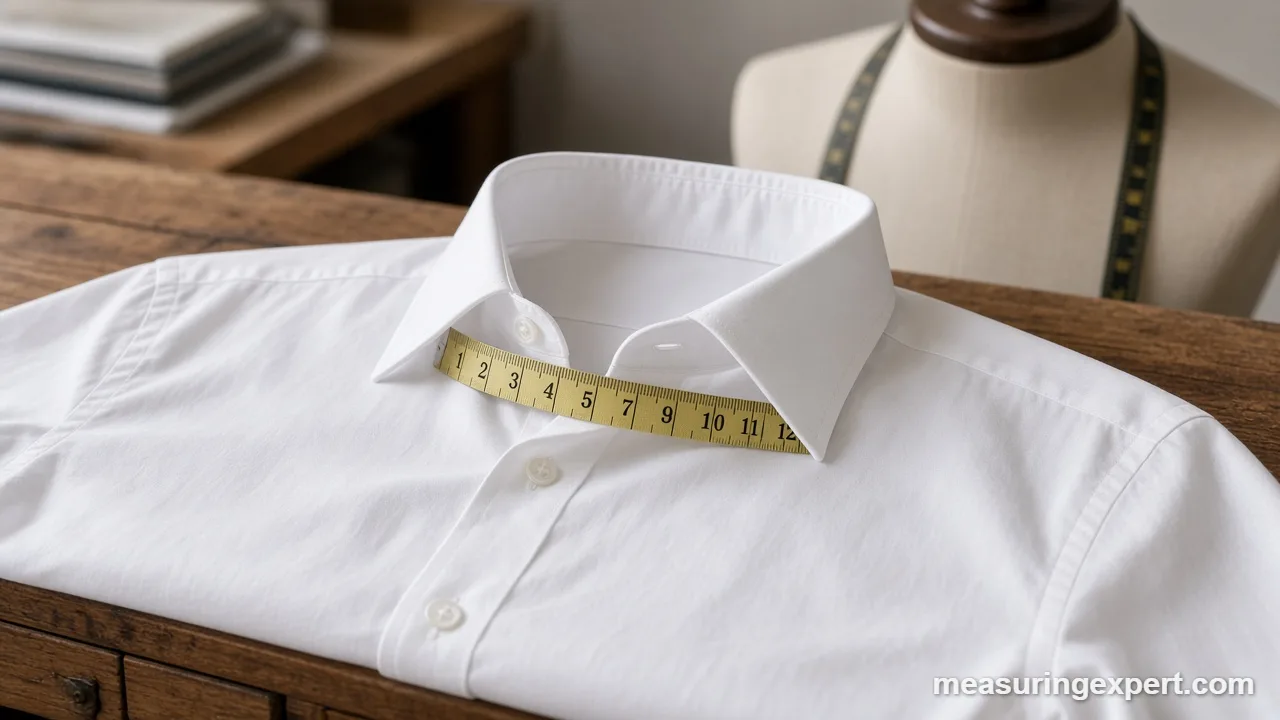
- Remove the collar. Take off any shirt, tie or necklace so the tape touches bare skin.
- Stand up straight. Look ahead with your shoulders relaxed, and keep your chin level rather than tucked or raised.
- Find the right height. Then place the tape around the base of the neck, at or just below the Adam’s apple, where a shirt collar would sit.
- Level the tape. Also check in the mirror that it runs horizontally all the way around, without dipping at the back.
- Snug, not tight. The tape should rest on the skin with no gap. However, it should not press in or make you swallow hard.
- Read where the end meets the tape. Note the number to the nearest 1/4 inch (or 0.5 cm), and then write it down.
- Add half an inch. A 15-inch neck becomes a 15 1/2 collar. If the result falls between sizes, round up to the next half inch.
Dress Shirt Collar Size Chart (Inches and Centimeters)
Specifically, this chart starts from your bare neck measurement. Then it adds half an inch and shows the collar size you would buy in US and European sizing. The exact centimeters come from 1 inch = 25.4 mm, the international definition, while the label column shows how brands usually round it.
| Your neck (in) | Your neck (cm) | US collar size (in) | Collar exact (cm) | EU / metric label (cm) |
|---|---|---|---|---|
| 13 1/2 | 34.3 | 14 | 35.56 | 36 |
| 14 | 35.6 | 14 1/2 | 36.83 | 37 |
| 14 1/2 | 36.8 | 15 | 38.10 | 38 |
| 15 | 38.1 | 15 1/2 | 39.37 | 39 |
| 15 1/2 | 39.4 | 16 | 40.64 | 40 or 41 |
| 16 | 40.6 | 16 1/2 | 41.91 | 42 |
| 16 1/2 | 41.9 | 17 | 43.18 | 43 |
| 17 | 43.2 | 17 1/2 | 44.45 | 44 |
| 17 1/2 | 44.5 | 18 | 45.72 | 45 or 46 |
| 18 | 45.7 | 18 1/2 | 46.99 | 47 |
| 18 1/2 | 47.0 | 19 | 48.26 | 48 |
Because 1 cm is only about 0.39 inch, European collars come in finer steps than US ones. As a result, a 40 and a 41 both map to the US 16. When you sit between two metric sizes, pick the larger one, since collars can shrink a little after the first washes.
How to Measure Neck Size From a Shirt You Already Own
If no tape fits around your neck right now, or you simply want a second check, use a dress shirt whose collar feels right when buttoned.
- Lay it flat. Unbutton the collar and spread it out on a table, inside facing up.
- Measure button to buttonhole. Run a ruler or tape from the center of the top button to the far end of the buttonhole.
- Compare. That distance is the collar size, so it should be close to your neck reading plus half an inch.
- Check the label too. Most dress shirts print the collar size on the neck tag, often as two numbers such as 15.5/34.
No ruler at all? Then wrap a piece of string or a phone charger cable around your neck, mark where it overlaps, and lay it along a straight ruler or a sheet of US letter paper, which is exactly 11 inches long. It is rougher than a tape, but it gets you close.
Neck Measurement vs Collar Size vs Sleeve Length
Three numbers often get mixed up when people shop for shirts. Therefore, this table separates them.
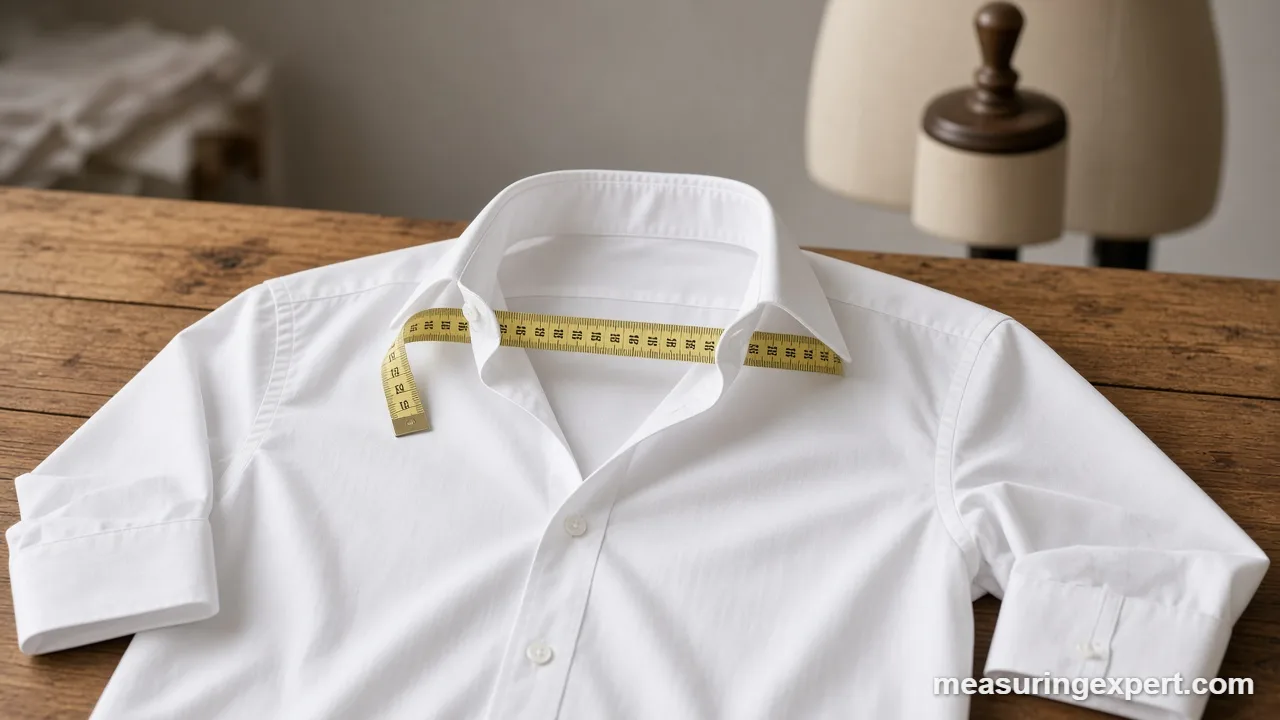
| Number | What it is | Where you take it | Example |
|---|---|---|---|
| Neck measurement | Your bare body circumference | Around the neck at Adam’s apple level | 15 in (38.1 cm) |
| Collar size | The shirt’s collar length, with ease added | Button center to buttonhole end, laid flat | 15 1/2 in (39 cm) |
| Sleeve length | Center back of neck to wrist | Across the shoulder, down the arm, arm slightly bent | 34 in (86.4 cm) |
A shirt labeled 15.5/34 therefore has a 15 1/2-inch collar and a 34-inch sleeve. For the arm number, see our guide on how to measure sleeve length for a shirt.
Checking the Fit: The Two-Finger Test
Once you buy a shirt, button the collar and slide your fingers between the collar and your neck. One or two flat fingers should fit, so you can turn your head and swallow freely. If you cannot fit one finger, the collar is too small. By contrast, if three fingers slip in easily, the collar will gap and the tie knot will sag.
Women’s Blouses and Other Neck Measurements
Women can measure neck size exactly the same way: tape at the base of the neck, level and snug. In particular, that number matters most for tailored button-up shirts, mandarin collars and high-neck tops. However, most women’s blouses use bust, waist and hip measurements instead, so read our guide on what bust measurement means before you order.
The neck is also just one of several body circumferences that tailors and fitness trackers use. Our overview of girth measurements covers the chest, waist, hips, arms and thighs with the same tape technique. In addition, the US military’s circumference body fat method includes a neck reading, although it sets its own rules for where the tape goes.
Do and Don’t
Do
- Measure bare skin, not over a collar.
- Keep the tape level all the way around.
- Add half an inch for a dress shirt collar.
- Round up when you fall between sizes.
- Check against a shirt that fits.
Don’t
- Pull the tape tight to get a smaller number.
- Tilt your chin up while reading the tape.
- Assume S, M and L follow a standard neck size.
- Trust a stretched or frayed cloth tape.
- Buy based on a reading taken years ago.
Honest Limits When You Measure Neck Size at Home
A home tape reading is a good guide, not a guarantee. First, necks are not perfect circles, so where the tape sits changes the result by a quarter inch or more. Second, brands cut collars differently: one maker’s 16 can feel like another’s 15 1/2, especially in slim-fit lines. Third, cotton collars may shrink slightly after washing, while stretch fabrics give a little. Finally, your neck size changes when your weight changes, so a number from five years ago may be wrong today. In short, treat your result as a starting point and use the brand’s chart for the final choice.
When to See a Tailor
A tailor or a menswear shop is worth a visit when you order a made-to-measure shirt, when you need a wedding or formal shirt that must fit perfectly, or when your readings keep falling between sizes. Likewise, they can tell you whether a collar is fixable or whether you need a different size. Besides, most shops will take the measurement in a few minutes.
Neck Size FAQs
Where exactly do I measure neck size for a shirt?
Wrap the tape around the base of your neck, at or just below the Adam’s apple, where a shirt collar sits. Keep it level and snug against the skin.
Should I add anything when I measure neck size?
Yes. For a dress shirt, add about 1/2 inch (1.3 cm) to the bare neck reading. That ease lets the buttoned collar sit comfortably.
What collar size is a 15-inch neck?
A 15-inch (38.1 cm) neck usually takes a 15 1/2 collar, which European brands label 39 cm.
Is a 16-inch neck big?
No. A 16-inch neck sits in the middle of the standard men’s dress shirt range, which runs from about 14 to 18 inches in most stores.
Is a 14-inch neck small?
For an adult man, 14 inches is at the smaller end of the range, while it is common for teens and many women. Brands still stock 14 and 14 1/2 collars.
Can I measure neck size without a tape measure?
Yes. Wrap a string around your neck, mark the overlap, and then lay it along a ruler. Alternatively, measure the collar of a shirt that fits you from button to buttonhole.
Do women measure neck size the same way?
Yes. The method is identical, but most women’s blouses size by bust, waist and hips, so the neck number matters mainly for tailored collared shirts.
What does 15.5/34 mean on a shirt?
It means a 15 1/2-inch collar and a 34-inch sleeve, measured from the center back of the neck to the wrist.
Is it better to measure neck size in inches or centimeters?
Use the unit of the shirt you are buying. US brands label collars in inches, and European brands use centimeters. The converter above switches between them.
How often should I measure neck size?
Measure again before any big shirt purchase, and whenever your weight changes noticeably. A reading from years ago may no longer match.
The Bottom Line
To sum up, a correct collar starts with a level, snug tape at the base of the neck. Add half an inch, then match the result to a US size in inches or a European size in centimeters. After that, confirm it with the two-finger test.
So keep your neck number and your collar number written down together, and check them against a shirt you already like. If you still sit between two sizes, round up, or ask a tailor to measure for you.