

There are about 1.057 US liquid quarts in a liter. To be exact, 1 liter equals 1.0566882 US liquid quarts, because one US liquid quart is defined as 0.946352946 L. However, a liter is only about 0.908 US dry quarts or 0.880 imperial (UK) quarts, so check which quart your recipe means.


As an Amazon Associate, Measuring Expert earns from qualifying purchases.
Convert Liters to Quarts
First, enter any amount and choose the unit you have. The converter then uses the exact NIST definitions and shows US quarts, gallons, cups, fluid ounces and milliliters at once. In addition, it lists UK pints, which helps with British recipes.
Note that the converter’s quart is the US liquid quart, the one on milk cartons and motor oil bottles. For dry quarts and imperial quarts, use the chart below instead.
Why Quarts in a Liter Is Not Exactly 1
A liter and a quart look close enough to swap, and in casual talk people often do. Even so, they are not the same size. To begin with, a liter is a metric unit equal to 1,000 milliliters, or the volume of a cube 10 cm on each side. A US liquid quart, by contrast, is a customary unit: a quarter of a US gallon, or 2 pints, or 4 cups. Because the US gallon is defined as exactly 231 cubic inches, the quart works out to exactly 0.946352946 L.
So a liter is a little bigger, roughly 5.7 percent more than a US quart. Of course, that gap is small in a pot of soup. On the other hand, it adds up fast when you scale a recipe, mix fuel or fill a fish tank. The US National Institute of Standards and Technology (NIST) lists the factors in its SP 811 conversion table: 1 US liquid quart = 0.9463529 L and 1 US dry quart = 1.101221 L.
Quarts in a Liter: Conversion Chart
Below, this chart covers the liter amounts you meet most often, from a small water bottle to a 20 L jug. In addition, each row shows all three quarts, rounded to three decimals.
| Liters | US liquid quarts | US dry quarts | Imperial quarts |
|---|---|---|---|
| 0.25 L | 0.264 | 0.227 | 0.220 |
| 0.5 L | 0.528 | 0.454 | 0.440 |
| 1 L | 1.057 | 0.908 | 0.880 |
| 1.5 L | 1.585 | 1.362 | 1.320 |
| 2 L | 2.113 | 1.816 | 1.760 |
| 2.5 L | 2.642 | 2.270 | 2.200 |
| 3 L | 3.170 | 2.724 | 2.640 |
| 4 L | 4.227 | 3.632 | 3.520 |
| 5 L | 5.283 | 4.540 | 4.399 |
| 10 L | 10.567 | 9.081 | 8.799 |
| 20 L | 21.134 | 18.162 | 17.598 |
As a printable tip, save this page as a PDF, or print just the chart, and tape it inside a cabinet door. Going the other way, 1 US quart is 0.946 L, 2 quarts are 1.893 L, and 4 quarts (1 gallon) are 3.785 L.
Quarts in a Liter for Each Type of Quart
To start, the word “quart” just means a quarter of a gallon. The trouble is that there are three gallons in common use, so there are three quarts as well.
| Quart | Exact size | Quarts per liter | Where you see it |
|---|---|---|---|
| US liquid quart | 0.946352946 L (57.75 cubic in) | 1.0566882 | Milk, juice, motor oil, US recipes |
| US dry quart | 1.101220943 L (67.2 cubic in) | 0.9080830 | Berries and produce sold by the box |
| Imperial (UK) quart | 1.1365225 L | 0.8798770 | Older British and Canadian recipes |
In other words, the US liquid quart is the only one smaller than a liter. Both the dry quart and the imperial quart are larger, so a liter holds less than one of them. For example, a 1-quart box of strawberries holds about 1.1 L, not 0.95 L.
How to Calculate Quarts in a Liter
In fact, you only need one number for each quart. First, divide the liters by the size of the quart in liters. Alternatively, multiply by the quarts-per-liter factor; both give the same result.
- US liquid: quarts = liters x 1.05669. For instance, 3 L x 1.05669 = 3.17 qt.
- US dry: quarts = liters x 0.90808. So 2 L x 0.90808 = 1.82 dry qt.
- Imperial: quarts = liters x 0.87988. Thus 5 L x 0.87988 = 4.40 UK qt.
To go from quarts back to liters, multiply by 0.946353 (US liquid), 1.101221 (US dry) or 1.136523 (imperial). As a quick mental shortcut, add about 6 percent to a liter amount to get US quarts. Similarly, take about 5 percent off a quart amount to get liters.
Want more? A liter is also about 4.23 US cups, 33.81 US fluid ounces or 2.11 US pints. Meanwhile, a US gallon holds 4 quarts, which you can see in our guide to how many quarts are in a gallon.
How to Measure a Liter With US Measuring Cups
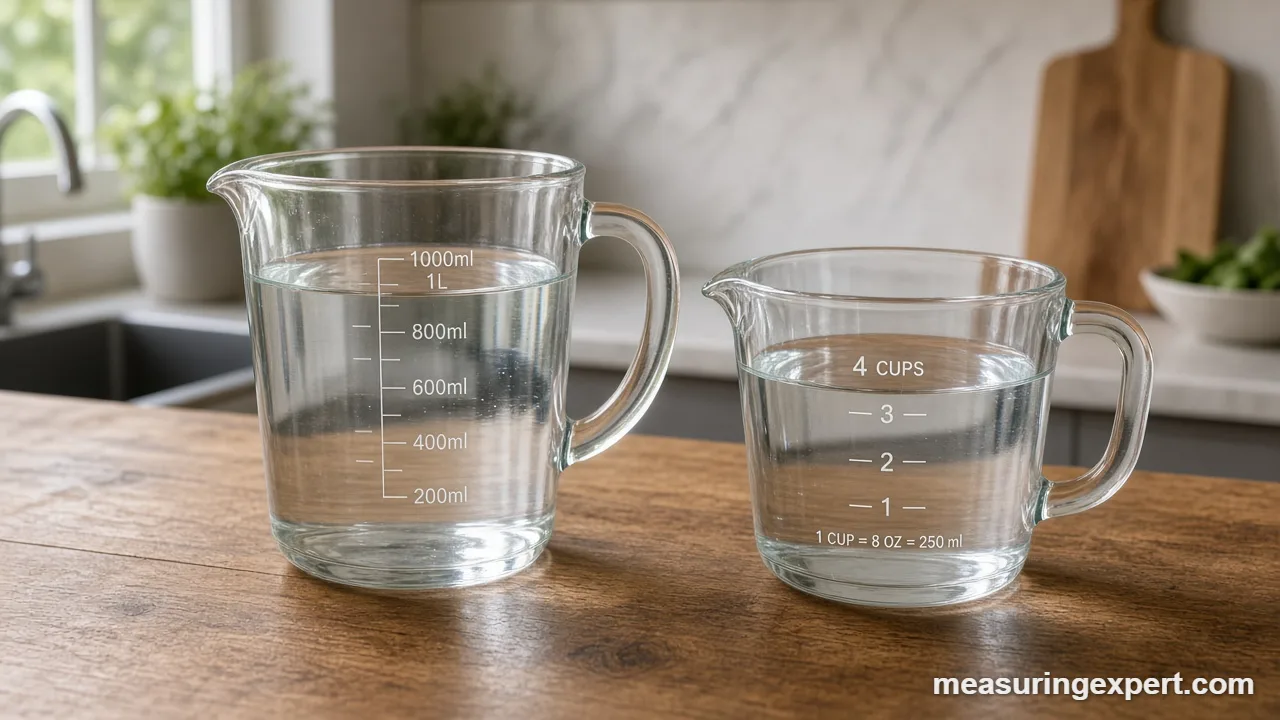
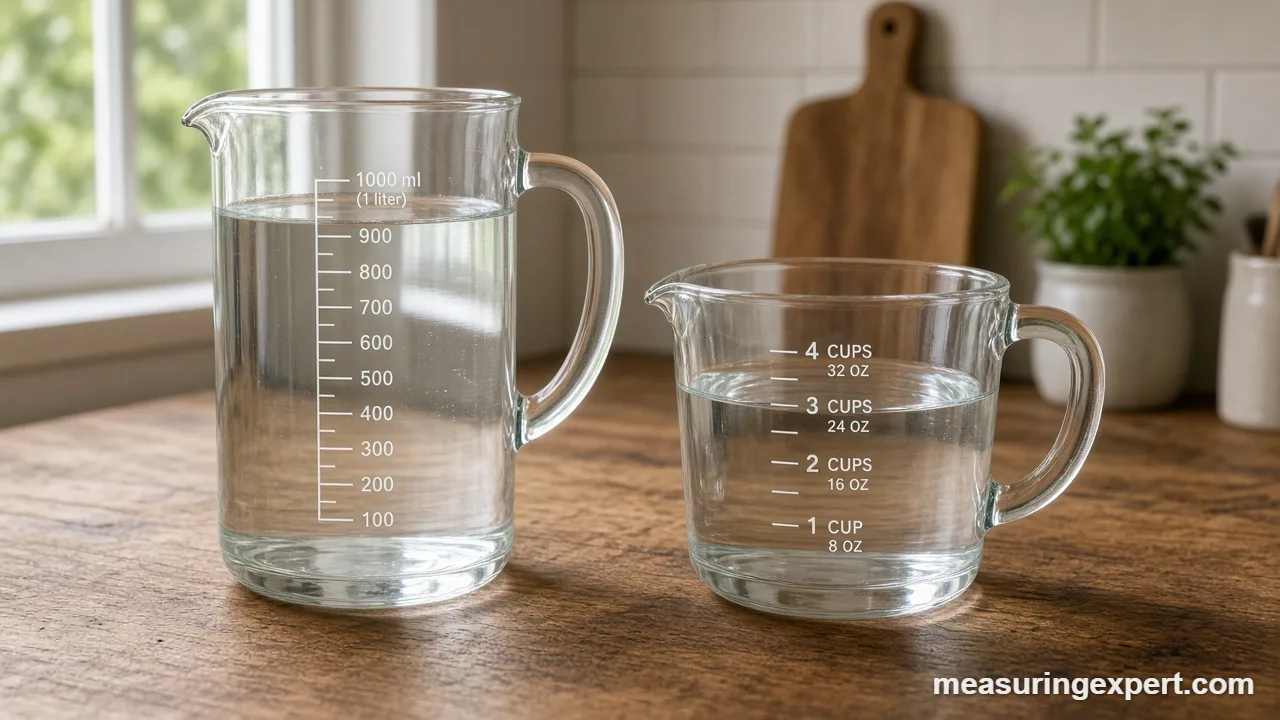
If your measuring tools are marked only in cups and quarts, you can still get close to a liter:
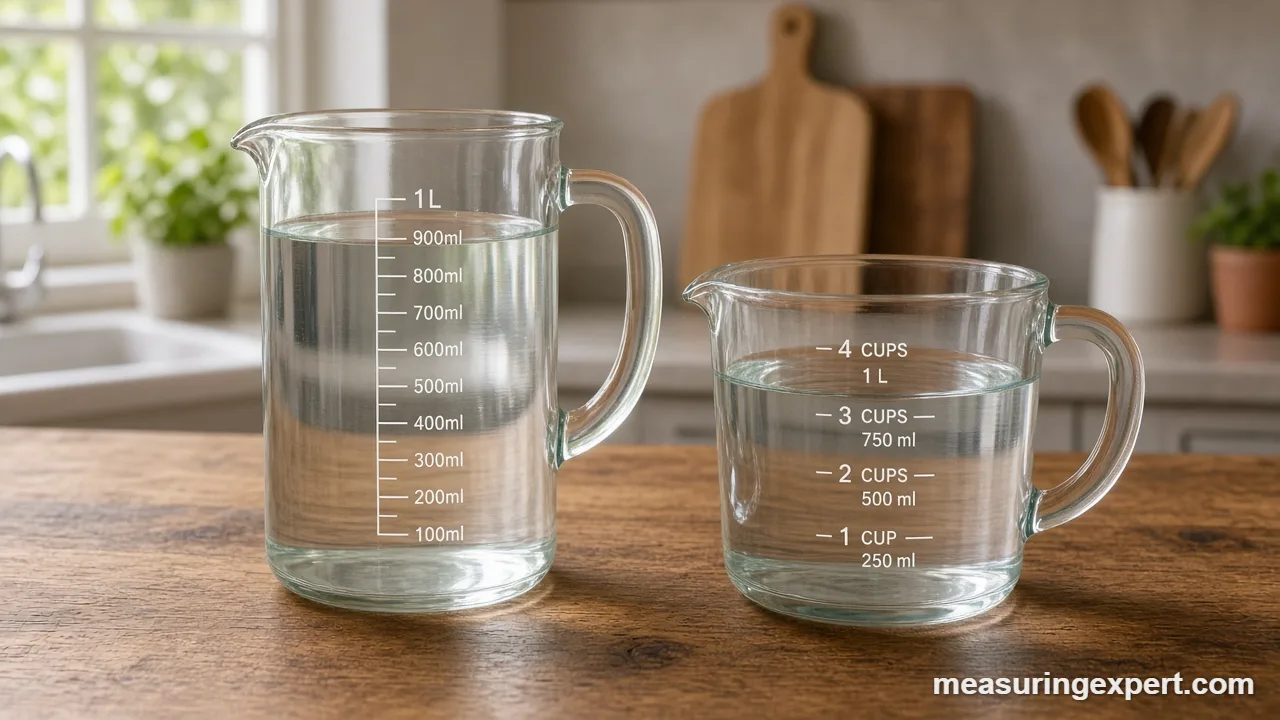
- Grab a 4-cup (1-quart) liquid measuring cup. Also, most glass and plastic jugs have both cup and mL markings on opposite sides.
- Check for a metric scale first. Then, if you see a 1,000 mL or 1 L line, simply fill to it.
- Otherwise, fill to the 4-cup line. As a result, you have 1 US quart, or 946 mL.
- Add 1/4 cup minus 1 teaspoon. This adds about 54 mL and brings the total to roughly 1 liter.
- Read at eye level. Next, set the cup on the counter and bend down so the bottom of the curved surface sits on the line.
- Use a kitchen scale for water. One liter of water weighs about 1,000 g (2.2 lb), so weighing is a fast cross-check.
Recommended Measuring Cups and Pitchers for Liters and Quarts
The easiest way to stop converting is a jug that shows both systems. For this reason, look for cups that print US cups or ounces on one side and milliliters on the other. Also, choose a 4-cup size so 1 quart and 1 liter both fit; a larger pitcher helps for oil changes, pool chemicals and big batches.
Common Mistakes With Quarts in a Liter
Older versions of many conversion pages, including an earlier version of this one, repeated a few errors. So here are the ones to watch for.
- “1 liter equals 1 quart.” It does not. In fact, a liter is about 1.057 US quarts, so a 2 L soda bottle holds about 2.11 quarts, a bit more than a 2-quart carton.
- “Liters belong to the imperial system.” Wrong again. Instead, the liter is metric only; imperial units are pints, quarts and gallons.
- “2.5 liters is about 5 quarts.” Actually, 2.5 L is about 2.64 US quarts or 2.2 imperial quarts.
- Rounding too early. If you round 0.946 to 0.9, every 10 quarts you convert loses almost half a liter.
Do
- First, check whether a recipe is US or British.
- Use the mL side of a measuring cup for liters.
- Keep three decimals when scaling large batches.
- Also, read liquid levels at eye level.
Don’t
- Treat a liter and a quart as equal.
- Use the liquid quart for berries sold by the box.
- Guess fuel or chemical mixes by eye, because errors add up.
- Mix US and imperial values in one recipe.
Where Quarts in a Liter Come Up in Real Life
Cooking is the obvious case, yet it is far from the only one. For example, here are a few everyday places where the conversion matters:
- Motor oil. US oil is sold in quarts, while many owner’s manuals list capacity in liters. For example, an engine that takes 4.5 L needs about 4.76 US quarts.
- Bottled drinks. Similarly, a 1 L bottle of water is about 33.8 fl oz, while a 1-quart bottle is 32 fl oz.
- Garden and pool chemicals. Labels often give doses per gallon or per liter, so a clear conversion avoids overdosing.
- Canning. Mason jars come in pint and quart sizes. However, a quart jar holds about 0.95 L, so 1 L of sauce slightly overfills it.
For smaller jobs, our page on how much 2 quarts is converts half a gallon into cups, ounces and liters.
Honest Limits of Quart and Liter Conversions
The factors on this page are exact definitions, but real containers are not perfect. For instance, kitchen measuring cups can be off by a few percent, and printed lines are often thick. In addition, liquids expand slightly as they warm, so a liter of hot water weighs a little less than a liter of cold water. Finally, volume does not convert to weight unless you know the density: a liter of water weighs about 1 kg, whereas a liter of cooking oil weighs only about 0.92 kg. Overall, for most cooking, these differences do not matter. For lab work or medicine, however, use a graduated cylinder or the dosing device provided.
Frequently Asked Questions
How many quarts in a liter exactly?
One liter equals 1.0566882 US liquid quarts. It is also 0.9080830 US dry quarts or 0.8798770 imperial quarts.
Is a liter bigger than a quart?
Yes, a liter is about 5.7 percent bigger than a US liquid quart. However, it is smaller than a US dry quart or an imperial quart.
How many liters are in a quart?
One US liquid quart is 0.946352946 L, or about 946 mL. An imperial quart, however, is 1.1365 L.
How many quarts in a liter of water?
Basically, the answer is the same for water as for any liquid: about 1.057 US quarts. Volume does not depend on what fills it.
How many quarts are in 2 liters?
Two liters equal about 2.113 US liquid quarts, so a 2 L soda bottle holds a little over 2 quarts.
How many quarts are in 4 liters?
Four liters equal about 4.227 US quarts. As a result, it is slightly more than a US gallon, which is 3.785 L.
How many liters are in 4 quarts?
Four US quarts make 1 US gallon, which is exactly 3.785411784 L, or about 3.79 L.
Why do quarts in a liter differ between the US and UK?
This is because the two countries use different gallons. The US gallon is 3.785 L, while the imperial gallon is 4.546 L, so their quarts differ too.
How many cups are in a liter?
A liter holds about 4.23 US cups. However, in metric recipes that use a 250 mL cup, it is exactly 4 cups.
What is an easy way to estimate liters to quarts?
Add about 6 percent to the liters. For example, 10 L plus 6 percent is about 10.6 US quarts, close to the exact 10.57.
The Bottom Line on Liters and Quarts
In short, one liter is about 1.057 US liquid quarts, 0.908 US dry quarts or 0.880 imperial quarts. Also, a liter is a bit bigger than the quart on a US milk carton, yet smaller than a British quart or a box of berries.
So when a number matters, use the converter at the top of this page or the chart above, and keep three decimals for big batches. For everyday cooking, a 4-cup jug with metric markings will save you from doing any math at all.
Black Friday is coming: shop the deals with Prime